Commuted Pension Restoration in Punjab Is Not Always After 15 Years, Federal Constitutional Court Rules
The FCC ruled on 16 November 2026 that a commuted Punjab pension is restored on the age next birthday factor, not a flat 15 years. See the table, check yours.
یہ صفحہ اردو میں پڑھیں
Short answer: The Federal Constitutional Court of Pakistan (FCC) ruled on 16 November 2026 that a commuted pension under the Punjab Civil Services Pension Rules, 1963 is not always restored after 15 years. The restoration date depends on your age at retirement and the factor in the commutation table. It can be less than, equal to, or more than 15 years.
The detailed judgment was released in four appeals filed by the Punjab Road Transport Corporation (PRTC) and the Punjab Finance Department. A two-member bench of Justice Syed Hasan Azhar Rizvi and Justice Muhammad Karim Khan Agha set aside two Lahore High Court judgments that had ordered restoration after a flat 15 years.
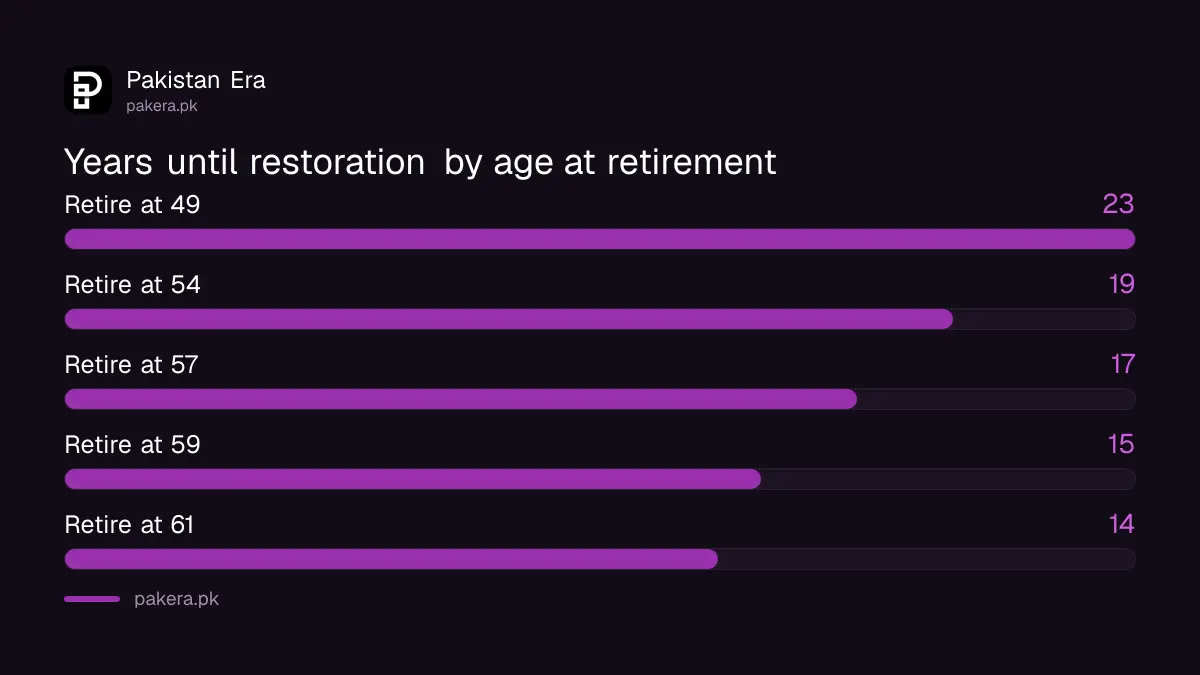
The court said there is no uniform 15 year rule
The FCC held that the Punjab pension rules do not set one 15 year restoration period for every pensioner. Rule 8.11 gives a factor for each "age next birthday", and Rule 8.12 uses that factor to fix when the commuted half comes back. Different ages mean different dates.
Commutation means a retiring employee gives up part of the monthly pension, usually half, and takes a lump sum instead. Restoration means that surrendered half starts being paid again later. People often call a restored pension "double pension", because the monthly amount roughly doubles.
The court explained that the commutation factor does two jobs. It sets the size of the lump sum, and it sets the number of years after which the commuted part is restored. So two retirees under the same rules can have different restoration dates, and the court said that is not discrimination under Article 25 of the Constitution.
Your restoration period comes from your age at retirement
Find your age next birthday on the day you retired, read the factor for that age in the commutation table that applied to you, and round it. A fraction of six months or more counts as a full year. A fraction under six months is dropped.
The judgment reproduces the table introduced by the Punjab Finance Department notification of 1 March 1992, which applied to employees who retired in 1997. The factors below are taken from it, and the last column applies the Rule 8.12(b) rounding the court set out.
| Age at retirement | Age next birthday | Factor (years purchased) | Restoration after |
|---|---|---|---|
| 49 | 50 | 22.8911 | 23 years |
| 54 | 55 | 18.9348 | 19 years |
| 57 | 58 | 16.7925 | 17 years |
| 59 | 60 | 15.4649 | 15 years |
| 60 | 61 | 14.8290 | 15 years |
| 61 | 62 | 14.2105 | 14 years |
Look at the age 59 row. The factor is 15.4649. The fraction, 0.4649 of a year, is about 5.6 months, so it is dropped and restoration comes after 15 years. At age 57 the fraction is about 9.5 months, so it rounds up to 17 years.
An earlier retirement means a longer wait. That is why the PRTC employees in this case, who retired early under a golden handshake scheme, could not claim restoration at 15 years as a matter of course.
The court worked through an example with Rs 100,000 pension
The judgment gives a worked case: an employee retires at 49 with a gross pension of Rs 100,000 a month and commutes half. The lump sum is Rs 13,734,660, and the commuted Rs 50,000 a month is restored after 23 years, not 15.
- Age at retirement is 49, so age next birthday is 50.
- The factor for age 50 is 22.8911.
- Lump sum: Rs 50,000 x 12 x 22.8911 = Rs 13,734,660.
- The factor is 22 years plus 0.8911 of a year. That fraction is about 10.7 months.
- Since 10.7 months is six months or more, it counts as one year: 22 + 1 = 23 years.
- The commuted Rs 50,000 a month comes back 23 years after the retirement date.
The court also noted that Rule 8.12(a) on its own restores one fourth of the full pension. A Punjab Finance Department notification of 30 September 1991 extended restoration to the other fourth, so the full commuted half can be restored once the period ends.
What the ruling means for pensioners who already went to court
The ruling does not take away anyone's right to restoration. It says the date must be worked out from the rules. Arrears and pension increases from an earlier date are payable only where the law allows, including limits on claiming old payments.
The PRTC staff in this case retired in 1997, and their commuted pension was restored in 2017, 20 years later. They wanted it from 2012 and asked for five years of arrears. They relied on Mian Muhammad Ishaq, a former colleague who had won restoration after 15 years. The Supreme Court later refused to hear the department's appeal in his case.
The FCC said that refusal settled Ishaq's own case but did not create a rule for everyone. A win in one person's case binds only the parties to it. A similar case does not, on its own, entitle another pensioner to the same date.
On delay, the court said pension is a continuing right, so a late claim is not thrown out only because time has passed. Taking the lump sum at retirement is not acceptance of a later refusal. But nobody can claim restoration from a date earlier than the rules give.
The bench also explained that an earlier Supreme Court judgment, Ismail Tayer (2014), was about pension increases after restoration. It did not set 15 years as the restoration period for all.
For the court's similar ruling on old-age benefits, read how the FCC decided the EOBI 15 year pension case in October.
How to check your own restoration date
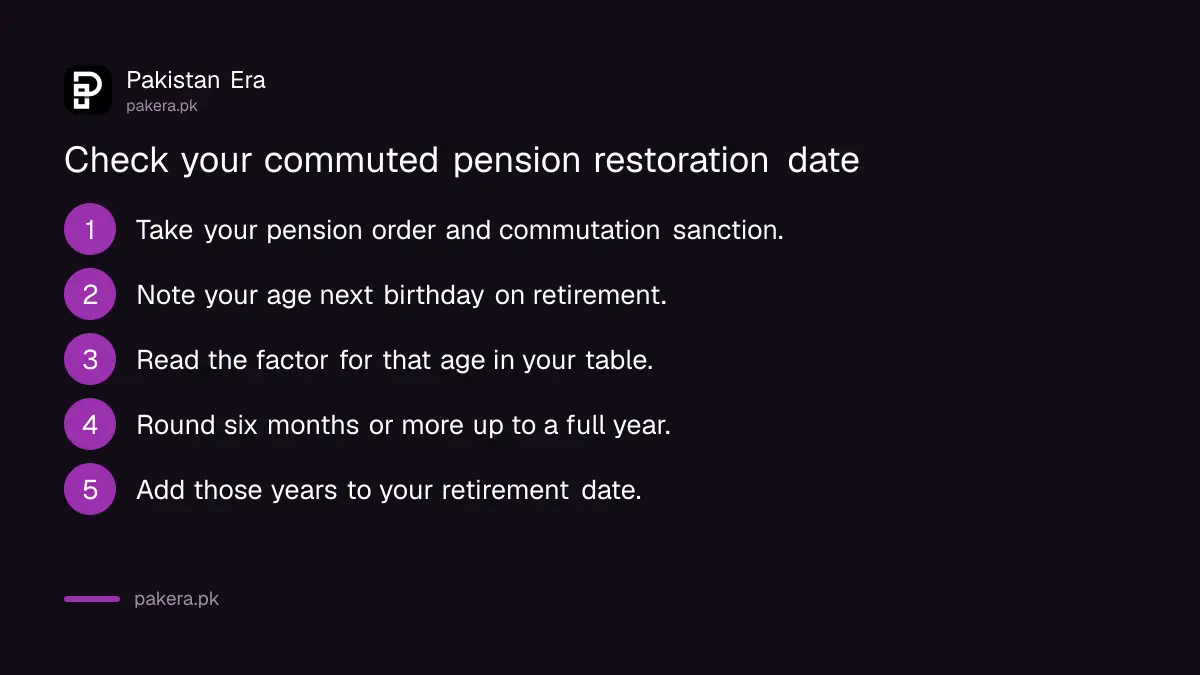
Work out your own date from your pension papers before writing to the pension office. You need your date of birth, your retirement date, the share you commuted and the commutation table in force when you retired. Then compare the result with the date your restoration actually started.
- Take your pension payment order and the commutation sanction from your file.
- Note your age next birthday on the retirement date.
- Find the factor for that age in the table that applied on your retirement date.
- Round the factor: six months or more counts as a year, less is dropped.
- Add that number of years to your retirement date.
- If restoration started later than that date, write to the office that pays your pension with your working and copies of the papers.
Tables change over time, and the 1992 table above applied to these 1997 retirees. Ask for the table that covered your retirement date. Federal employees follow different rules, explained in the federal pension commutation table and 35 per cent rule.
If the office refuses, the routes for a pension complaint, from the department to the courts, are set out in how to file a government pension case in Pakistan.
The case from 1997 to 2026
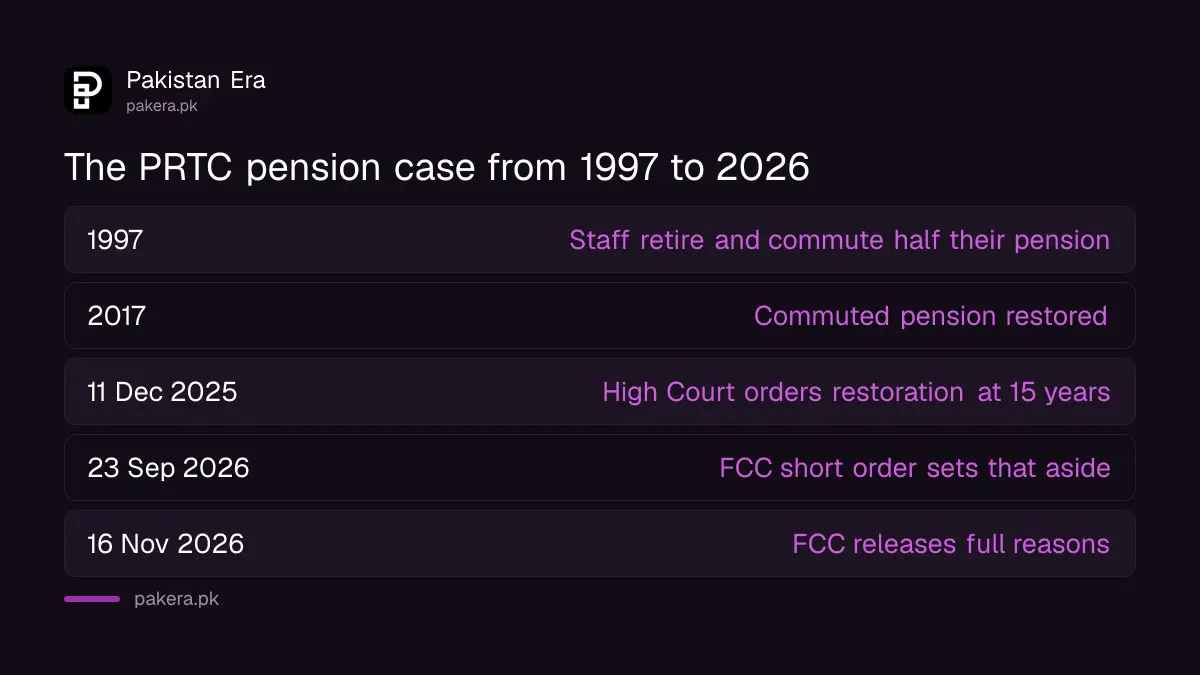
The dispute ran for almost three decades, from the 1997 golden handshake to the FCC's reasons on 16 November 2026. The short order came first, on 23 September 2026, and the full reasons followed on 16 November.
| Date | Step |
|---|---|
| 1997 | PRTC employees retire under a golden handshake and commute half their pension |
| 2017 | Their commuted pension is restored |
| 11 December 2025 | Lahore High Court single bench orders restoration from 15 years |
| 19 May 2026 | Lahore High Court division bench dismisses the government's appeal |
| 23 September 2026 | FCC short order sets both judgments aside |
| 16 November 2026 | FCC releases detailed reasons, approved for reporting |
The FCC took over cases like this after the 27th Amendment. Its first year is covered in the Federal Constitutional Court's first year.
Common questions
Is commuted pension restored after 15 years in Punjab?
Not always. The FCC ruled on 16 November 2026 that the period depends on your age next birthday at retirement and the commutation table. It can be under, at or over 15 years.
What does "age next birthday" mean?
It is the age you would turn on your next birthday after retiring. Someone who retires at 49 has an age next birthday of 50, and the table factor for 50 applies.
How is the factor rounded?
Under Rule 8.12(b), a fraction of six months or more counts as a full year. A fraction under six months is dropped. So 22.8911 becomes 23 years, and 15.4649 stays 15 years.
Can I still get arrears if my restoration was late?
The court said arrears and increases from an earlier date are payable where the law allows, including any limits on recovering past payments. The date must come from the rules, not from another person's case.
Does this ruling apply to federal pensioners?
The case was decided under the Punjab Civil Services Pension Rules, 1963, which PRTC had adopted. Federal pensioners are under federal rules, so check the rules that cover your service.
Which case is this?
F.C.P.L.A. Nos. 337-L, 341-L, 342-L and 353-L of 2026, PRTC and Province of Punjab against Rana Muhammad Saleem Khan Chohan and others. It is marked approved for reporting.
How we verified this
What we checked and where we read it.
We read the full 20 page judgment from the judgments page of the Federal Constitutional Court of Pakistan on 16 November 2026, listed as F.C.P.L.A. No. 337-L of 2026, author Justice Syed Hasan Azhar Rizvi, uploaded 16 November 2026. The commutation factors, the worked example and the case dates above are quoted from it. The rounded restoration periods in the age table are our own arithmetic using the rule the court set out. The judgment reproduces the table for ages 20 to 44 and 50 to 74 only, so ages 45 to 49 next birthday are not shown here.
About the author

Public Services and Education Journalist
Fajr Riaz is a journalist and content writer at Pakistan Era, based in Lahore. She covers the questions people meet in everyday life in Pakistan: how a public service works, what a change in the rules means, and where to find a reliable answer.