Court Rules EOBI Pension Needs 15 Years of Contributions and the Ombudsman Cannot Override the Law
The Federal Constitutional Court ruled on 9 October 2026 that an EOBI pension needs 15 years of contributions and the Ombudsman cannot waive it. See the impact.
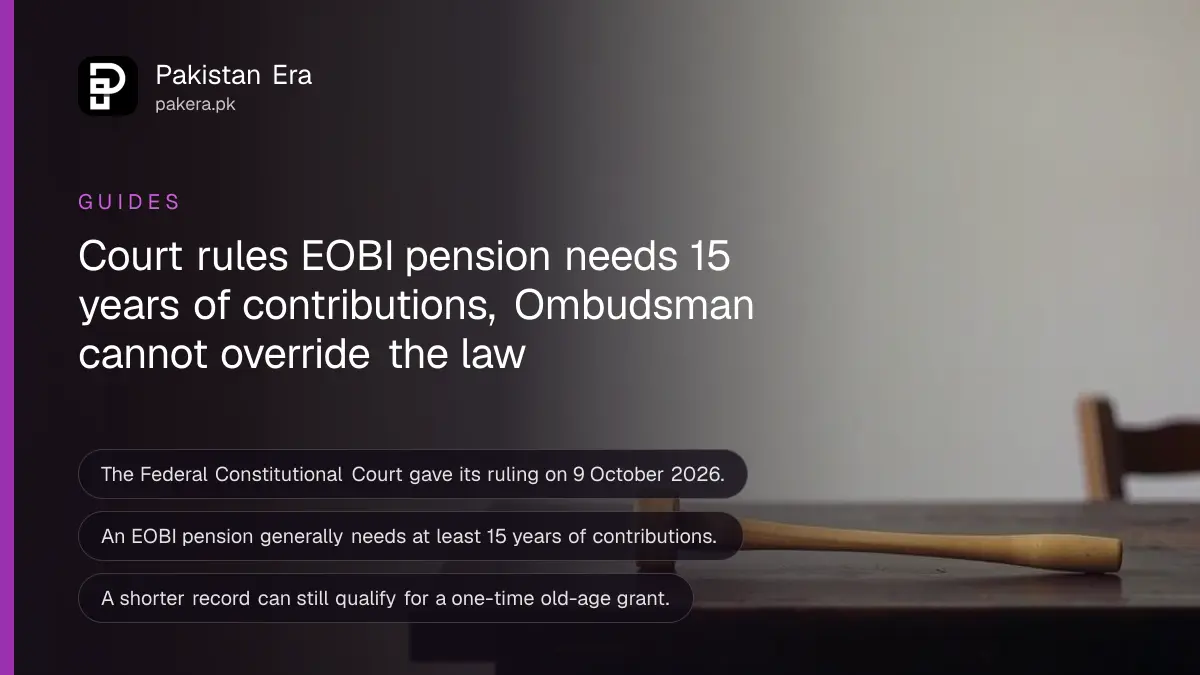
Short answer: On 9 October 2026 the Federal Constitutional Court ruled that a person who does not meet the legal conditions for an EOBI pension cannot be ordered to receive one. It also ruled that the Federal Ombudsman cannot bypass those conditions. A monthly EOBI pension still needs at least 15 years of contributions.
The court allowed an appeal by the Employees' Old-Age Benefits Institution (EOBI) and set aside three earlier orders that had told it to pay a pension. The worker in the case had less than six years of insured work.
We could not open the judgment text itself, because the court's file was not available to us at the time of writing. The details below follow reports of the ruling, and we mark them as reported. The rules on EOBI's own pages we did read.
The court set aside three orders that had granted a pension
The Federal Constitutional Court allowed EOBI's appeal on 9 October 2026. As reported, it reversed the Federal Ombudsman's direction, the President's decision that upheld it, and an Islamabad High Court order that refused to interfere.
The case began with a former private bank employee. As reported, he worked for 5 years and 10 months, from 1 July 2008 to 9 May 2014. EOBI gave him a one-time old-age grant of Rs 48,000 in December 2015. He then asked for a monthly pension instead.
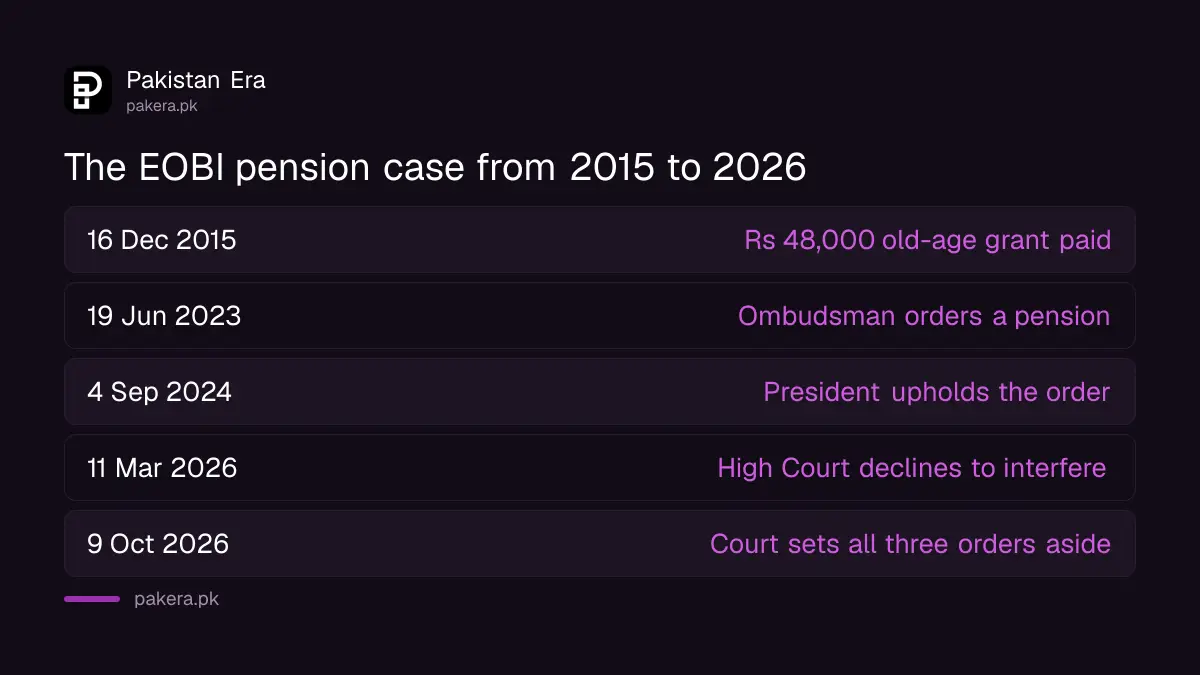
| Step | Date, as reported | What happened |
|---|---|---|
| Old-age grant paid | 16 December 2015 | Rs 48,000 lump sum |
| Federal Ombudsman | 19 June 2023 | Directed EOBI to grant a pension |
| President | 4 September 2024 | Upheld the Ombudsman's decision |
| Islamabad High Court | 11 March 2026 | Declined to interfere |
| Federal Constitutional Court | 9 October 2026 | Allowed EOBI's appeal, set all three orders aside |
The Ombudsman cannot rewrite the conditions in the EOBI law
The court said the Federal Ombudsman cannot use his power over maladministration to get around the entitlement conditions in the Employees' Old-Age Benefits Act, 1976. A refusal that follows the law is not maladministration by itself.
As reported, the court added a test. Maladministration needs something more, such as arbitrariness, discrimination or negligence in how a decision was made. EOBI rejecting a claim that the law does not allow does not meet that test.
This matters beyond one worker. Many pensioners and near-pensioners take a refused claim to the Ombudsman as a free route. That route still exists for real delays and unfair treatment. It does not create a pension the Act does not give.
The 15-year rule still decides pension or grant
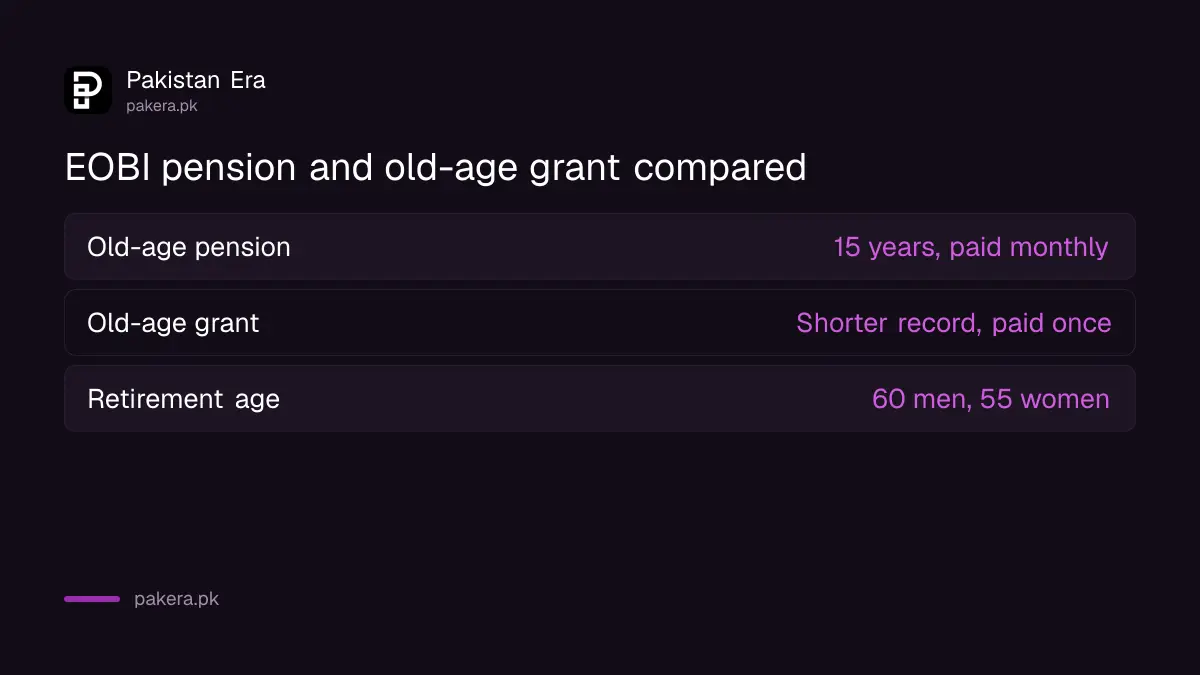
EOBI's own page says an old-age pension is paid on retirement, at 60 for men and 55 for women. As reported, the court restated that the general rule needs at least 15 years of contributions.
A shorter record does not mean nothing. The same EOBI page describes an old-age grant for an insured person who reaches the retirement age without the minimum record for a pension. It is a lump sum, not a monthly payment.
- Pension: contributions for at least 15 years, paid monthly for life.
- Old-age grant: a shorter record, paid once as a lump sum.
- No benefit: a record below the lowest limit in the law.
The full explanation of the thresholds sits in the guide to how an EOBI pension is claimed and the check of what the pension is and who qualifies.
The five-year concession does not reach workers insured after 2008
As reported, there is a special concession that allowed a pension with five years of contributions. The court held that it does not apply to employees covered on or after 1 July 2008.
That detail decided the case. The worker joined the insured workforce on 1 July 2008, the first day outside the concession. With under six years of work, he fell short of 15 years and could not use the five-year route.
If you started insured work before July 2008, your position may differ. Do not assume. Ask EOBI to read your own record against the Act.
What workers and employers should check now
Check your contribution count before you plan around a pension. Many workers learn their record only at retirement, which is the worst time to find missing years. Employers who did not pay for some months leave gaps that the worker feels later.
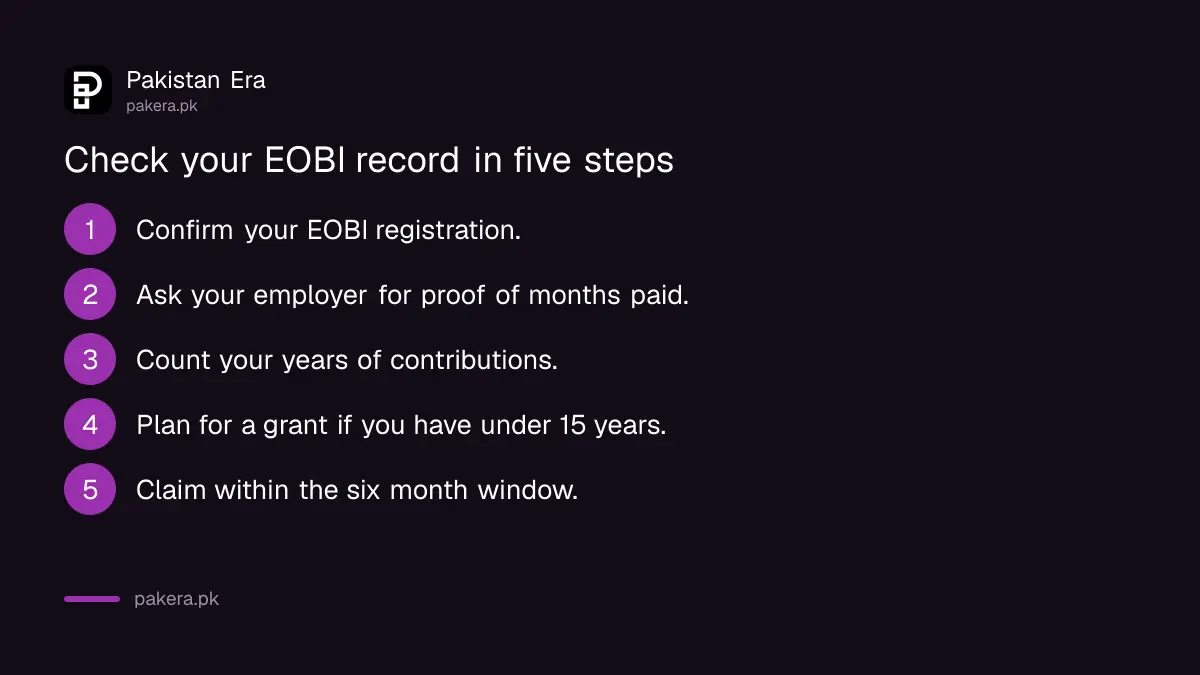
- Confirm you are registered, using the steps in the check of whether you are registered with EOBI.
- Ask your employer for proof of the months paid in your name.
- Count the years. If you are under 15, plan for a lump sum, not a monthly pension.
- Claim within the time limit on EOBI's page. The old-age pension cannot be allowed for more than six months before the claim.
- If EOBI is slow or unfair, complain. A decision that follows the Act is not a ground for complaint.
Separate from EOBI, the government is working on a voluntary pension for domestic and informal workers, covered in the report on the pension plan for informal work. That plan is not in force.
Where an EOBI dispute can still go
A worker who disagrees with an EOBI decision can still use the appeal and representation routes. The ruling closes one door, which is asking the Ombudsman to grant what the Act does not. It does not close the others.
If an Ombudsman decision is already in your hands, the time to act is short. The steps and the 30-day window are in the note on challenging an Ombudsman decision with a representation to the President. The time limits for the new court are set out in the summary of the Federal Constitutional Court rules on appeals and reviews.
Common questions
Did the court cancel the EOBI pension for everyone?
No. The ruling is about one worker who did not meet the legal conditions. Workers who meet the conditions still get the pension.
How many years do I need for an EOBI pension?
At least 15 years of contributions is the general rule, as reported from the ruling and as shown in EOBI's own description of the benefit.
Can I still go to the Federal Ombudsman against EOBI?
Yes, for real maladministration such as delay or unfair treatment. You cannot use it to get a benefit the Act does not allow.
What if I have fewer than 15 years?
You may be entitled to an old-age grant, a one-time lump sum, if your record meets the lower limit in the law.
Does the ruling change the pension amount?
No. It is about who qualifies. The amount is set separately, and the rate is covered in the EOBI pension guide.
Where can I read the judgment?
On the Federal Constitutional Court's own website or from the court's registry. We could not open the text, so check it before you rely on a detail.
How we verified this
What we checked, where we read it, and what we could not confirm.
We read the pension, grant and eligibility description on the EOBI website on 12 October 2026. The court's findings, dates and amounts above are as reported from the 9 October 2026 ruling, because we could not read the judgment itself. Check the judgment and your own EOBI record before you act.
About the author

Public Services and Education Journalist
Fajr Riaz is a journalist and content writer at Pakistan Era, based in Lahore. She covers the questions people meet in everyday life in Pakistan: how a public service works, what a change in the rules means, and where to find a reliable answer.