Federal Pension Commutation in Pakistan: 35 Per Cent Rule, Age Table and How to Calculate Your Lump Sum
Federal pension commutation in Pakistan: commute up to 35% of gross pension. Lump sum is commuted amount x 12 x years purchased, 12.3719 at age 60. Full table.
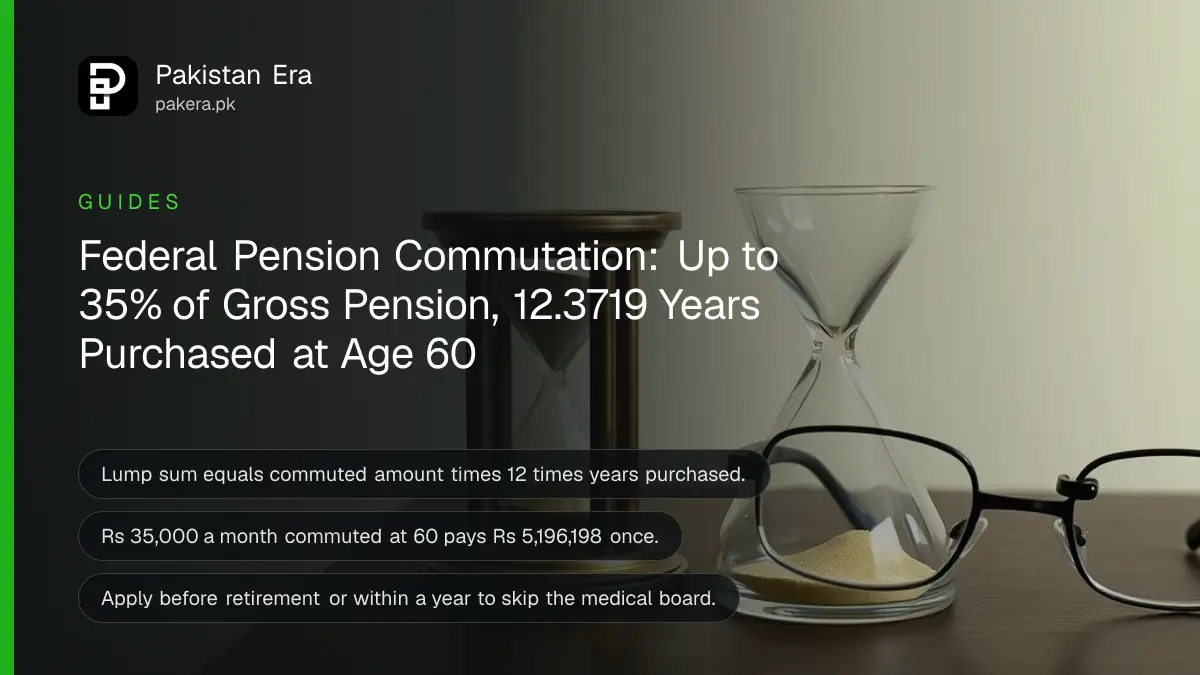
A federal government servant in Pakistan can commute up to 35 per cent of the gross pension into one lump sum. The lump sum is the commuted monthly amount, times 12, times the "years purchased" for your age next birthday in the Finance Division's commutation table. At age 60 that figure is 12.3719. So Rs 35,000 a month commuted at 60 pays about Rs 51.96 lakh once, and your monthly pension drops to 65 per cent of gross.
The table below gives the factor for the ages most people retire at. The worked example after it shows the full sum, step by step.
The commutation rule is 35 per cent of gross pension
Under the Finance Division's office memorandum of 1 July 2005, a pensioner may commute up to 35 per cent of the gross pension, at the pensioner's own option. The remaining 65 per cent is paid every month as net pension for life.
Commutation is optional. You can commute less than 35 per cent, or nothing at all. The choice is made on the pension papers, and the option form is part of the pension case your office sends to the accounts office.
The 35 per cent cap replaced earlier limits. Before 1 December 2001 the cap was 50 per cent, and from 1 December 2001 it was 40 per cent. Anyone retiring now is under the 35 per cent rule.
Commutation table: years purchased by age next birthday
The lump sum depends on your age next birthday after retirement. The younger you are, the more years are purchased, so the bigger the lump sum. The factors below come from the commutation table annexed to Finance Division O.M. No. F. 1(5)Imp/2001 of 4 September 2001.
| Age next birthday | Years purchased | Lump sum for Rs 10,000 a month commuted |
|---|---|---|
| 45 | 21.7592 | Rs 2,611,104 |
| 50 | 18.3129 | Rs 2,197,548 |
| 55 | 15.1478 | Rs 1,817,736 |
| 58 | 13.4340 | Rs 1,612,080 |
| 59 | 12.8953 | Rs 1,547,436 |
| 60 | 12.3719 | Rs 1,484,628 |
| 61 | 11.8632 | Rs 1,423,584 |
| 62 | 11.3684 | Rs 1,364,208 |
| 65 | 9.9639 | Rs 1,195,668 |
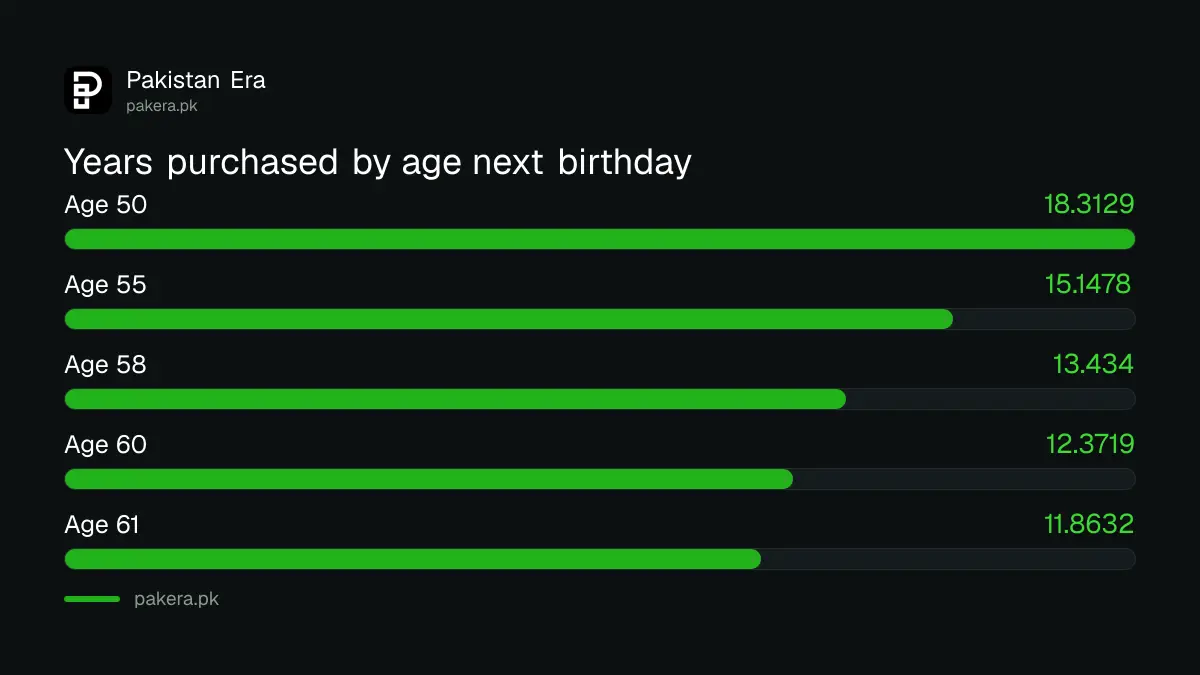
The full table runs from age 20 (40.5043 years) to age 80 (4.6321 years). For an age not listed here, ask your accounts office for the factor, or read it from the same table in the AGPR pension manual linked at the end.
How to calculate your commuted value in 4 steps
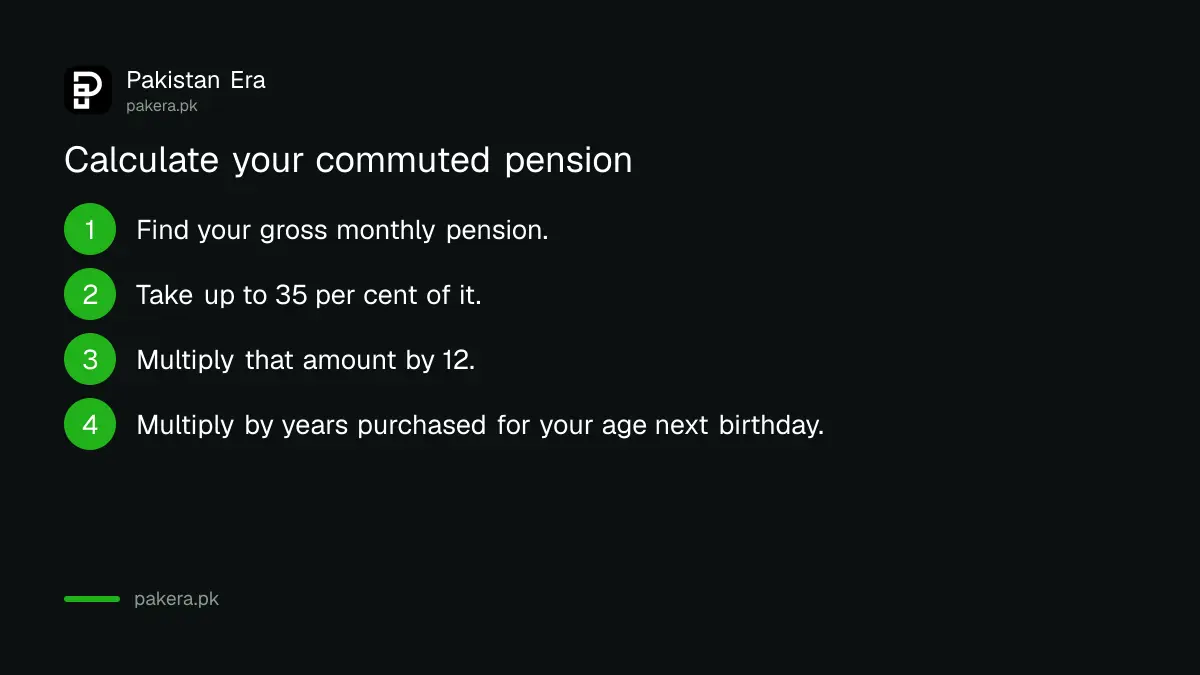
Take your gross pension, work out 35 per cent of it, multiply by 12, then multiply by the years purchased for your age next birthday. The answer is the one time lump sum. Your monthly pension becomes the gross pension minus the commuted part.
- Find your gross pension. It comes from your average pensionable emoluments and qualifying service. The method is in our page on the 24 month average pension calculation.
- Take the share you will commute. At the maximum, that is 35 per cent of gross pension.
- Multiply by 12 to get a year's worth of the commuted amount.
- Multiply by the years purchased for your age next birthday.
Worked example at age 60
Say your gross pension is Rs 100,000 a month and you retire at 60, applying while still in service.
- 35 per cent commuted: Rs 35,000 a month.
- Times 12: Rs 420,000.
- Times 12.3719: Rs 5,196,198 lump sum.
- Monthly net pension: Rs 65,000.
We checked this arithmetic against the table. The lump sum equals about 148 months, or 12.4 years, of the Rs 35,000 you gave up. If the same person applied at age next birthday 61, the lump sum would be Rs 4,982,544, which is Rs 213,654 less.
Apply while in service to get the age 60 rate
A servant who retires on or after reaching 60 and applies for commutation while still in service gets the age 60 factor, not the age 61 factor. Apply before your retirement date, on the pension papers, so you do not lose that difference.
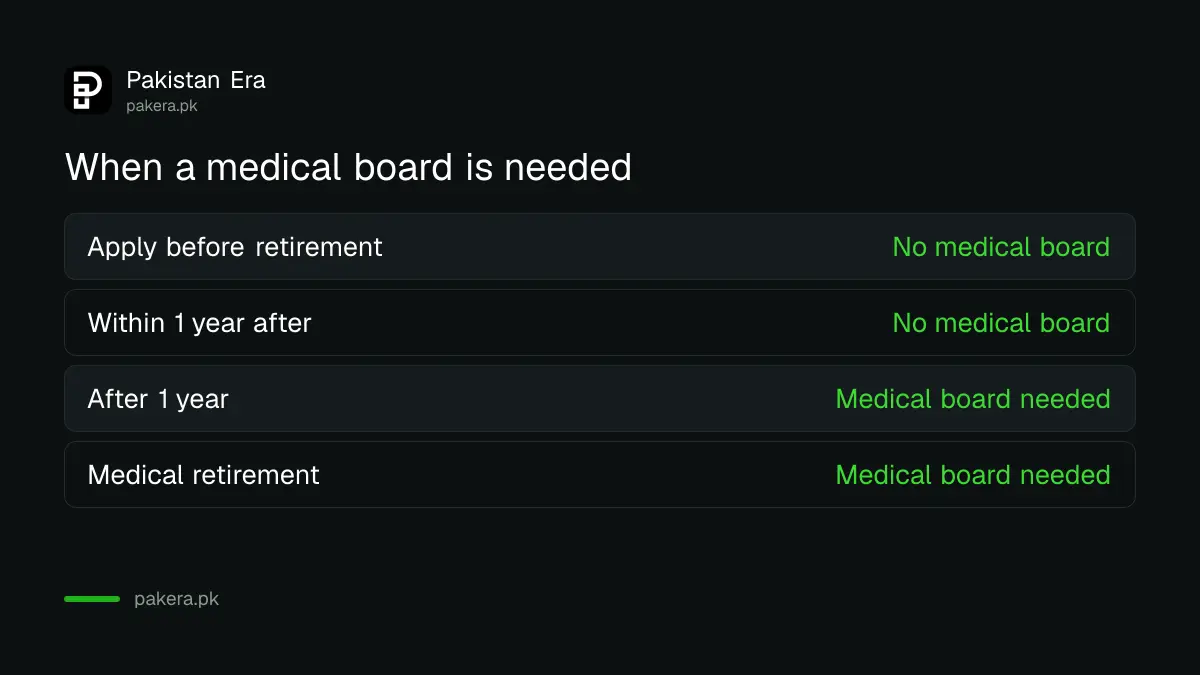
Timing also decides whether you need a medical board. The table below sets out the three cases from the Finance Division instructions reproduced in the AGPR manual.
| When you apply | Medical board | When commutation becomes absolute |
|---|---|---|
| Before retirement | Not needed | On the date of retirement |
| Within 1 year after retirement | Not needed | On the date of your application |
| More than 1 year after retirement | Needed, within 3 months of sanction | On the day the medical board signs |
| Retired early on medical grounds | Needed | On the day the medical board signs |
"Absolute" means the date from which your title to the commuted part ends and your title to the lump sum begins. If a pensioner dies after that date but before the money is paid, the lump sum goes to the heirs.
What commutation does to later pension increases
Since 1 January 2025, every federal pension increase is worked out on the baseline pension, which is gross pension minus the commuted part. So commuting 35 per cent also lowers the base on which each future increase is paid.
In the example above, a 7 per cent increase is paid on Rs 65,000, not Rs 100,000. That is Rs 4,550 a month instead of Rs 7,000. The Finance Division's clarification of 4 March 2025 adds that where a commuted portion is restored, the baseline is treated as including it. The latest increase is in our page on the 2026 federal pension increase.
This is the real trade. A large lump sum now, against a smaller monthly pension and smaller increases for life. Many retirees put part of the lump sum in a Pensioners' Benefit Account at National Savings to replace the lost monthly income.
Common problems and how to fix them
Most delays come from a missing option form, a wrong date of birth on the papers, or an application sent after the one year window. Check each before your file leaves the office.
- Option not marked on the papers. Ask your office to add your commutation option before the case goes to the accounts office.
- Age next birthday read wrongly. The factor depends on it. Check it against your service book date of birth.
- More than a year has passed. You can still apply, but expect a medical board. If it is not held within 3 months of sanction, the sanction lapses, though the sanctioning authority may renew it for 3 more months.
- Changed your mind. You can withdraw by written notice any time before you appear before the medical board.
Common questions
What is the maximum pension commutation for federal employees in Pakistan?
35 per cent of gross pension, at your option. The rest, 65 per cent, is your monthly net pension.
What is the commutation factor at age 60?
12.3719 years purchased. At age 61 it is 11.8632, and at age 55 it is 15.1478.
Do I need a medical examination for commutation?
Not if you apply before retirement or within one year after it. After one year, a medical board is required.
Can a widow get the commuted value if the servant died before signing?
Yes. A Finance Division memo of 4 March 2002 lets the family of a servant who was compulsorily retired, and died before signing the pension papers, receive the commuted value. Family pension rules are in our page on federal family pension.
Can I commute less than 35 per cent?
Yes. 35 per cent is the ceiling, not a requirement. Any smaller share works the same way: that monthly amount, times 12, times the factor for your age. Pension tax filing is covered in our pensioner tax return steps.
How we verified this
What we checked and where we read it.
Last checked on 14 November 2026. We read the commutation rules and the 2001 commutation table in "A Manual of Pension Procedures" (revised edition 2006, Establishment Division with the Finance Division and AGPR), published on the Accountant General Pakistan Revenues website. The 35 per cent cap is Finance Division O.M. No. F.1(1)/Imp/2005 of 1 July 2005. The table is the annexure to O.M. No. F. 1(5)Imp/2001 of 4 September 2001. The baseline pension clarification is Finance Division O.M. No. F. 9(3)/Reg. 6/2024 of 4 March 2025 on the Finance Division circulars page. The Rs 100,000 example and every lump sum in the tables are our own arithmetic from the published factors.
About the author

Tax, Bills and Technology Writer
Ali Akhtar is a young and curious voice here at Pakistan Era. He is currently pursuing his A-Levels and has a growing interest in Pakistan’s changing industrial landscape and educational trends. Ali likes to write in a way that helps him explain and explore the world around him. His writing reflects the perspective of the new generation navigating the evolving trends of Pakistan where technology, youth innovation, and shifting opportunities are reshaping the country’s future.