Islamabad Number Plate Policy: Your Number Stays With You When You Sell (Seller and Buyer Steps)
Islamabad now links a vehicle number to the owner's CNIC, so the seller keeps it and the buyer gets a new one. See the 4 exceptions, transfer steps and fees.
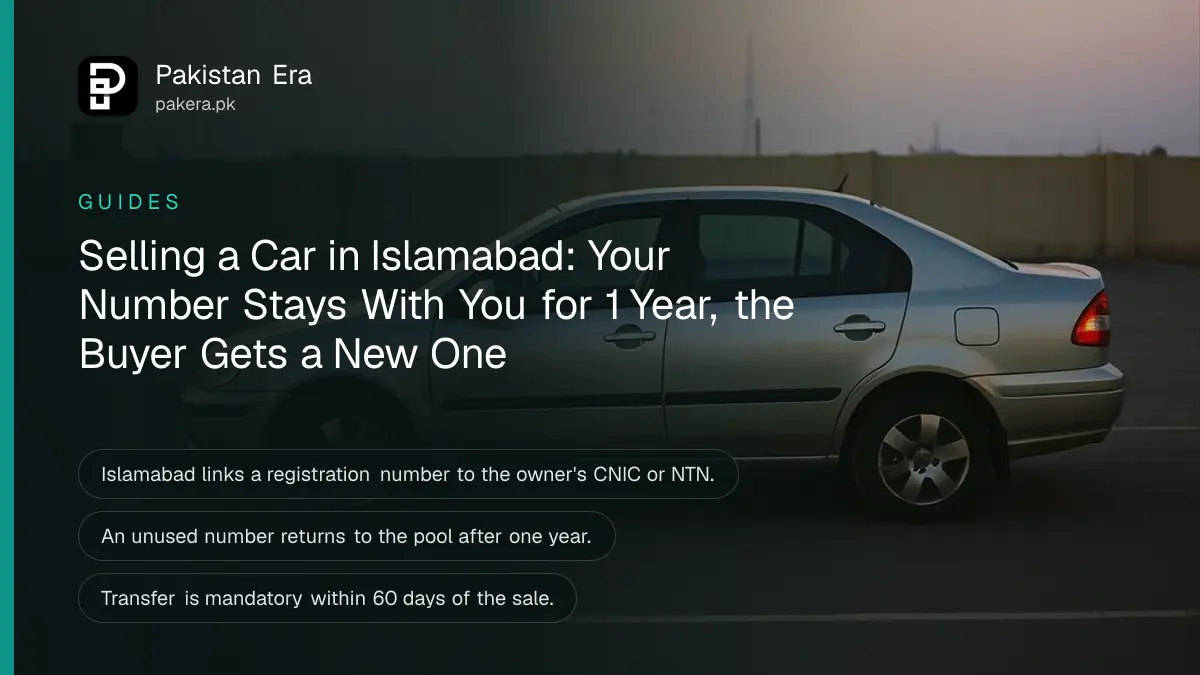
In Islamabad, a vehicle's registration number now belongs to the owner's CNIC, not to the car, so when you sell, the number stays with you and the buyer gets a new one. That is the Excise and Taxation Department's own policy. Below are the four exceptions, the transfer steps, the fees and the penalty table that sellers and buyers both need.
We read the department's Registration Number Policy, its transfer of ownership page and its fee schedule on islamabadexcise.gov.pk on 27 October 2026. The department says the change helps it track ownership, enforce e-challans and keep vehicle records clean.
Islamabad links the registration number to the owner, not the chassis
Under the policy, a number is attached to the owner through their CNIC or NTN. When the vehicle is sold, the number is detached from it and stays with the seller. The buyer receives a fresh number in their own name.
If the buyer already holds a personalised number in Islamabad, that number is put on the car they have just bought. So a family that paid for "ISL 313" years ago can move it from car to car as long as they keep using it.
For most people this changes one practical thing. A car bought second hand in Islamabad will not keep the plate it had. Expect new plates, a new smart card and a new number on the insurance papers after the transfer.
| Situation | What happens to the number |
|---|---|
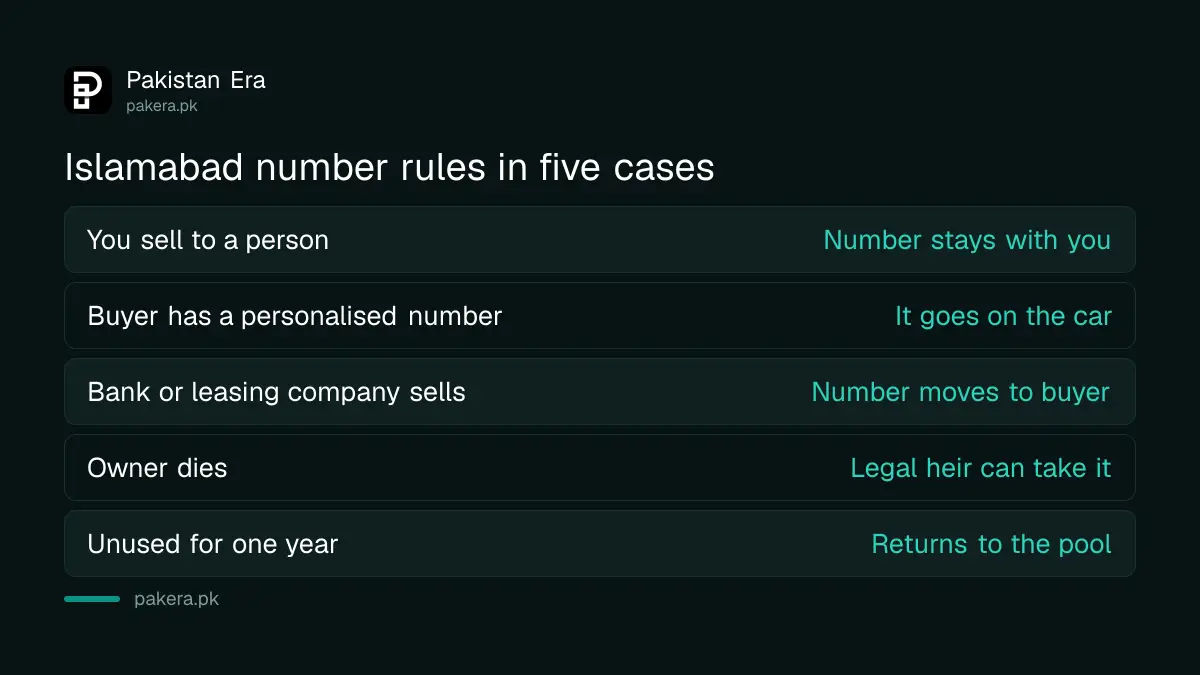
| You sell your car to a person | The number stays with you; the buyer gets a new one |
| The buyer already has a personalised number | That number goes on the car they bought |
| The seller is a bank or leasing company | The number moves with the car to the buyer |
| The owner dies | The number can pass to a legal heir |
| You do not reuse the number within one year | It returns to the pool for anyone to buy |
Four exceptions decide who keeps an Islamabad number
The policy has four notes. Bank and leasing company sales pass the number to the buyer. A personalised number cannot go to another person within a year of allotment. A legal heir can inherit it. And an unused number expires after a year.
The one year rules are the ones to watch. If you sell your car in January and buy the next one in March, the number moves across without trouble. If you wait more than a year, the number is released back into the pool. After that, anyone can buy it by paying the fee set for that number, and the fee for special numbers runs up to Rs 2 million for a car.
The policy also says a personalised number that sits unallotted for more than a year can be given to another applicant. In plain words: do not leave a valuable number parked for too long.
The full price list for picking a number, from Rs 10,000 to Rs 2 million, sits in the department's fee schedule. Cars financed by a bank follow the leasing rule, so the number travels with the car when the bank is the seller.
How to transfer a car in Islamabad under the new number rule
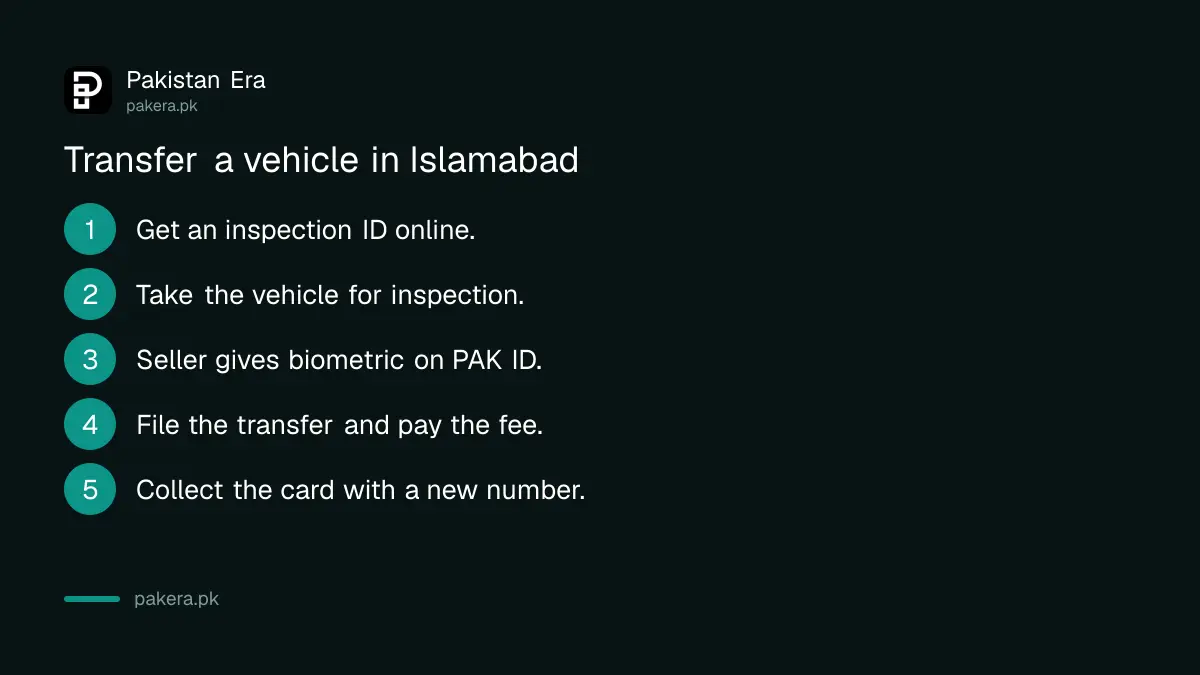
Transfer in Islamabad starts online with an inspection ID, then a physical inspection, the seller's biometric verification, the application and the fee. The department says transfer is mandatory within 60 days of the sale. The new smart card takes 10 days.
- Get a vehicle inspection ID from the department's online portal.
- Take the vehicle for physical inspection at the Excise location named for that ID.
- The seller gives "Transfer of Ownership" biometric verification. The department's site names the PAK ID app for this.
- File the transfer application on the web portal or at the Excise office in Sector H-9.
- Pay the transfer fee, then collect the new registration card with the buyer's new number.
Documents listed by the department: the original registration book, certificate or smart card; CNIC copies of buyer and seller; a transfer letter signed by both; the seller's affidavit; the biometric receipt; a bank NOC if the car was financed; and a token tax clearance certificate if the car still has a paper registration book.
Islamabad transfer fees run from Rs 2,700 to Rs 11,000 for cars
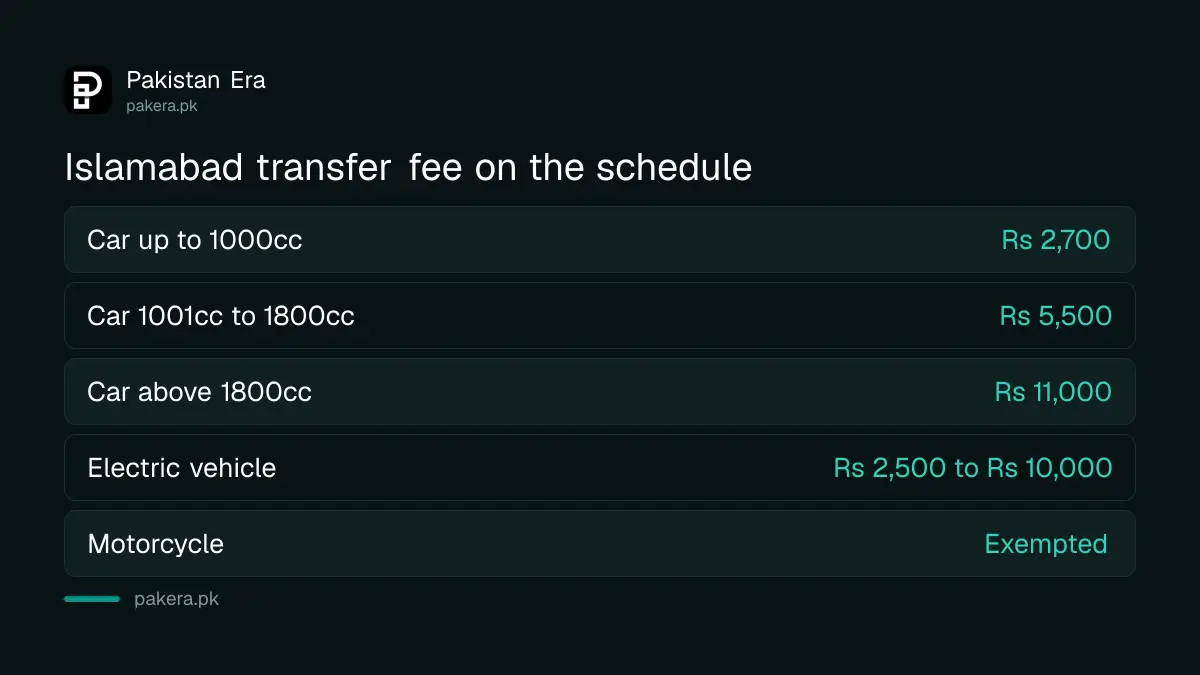
The fee schedule on the Excise site lists Rs 2,700 for cars up to 1000cc, Rs 5,500 from 1001cc to 1800cc and Rs 11,000 above 1800cc. Electric vehicles pay Rs 2,500 to Rs 10,000 by motor power. Motorcycles show as exempt.
| Vehicle | Size | Transfer fee on the schedule |
|---|---|---|
| Car, private or commercial | Up to 1000cc | Rs 2,700 |
| Car, private or commercial | 1001cc to 1800cc | Rs 5,500 |
| Car, private or commercial | Above 1800cc | Rs 11,000 |
| Electric vehicle | By motor power | Rs 2,500, Rs 5,500 or Rs 10,000 |
| Motorcycle | Any | Exempted |
The department's own pages do not agree on two lines. Its newer fee schedule says Rs 2,700 for the smallest cars and "Exempted" for motorcycles. Its older fee page and its online fee calculator still use Rs 2,750 for the smallest cars, and the older page lists Rs 550 to Rs 1,500 for motorcycles. The electric vehicle rows also look mislabelled, with "Not Exceeding 50 KW" printed twice. Pay what your challan shows, and keep it. The same schedule sets Islamabad token tax and registration fees.
Advance income tax is also due on many transfers. The schedule lists Rs 5,000 for a filer with an 851cc to 1000cc car, rising to Rs 62,500 above 3000cc, and three times that for a non-filer. Cars up to 850cc show nil. A filer is a person on the FBR Active Taxpayers List, so check your filer status before you go.
A late penalty runs by the month once the biometric expires
The fee schedule carries a "Biometric Late Penalty" counted from the expiry date: Rs 2,000 a month for the first six months, Rs 4,000 a month from the seventh month to one year, and Rs 8,000 a month after a year.
The schedule does not say which expiry date it counts from, or whether it falls on the seller or the buyer. Read with the 60 day transfer rule, the safe course is plain: finish the transfer quickly once the seller has given biometric verification. Ask at the counter if your transfer has been delayed.
Buyers who leave a car on an "open letter", meaning a signed transfer letter that was never lodged, carry the most risk. The car stays in the seller's name, and so do its challans and defaults. Before paying for any used car, check the Islamabad vehicle record online and make sure the seller is the person on it.
Common questions
Does the number plate stay with the car in Islamabad?
No. Under the Excise policy the number stays with the seller, and the buyer receives a new number, unless a bank or leasing company is selling.
How long can I keep my old number without a car?
One year. If you do not put it on another vehicle within a year of it being detached, it returns to the pool.
Can I give my personalised number to a relative?
Not within one year of allotment. A legal heir can receive it after the owner's death.
What is the deadline to transfer a car in Islamabad?
The department says transfer is mandatory within 60 days of the sale.
How much is the car transfer fee in Islamabad?
The newer schedule shows Rs 2,700 up to 1000cc, Rs 5,500 up to 1800cc and Rs 11,000 above that. The older fee page and the fee calculator still use Rs 2,750 for the smallest cars, so pay what your challan shows.
Who do I call about a transfer problem?
Call the Excise helpline on 051-111-383-383, open Monday to Friday during office hours.
How we verified this
What we checked, where we read it, and what we could not confirm.
Last checked 27 October 2026. The policy, its four notes, the transfer steps and documents, the 60 day rule, the fees and the penalty table come from the Excise and Taxation Department, Islamabad, at islamabadexcise.gov.pk, read on 27 October 2026. The Rs 2,750 and motorcycle figures come from our own earlier reading of an April 2025 notification. We could not open the department's online portal from our connection, so we did not test an inspection ID, and we did not transfer a vehicle. The site does not explain which expiry date the biometric penalty uses.
About the author

Global Affairs & Political Economy Writer
Muhammad Hatim is a book lover who started writing because he enjoys it. At Pakistan Era he writes about international relations, geopolitics and the global economy, with a particular interest in South Asia and the forces behind current events.