Lifeline Electricity Consumer in Pakistan 2026: Rs 3.95 a Unit, Who Qualifies and How You Lose It
Lifeline homes in Pakistan pay Rs 3.95 a unit up to 50 units and Rs 7.74 up to 100, with no fuel charge. See who qualifies, the 1 kW rule and how you lose it.
A lifeline electricity consumer in Pakistan pays Rs 3.95 a unit up to 50 units and Rs 7.74 a unit up to 100 units in 2026, with no fixed charge, no fuel charge and no quarterly adjustment. To qualify, the home needs a single phase connection with a sanctioned load of up to 1 kW, and its use must stay at or under 100 units in every month of the past year.
That is the cheapest electricity in the country by a wide margin. A protected home pays Rs 10.54 for its first 100 units and an ordinary home Rs 22.44. But the lifeline rate is easy to lose and slow to win back, so it is worth knowing exactly where the line sits.
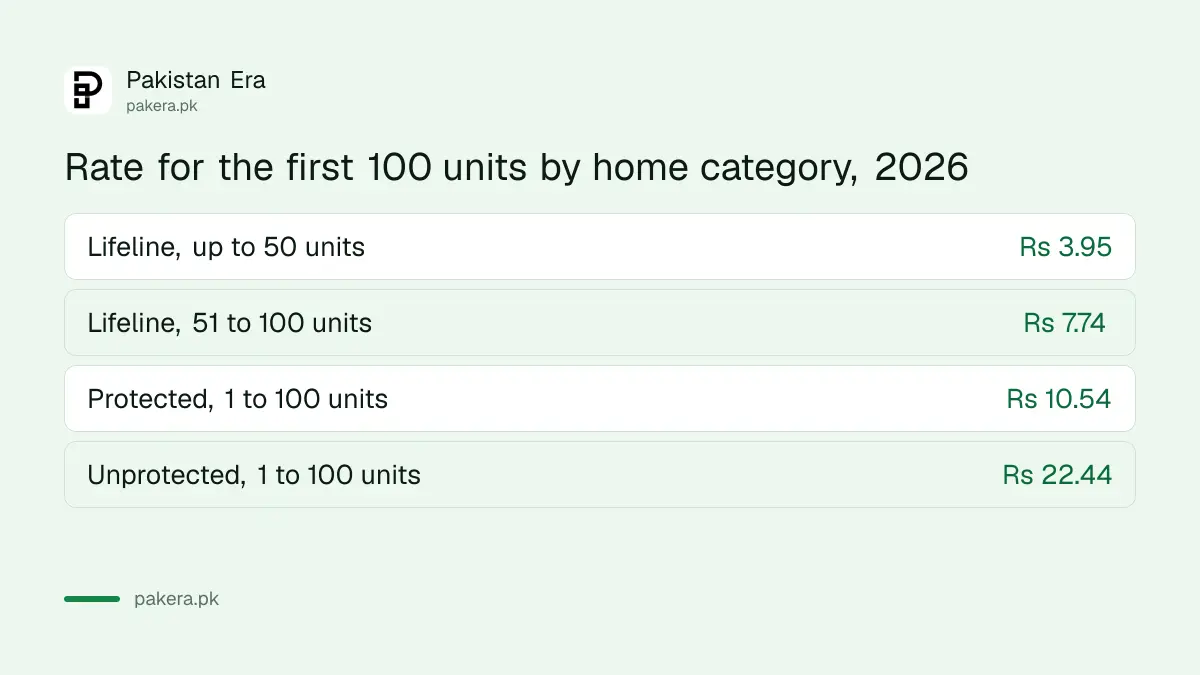
Lifeline rates for 2026 are Rs 3.95 and Rs 7.74 a unit
Under the federal government's February 2026 tariff notification, lifeline homes pay Rs 3.95 a unit if they use up to 50 units in the month and Rs 7.74 a unit for 51 to 100 units. The rates are the same for K-Electric and the state-owned companies.
| Home category | First 100 units, per unit | Fixed charge |
|---|---|---|
| Lifeline, up to 50 units | Rs 3.95 | none |
| Lifeline, 51 to 100 units | Rs 7.74 | none |
| Protected, 1 to 100 units | Rs 10.54 | Rs 200 per kW a month |
| Unprotected, 1 to 100 units | Rs 22.44 | Rs 275 per kW a month |
The tariff notification says lifeline homes get no slab benefit. So a home that uses 60 units pays all 60 at Rs 7.74, which is Rs 464.40, not 50 units at Rs 3.95 and 10 at Rs 7.74. At exactly 50 units the energy charge is Rs 197.50, by our arithmetic.
A lifeline home needs a 1 kW single phase connection and 100 units or less
The tariff terms define a lifeline consumer as a residential consumer with a single phase connection and a sanctioned load of up to 1 kW. The home must not be on a Time of Use meter, and its highest month in the last twelve and the current month must be 100 units or less.
Read that last condition twice. It is not your average. It is your single highest month. If you used 40 units for eleven months and 104 units in one hot August, you are out.
| Condition | Lifeline needs |
|---|---|
| Connection type | Residential, single phase |
| Sanctioned load | Up to 1 kW |
| Meter | Not Time of Use |
| Use in the current month | 100 units or less |
| Highest month in the last 12 | 100 units or less |
We read these definitions in the tariff terms K-Electric publishes on its website. We could not open the matching terms document for the state-owned companies, though their bills use the same lifeline rates under the same notification.
One month above 100 units costs you the rate for a year
Because the test uses the highest month of the past twelve, a single month above 100 units ends lifeline billing until that month drops out of the twelve month window. In practice, one bad month can cost you a full year of the lowest rate.
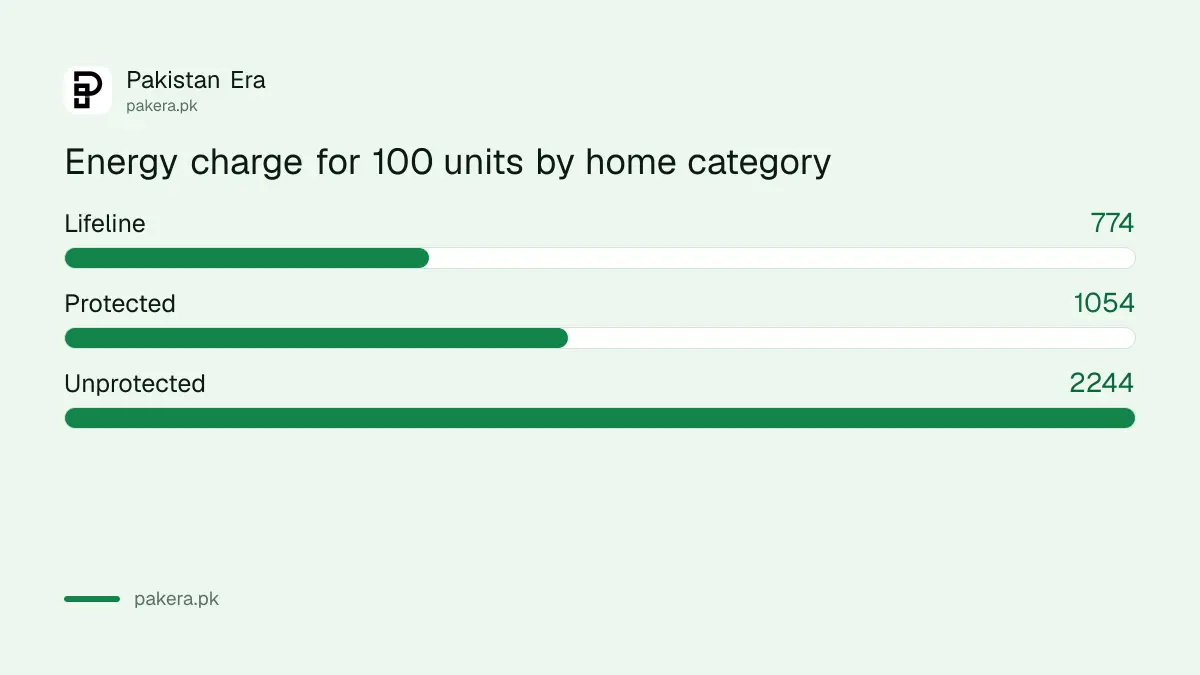
Here is the jump in rupees. At 100 units as a lifeline home, the energy charge is Rs 774. A home that has dropped out of lifeline but still qualifies as protected pays Rs 1,054 for the same 100 units, plus a fixed charge of Rs 200 per kW. An unprotected home pays Rs 2,244 plus Rs 275 per kW.
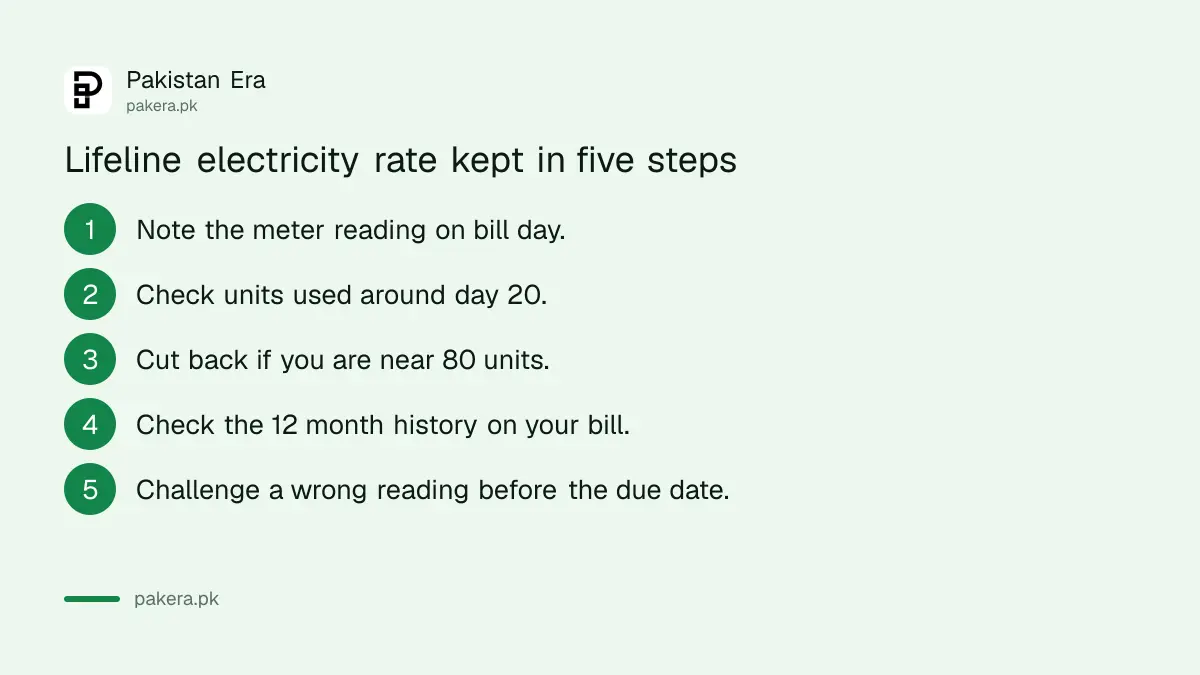
- Note your meter reading on the day your bill is read each month.
- Read it again around the 20th day and work out the units used so far.
- If you are near 80 units with ten days left, cut back on heaters, irons and pumps.
- Check the twelve month history printed on your bill for any month over 100.
- If a wrong reading pushed you over, complain before the due date with a photo of the meter.
A meter photo is the strongest evidence you can have. How to get the reading company's snapshot is explained in checking your meter reading snapshot.
Lifeline homes skip the fuel charge and quarterly adjustment
NEPRA's monthly fuel charge decisions apply to every consumer category except lifeline consumers, EV charging stations and prepaid users. The current quarterly adjustment of Rs 0.5194 a unit, billed from September to November 2026, also excludes lifeline homes.
That is why a lifeline bill stays almost flat when other bills jump. When NEPRA added Rs 1.1086 a unit for the August fuel charge in October bills, a lifeline home paid none of it. The monthly history of that charge is in FCA in electricity bills for 2026.
Lifeline homes also pay no fixed charge. The decision behind the February 2026 notification says fixed charges were applied to all domestic consumers except lifeline consumers. A separate minimum monthly charge applies where no fixed charge is levied: Rs 75 for a single phase connection, even if no units are used.
What to do if your lifeline status is wrong
If your bill shows a protected or unprotected rate but you meet every lifeline condition, ask your electricity company's subdivision office to correct the tariff. Take your CNIC, the last twelve bills and a meter photo. If the office does not fix it, complain to NEPRA.
The most common cause is a wrong reading in one month, which pushes the history over 100. Getting the reading corrected is the fix, and the time limits for complaints are covered in electricity bill complaint deadlines. If you are not lifeline but stay under 200 units, the next cheapest category is set out in the 200 unit protected rule.
Common questions
What is a lifeline consumer in electricity?
A residential consumer with a single phase connection of up to 1 kW whose use stays at or under 100 units in every month of the past year.
What is the lifeline electricity rate in 2026?
Rs 3.95 a unit up to 50 units and Rs 7.74 a unit for 51 to 100 units.
Do lifeline consumers pay the fuel charge adjustment?
No. NEPRA's fuel charge decisions exclude lifeline consumers.
Do lifeline consumers get the previous slab benefit?
No. The tariff notification says lifeline consumers get no slab benefit.
How long do I lose lifeline status after using 101 units?
Until that month is no longer among your last twelve, so up to a year.
Do lifeline homes pay a fixed charge?
No fixed charge. A minimum monthly charge of Rs 75 applies to a single phase connection.
How we verified this
What we checked, where we read it, and what we could not confirm.
On 1 November 2026 we read the residential schedules and notes in S.R.O. 279(I)/2026 of 12 February 2026, a scanned file, and the lifeline definition in K-Electric's posted tariff terms (Annex-VI). We also read NEPRA's August 2026 fuel charge decision and NEPRA's S.R.O. 1501(I)/2026 for their exclusions, both from copies on K-Electric's tariff page. All worked examples are our arithmetic. We could not open the state-owned companies' own terms document, and we did not check sales tax or electricity duty on lifeline bills.
About the author

Global Affairs & Political Economy Writer
Muhammad Hatim is a book lover who started writing because he enjoys it. At Pakistan Era he writes about international relations, geopolitics and the global economy, with a particular interest in South Asia and the forces behind current events.