NADRA Says the Last Digit of Your CNIC Is a Check Digit, Not Your Gender
NADRA says the last digit of a CNIC is a check digit and does not show gender. The odd male, even female claim is a myth. See what NADRA said and what to do.
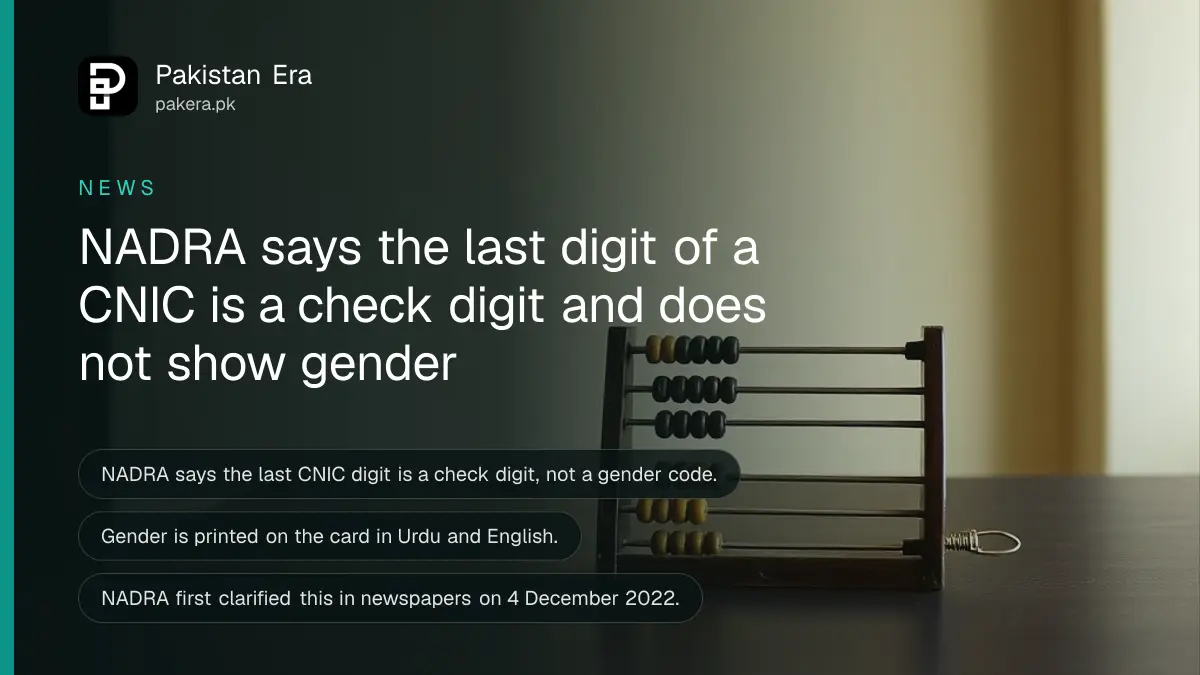
Short answer: NADRA has said that the last digit of a CNIC number is a check digit. It is worked out by a mathematical method to help confirm the number is valid. It does not show whether the holder is male or female. The claim that odd means male and even means female is a myth. Your gender is printed on the card in Urdu and English.
The statement was reported on 12 October 2026. It answers a rumour that keeps coming back on social media: look at the last digit of any CNIC and you can tell the holder's gender. Many people have repeated it, and many explainers have printed it as fact.
We could not find the statement on NADRA's own media release page on 12 October 2026. The latest release listed there was dated 7 September 2026. So the wording below is as reported. We mark where that matters.
NADRA says the last digit is a check digit, not a gender code
As reported, NADRA described the last digit as "a check digit calculated using a specific technical and mathematical method to help verify the validity of the identification number". It added that the digit does not show a citizen's gender or other personal information.
A check digit is a number added at the end of a longer number. A formula builds it from the other digits. If someone mistypes the number, the check digit usually no longer matches, and the system can flag the error. Bank cards and barcodes use the same idea.
This means the last digit tells you nothing about a person. It only helps a computer catch a wrong entry.
The odd and even rumour has no basis in NADRA's statement
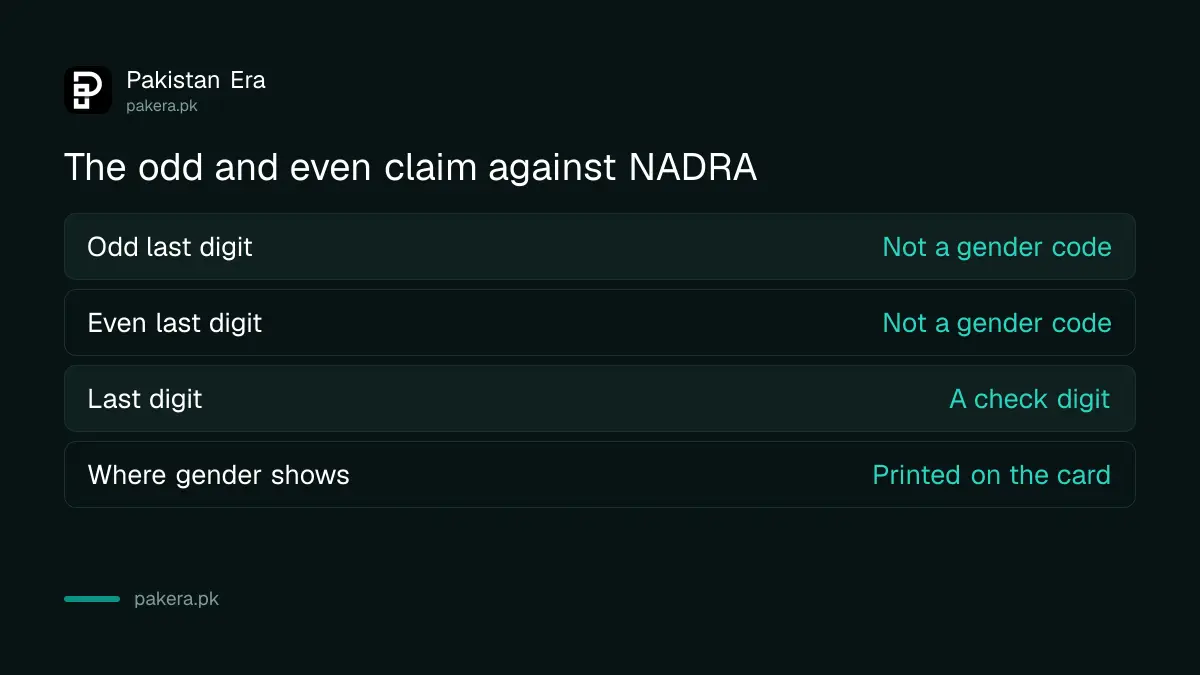
The claim being corrected is simple. Odd numbers belong to men, and even numbers belong to women. NADRA's statement rejects it directly.
| Claim going around | What NADRA said, as reported |
|---|---|
| Odd last digit means male | The last digit is a check digit and does not show gender |
| Even last digit means female | The last digit is a check digit and does not show gender |
| The last digit carries personal information | It carries no personal information |
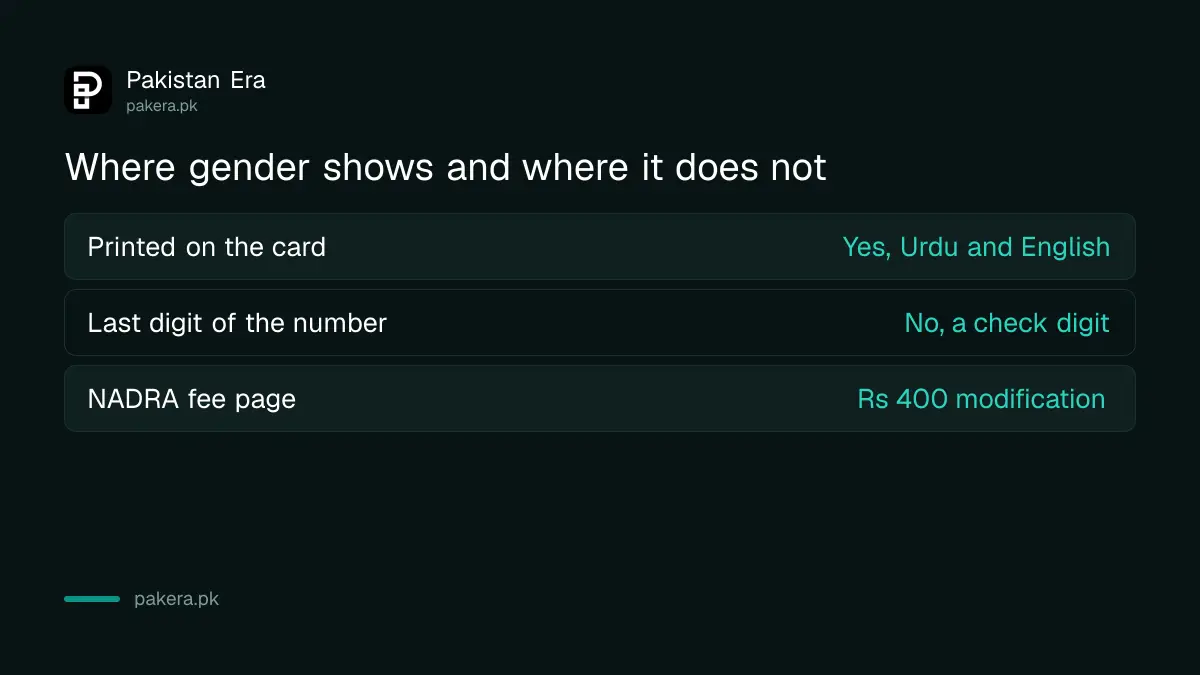
| You can read gender from the number | Gender is printed on the card in Urdu and English |
NADRA had already answered this in 2022
According to the report, NADRA had issued a public clarification through newspapers on 4 December 2022. It said that came in light of the Peshawar High Court's orders in Writ Petition No. P-40/2021.
So this is a repeat of an older position, not a new rule. Nothing about the card or the number has changed. What has changed is that the clarification is being circulated again because the rumour is circulating again.
Some explainers, including ours, read the digit as gender
Many pages that explain the CNIC number have said the last digit shows gender, and ours is one of them. The breakdown of what every digit of a CNIC number means reads the last digit that way. NADRA's statement says that reading is wrong, so treat the gender claim there as superseded. We have flagged that page for correction.
The other parts of the number are not the subject of this statement. NADRA spoke only about the last digit. We do not know from this statement whether NADRA has said anything about the other twelve digits, and we do not claim that it has.
What you should do with this
You do not need to do anything to your card. The rumour does not put you at risk by itself. But it is a good reminder of two habits: read the gender and other details off the card itself, and never trust a stranger's claim about what your number "means".
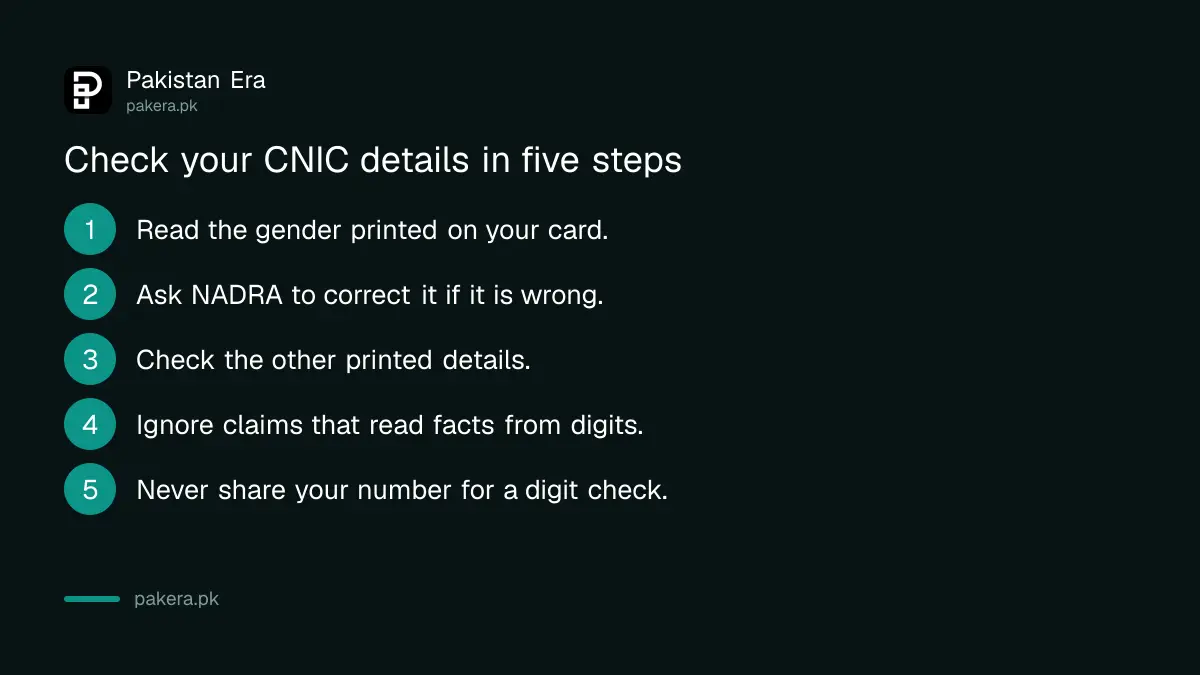
- Look at the printed gender on your card. It appears in Urdu and English.
- If it is wrong, ask NADRA for a correction. NADRA's fee page lists Rs 400 for a CNIC modification at the normal 15 day timeline, and Rs 750 for a Smart NIC modification at 31 days.
- Check the other printed details too. How to check CNIC details with picture sets out what NADRA allows.
- Ignore messages that claim to read personal facts from your digits. Treat them as a sign of a scam or a prank.
- Do not share your number with a stranger who says they can "verify" it from the last digit.
Why a rumour about a digit matters
It sounds harmless. It is not entirely harmless. A false belief that the number reveals gender can lead people to guess about others from a number they see on a form, a receipt or a list.
It also teaches people to read meaning into numbers. Fraudsters use that. A caller who "reads" something about you from your CNIC sounds like an official. The better habit is the opposite: the number is only an identifier, and what is private about you is not in it.
If you have shared your number widely, the steps in protecting your CNIC from misuse are worth ten minutes.
Common questions
Does an odd last digit on a CNIC mean the holder is male?
No. NADRA says the last digit is a check digit calculated by a technical and mathematical method. It does not show gender.
What is a check digit?
It is a digit added at the end of a number and worked out from the other digits. It helps a system confirm the number was entered correctly.
Where is my gender shown on the CNIC?
It is printed on the card itself, in both Urdu and English, as NADRA states.
Is this a new NADRA rule?
No. As reported, NADRA gave a public clarification through newspapers on 4 December 2022 after Peshawar High Court orders. The clarification is being shared again now.
Can I change the gender on my CNIC if it is printed wrongly?
Yes, a correction is a modification at NADRA. Its fee page lists Rs 400 for a CNIC modification at the normal timeline. Confirm the documents needed at a NADRA centre before you go.
Did NADRA publish this on its own website?
We did not find it on NADRA's media release page on 12 October 2026. That is why we say "as reported". Check NADRA's official channels for the original wording.
How we verified this
What we checked, where we read it, and what we could not confirm.
We checked NADRA's fee structure page and its media centre on 12 October 2026. The statement on the last digit is reported and was not found on NADRA's own media release page. For fee detail across documents, see NADRA fees for every document. Confirm any fee at a NADRA centre or on the PakID app before you pay.
About the author

Tax, Bills and Technology Writer
Ali Akhtar is a young and curious voice here at Pakistan Era. He is currently pursuing his A-Levels and has a growing interest in Pakistan’s changing industrial landscape and educational trends. Ali likes to write in a way that helps him explain and explore the world around him. His writing reflects the perspective of the new generation navigating the evolving trends of Pakistan where technology, youth innovation, and shifting opportunities are reshaping the country’s future.