What Every Digit of Your CNIC Number Means
Thirteen digits, three parts. The first five say where you were registered, the middle seven are your family, and the last one is your gender.
Your CNIC number is not a random string. Every one of the thirteen digits is doing a job, and once you know the pattern you can read your own number in about ten seconds.
It splits into three parts: five digits, then seven, then one.
The first five say where you were registered
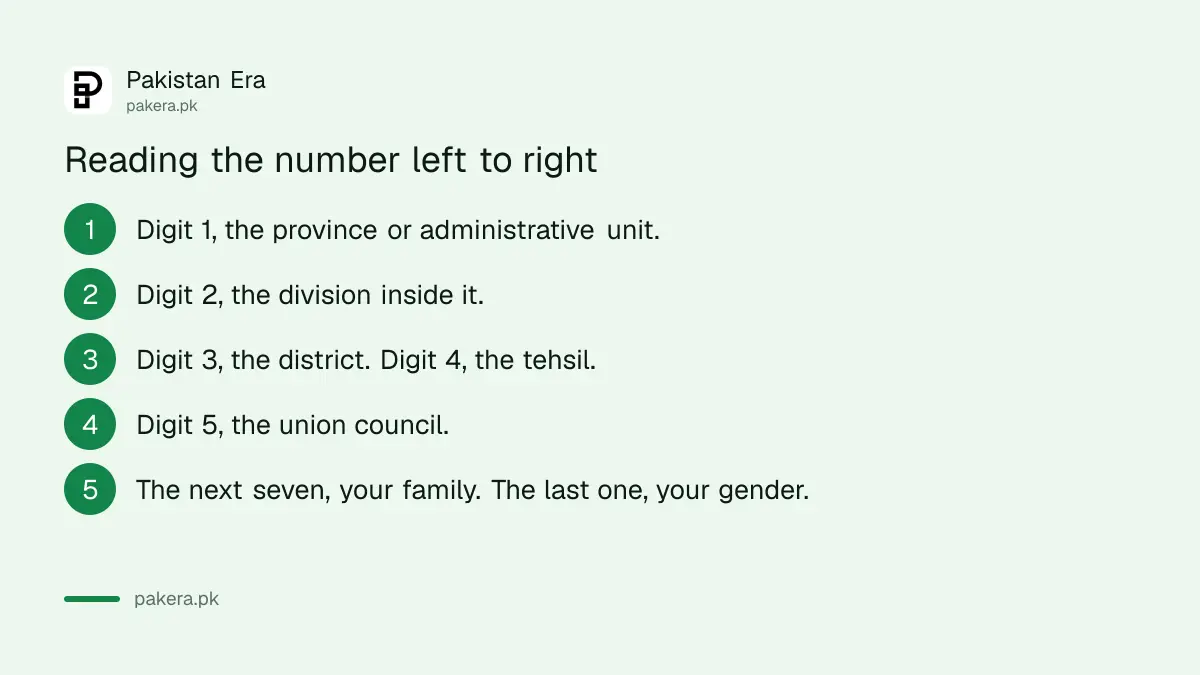
They narrow down from a province to a union council, one digit at a time.
- The first digit is the province or administrative unit.
- The second is the division inside that province.
- The third is the district.
- The fourth is the tehsil.
- The fifth is the union council.
So a number beginning 35202 is Punjab, then a division, then a district, then a tehsil, then a union council, getting more local with each step.
What the first digit tells you
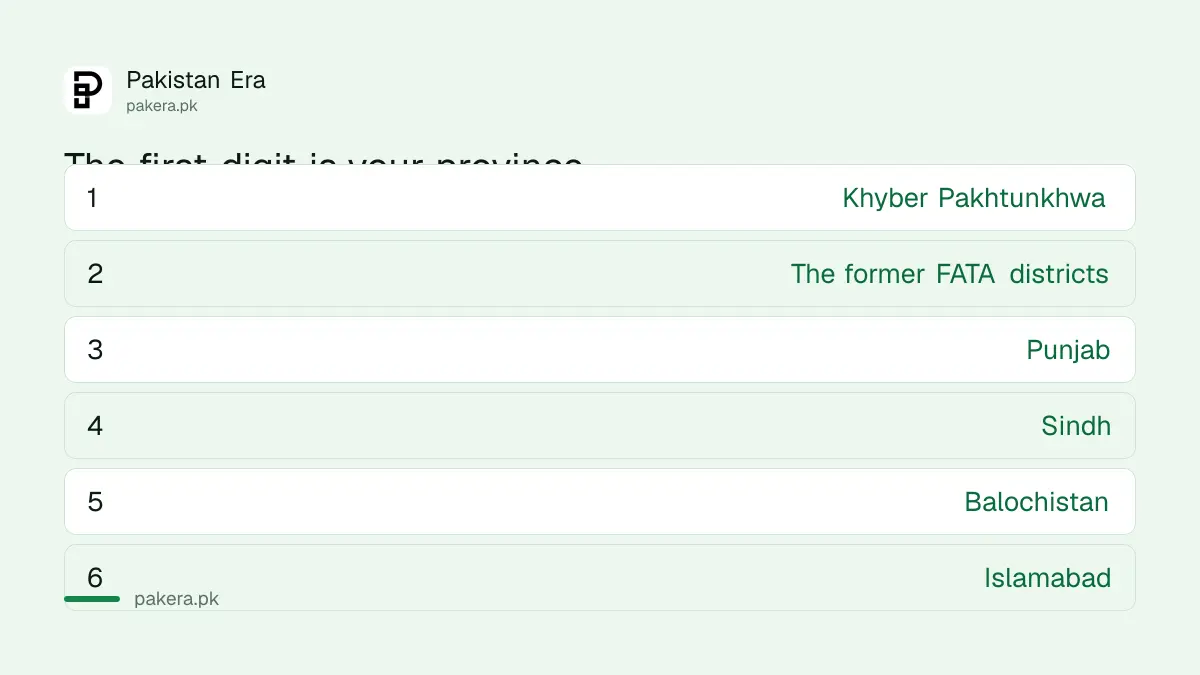
| First digit | Where |
|---|---|
| 1 | Khyber Pakhtunkhwa |
| 2 | The former FATA districts |
| 3 | Punjab |
| 4 | Sindh |
| 5 | Balochistan |
| 6 | Islamabad |
| 7 | Gilgit-Baltistan |
| 8 | Azad Jammu and Kashmir |
Azad Kashmir splits further at the second digit. 81 is Mirpur Division, and 82 covers Poonch and Muzaffarabad Divisions. A lot of pages listing these codes leave Azad Kashmir out entirely.
Why a 2 does not mean what it used to
This is the part almost every explainer gets wrong, and it affects millions of cards.
Code 2 was assigned to the Federally Administered Tribal Areas. FATA no longer exists as a separate unit. The tribal districts were merged into Khyber Pakhtunkhwa in 2018.
Cards issued before that merger still carry a 2. So a 2 does not tell you the holder lives somewhere outside a province. It tells you where they were registered, under an arrangement that has since changed.
That points at the wider mistake people make with these codes. The locality digits record a registration, not an address. Someone registered in Kalat at eighteen who has lived in Karachi for twenty years still carries the Balochistan code. Reading a CNIC as a current address will be wrong often enough to matter.
The middle seven are your family
The seven digits in the middle are a family number rather than a personal one.
Members of the same family share a common code here, which is how the register connects blood relatives to one another. It is the part that makes a CNIC useful to the state for things like inheritance records and family registration certificates, and it is why the number is not simply issued in order of application.
If you have a B Form for a child, this is the thread that ties it to the parents' records.
The last digit is your gender
One digit, one job.
Odd numbers are men. 1, 3, 5, 7 and 9. Even numbers are women. 0, 2, 4, 6 and 8.
That is the whole rule, and it is the reason people occasionally discover a data entry error years later, when a form rejects their number for not matching the gender on file.
Some pages claim this digit also works as a mathematical check on the rest of the number. We could not confirm that, so we are describing only what we can: it records gender.
What this means for your privacy
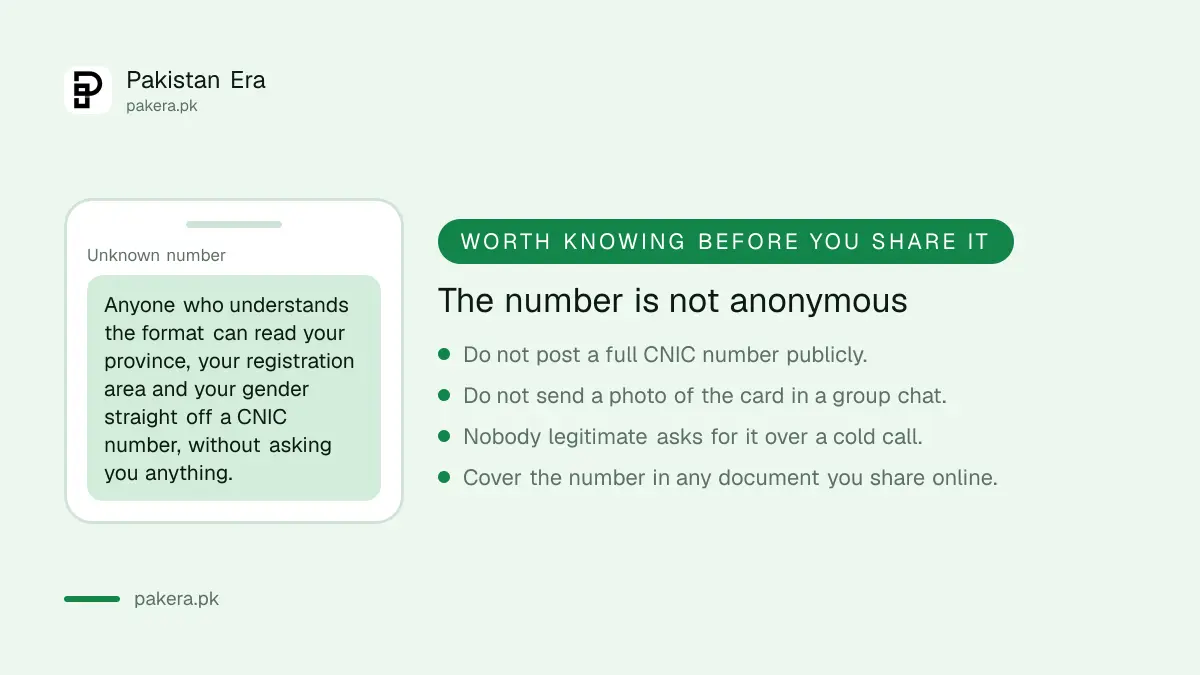
Now the uncomfortable part. Everything above works in both directions.
You can read your own number. So can anybody else. A stranger holding your CNIC number knows your province, narrows your registration down to a union council, and knows your gender, without asking you a single question.
Three habits follow from that.
Do not post a full CNIC number publicly, and do not send a photograph of the card into a group chat. Screenshots travel further than people expect.
Cover the number on any document you share online. Utility bills, application forms and appointment slips carry it more often than you would think.
Nobody legitimate asks for it on a cold call. If someone rings claiming to be from a bank, a telecom or a government office and asks you to confirm your CNIC, hang up and call the organisation back on a number you looked up yourself.
You can see which connections are already registered against your number using our guide to checking SIMs on your CNIC, which is worth doing once a year.
Where we got this and what we could not check
We could not read this from NADRA's own pages. They refused our requests on the day we wrote this, which most likely reflects where we were connecting from rather than any problem at their end.
So the structure here is taken from the most careful public accounts we could find and cross checked between them. It is consistent, and it matches what people see on their own cards, but we would rather tell you that than pretend we read it off an official document.
We have also not published a district code table. The province codes are useful for understanding your own number. A full lookup of every district is a tool for reading other people's, and that is not what this is for.
If you are dealing with NADRA for something practical, we have tested guides to tracking a CNIC application and the marriage certificate. On fees, our check of what the ranking pages claim found they do not agree with each other.
Questions readers are asking
What do the first five digits of a CNIC mean?
They are a locality code. Province, then division, district, tehsil and union council, narrowing one digit at a time.
What does the last digit of a CNIC mean?
Gender. Odd digits are used for men and even digits for women.
What are the middle seven digits?
A family number, shared between blood relatives, which is how the register links family members to one another.
Which province does 3 mean?
Punjab. The full set is 1 for Khyber Pakhtunkhwa, 2 for the former FATA, 3 Punjab, 4 Sindh, 5 Balochistan, 6 Islamabad, 7 Gilgit-Baltistan and 8 Azad Jammu and Kashmir.
Does the number show where I live now?
No. It records where you were registered. People who moved decades ago still carry their original locality code.
Why does my card start with 2 if FATA no longer exists?
The tribal districts merged into Khyber Pakhtunkhwa in 2018. Cards issued before the merger kept the code they were given.
Is it safe to share my CNIC number?
Share it where it is genuinely required, such as a bank or a government form. Do not post it publicly, and do not give it to anyone who rings you asking for it.
About the author
Public Services and Education Journalist
Fajr Riaz is a journalist and content writer at Pakistan Era, based in Lahore. She covers the questions people meet in everyday life in Pakistan: how a public service works, what a change in the rules means, and where to find a reliable answer.