Cancelling a CNIC After a Death: Free, and Done in a Day
NADRA charges no fee to cancel an identity record after a death and processes it in one day. It is the step that inheritance waits on.
When somebody dies, their NADRA record does not close by itself. Somebody has to ask for it.
That request costs nothing and is processed in one day. Families routinely leave it for months, usually because they assume it is expensive, slow, or something the union council already handled.
What it costs

From NADRA's published fee schedule, read on 18 August 2026.
| Service | Fee | Time |
|---|---|---|
| CNIC or CRC cancellation after a death | Free | 1 day |
| NICOP cancellation after a death | Free | Not stated |
There is a detail in that table worth pointing at. Almost every other NADRA service has three tiers, normal, urgent and executive, where paying more buys speed.
Cancellation has only one tier. There is no urgent option and no executive option, because there is nothing to sell. The standard service already takes a day.
So nobody needs to be persuaded to pay for faster handling of this, and if anybody suggests otherwise, the fee schedule says free.
Why it matters more than it looks
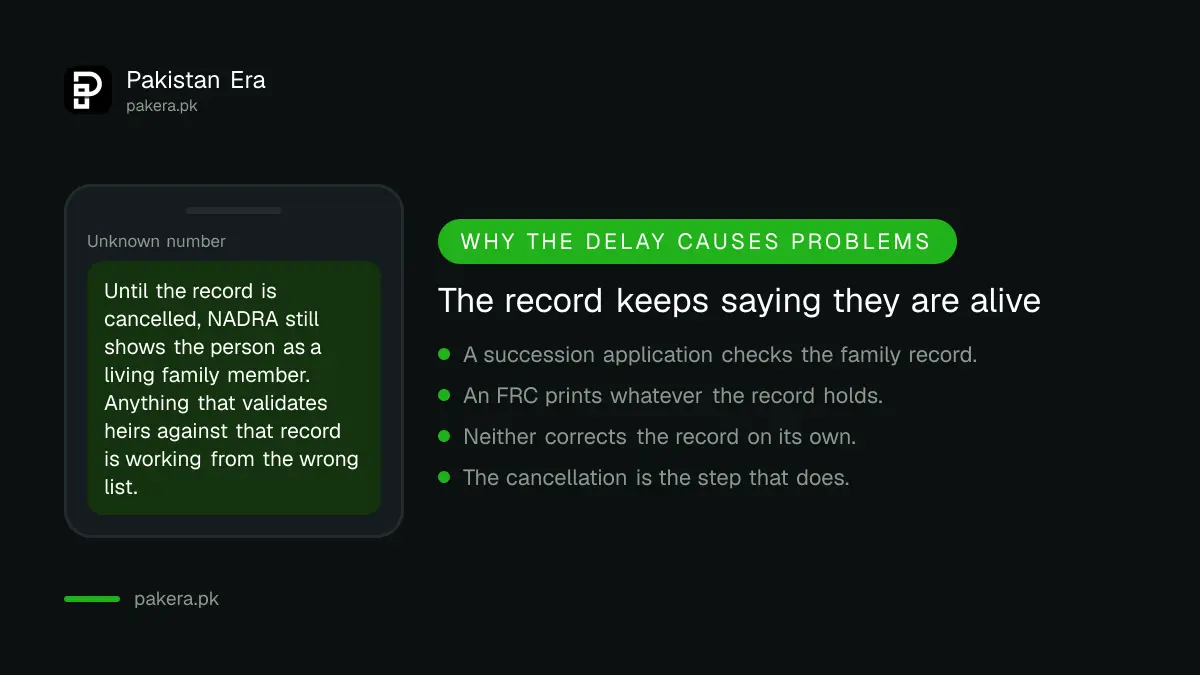
Until the record is cancelled, NADRA still shows the person as a living member of the family.
That is not merely untidy. It has a practical consequence, and it lands at the point where a family least wants an obstacle.
NADRA validates legal heirs against the family record when a succession certificate is issued. If the record still lists the deceased as living, the list of heirs being checked is the wrong list. A Family Registration Certificate has the same problem in a different form: it prints what the record holds, so it will reproduce the error onto official paper.
Neither of those documents fixes the record. They read it. The cancellation is the step that changes it, which is why doing it first saves the family from discovering the problem halfway through an inheritance process.
The order the paperwork runs in
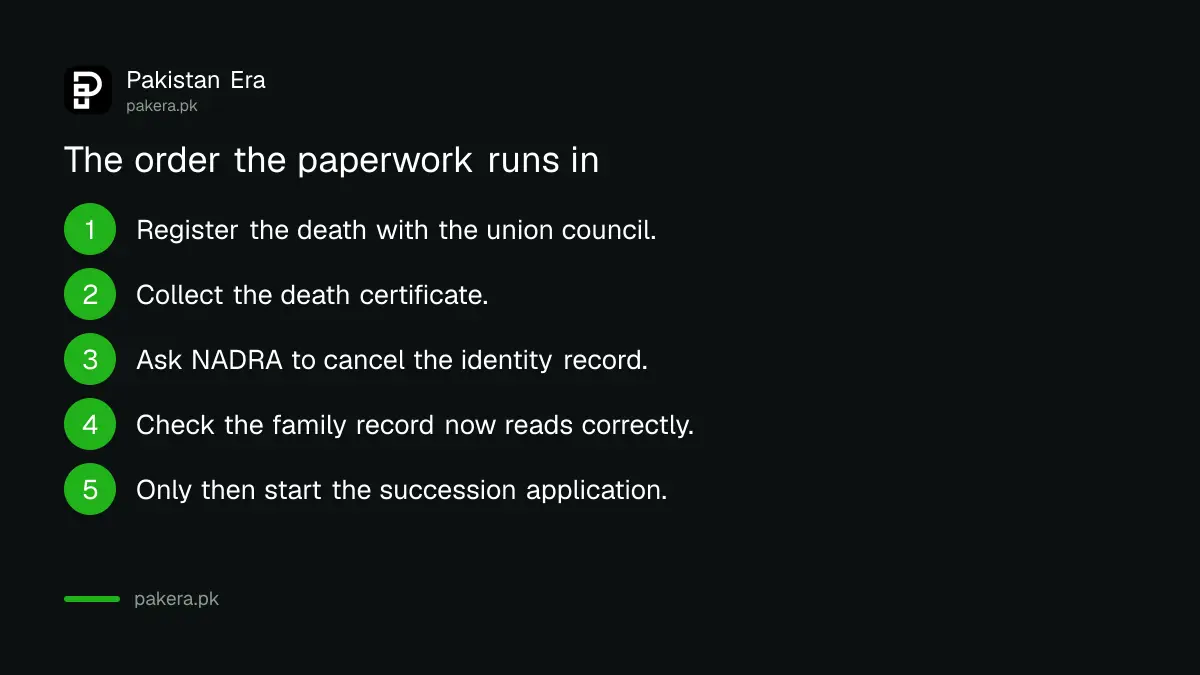
Getting these in the wrong order is the most common way this goes slowly.
- Register the death with the union council. This is the local government step and it comes first. We cover it in the death certificate guide.
- Collect the death certificate, which is the document the later steps rest on.
- Ask NADRA to cancel the identity record. Free, one day.
- Check the family record now reads correctly before relying on it.
- Then start the succession application, covered in our succession certificate guide.
Steps one and two are a union council matter. Step three is NADRA. Those are different offices, and the union council does not pass the information along on your behalf.
That assumption, that registering a death somewhere means it is registered everywhere, is the reason so many records sit uncancelled.
What we could not confirm
We want to be exact about the limits here, because a family dealing with a death should not make a wasted journey on our account.
We read NADRA's fee schedule directly and the fee and timeline above come from it. We did not find a procedural page for cancellation. The addresses we tried resolved to NADRA's homepage rather than to a document.
So we are not listing the documents to carry beyond the obvious death certificate, and we are not naming a form. We do not know them, and guessing would be worse than saying so.
What we can tell you is that the fee is zero and the stated turnaround is a day, so if a centre quotes you a charge for this, the published schedule is the thing to point at.
Confirm the document list with a NADRA Registration Centre before travelling. A phone call is cheaper than a second trip.
If the person lived abroad
NICOP cancellation after a death is also listed at no charge, in the same schedule.
The overseas case has an extra complication we are not going to pretend away. A death registered in another country produces that country's death certificate, and what NADRA requires in order to accept it, attestation, translation, or a consular route, is not something we read at source. Ask the Pakistani mission in that country.
Which overseas document applies to whom is set out in our NICOP and POC guide.
Do not delay it for the wrong reason
Three beliefs keep this step waiting, and none of them holds.
That it costs money. It does not. The published fee is zero.
That there is no hurry. There usually is, because inheritance, pensions and bank matters all eventually run into a record that still says the person is alive.
That somebody else has done it. The union council registers the death. NADRA cancels the identity record. Those are two separate acts by two separate bodies.
If you are unsure whether it has been done, checking the family record is the direct way to find out. An FRC shows exactly who NADRA currently lists as family, and how to read one is covered in the FRC guide.
Questions readers are asking
How much does it cost to cancel a CNIC after a death?
Nothing. NADRA's fee schedule lists cancellation due to death at a fee of zero.
How long does it take?
One day, according to the published timeline. There is no urgent or executive tier, because the standard service is already same day.
Does the union council do this automatically?
No. The union council registers the death. Cancelling the NADRA identity record is a separate request to NADRA.
Why does it matter for inheritance?
Because NADRA validates legal heirs against the family record. If the record still lists the deceased as living, that check is running against the wrong information.
What documents do I need to take?
We could not confirm the full list at source, so we are not guessing. The death certificate is the obvious one. Ring a NADRA Registration Centre to confirm the rest before travelling.
What about somebody who died abroad?
NICOP cancellation after a death is also free. What NADRA requires for a foreign death certificate is not something we verified, so ask the Pakistani mission in that country.
Can a child's B Form record be cancelled the same way?
Yes. The schedule lists CNIC and CRC cancellation together, at the same zero fee and one day timeline.
About the author

Tax, Bills and Technology Writer
Ali Akhtar is a young and curious voice here at Pakistan Era. He is currently pursuing his A-Levels and has a growing interest in Pakistan’s changing industrial landscape and educational trends. Ali likes to write in a way that helps him explain and explore the world around him. His writing reflects the perspective of the new generation navigating the evolving trends of Pakistan where technology, youth innovation, and shifting opportunities are reshaping the country’s future.