Pakistan's New QR Code CNIC: What Changed on 14 August
NADRA replaced the imported microchip with a QR code read by any phone. What the new card shows, when each type changes, and who must act.
Pakistan has stopped putting a microchip in the national identity card. Since 14 August 2026, the standard card carries a QR code instead, and it is made in Pakistan.
The reason NADRA gives for the change is unusually direct, and it is the most interesting part of the announcement.
The chip never really worked
The chip based Smart card was introduced about fourteen years ago. NADRA now says its chip enabled functions could not be used as intended, because chip readers and the supporting infrastructure were not available.
That is the authority describing its own previous card. For fourteen years people carried a chip that mostly nothing could read.
A QR code solves that in the least glamorous way possible. It is read by a phone camera, and almost everybody who needs to verify an identity already has a phone. There is no reader to buy, deploy or maintain.
The new card is verified through the Pak Identity mobile application, or through appropriate software connected to a camera.
What is different about the card
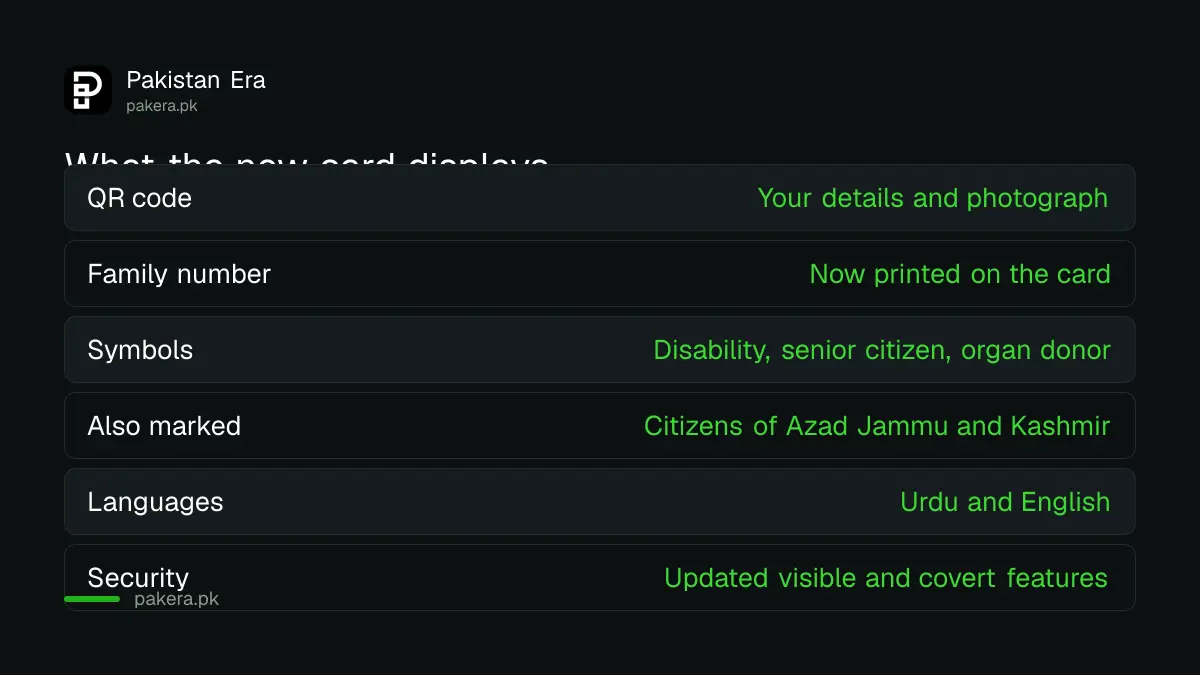
The QR code holds the cardholder's information and photograph. NADRA says this lets institutions capture names, addresses and other identity details into their systems more consistently, and with fewer typing errors.
The printed face of the card changed too.
| Feature | What it is |
|---|---|
| QR code | Holds cardholder details and photograph |
| Family number | Now displayed on the card |
| Symbols | Persons with disabilities, senior citizens, organ donors, citizens of Azad Jammu and Kashmir |
| Languages | Name and address in Urdu and English |
| Security | Updated visible and covert features |
| Made by | Pakistan Security Printing Corporation, Karachi |
The manufacturing point is the one the announcement leads on. The card is produced domestically, to NADRA's technical and security requirements, by the body formerly called the National Security Printing Company. Removing an imported component from a national identity document is the stated purpose of the redesign.
When each type of card changes
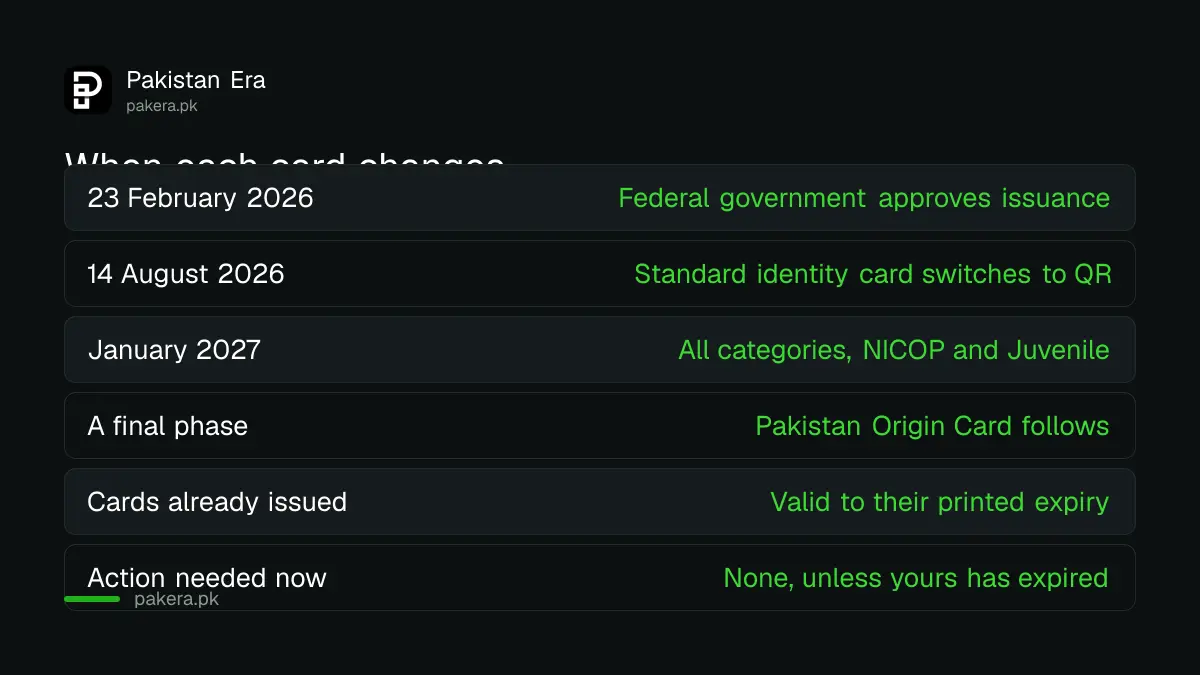
This is being done in stages, and the stage you are in decides whether any of it affects you yet.
- 23 February 2026. The federal government approved issuance of the new card.
- 14 August 2026. Phase one begins. The QR card replaces the standard National Identity Card, and only that.
- January 2027. It extends to all categories, including the National Identity Card for Overseas Pakistanis and Juvenile Cards.
- A final phase. The Pakistan Origin Card also moves to the chipless format.
So an overseas Pakistani holding a NICOP is not affected in this phase. Which overseas document applies to whom is covered in our NICOP and POC guide.
Do you need to do anything?
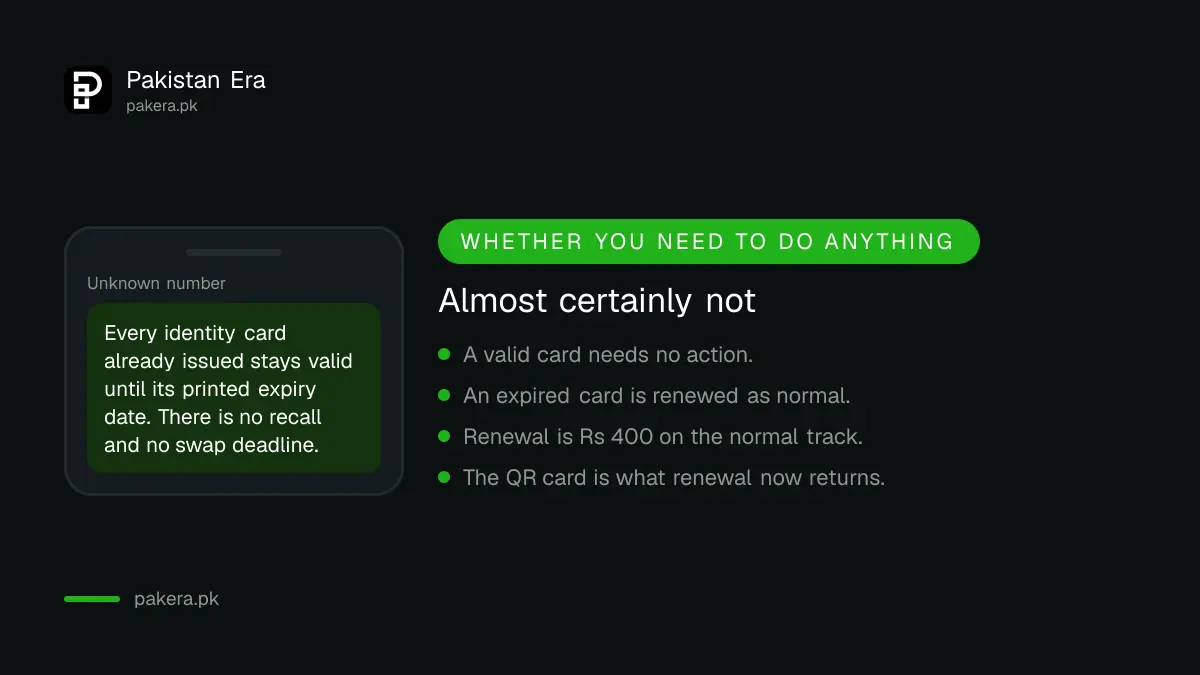
Almost certainly not, and this is the part worth being clear about because it is where confident misinformation tends to appear.
All identity cards already issued remain valid until their respective expiry dates. There is no recall, no swap window and no deadline.
If your Smart card is valid, keep using it. Nothing about the new card shortens the life of the one in your wallet.
If your card has expired, renew it as you normally would, and the card you receive will be the new one. Renewal costs Rs 400 on the normal fifteen day track, and we set out the process in the CNIC renewal guide.
One correction to something this page previously implied. A first CNIC is free on the normal track. A renewal or replacement is not, it is Rs 400. Every NADRA fee is listed in our fee guide.
The question nobody has answered yet
NADRA says telecom operators, banks, hospitals, Pakistan Railways, police and other authorised institutions will be provided with software to read and verify the QR code.
That is a future tense, and it is worth noticing which future tense it is.
The stated failure of the chip card was precisely this: the technology was on the card, and the infrastructure to use it was not there. The QR approach is far better placed, because a camera is not specialist hardware and the reading app already exists. But the distribution of institutional verification software is still a promise rather than something we have seen working.
We are not predicting that it fails. We are noting that this is the same category of thing that went wrong last time, and it is the part to watch.
For what a phone can already verify against NADRA records today, see our piece on facial and iris verification.
What we could not verify
Everything above about the new card comes from NADRA's own media release dated 14 August 2026, read on 18 August 2026. Fees come from NADRA's published fee schedule, read the same day.
We have not held one of these cards. We cannot tell you what the QR code scans to in practice, how long the reading takes, or whether the printed symbols are legible at a glance.
We do not know whether the institutional verification software has actually been distributed to banks, hospitals or telecom operators, or when it will be. NADRA states it will be provided. We have not seen it in use.
We also cannot say whether every registration centre is issuing the new card yet, or whether phase one is uniform across the country from day one.
An earlier version of this page described the QR card as available in mid 2025 and gave a fee table for it. That was written before the card existed. It has been replaced with what the authority has now published, and the correction is recorded here rather than made quietly.
Questions readers are asking
When did the QR code CNIC start?
Issuance began on 14 August 2026, after federal government approval on 23 February 2026.
Do I have to replace my Smart card?
No. NADRA says every identity card already issued stays valid until its printed expiry date.
Why was the chip removed?
NADRA says the chip functions could not be used as intended because chip readers and supporting infrastructure were never available. A QR code can be read by an ordinary phone camera.
Where is the new card made?
In Pakistan, by the Pakistan Security Printing Corporation in Karachi, formerly the National Security Printing Company.
What extra information does it show?
The family number, and symbols identifying persons with disabilities, senior citizens, organ donors and citizens of Azad Jammu and Kashmir. Name and address appear in both Urdu and English.
Does this apply to NICOP holders?
Not in this phase. NICOP and Juvenile Cards move to the QR format from January 2027, and the Pakistan Origin Card in a final phase.
Is the new card free?
A first CNIC is free on the normal track. A renewal or replacement costs Rs 400, or more if you pay for faster service.
About the author

Tax, Bills and Technology Writer
Ali Akhtar is a young and curious voice here at Pakistan Era. He is currently pursuing his A-Levels and has a growing interest in Pakistan’s changing industrial landscape and educational trends. Ali likes to write in a way that helps him explain and explore the world around him. His writing reflects the perspective of the new generation navigating the evolving trends of Pakistan where technology, youth innovation, and shifting opportunities are reshaping the country’s future.