If Your Fingerprints Will Not Read, NADRA Now Has Two Other Ways to Verify You
Facial and iris scans are now legally recognised biometrics. The certificate costs Rs 20, lasts seven days, and solves failed fingerprints.
If you have ever stood at a counter pressing your thumb on a scanner while somebody says try again, and again, and then says there is nothing they can do, there is now something they can do.
The National Identity Card Rules were amended to recognise facial and iris scans as biometrics alongside fingerprints. Since 20 January 2026, NADRA has been issuing facial recognition based verification certificates at every registration centre for people whose fingerprints will not read.
Plenty of counter staff still do not offer it, which is the main reason this article exists.
Who this is actually for
Fingerprint verification failing is not rare and it is not random. It clusters in specific groups.
Manual workers wear their fingerprints down. Masons, farmers, mechanics, anyone whose hands meet cement, chemicals or heat all day. Elderly people lose ridge definition as skin thins, which is why the problem shows up most at pension counters. People with certain skin conditions, scarring or an injury to the hand. And a small number of people whose prints were simply captured badly when they were first enrolled.
For any of them, a fingerprint scanner is a locked door in front of a SIM, a bank account, a pension, a property transfer and a benefits payment. That is the problem the rule change addresses.
How to get the certificate
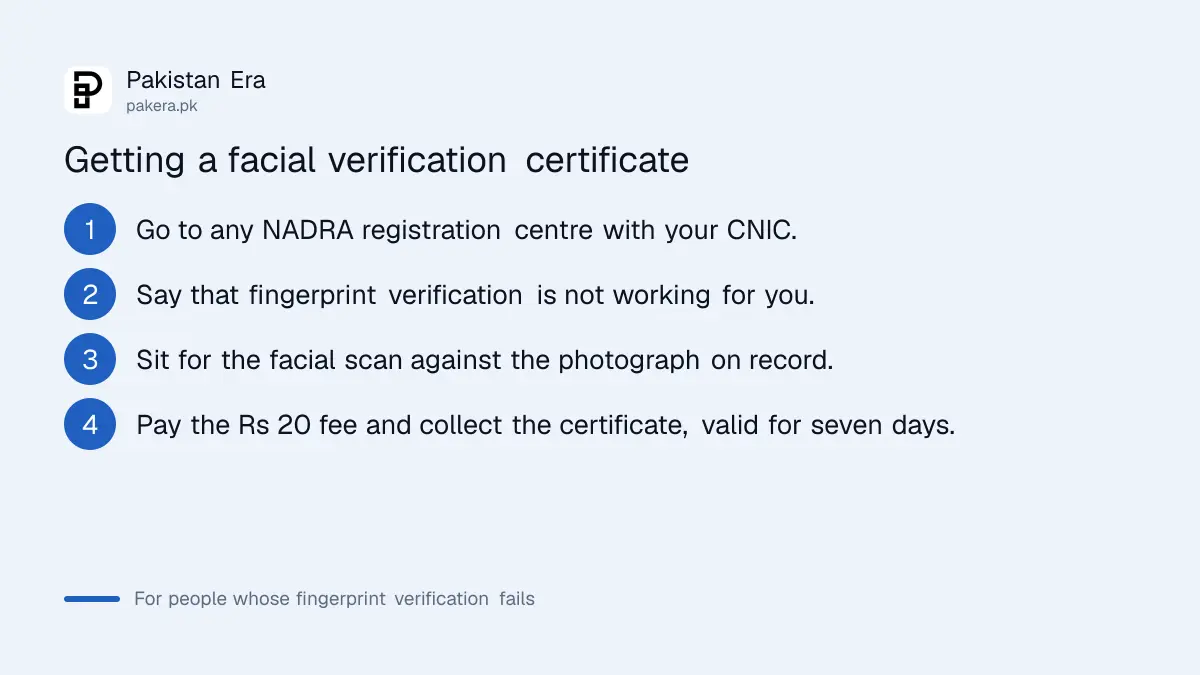
- Go to any NADRA registration centre with your CNIC. Not a franchise, not an e-Sahulat agent, a registration centre.
- Say that fingerprint verification is not working for you. Ask specifically for facial recognition based biometric verification, by name. Being specific is what gets it done.
- Sit for the facial scan. Your live image is matched against the photograph NADRA already holds.
- Pay Rs 20 and collect the certificate. It is valid for seven days.
The facial and iris capability has also been built into NADRA registration centres and the Pak ID mobile application, so the underlying technology is not a special arrangement made at one desk.
What the certificate contains
| On the certificate | Why it is there |
|---|---|
| Purpose of verification | Ties the certificate to what you are using it for |
| Your recent photograph and the one on record | Lets the receiving party see the match themselves |
| CNIC number, name, father's name | Identifies you against your record |
| A unique tracking ID | Lets the receiving party confirm it is genuine |
| A QR code | Machine readable version of the same |
The tracking ID and QR code are the parts that matter to whoever you hand it to. They are what turns a printed page into something a bank or a telco can actually rely on.
The seven day validity is the part to plan around
Seven days is short, and it is short on purpose: a biometric verification is a snapshot of a moment, and an open ended certificate would be worth forging.
The practical consequence is ordering. Do not collect the certificate and then start gathering the rest of your paperwork. Get everything else ready first, find out exactly what the bank, telco or office needs, and collect the certificate last. Otherwise you pay Rs 20 twice, which is trivial, and make the journey twice, which is not.
If your CNIC itself is expired or needs correcting, deal with that before any of this. Our guide to applying for a CNIC online covers the current process, and the QR code CNIC explains what the newer card carries.
What facial and iris recognition being legal biometrics changes
The rule change matters beyond the certificate. Recognising facial and iris scans as valid biometric identifiers means they can be used wherever the law requires biometric verification, not merely as a courtesy workaround at a NADRA counter.
That reaches a long way. SIM issuance and re-verification, bank account opening, pension disbursement, benefit programmes, property registration, and eventually anything built on the single digital ID and the dematerialised ID card. A system that only ever accepted fingerprints was quietly excluding the people least able to argue with it.
It is worth being clear eyed about the other side of that. Facial recognition is a more powerful identifier than a fingerprint because it can, in principle, be used at a distance and without cooperation. Nothing in this change does that, and the certificate route is explicitly something you turn up and ask for. But a national database that holds face and iris data is a different kind of thing from one that holds prints, and that is worth knowing rather than only celebrating.
If the counter says it cannot be done
The service exists at all registration centres and has since January. If you are told otherwise, three things usually help.
Ask for it by its name, facial recognition based biometric verification certificate, rather than describing the problem. Ask to speak to the centre in charge rather than the operator at the window. And if neither works, try a different registration centre, because availability of a service and awareness of it are not the same thing.
If the obstacle is technical rather than human, the NADRA systems being down is a real and recurring problem with its own workarounds.
Questions readers are asking
What does the NADRA facial verification certificate cost?
Rs 20. It is available at any NADRA registration centre and is valid for seven days from issue.
Who can use facial verification instead of fingerprints?
Citizens whose fingerprint based verification is not possible. In practice that is mostly manual workers with worn prints, elderly people, and anyone with scarring or a skin condition affecting the hands.
Are facial and iris scans legally valid biometrics in Pakistan?
Yes. The National Identity Card Rules were amended to expand the definition of biometrics to include facial and iris scans alongside fingerprints.
Can I do this from the Pak ID app instead of visiting a centre?
NADRA has integrated the facial and iris capability into both its registration centres and the Pak ID app. The verification certificate itself is issued at registration centres.
Why is the certificate only valid for seven days?
Because it records a verification made at a particular moment. A longer validity would make the document worth forging and would weaken what it proves. Plan to collect it last, once everything else is ready.
Does this replace my CNIC?
No. It is a verification certificate proving that you are the person on your CNIC when a fingerprint scanner cannot establish that. You still need the card itself.
About the author

Public Services and Education Journalist
Fajr Riaz is a journalist and content writer at Pakistan Era, based in Lahore. She covers the questions people meet in everyday life in Pakistan: how a public service works, what a change in the rules means, and where to find a reliable answer.