Wait 8 Hours Between SIM Requests on One CNIC in Pakistan: PTA's Buffer Rule
PTA keeps an 8 hour buffer between SIM activities on one CNIC. See which requests start the clock, how to plan your visits and what to do about a lost SIM.
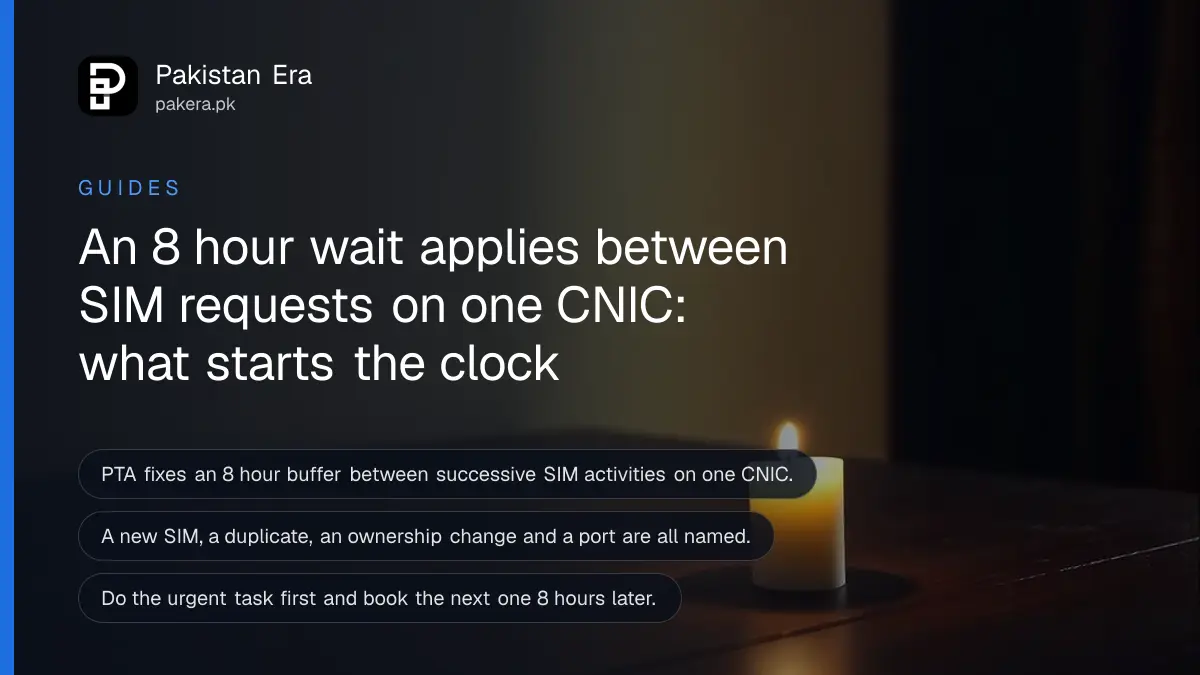
Short answer: PTA keeps an 8 hour buffer between SIM related activities on one CNIC. After you buy a new SIM, get a duplicate, change ownership or port your number, the next such request on the same CNIC can be done only after 8 hours. Plan your SIM tasks in separate sittings, and do the one that cannot wait first.
A shopkeeper in Multan buys a new SIM at 10 am. At noon his old number fails, so he goes back for a duplicate. The counter refuses. He thinks the system is broken. It is not. A buffer rule is working as designed.
We read PTA's own list of SIM questions and answers on 12 October 2026. The rule sits there as a single question and answer. PTA's page does not say why it exists, so the reason we give below is our reading, marked as such. We did not trigger the block at a counter ourselves.
The buffer applies to every SIM request on the same CNIC
PTA's page asks whether there is any restriction on SIM related activity against a particular CNIC. Its answer is that a buffer of 8 hours is fixed between successive SIM related activities. After one activity, the next can be done once 8 hours have passed.
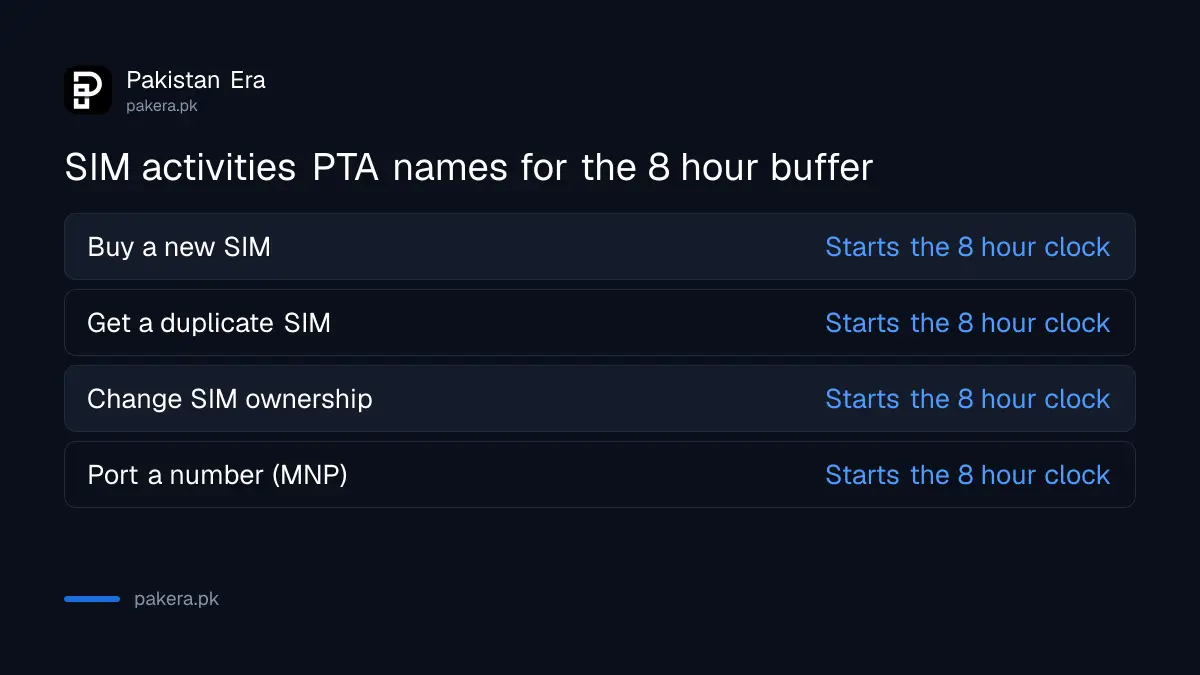
The page names four examples: buying a new SIM, getting a duplicate SIM, changing the ownership of a SIM and Mobile Number Portability, or MNP, which is moving your number to another network. The page ends the list with "etc.", so other requests may fall under the same rule.
The counter is the CNIC, not the SIM and not the operator. A request at one operator starts the clock for a request at another operator on the same CNIC.
Which tasks start the clock
The four named activities are the ones to plan around. We have put them next to the guide for each, so you can see what each one needs before you go.
| Activity PTA names | What it does | What else to know |
|---|---|---|
| Buy a new SIM | Adds a SIM to your CNIC | Limit is 5 voice and 3 data SIMs per CNIC |
| Get a duplicate SIM | Replaces a lost or damaged SIM on the same number | The SIM must be registered on the buyer's CNIC |
| Change SIM ownership | Moves a SIM to another person's CNIC | Both current owner and new owner must be present |
| Port a number (MNP) | Moves a number to another operator | Same number, new network |
Ownership transfers need both people at the counter, which PTA says is mandatory except in some cases where the owner has died or is abroad. The steps are in how to transfer a SIM to another person's name.
Our reading of why the buffer exists
PTA's page gives no reason. Our reading is that it slows down fraud. A criminal who steals a CNIC number needs several quick SIM actions to take over a number, and a buffer breaks that chain. The case in point is a SIM swap, where a thief gets a duplicate of your SIM to read your bank codes.
That reading matches the way PTA treats duplicate SIMs and biometric checks elsewhere on the same page. It is an inference, though. Treat it as a reasoned guess, not as PTA's statement. The signs of a swap and the first 30 minutes after one are in how to stop SIM swap fraud in Pakistan.
Plan your tasks so the buffer does not cost you a day
The buffer matters most when two tasks depend on each other. Port first and transfer later, or the other way round, and you may wait a night. Put the urgent task first, and leave the rest for the next day.
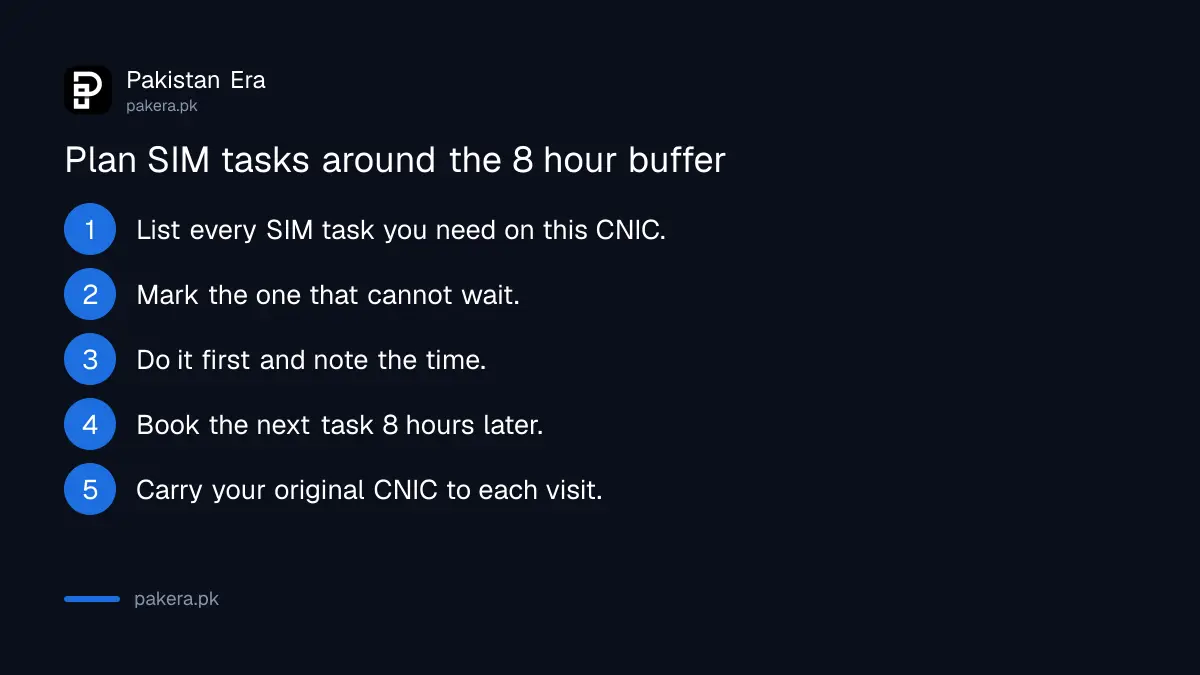
- List every SIM task you need on this CNIC, such as a new SIM, a duplicate, a transfer and a port.
- Mark the one that cannot wait, such as a duplicate for a lost number that holds your bank codes.
- Do that task first and note the time on the receipt.
- Book the next task at least 8 hours later, so a morning visit leads to an evening or next day visit.
- Carry your original CNIC to each visit and ask the agent to confirm the time before you start.
A lost SIM is the case where the buffer hurts
If your phone is stolen, you want to block the SIM and get a duplicate fast. PTA's page names a duplicate SIM among the activities. It does not say whether blocking a SIM counts, so we cannot say yes or no. Ask the operator's helpline before you travel.
The safe order is to block first, which stops misuse, and then to get the duplicate. For the codes and steps at each operator, see how to block a lost or stolen SIM on Jazz, Zong, Telenor or Ufone. If the duplicate is refused for 8 hours, the block keeps the number safe in the meantime.
Related limits worth knowing together
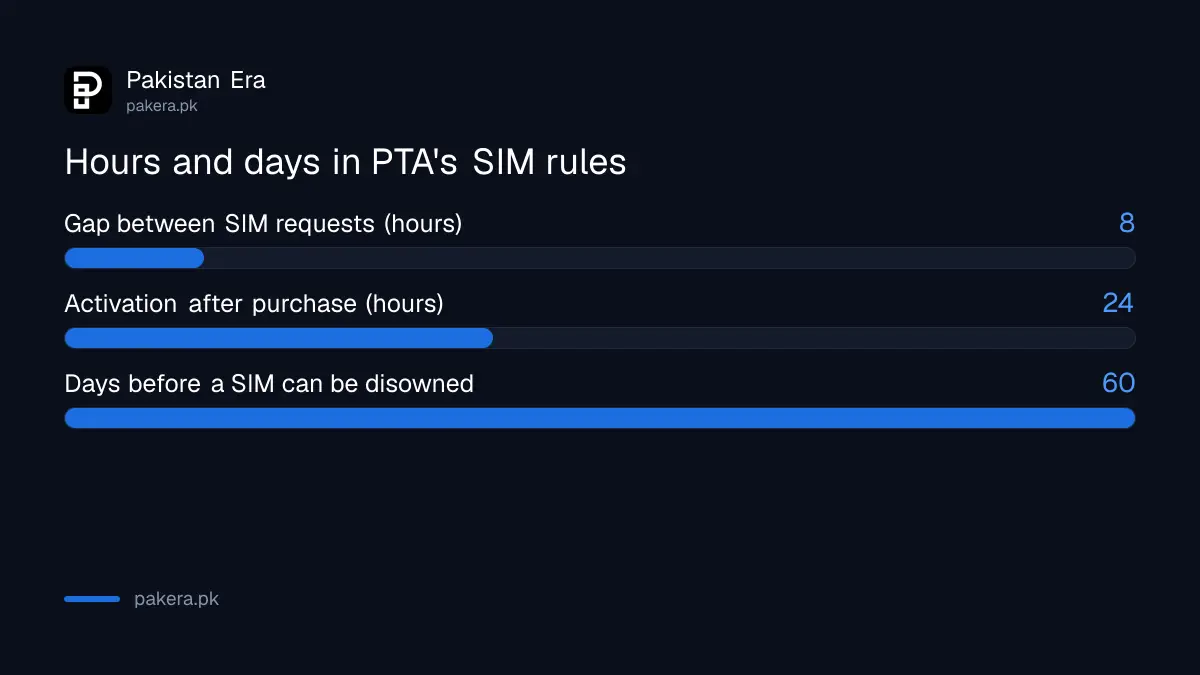
Two other limits from the same page often come up on the same visit. A SIM can be disowned, meaning removed from your CNIC, only after a biometric check, and not before 60 days from its issue. And a new SIM is activated within 24 hours.
PTA also says one CNIC can hold 8 SIMs for personal use. You can check your count by sending your CNIC number, without dashes, to 668. The list of numbers on your CNIC is explained in how to check SIMs on your CNIC.
Common questions
How long is the gap between SIM requests on one CNIC?
8 hours, according to PTA's page. It applies between successive SIM related activities on the same CNIC.
Does the gap apply across operators?
PTA fixes it against a specific CNIC, not an operator. A request at one operator should therefore also count for the next request elsewhere.
Does buying a second SIM count?
Yes. Buying a new SIM is the first activity PTA names. The next activity must wait 8 hours.
Does blocking a SIM start the clock?
PTA's page does not say. Ask your operator's helpline before you rely on either answer.
Is the buffer in a regulation I can quote?
We read it only as an answer on PTA's SIM page. We did not find the regulation it comes from, so quote the page and ask the operator for the rule text.
Whom do I ask if a counter refuses me before 8 hours?
Ask the operator's service centre, then PTA on 0800-55055. PTA's complaint FAQ lists that helpline.
How we verified this
What we checked, where we read it, and what we could not confirm.
We read PTA's SIM(s) information question and answer page on 12 October 2026, which holds the 8 hour buffer, the 60 day disown rule, the SIM limit and the 668 count service. We did not test a refusal at a counter. The "why" paragraph is our reading and not PTA's statement.
About the author

Technology Journalist & Multimedia Producer
Ahmad Ali is a technology journalist and multimedia producer at Pakistan Era, joining the team in October 2026. He covers consumer technology and digital life for Pakistani readers, combining research with hands-on product testing.