No-Confidence Motion in Pakistan: 68 Signatures to Move It, 169 Votes to Remove the Prime Minister
A no-confidence motion against Pakistan's PM needs 68 signatures and 169 of 336 votes, held 3 to 7 days after it is moved. Article 95, defection, CM numbers.

A no-confidence motion against Pakistan's Prime Minister needs a written notice signed by at least 68 members of the National Assembly, which is 20 per cent of its 336 seats. The vote must happen between 3 and 7 days after the motion is moved. If 169 members, a majority of the total membership, vote for it, the Prime Minister leaves office.
The rules are in Article 95 of the Constitution and Rule 37 of the National Assembly's Rules of Procedure. Article 136 applies the same pattern to a Chief Minister in a provincial assembly. The numbers matter because they count total seats, not members present on the day.
The numbers needed in the National Assembly
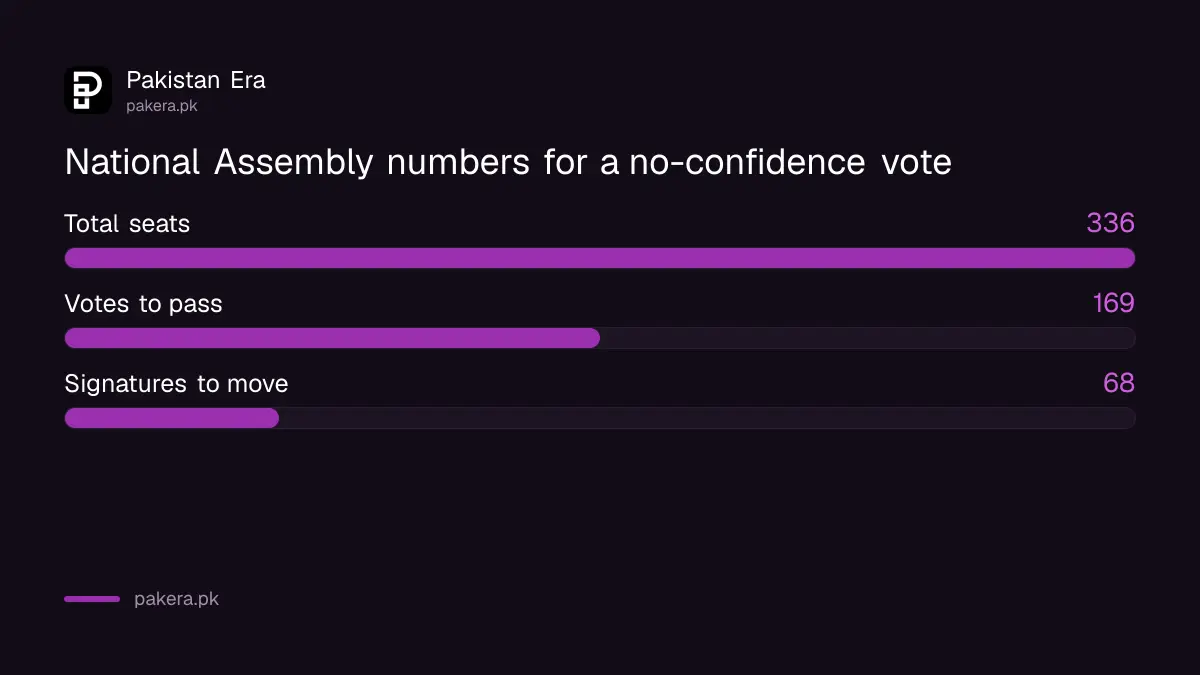
The National Assembly has 336 seats under Article 51. A no-confidence resolution must be moved by at least 20 per cent of them, so 68 members must sign. It passes only with 169 votes, more than half of all 336 seats, however many attend.
| Step | Rule | Number in the National Assembly |
|---|---|---|
| Signatures on the notice | At least 20 per cent of total membership | 68 of 336 |
| Votes to pass | Majority of total membership | 169 of 336 |
| Earliest vote | Not before 3 days have passed from the day it is moved | After day 3 |
| Latest vote | Not later than 7 days from the day it is moved | By day 7 |
We worked out 68 and 169 from the 336 seats in Article 51. Twenty per cent of 336 is 67.2, and "not less than" means 68. A majority of 336 is 169. Empty seats still count in the total.
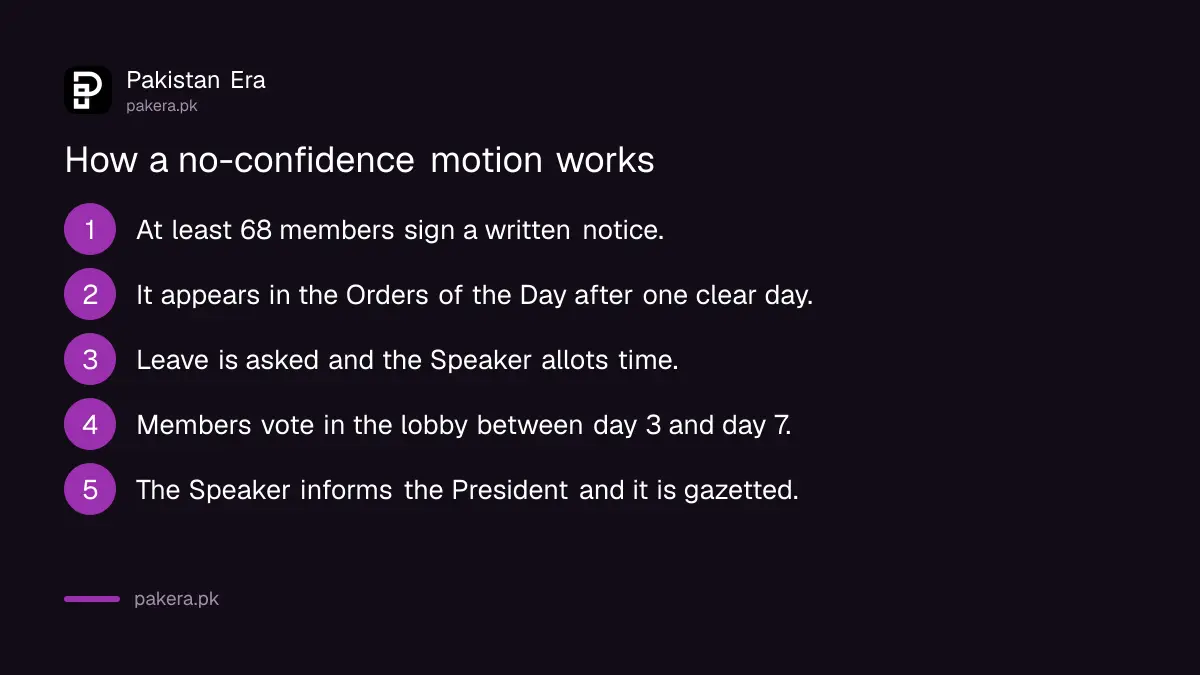
How a no-confidence motion moves, step by step
Members hand a signed notice to the National Assembly Secretary. It appears in the Orders of the Day after one clear day. The movers ask for leave to move it, the Speaker allots time for debate, and the vote must fall within the 3 to 7 day window.
- Written notice. At least 68 members sign and submit it to the Secretary (Rule 37(1)).
- Circulation. The Secretary circulates the notice to all members.
- Orders of the Day. It is listed for the first working day after one clear day from receipt (Rule 37(3)).
- Leave to move. Leave is asked after Question Hour and before other business.
- Debate. The Speaker allots a day or days for discussion.
- Vote. Members vote by walking through the lobby, not by voice, between day 3 and day 7.
- Result. The Speaker informs the President in writing, and a notification is published in the Gazette (Rule 38).
While the motion is pending, the Assembly cannot be prorogued until it is disposed of, or until the vote is held if leave was granted (Rule 37(8)).
How the vote is recorded
The vote follows the Second Schedule of the Assembly rules. Bells ring for five minutes, the lobby doors are locked, and members who support the motion walk in single file past tellers who mark each name. Then the Secretary counts and the Speaker announces the result.
This method creates a record of how every member voted. That record matters for the defection rule below.
When a no-confidence motion cannot be moved
Article 95(3) bars moving the resolution while the National Assembly is considering demands for grants in the Annual Budget Statement. In practice, that is the part of the budget session, usually in June, when the Assembly votes on ministries' spending.
The Constitution sets no other blackout period in Article 95. The motion can be moved at any sitting outside that budget stage, as long as the notice and timing rules are met.
Party members who vote against their party
Under Article 63A, a member who votes or abstains against the party's direction on a no-confidence vote can be declared a defector by the party head. The Election Commission then decides within 30 days, and an appeal goes to the Federal Constitutional Court.
| Stage | Time limit |
|---|---|
| Party head gives a show-cause chance, then declares defection | No fixed limit |
| Speaker refers the declaration to the Chief Election Commissioner | Within 2 days, or it is deemed referred |
| Election Commission decides | Within 30 days of receipt |
| Appeal to the Federal Constitutional Court | Filed within 30 days, decided within 90 days |
If the Election Commission confirms the declaration, the member stops being a member and the seat becomes vacant. The Federal Constitutional Court took over this appeal from the Supreme Court under the Twenty-seventh Amendment.
Vote of confidence is a different process
A vote of confidence is not the same as a no-confidence motion. Under Article 91(7), the President can ask the Prime Minister to obtain a vote of confidence if satisfied that he has lost the majority. It is recorded by the same lobby method, under Rule 36.
The difference is who starts it. Members start a no-confidence motion. The President starts a call for a vote of confidence, and the Prime Minister must then show majority support.
No-confidence against a Chief Minister
Article 136 uses the same rules for a Chief Minister: notice by 20 per cent of the provincial assembly, a vote between 3 and 7 days, and a majority of the total membership to pass. The numbers depend on each assembly's size under Article 106.
| Provincial Assembly | Total seats | Signatures needed (20%) | Votes to pass |
|---|---|---|---|
| Punjab | 371 | 75 | 186 |
| Sindh | 168 | 34 | 85 |
| Khyber Pakhtunkhwa | 145 | 29 | 73 |
| Balochistan | 65 | 13 | 33 |

To see who your own representative is, use the guide to finding your MNA by constituency. The day's business, including any such motion, appears in the National Assembly session agenda.
Common questions about no-confidence motions in Pakistan
How many votes are needed to remove the Prime Minister of Pakistan?
169 votes, a majority of the National Assembly's 336 seats. Members absent on the day do not lower that number.
How many members must sign a no-confidence notice?
At least 20 per cent of the total membership, which is 68 members in the 336 seat National Assembly.
How soon is the vote held?
Not before 3 days and not later than 7 days from the day the resolution is moved in the Assembly.
Can a no-confidence motion be moved during the budget?
Not while the Assembly is considering demands for grants in the Annual Budget Statement. Article 95(3) bars it.
Does the Senate vote on a no-confidence motion?
No. Only the National Assembly votes on a no-confidence resolution against the Prime Minister.
How we verified this
What we checked and where we read it.
Last checked 15 November 2026. Articles 51, 63A, 91, 95, 106 and 136 are from the Constitution on Pakistan Code, which includes the Twenty-seventh Amendment. Rules 36, 37 and 38 and the Second Schedule are from the National Assembly Rules of Procedure, 2007, as modified up to 18 August 2026. The signature and vote counts in both tables are our arithmetic from the seat numbers in Articles 51 and 106.
About the author

Global Affairs & Political Economy Writer
Muhammad Hatim is a book lover who started writing because he enjoys it. At Pakistan Era he writes about international relations, geopolitics and the global economy, with a particular interest in South Asia and the forces behind current events.