Oman Annual Leave, Sick Leave and Working Hours for Pakistani Workers: 30 Days, 182 Days, 8 Hours
Oman's Labour Law gives 30 days of paid leave, a ticket home, up to 182 days of sick leave and an 8 hour day. See overtime rates and how to claim what is owed.
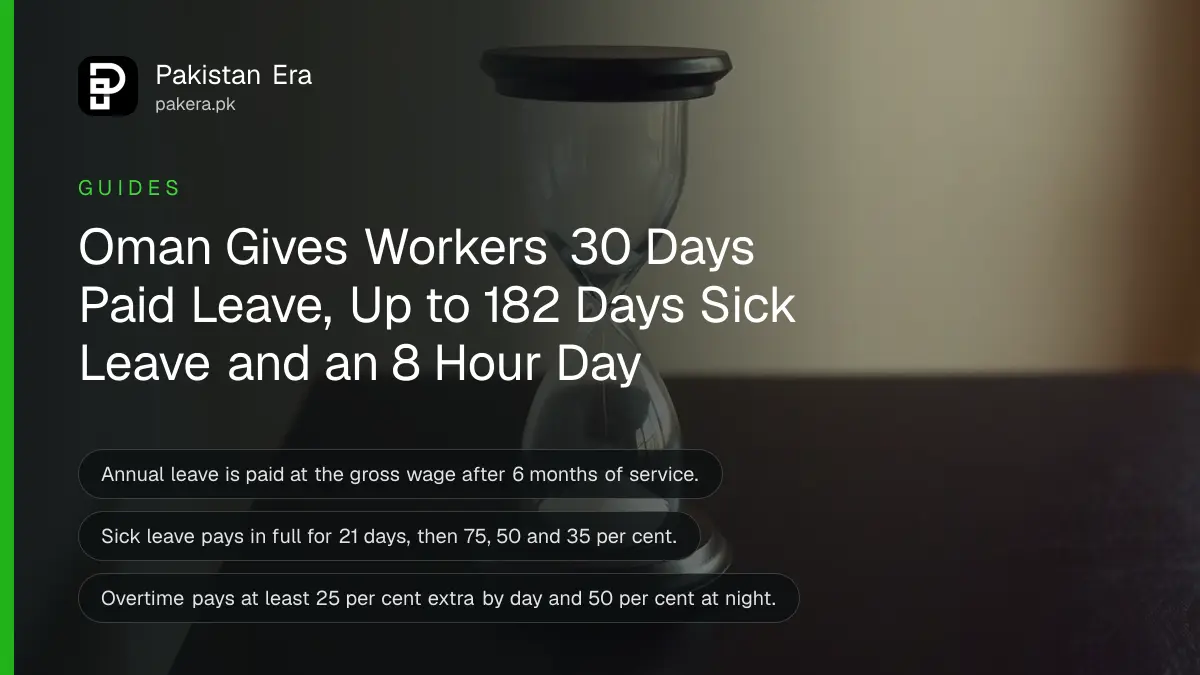
Under Oman's Labour Law, a worker gets at least 30 days of paid annual leave a year, up to 182 days of sick leave on a sliding scale of pay, and two paid rest days a week. The working day is capped at 8 hours and 40 hours a week, and overtime pays at least 25 per cent extra by day and 50 per cent at night. A non-Omani worker also gets a return ticket home for leave, as the contract sets it.
These rules come from the Labour Law issued by Royal Decree 53/2023, which we read in its official Arabic text and English translation on 20 October 2026. They are minimums. A contract can give a Pakistani worker more, but any term that gives less is void under Article 4.
Annual leave is at least 30 days on full pay
Article 78 gives every worker at least 30 days of annual leave on the gross wage, meaning basic pay plus allowances. You can take it after 6 months of service. A non-Omani worker also gets a return ticket home, as the contract sets it.
You may carry over up to 30 unused days, unless work needs kept you from taking them. The employer can delay your leave by up to 6 months if work requires it. But Article 81 says you must take leave at least once every two years, for at least 30 days.
The employer may pay you the basic wage for leave days you do not take, but only if you agree in writing. If your job ends with leave still owed, you are paid for it at the gross wage. You cannot sign away your leave altogether.
Sick leave lasts up to 182 days, on falling pay
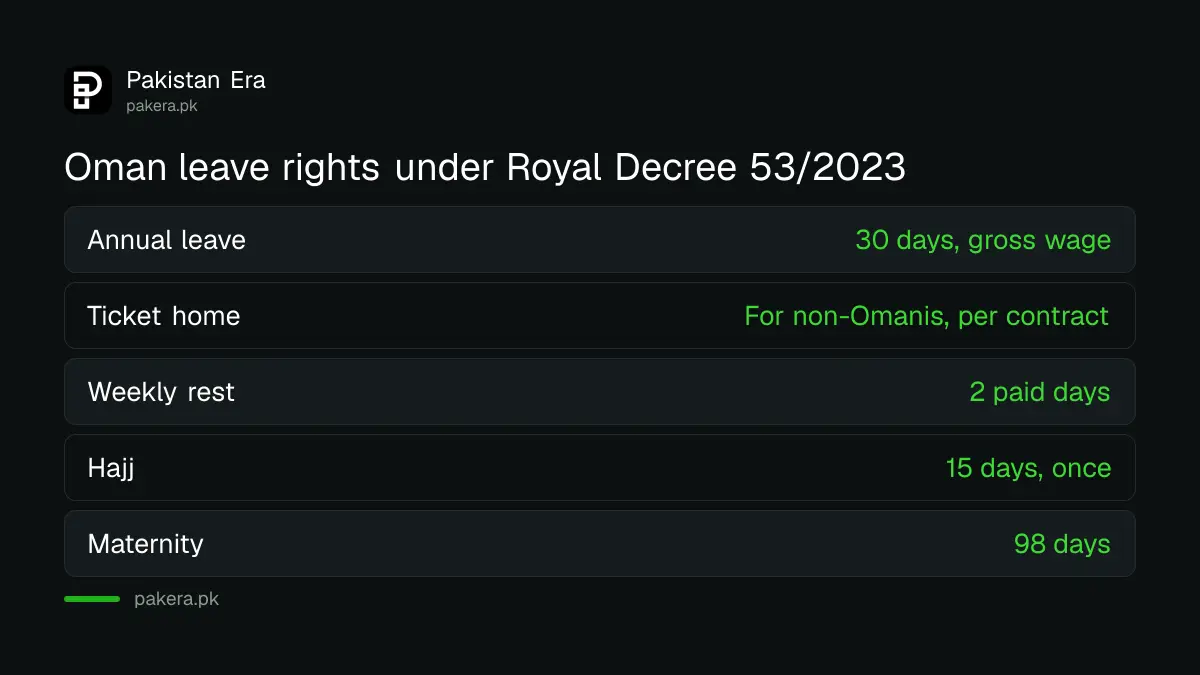
Article 82 gives a worker with a proven illness up to 182 days of sick leave a year. Pay is the full gross wage for 21 days, then falls in steps to 75 per cent, 50 per cent, and 35 per cent from day 71.
| Days of sick leave in the year | Pay, share of gross wage |
|---|---|
| Day 1 to day 21 | 100 per cent |
| Day 22 to day 35 | 75 per cent |
| Day 36 to day 70 | 50 per cent |
| Day 71 to day 182 | 35 per cent |
Get a medical certificate for every sick day, because the illness must be proven. Article 42 lets the contract end if an illness keeps you away for at least 3 months in a year, but only after your sick leave and your annual leave balance are used up.
Working hours are 8 a day and 40 a week
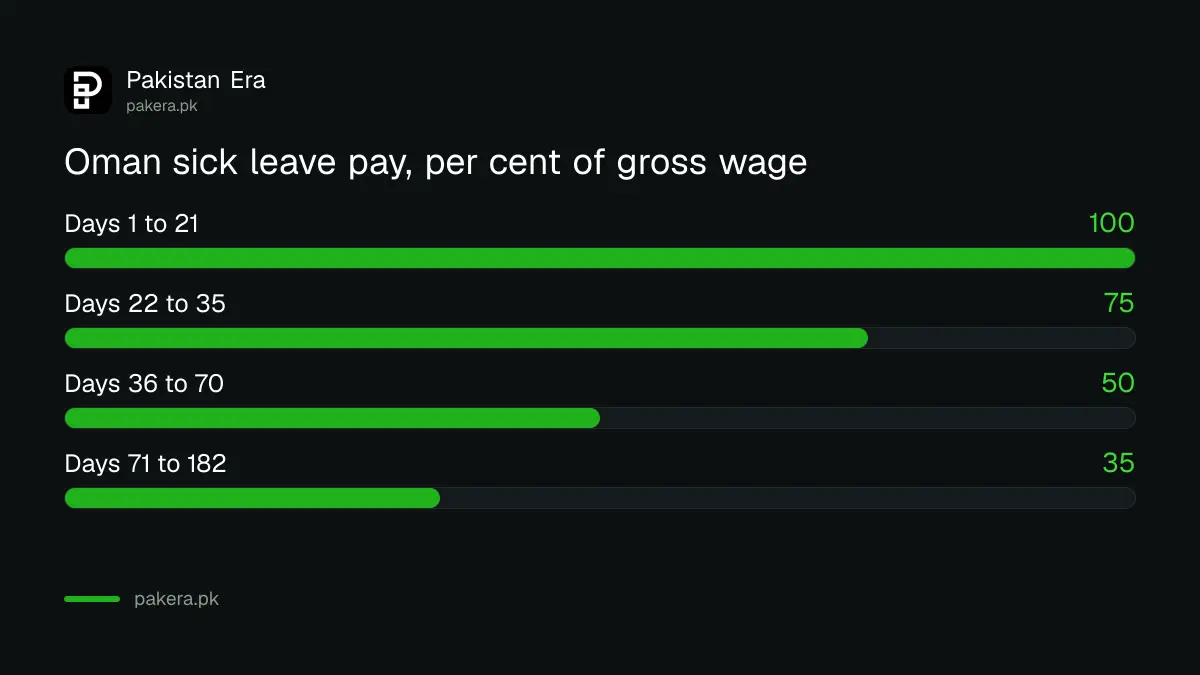
Article 70 caps work at 8 actual hours a day and 40 a week. A daily rest hour is not counted, and no stretch of work may pass 6 hours. In Ramadan, Muslim workers work at most 6 hours a day or 30 a week.
Article 77 adds at least two consecutive paid rest days every week. The employer must post a schedule of working hours and rest days where workers can see it. Night hours, under the law's definitions, run from 9 pm to 5 am.
Overtime pays at least 25 per cent extra by day, 50 per cent at night
Under Article 71, overtime needs your consent, and the total day with overtime may not pass 12 hours. You get your basic hourly wage plus at least 25 per cent for daytime overtime and 50 per cent for night overtime, or time off instead.
Work on a weekly rest day or an official holiday pays 100 per cent of the daily basic wage on top of the day's own wage, or a day off for each day worked. In emergencies listed in Article 72, the employer can order overtime without consent, but then pays more: at least 50 per cent extra by day, 75 per cent at night, and 200 per cent on rest days and holidays.
| Overtime | With your consent (Art 71) | Emergency order (Art 72) |
|---|---|---|
| Daytime | Basic wage plus at least 25% | Basic wage plus at least 50% |
| Night, 9 pm to 5 am | Basic wage plus at least 50% | Basic wage plus at least 75% |
| Rest day or holiday | 100% of daily basic wage plus the day's wage | 200% of basic wage plus the day's wage |
| Daily limit | 12 hours in total | Up to 15 days a year for stock taking |
Special leave covers Hajj, deaths, marriage and childbirth
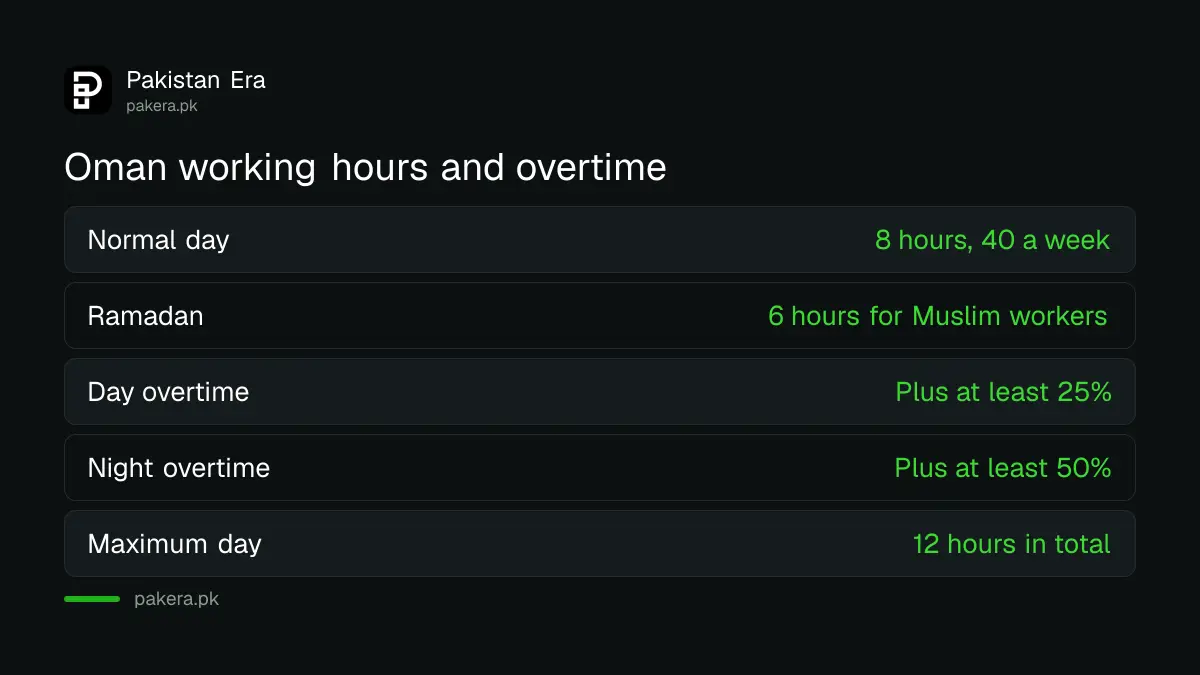
Article 84 gives paid special leave on the gross wage: 15 days once for Hajj after a year with the employer, 3 days for your marriage, 7 days of paternity leave, and 2 to 10 days on a death in the family.
- Death of a father, mother, grandparent, brother or sister: 3 days.
- Death of an uncle or aunt: 2 days.
- Death of a wife, son or daughter: 10 days.
- Maternity leave: 98 days, of which up to 14 may come before the birth on medical advice.
- A Muslim woman whose husband dies: 130 days.
You must give proof for each one, such as a death or birth certificate. A nursing mother also gets one paid hour a day for a year after maternity leave ends, under Article 76. Official holidays are paid at the gross wage under Article 79.
Your passport and pay have their own protections
Article 6 says the employer may not keep your passport or personal papers without your written consent. Wages go in Omani rials into an account at a local bank under Article 87, and the employer must prove it paid you.
- Keep your contract, payslips and a note of the hours you work each day.
- Ask the employer in writing for the leave or overtime pay you are owed.
- If it is refused, file a labour complaint with the Ministry of Labour.
- Attend the settlement sessions, which can last up to 30 days.
- If there is no settlement, the Ministry sends the case to court within 7 days.
If leave or overtime is refused, start with the Ministry of Labour. Every claim goes there first for a settlement attempt of up to 30 days, and a claim lapses a year after it falls due. The money owed when you leave is covered in how to calculate the Oman end-of-service gratuity. Compare it with annual leave in Saudi Arabia if you are weighing two offers, and read the Oman work visa steps from Pakistan before you sign.
Common questions
How many days of annual leave do workers get in Oman?
At least 30 days a year on the gross wage, after 6 months of service, under Article 78 of Royal Decree 53/2023.
Does a Pakistani worker in Oman get a ticket home?
Yes. Article 78 gives a non-Omani worker a return ticket to their country for leave, as agreed in the contract.
How long is sick leave in Oman?
Up to 182 days a year: full pay for 21 days, then 75, 50 and 35 per cent of the gross wage in steps.
What are the working hours in Oman?
8 hours a day and 40 a week, with a rest hour not counted. In Ramadan, Muslim workers work at most 6 hours a day.
How much is overtime in Oman?
Basic hourly wage plus at least 25 per cent by day and 50 per cent at night, with your consent. Emergency overtime pays more.
Can my employer keep my passport in Oman?
No, not without your written consent, under Article 6 of the Labour Law.
How we verified this
What we checked, where we read it, and what we could not confirm.
Last checked 20 October 2026. Articles 4, 6, 42, 70 to 72, 76 to 79, 81, 82, 84 and 87 and the night hours definition come from Royal Decree 53/2023 issuing the Labour Law, which we read in the official Arabic text and the English translation on 20 October 2026. We checked the 30 day, 182 day and percentage figures against the Arabic. Ministerial decisions can set different hours for seasonal work and some sectors under Article 73, and we did not read those decisions. We did not test a claim with the Ministry of Labour.
About the author

Global Affairs & Political Economy Writer
Muhammad Hatim is a book lover who started writing because he enjoys it. At Pakistan Era he writes about international relations, geopolitics and the global economy, with a particular interest in South Asia and the forces behind current events.