Saudi Arabia Annual Leave: 21 Days, 30 After 5 Years, for Pakistani Workers
Saudi Labor Law gives 21 days of paid annual leave, and 30 days after five years. See notice, cash in lieu, Hajj leave and unused leave pay for workers.
Short answer: Under the Saudi Labor Law text published by the Ministry of Human Resources and Social Development (HRSD), a worker gets paid annual leave of not less than 21 days a year, rising to not less than 30 days after five consecutive years with the same employer. The employer must tell you the dates at least 30 days ahead.
Many Pakistani workers in the Kingdom hear different things from different supervisors. One says leave is every two years. Another says it can be paid out in cash. We read the HRSD English text of the Labor Law, Articles 109 to 118, and set out what it says in plain steps.
One warning first. The English file on HRSD's website is the Labor Law as issued by Royal Decree M/51 in 2005. The law was reported to be amended in February 2025, and the annual leave figures were reported as unchanged. We could not open an official amended text, so check your own contract and your Qiwa record for the figure that applies to you.
Saudi law gives 21 days a year and 30 days after five years
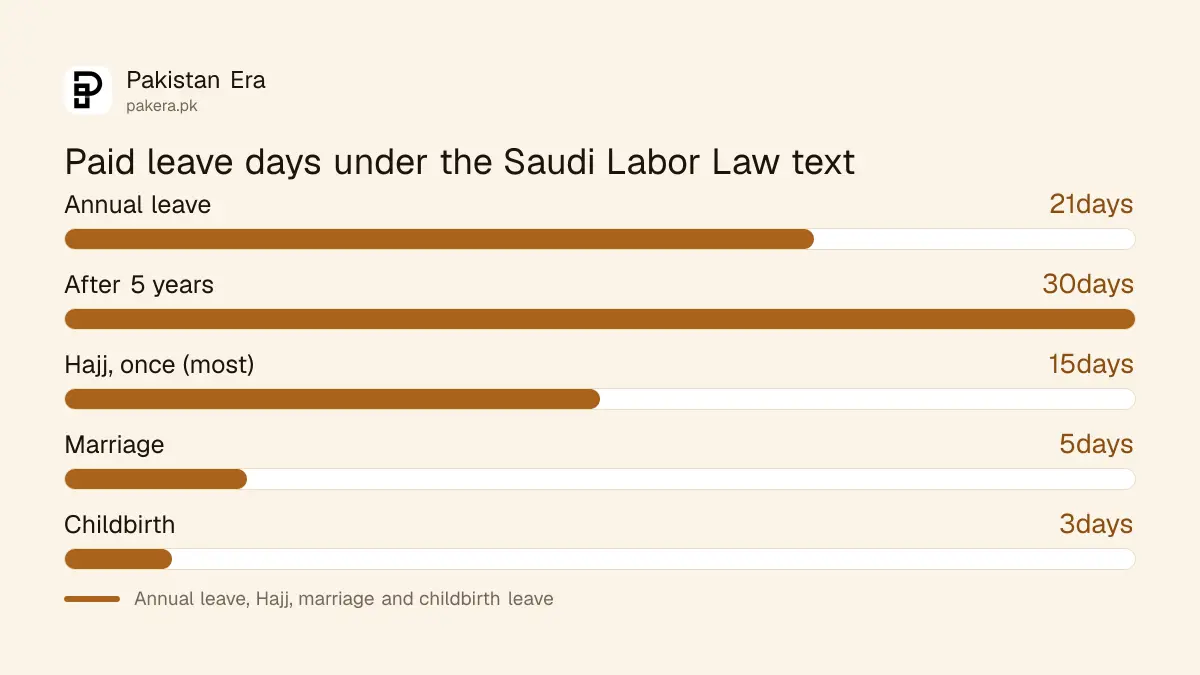
Article 109 says a worker is entitled to prepaid annual leave of not less than 21 days. It rises to not less than 30 days if the worker spends five consecutive years in the service of the employer. "Not less than" means a contract can give more, but never less.
Prepaid means your wage for the leave days is paid as normal. The five years are counted with one employer. If you change employer, the count starts again with the new one, unless the law or your contract says otherwise.
| Item | What Article 109 to 111 says |
|---|---|
| Basic annual leave | Not less than 21 days, prepaid |
| After 5 consecutive years | Not less than 30 days |
| Notice of leave dates | Not less than 30 days in advance |
| Cash instead of leave | Not allowed during service |
| Unused leave when you leave the job | Paid out as wage for the accrued days |
Your employer sets the dates but must tell you 30 days ahead
Article 109 lets the employer set the dates of leave according to work needs, or give leave in rotation so work runs smoothly. It must notify the worker of the date in sufficient time, not less than 30 days. You cannot simply announce your own date and fly.
If you want to fly home for a family event, ask early. Put the request in writing, through the channel your company uses, and keep a copy. A written request with a date is your proof if a dispute starts later.
Article 118 adds one rule that catches people out. A worker may not work for another employer while on any leave under this chapter. If the employer proves it, he may withhold the wages for the leave or recover what was paid.
You cannot give up your leave or take cash for it during service
Article 109 says a worker shall enjoy his leave in the year it is due. He may not forgo it or receive cash in lieu during his period of service. So a supervisor who offers "double salary instead of leave" is offering something the law does not allow.
This protects you from a quiet loss. Leave you never take is not wiped out. It stays on record, and the law deals with it when the job ends, as the last section below explains.
Article 110 allows some delay. With the employer's approval, you may postpone your leave or part of it to the following year. The employer may also postpone it for up to 90 days after the end of the year it is due, if work conditions require. A longer postponement needs your written consent, and it cannot go past the end of the year following the year the leave is due.
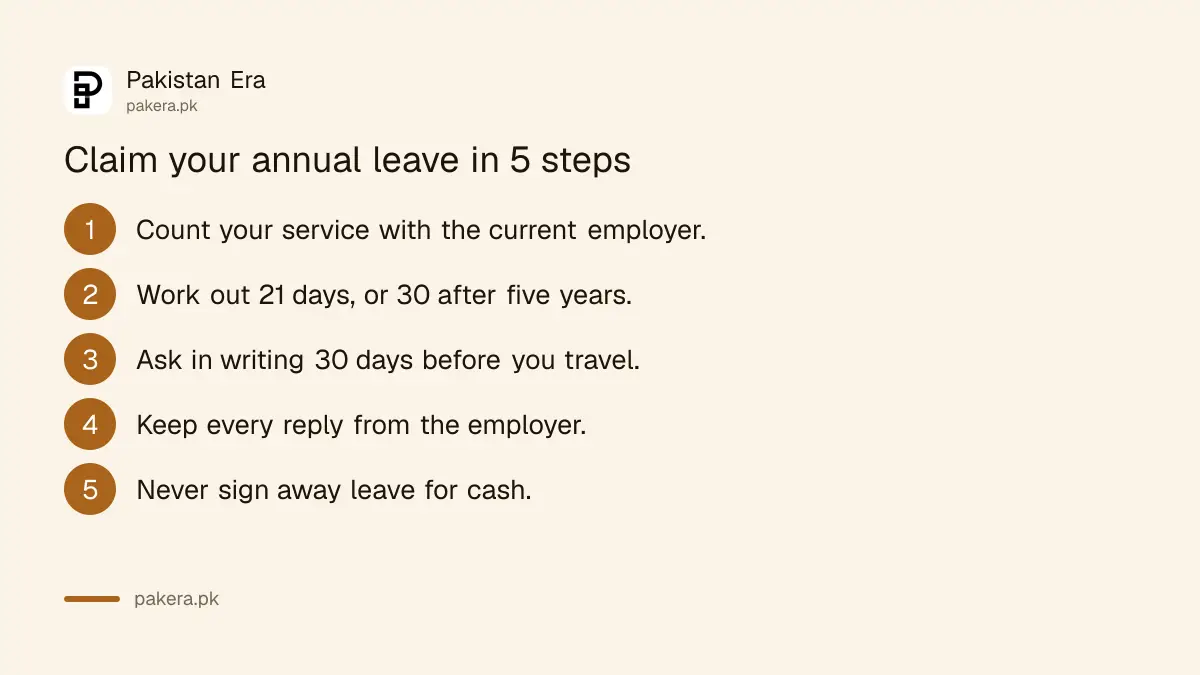
- Count your service with the current employer from your first working day.
- Work out your entitlement: 21 days, or 30 days after five consecutive years.
- Ask in writing for dates at least 30 days before you want to travel.
- If the employer delays, keep the reply. Delay beyond 90 days after the year ends needs your written consent.
- Do not sign a paper that gives up your leave or swaps it for cash while you are still employed.
Other paid leave sits in the same chapter
The same chapter lists leave for family events and for Hajj. In the text we read, Article 113 gives five days of full pay on the death of a spouse, parent or child, or on marriage, and three days on childbirth. The employer may ask for supporting documents.
Article 114 gives a paid leave of not less than 10 and not more than 15 days, including Eid Al-Adha, to perform Hajj once. You must have at least two consecutive years of service with the employer, and you must not have performed Hajj before. Article 112 gives full-pay leave on Eids and occasions set in the Regulations.
| Leave | Days | Condition in the text we read |
|---|---|---|
| Marriage | 5, full pay | Employer may ask for documents |
| Death of spouse, parent or child | 5, full pay | Employer may ask for documents |
| Childbirth | 3, full pay | Employer may ask for documents |
| Hajj, once | 10 to 15, paid | 2 consecutive years of service, Hajj not done before |
These family leave figures are exactly the ones the reported 2025 amendments touched, so check the current figure on Qiwa or with HRSD before you plan around them.
Unused leave is paid when you leave the job
Article 111 says a worker is entitled to a wage for the accrued days of leave if he leaves work without using them. He is also entitled to leave pay for the part of the year he worked, in proportion. So accrued leave should appear in your final settlement.
When you total your settlement, add this to your end-of-service award. We explain that calculation in how to calculate your Saudi end-of-service award. If the employer ended your contract, read what notice and compensation a Saudi employer owes as well.
If dues are refused, contact your embassy's community welfare section first. Our list of Pakistan embassy contacts in Saudi Arabia has the numbers, and recovering unpaid dues abroad through OPF explains the Pakistani side.
Common questions
How many days of annual leave does a worker get in Saudi Arabia?
At least 21 days a year, and at least 30 days after five consecutive years with the same employer. The figure is in Article 109 of the Labor Law text published by HRSD.
Can my employer pay me cash instead of giving leave?
No, not during service. Article 109 says a worker may not forgo leave or receive cash in lieu while employed. Unused leave is paid when you leave the job.
Can my employer refuse leave in a busy season?
The employer may set the dates by work needs and may postpone leave for up to 90 days after the year it is due. A longer delay needs your written consent, and it cannot go beyond the end of the next year.
Do I get paid for leave I did not take when I resign?
Yes. Article 111 says you are entitled to a wage for the accrued leave days, and to leave pay in proportion for the part of the year you worked.
Is Hajj leave extra?
It is a separate paid leave of 10 to 15 days, including Eid Al-Adha, once in service, after two consecutive years with the employer. The employer may decide how many workers get it each year.
Does the 2025 amendment change these figures?
The amendments were reported to leave the 21 and 30 day figures unchanged, but they changed some family leave rules. We could not open an official amended text, so confirm with HRSD or your contract.
How we verified this
What we checked, where we read it, and what we could not confirm.
Checked on 11 October 2026. We read Articles 109 to 118 of the Saudi Labor Law English text on the HRSD website (hrsd.gov.sa, file dated February 2023, Royal Decree M/51 of 2005). We did not open an amended official text. Rules for your own job also depend on your contract and the Regulations.
About the author

Global Affairs & Political Economy Writer
Muhammad Hatim is a book lover who started writing because he enjoys it. At Pakistan Era he writes about international relations, geopolitics and the global economy, with a particular interest in South Asia and the forces behind current events.