Ordinance in Pakistan: It Lasts 120 Days, Can Be Extended Once, and Ends at 240 Days Under Article 89
An ordinance in Pakistan lasts 120 days and can be extended once for 120 more. Who issues it, how Parliament extends or rejects it, and which became Acts.
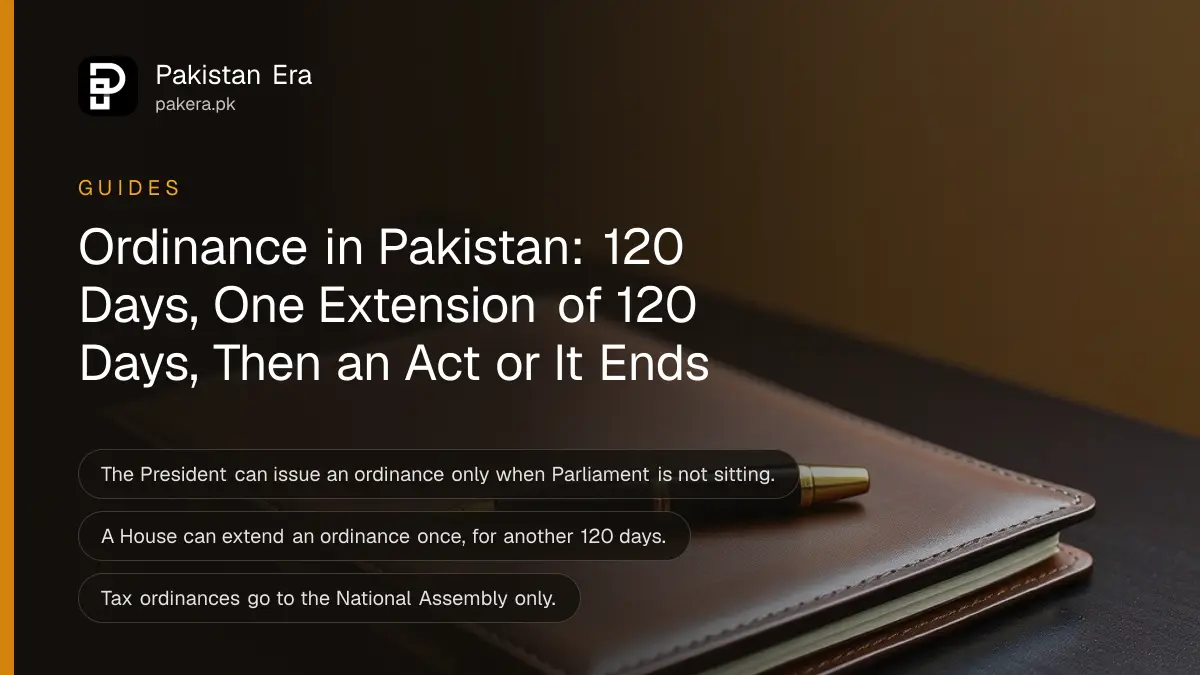
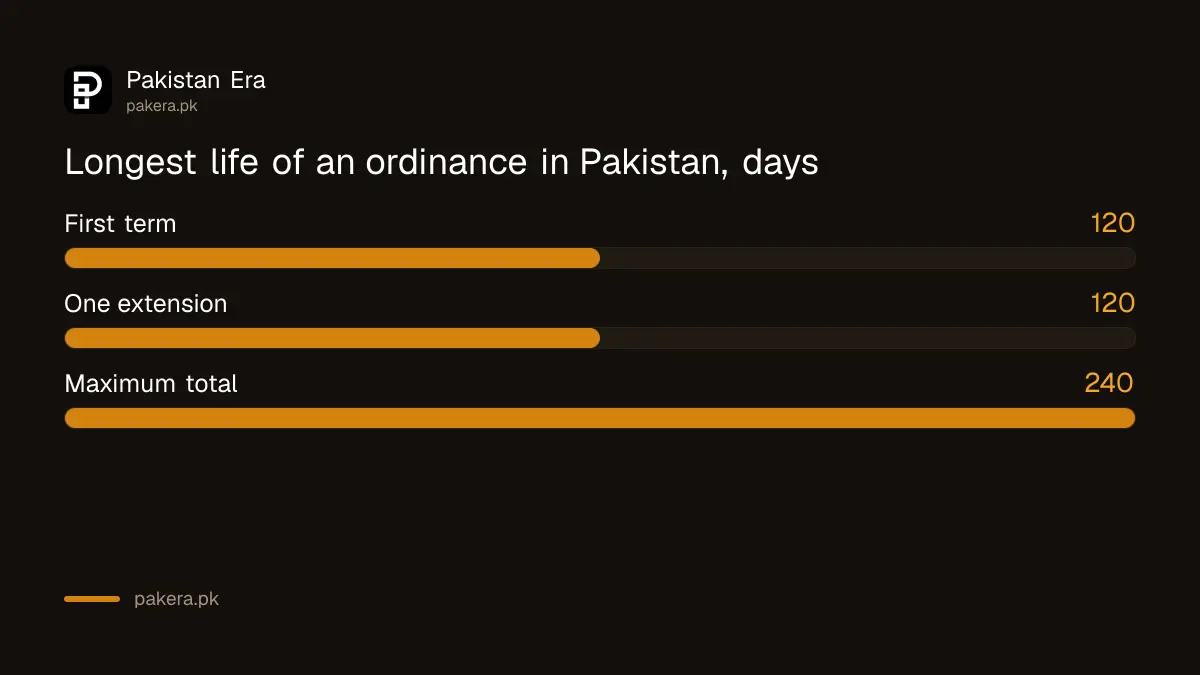
An ordinance in Pakistan lasts 120 days from the day the President signs it. Parliament can extend it once, for another 120 days, so the longest life is 240 days. It ends sooner if a House passes a resolution disapproving it, or if the President withdraws it. After that, it survives only if Parliament passes it as an Act.
The rule sits in Article 89 of the Constitution. An ordinance has the same force as an Act of Parliament while it lives, so a fee, penalty or new authority it creates applies to you from the day it is promulgated. The question most people have is how long that lasts, and what happens next.
When the President can issue an ordinance
The President can issue an ordinance only when the Senate or the National Assembly is not in session, and only if satisfied that circumstances need immediate action. In practice the proposal comes from the federal cabinet, because the Rules of Business send every ordinance there first.
Rule 16 of the Rules of Business, 1973 lists "promulgation and revocation of Ordinances" among the cases that must go before the federal cabinet. So the usual chain is a ministry proposal, cabinet approval, then the President's signature and a notification in the Gazette of Pakistan.
An ordinance is also bound by the same limits as an Act. It cannot do anything that Parliament itself could not do by law.
The 120 day clock and the single extension
Every ordinance stands repealed 120 days after it is promulgated. Before that, the House where it was laid can pass a resolution to extend it for a further 120 days. The Constitution allows that extension only once, so 240 days is the outer limit.
| Type of ordinance | Laid before | Who can extend it | Who can kill it early |
|---|---|---|---|
| Deals with money bill matters (tax, borrowing, the Federal Consolidated Fund) | National Assembly only | National Assembly, once, 120 more days | A National Assembly resolution |
| Any other subject | Both Houses | Either House, once, 120 more days | A resolution of either House |
| Either type | Not relevant | Not relevant | The President, by withdrawing it at any time |
The money bill test is the one in Article 73(2). An ordinance that imposes or changes a tax, or deals with government borrowing, goes to the National Assembly alone, because only the National Assembly passes money bills. The Senate can only make recommendations on them.
How an ordinance reaches the National Assembly
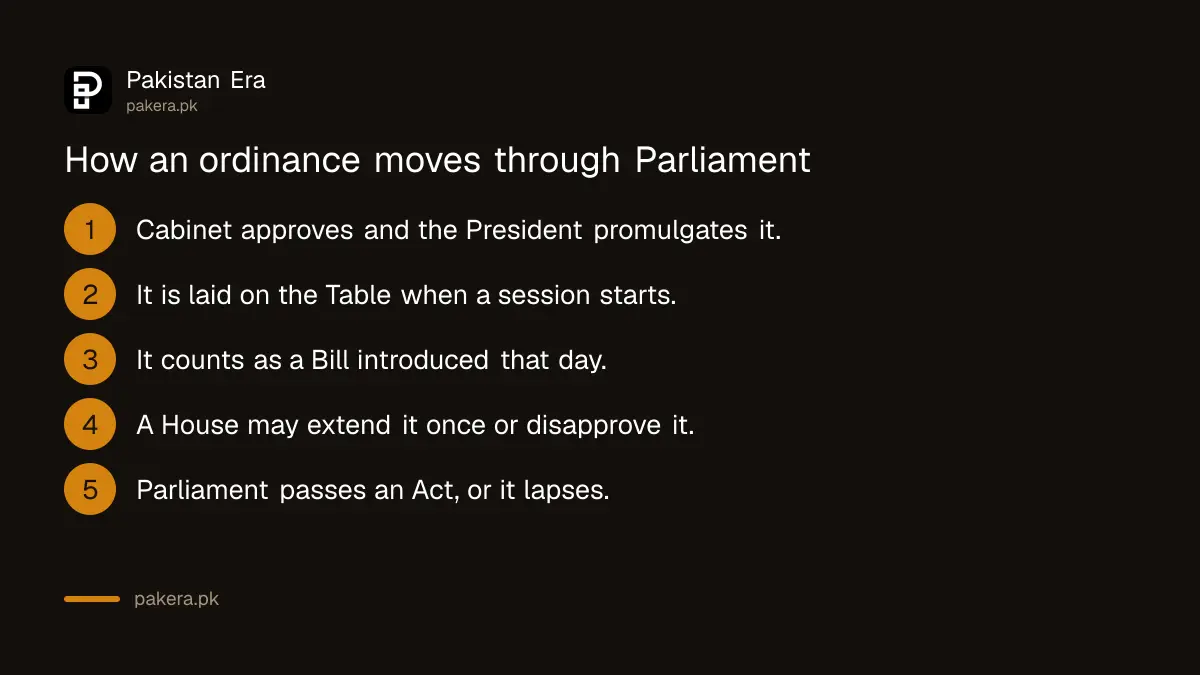
Under Rule 170 of the National Assembly's Rules of Procedure, every ordinance made after the last session ended is laid on the Table soon after the next session starts. From that day it is treated as a Bill introduced in the Assembly.
- The ordinance is promulgated while Parliament is not sitting.
- When a session begins, the government lays it on the Table of the House.
- It is deemed a Bill introduced on that day, under Article 89(3) and Rule 120(6).
- Members can move a resolution to disapprove it, or a Minister or member can move one to extend it.
- The government can take it through the normal Bill stages so it becomes a permanent Act.
Both resolutions need short notice. A disapproval resolution needs three clear days' notice under Rule 170(2). An extension resolution needs three days' notice under Rule 170A. When either is passed, the Assembly Secretariat publishes it in the Gazette.
Ordinances laid in the National Assembly since 2025
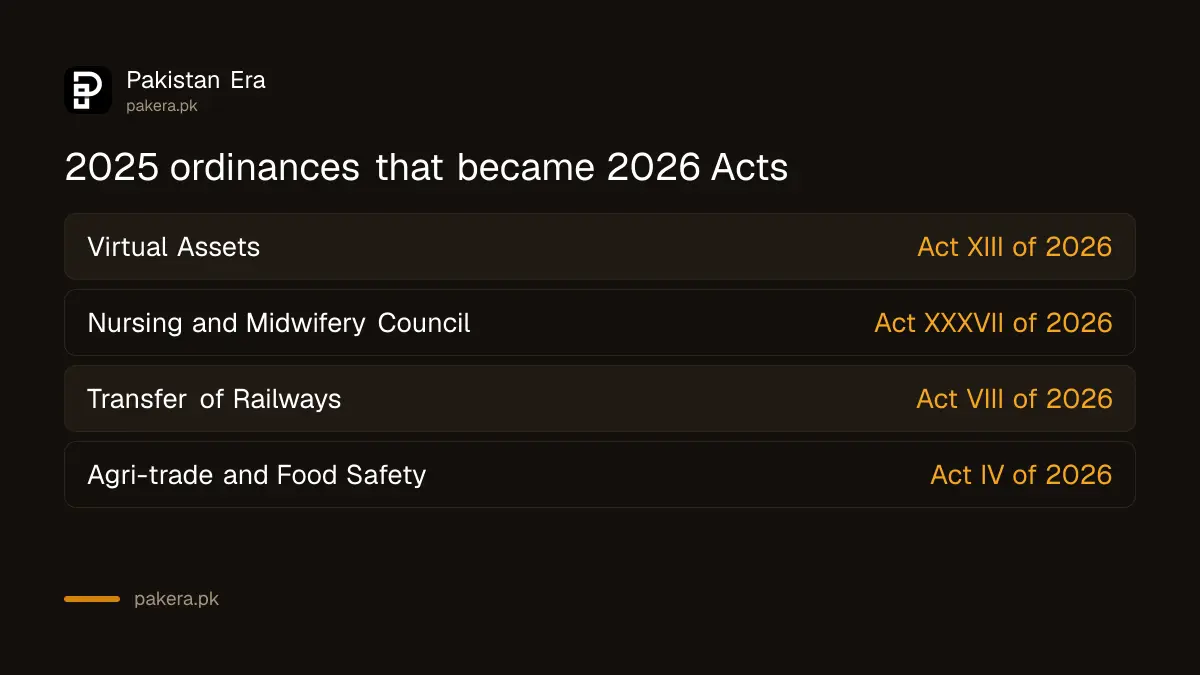
The National Assembly keeps a public list of every ordinance laid before it. Several ordinances from 2025 later came back as Acts of Parliament in 2026, which shows the usual path: an ordinance first, then a Bill passed by both Houses.
| Ordinance | Laid in NA | What happened next |
|---|---|---|
| Oil and Gas Regulatory Authority (Amendment) Ordinance, 2026 (No. V of 2026) | 22 October 2026 | Listed as laid; no Act on the NA Acts list yet |
| PIA Corporation (Conversion) (Repeal) Ordinance (No. III of 2026) | 15 May 2026 | Listed as laid |
| ICT Local Government (Amendment) Ordinance, 2026 | 12 March 2026 | Listed as laid |
| Pakistan Nursing and Midwifery Council Ordinance, 2025 | 16 January 2026 | Pakistan Nursing and Midwifery Council Act, 2026 (Act XXXVII of 2026) |
| Transfer of Railways (Amendment) Ordinance, 2025 | 16 January 2026 | Transfer of Railways (Amendment) Act, 2026 (Act VIII of 2026) |
| Virtual Assets Ordinance, 2025 | 5 September 2025 | Virtual Assets Act, 2026 (Act XIII of 2026) |
| National Agri-trade and Food Safety Authority Ordinance, 2025 | 6 August 2025 | National Agri-trade and Food Safety Authority Act, 2026 (Act IV of 2026) |
We matched each ordinance to the Acts of Parliament list kept by the same Assembly. For the 2026 ordinances, check the Acts list again before relying on them, since a Bill may pass at the next session.
How to check if an ordinance is still in force
Count 120 days from the date of promulgation in the Gazette notification. Then check whether either House extended or disapproved it, and whether an Act has replaced it. If none of those happened, the ordinance has lapsed.
- Find the promulgation date. It is on the ordinance itself and in the Gazette of Pakistan. The Pakistan Code portal also carries federal laws; checking the latest text of a federal law explains how to search it.
- Look for an extension resolution. It appears in the Orders of the Day and the Gazette. The National Assembly session agenda is where it first shows up.
- Look for a replacing Act. If Parliament passed a Bill on the same subject, the Act now governs, and the ordinance's life no longer matters.
When an ordinance and a later Act cover the same ground, read the Act. Its commencement clause tells you the date it took over, and the Act's own text may say what happens to steps taken under the ordinance.
Ordinance versus Act of Parliament
An ordinance is temporary law made by the President on cabinet advice while Parliament is away. An Act is permanent law passed by Parliament and signed by the President. Both have equal force while the ordinance lives, but only an Act lasts.
That is why governments use ordinances for urgent changes and then bring a Bill. For the full path of a Bill through both Houses, see how a bill becomes law in Pakistan.
Common questions about ordinances in Pakistan
How many days does an ordinance last in Pakistan?
120 days from promulgation. The relevant House can extend it once by resolution for another 120 days, so the maximum is 240 days.
Can an ordinance be extended twice?
No. Article 89 says the extension for a further period may be made only once. After that, Parliament must pass an Act or the ordinance ends.
Can the President issue an ordinance when Parliament is in session?
No. Article 89(1) allows it only when the Senate or the National Assembly is not in session.
Does the Senate vote on a tax ordinance?
No. An ordinance dealing with money bill matters is laid only before the National Assembly, and only that House can extend or disapprove it.
Who decides to issue an ordinance?
The federal cabinet considers it first under Rule 16 of the Rules of Business, 1973, and the President then promulgates it.
How we verified this
What we checked and where we read it.
Last checked 15 November 2026. Article 89 and Article 73(2) are from the Constitution as published on Pakistan Code, which includes the Twenty-seventh Amendment. Rules 120, 170 and 170A are from the National Assembly Rules of Procedure, 2007, as modified up to 18 August 2026. The ordinance list is the National Assembly's Ordinances Laid page, matched against its Acts of Parliament page. Rule 16 is from the Cabinet Division's Rules of Business, 1973, amended up to 23 July 2026. The dates in the ordinance table are the dates each ordinance was laid in the Assembly, as the list shows them, not the dates of promulgation.
About the author

Global Affairs & Political Economy Writer
Muhammad Hatim is a book lover who started writing because he enjoys it. At Pakistan Era he writes about international relations, geopolitics and the global economy, with a particular interest in South Asia and the forces behind current events.