Pakistan's First Astronaut Zeeshan Ali Reaches China's Tiangong Space Station on Shenzhou-24
Zeeshan Ali launched on Shenzhou-24 at 05:18 PKT on 25 November 2026 and docked at Tiangong 3 hours 38 minutes later. His crew, experiments and return.
یہ صفحہ اردو میں پڑھیں
Short answer: Wing Commander Muhammad Zeeshan Ali became Pakistan's first astronaut on 25 November 2026. He lifted off on China's Shenzhou-24 spacecraft at 05:18 PKT from the Jiuquan Satellite Launch Centre. The craft docked with the Tiangong space station 3 hours and 38 minutes later, at about 08:56 PKT. He is expected to spend around a week in orbit and run four Pakistani experiments.
He is also the first astronaut from any country other than China to board Tiangong. The flight is a joint mission of SUPARCO, Pakistan's space agency, and the China Manned Space Agency (CMSA). It falls in the 75th year of diplomatic relations between Pakistan and China.
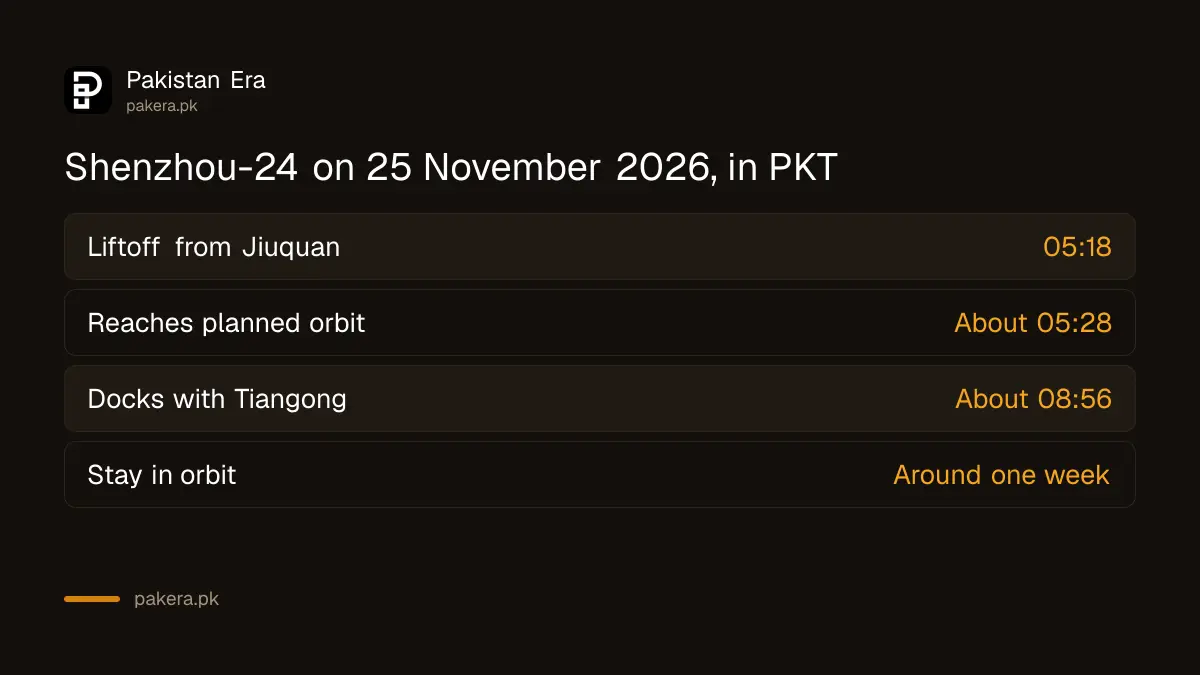
Shenzhou-24 launched at 05:18 PKT and docked 3 hours 38 minutes later
A Long March-2F rocket carried Shenzhou-24 into space at 8:18 a.m. Beijing time, which is 05:18 in Pakistan. About 10 minutes later the spacecraft reached its planned orbit. It then caught up with Tiangong and docked 3 hours and 38 minutes after liftoff.
China's space agency announced the launch date one day earlier, on 24 November, and named the three-person crew. Planning Minister Ahsan Iqbal watched the send-off and the launch in China. Schools, colleges and universities in Khyber Pakhtunkhwa and Balochistan put the launch on screens for students.
| Event on 25 November 2026 | Time (PKT) |
|---|---|
| Liftoff from Jiuquan, northwest China | 05:18 |
| Spacecraft reaches its planned orbit | About 05:28 |
| Docking with the Tiangong space station | About 08:56 (3 hours 38 minutes after liftoff) |
| Expected stay in orbit | Around one week |
Zeeshan Ali flies as the payload specialist in a crew of three
Zeeshan Ali is the crew's payload specialist. That means he runs the science experiments on board while the two Chinese astronauts fly the spacecraft. Tang Hongbo is the mission commander and Wu Yi is the pilot.
Wing Commander Zeeshan Ali has trained at China's astronaut centre since April 2026, alongside Chinese astronauts. SUPARCO says he also learned Chinese so he can talk to his crewmates. A second Pakistani candidate, Khurram Daud, completed the same training in China before Zeeshan Ali was picked for this flight.
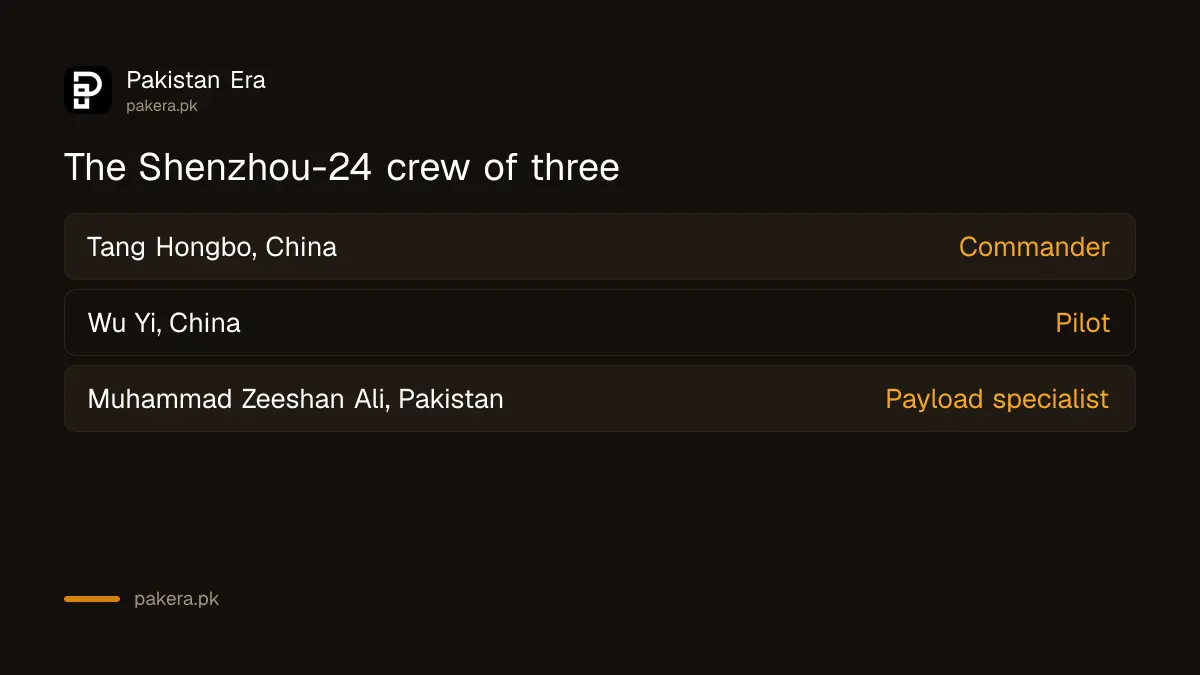
| Crew member | Country | Role on Shenzhou-24 |
|---|---|---|
| Tang Hongbo | China | Commander |
| Wu Yi | China | Pilot |
| Muhammad Zeeshan Ali | Pakistan | Payload specialist |
He will run four Pakistani experiments on Tiangong
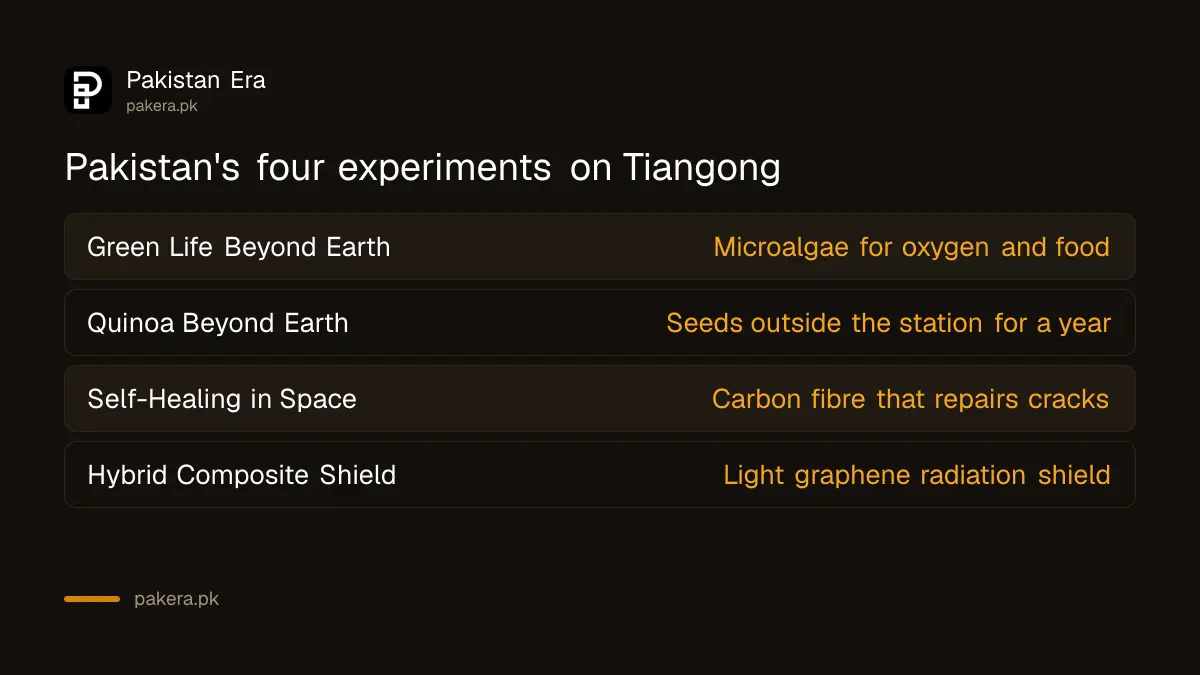
SUPARCO lists four experiments from Pakistan. One grows tiny plant-like life on board. The other three are fixed to the outside of the station and stay exposed to space for one year after he comes home. The whole crew is expected to carry out about 90 experiments.
- Green Life Beyond Earth. Zeeshan Ali grows microalgae and cyanobacteria on board. The aim is to see if they can make oxygen, remove carbon dioxide and become food on long missions.
- Quinoa Beyond Earth. Quinoa seeds sit outside the station for a year to test how weightlessness and space radiation affect their life, genes and nutrition. The hope is tougher crops for a hotter climate on Earth too.
- Self-Healing in Space. Carbon fibre materials with tiny capsules inside are tested to see if they repair their own small cracks. That could cut repair work on aircraft, spacecraft and buildings.
- Hybrid Composite Shield. Light, graphene-based materials are tested against vacuum, radiation and extreme heat and cold, for better spacecraft protection.
Chinese partners on the science include the Centre for Space Utilization, the Shanghai Institute of Technical Physics, Dalian Maritime University and Shanghai Jiao Tong University. SUPARCO says the work covers materials science, fluid physics, life sciences and biotechnology.
He is expected to come home after about a week
Zeeshan Ali's stay is a short visit of around one week. China's space agency has said he will return to Earth on the Shenzhou-23 spacecraft after this short flight. Shenzhou-23 has been docked at Tiangong since its crew arrived in May 2026. The mission also includes a handover of the station between the two crews.
China's space agency will announce the exact landing day closer to the time. The three outside experiments keep running for a year after he lands, so their results will come later. The microalgae work is the one he runs by hand during his week on board.
Leaders in Pakistan, China and the UN welcomed the mission
President Asif Ali Zardari called the launch a landmark and a moment of national pride. Prime Minister Shehbaz Sharif said it was the journey of 240 million Pakistanis, not one man. President Zardari and Chinese President Xi Jinping exchanged letters, and Xi said China would keep working with Pakistan on peaceful uses of space.
The chiefs of the armed forces congratulated SUPARCO's scientists and engineers and wished Zeeshan Ali a safe return. At the United Nations in New York, the Secretary-General's spokesperson Stephane Dujarric welcomed what he called peaceful cooperation in outer space between China and Pakistan. The Ministry of Information released a national song for the mission.
How to follow the mission from Pakistan
SUPARCO has put the mission on one free website, the SUPARCO Mission Hub, in English and Urdu. It has Zeeshan Ali's profile, the experiments, a mission clock and a live map of the station.
- See the station over your city. The hub's tracker lists when Tiangong passes over Pakistani cities in the next three days. The steps are in the SUPARCO Mission Hub guide to tracking the space station and getting the free boarding pass.
- Check the sky first. Winter fog and smog can hide the station. The PMD's Pak Weather app shows whether the evening will be clear.
- Watch for the return. We will publish the landing news when China's space agency confirms it.
For students inspired by the flight, China also offers fully funded university places. The Chinese Government Scholarship 2027 through HEC has 61 seats, and the China student visa documents list what to prepare.
Common questions
Who is Pakistan's first astronaut?
Wing Commander Muhammad Zeeshan Ali. He flew on China's Shenzhou-24 on 25 November 2026 as payload specialist and is the first foreign astronaut to board China's Tiangong space station.
What time did Shenzhou-24 launch in Pakistan?
At 05:18 PKT on Wednesday 25 November 2026, which was 8:18 a.m. in Beijing. It launched from the Jiuquan Satellite Launch Centre in northwest China.
How long will Zeeshan Ali stay in space?
Around one week. He is expected to come back on the Shenzhou-23 spacecraft, which is already docked at Tiangong.
What experiments is he doing?
Four from Pakistan: microalgae grown for oxygen and food, quinoa seeds exposed to space, self-healing carbon fibre materials and a light graphene-based shield. Three stay outside the station for a year.
Who else is on the Shenzhou-24 crew?
Two Chinese astronauts: Tang Hongbo, the commander, and Wu Yi, the pilot.
Can I see the space station from Pakistan?
Yes, on a clear night. It looks like a bright, steady dot moving across the sky. SUPARCO's Mission Hub gives pass times for Pakistani cities for the next three days.
How we verified this
What we checked and where we read it.
We checked these official pages on 25 November 2026, between about 19:30 and 20:30 PKT:
- SUPARCO Mission Hub, astronaut profile page: role, training from April 2026, Chinese language, launch at 8:18 a.m. Beijing time from Jiuquan, and the four experiments.
- The state radio broadcaster, 24 and 25 November 2026: launch date and crew names, docking in about 3.5 hours, around a week in orbit, the Zardari and Xi letters, the UN spokesperson's remarks, and students watching in Khyber Pakhtunkhwa and Balochistan.
- The state news agency, 18 and 25 November 2026: launch at 5:18 a.m. PKT on a Long March-2F, orbit after about 10 minutes, docking 3 hours 38 minutes after liftoff, the crew roles, experiment details and partner institutions, about 90 crew experiments, the ISPR statement naming him Wing Commander, and the second candidate Khurram Daud.
- The China Manned Space Agency's statement of 7 November 2026 that the Pakistani astronaut returns on Shenzhou-23 after a short flight.
The docking time in PKT (about 08:56) is our own sum of the launch time and the 3 hours 38 minutes given by the space agency.
About the author

Global Affairs & Political Economy Writer
Muhammad Hatim is a book lover who started writing because he enjoys it. At Pakistan Era he writes about international relations, geopolitics and the global economy, with a particular interest in South Asia and the forces behind current events.