NDMA Drought Watch for Sindh, Balochistan and South Punjab: Rain Up to 100% Below Normal
NDMA issued a Drought Watch on 24 November 2026 for Sindh, Balochistan and southern Punjab after months of low rain. See the rainfall gap and what to do now.
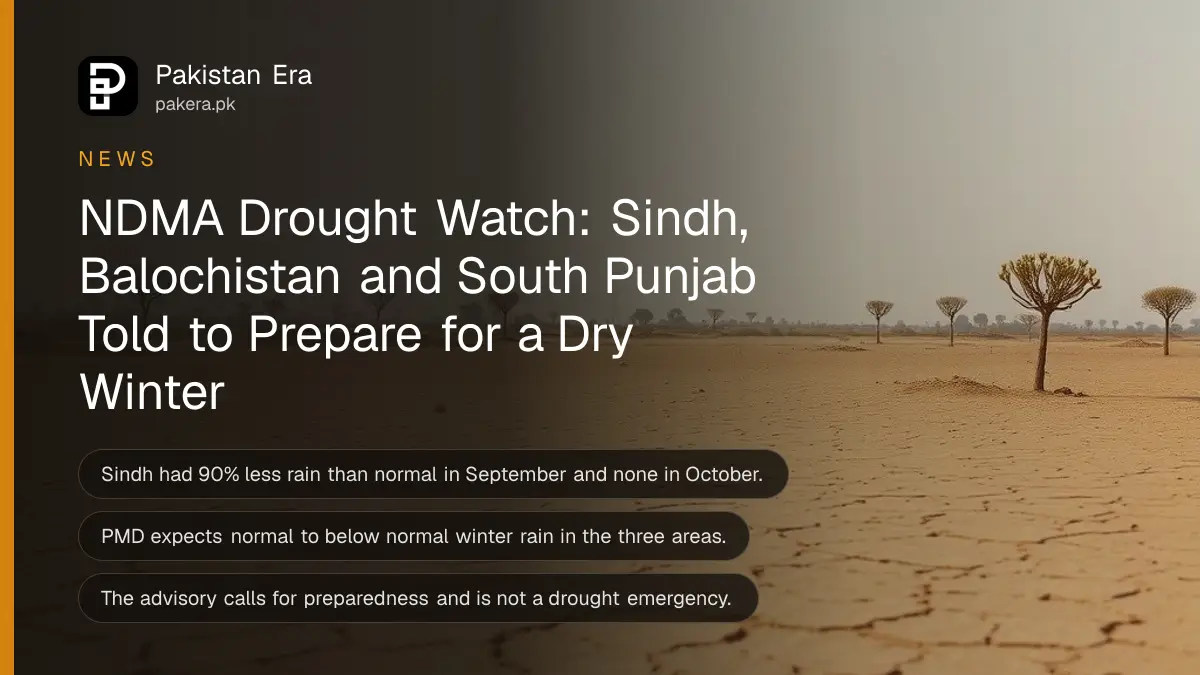
Short answer: NDMA issued a Drought Watch on 24 November 2026 for Sindh, Balochistan and southern Punjab. It passes on a Pakistan Meteorological Department (PMD) advisory of 20 November that finds mild drought conditions after months of below normal rain. It is a call to prepare, not a drought emergency. PMD's next update is its monthly drought bulletin on 5 December 2026.
| Point | What the advisory says |
|---|---|
| Issued by | NDMA, 24 November 2026, from PMD's Drought Watch of 20 November |
| Areas | Sindh, Balochistan and southern Punjab |
| Level | Mild drought conditions; preparedness advised, not an emergency |
| Period checked | 1 July to 20 November 2026 |
| Winter outlook | Normal to below normal rain, December 2026 to February 2027 |
| Next update | PMD monthly drought bulletin, 5 December 2026 |
The National Disaster Management Authority (NDMA) sent the advisory to provincial governments, irrigation departments, the provincial disaster authorities and federal ministries. It does not name districts. It covers the three areas as a whole, with the worst shortfall in Sindh and Balochistan.
Sindh and Balochistan have had less rain than normal in every month since July
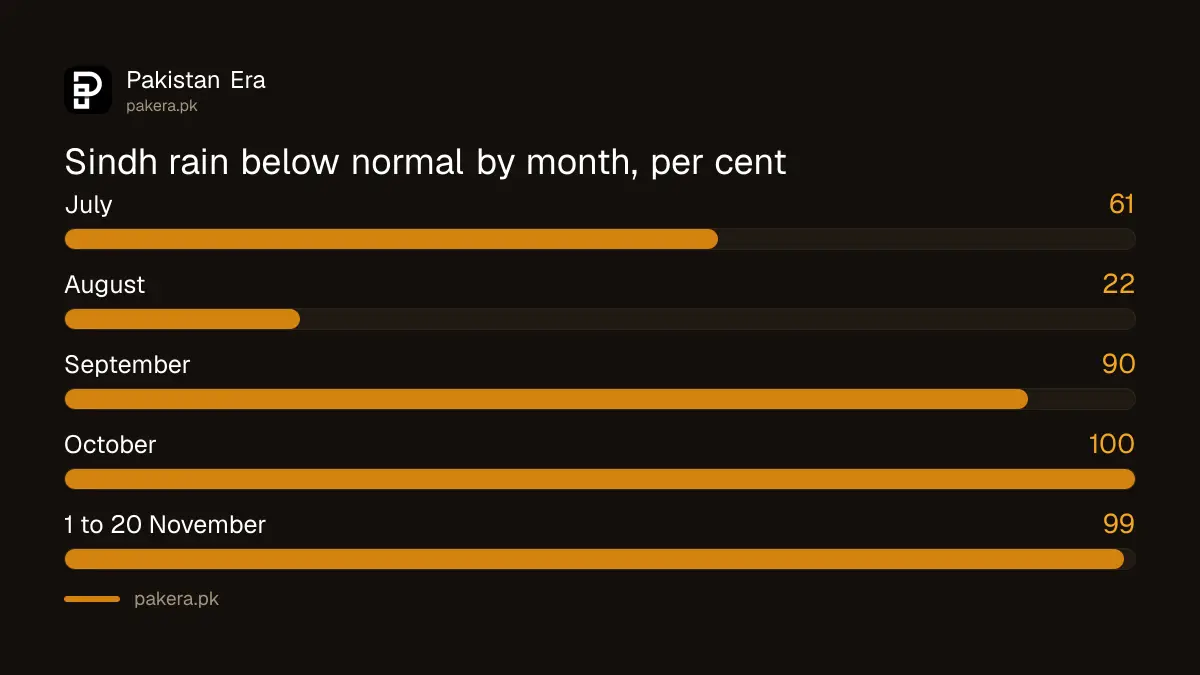
PMD's figures show Sindh and Balochistan below normal rain in all five periods from July to 20 November. Sindh got 90 per cent less rain than normal in September and none of its normal October rain. Punjab had a wet July and October, but its south is still dry.
| Region | July | August | September | October | 1 to 20 November |
|---|---|---|---|---|---|
| Sindh | -61% | -22% | -90% | -100% | -99% |
| Balochistan | -41% | -12% | -68% | -80% | -79% |
| Punjab | +13% | -21% | -6% | +52% | -74% |
| Khyber Pakhtunkhwa | -9% | -31% | -3% | +13% | +21% |
| Azad Jammu and Kashmir | -5% | -27% | -32% | +6% | -12% |
| Gilgit-Baltistan | +108% | -37% | -33% | +83% | +29% |
The figures are the change from the 1991 to 2020 average for each area. In millimetres, Sindh was 32.1 mm short in July and 27.9 mm short in September. PMD notes that October and November are normally dry months in the south, so the monsoon shortfall is the one that matters most.
Long dry spells are drying out the soil
PMD reports a rise in consecutive dry days, meaning days in a row with less than 1 mm of rain, across southern Pakistan. Its map counts up to 237 such days from 29 March to 20 November. Long dry spells use up soil moisture and leave less water for crops and homes.
The advisory says the effect is worst in rain-fed farming areas, where crops depend on rain rather than canals, and in places that were already short of water. Canal-fed areas depend more on the river water share; the Rabi season share is set out in the IRSA Rabi 2026-27 water allocation.
Winter rain may not fill the gap
PMD's outlook for December 2026 to February 2027 shows normal to below normal rain over Sindh, Balochistan and southern Punjab. Winter rain usually restores soil moisture for wheat and other Rabi crops. If it stays low, PMD warns the dry conditions could continue or worsen.
That matters now because wheat sowing is finishing. A dry winter after a weak monsoon can mean more stress on the crop and more pressure on groundwater and surface water. Farmers sowing late can check the seed rate advice in late wheat sowing in Punjab after 20 November and wheat sowing dates in Sindh.
What farmers and households should do now
The advisory asks farmers and communities to save water through mulching, efficient irrigation and careful use, and asks districts to protect livestock with feed, water point maps and vet services. Families in the three areas should plan their water use for a dry winter.
- Save soil moisture. Cover the soil around crops with straw or crop waste (mulching) so less water evaporates.
- Irrigate carefully. Water at the right stage of the crop rather than flooding the field, and fix leaking channels.
- Plan for animals. Store fodder early, and know where the nearest reliable water point is before ponds dry up.
- Report sick livestock early to the district livestock or veterinary office, which the advisory asks to step up services.
- At home, store drinking water safely, cover tanks and use less water for washing where you can.
- Watch for official updates from your PDMA, district administration and PMD's 5 December bulletin.
Farmers with crop loans who lose a crop to a shortage of water can ask their bank for relief. State Bank rules let a bank ease the repayment schedule by up to one year for losses caused by weather or water availability; the steps are in farm loan relief after a flood or drought.
Districts have been told to prepare beneficiary lists
NDMA asks provinces to monitor the situation through District Coordination Committees, switch on early warning systems, and identify vulnerable communities with beneficiary lists, so help can reach them quickly. It also asks districts to run drought assessments.
| Action asked of authorities | Who it is for |
|---|---|
| Monitor the drought through District Coordination Committees, activate early warning | Provinces and districts |
| Identify vulnerable communities, prepare beneficiary lists | Provinces and districts |
| Promote mulching, efficient irrigation, careful water use | Farm and community level |
| Drought assessments, livestock movement and water source maps, vet services and feed | Districts |
Sindh has already announced drought relief for Tharparkar and Umerkot. Who qualifies and when payments start are in Sindh drought relief of Rs 8,000.
Common questions
Is there a drought emergency in Pakistan?
No. NDMA and PMD say the Drought Watch is for early awareness and preparedness. It is not a declaration of a drought emergency.
Which areas are under the NDMA Drought Watch?
Sindh, Balochistan and southern Punjab. The advisory does not list individual districts.
How much less rain has Sindh had?
Sindh was 61 per cent below normal in July, 90 per cent in September, 100 per cent in October and 99 per cent from 1 to 20 November.
Will it rain this winter in Sindh and Balochistan?
PMD's outlook for December to February is normal to below normal rain over Sindh, Balochistan and southern Punjab.
When is the next drought update?
PMD's monthly drought bulletin is due on 5 December 2026.
How we verified this
What we checked and where we read it.
Last checked 25 November 2026. We read NDMA's Drought Watch of 24 November 2026 (letter F.2(E)/2026-NDMA, seven pages) and the PMD National Drought Monitoring and Early Warning Centre Drought Watch of 20 November 2026 attached to it as Annex A. The rainfall table, the 237 dry days figure, the winter outlook, the 5 December next update and the anticipatory actions are taken from those two documents. The six household and farm steps restate the advisory's actions in plain terms. The Pakistan Meteorological Department issues the monthly drought bulletins; the September 2026 one is summarised in the PMD drought bulletin for September 2026.
About the author

Global Affairs & Political Economy Writer
Muhammad Hatim is a book lover who started writing because he enjoys it. At Pakistan Era he writes about international relations, geopolitics and the global economy, with a particular interest in South Asia and the forces behind current events.