Wheat Sowing in Sindh 2026: Dates by District and 50 to 60 kg Seed an Acre
Sow wheat in lower Sindh from 1 to 20 November 2026 and upper Sindh from 7 November, with 50 to 60 kg seed an acre. See district dates and subsidy registration.
Sow wheat in lower Sindh from 1 to 20 November, and in upper Sindh from 7 November to 30 December. The Sindh Agriculture Department's district table sets those windows, its crop page sets 50 to 60 kg of seed an acre, and it warns that wheat yield starts falling by about 20 kg a day once sowing slips past 20 November.
So in Hyderabad, Badin, Thatta, Mirpurkhas, Sanghar, Nawabshah, Thar and Dadu, the best window opens in 12 days and lasts only 20. Upper Sindh, from Ghotki and Sukkur to Jacobabad and Larkana, has longer, because its cotton and rice come off later. We read the department's district sowing table and its wheat crop page on 20 October 2026 and set out what they say, and what they leave out.
Lower Sindh sows wheat from 1 to 20 November
The department's district table gives eight lower and central Sindh districts the same window, 1 to 20 November. Seven upper Sindh districts get 7 November to 30 December. Karachi has no wheat window in the table.
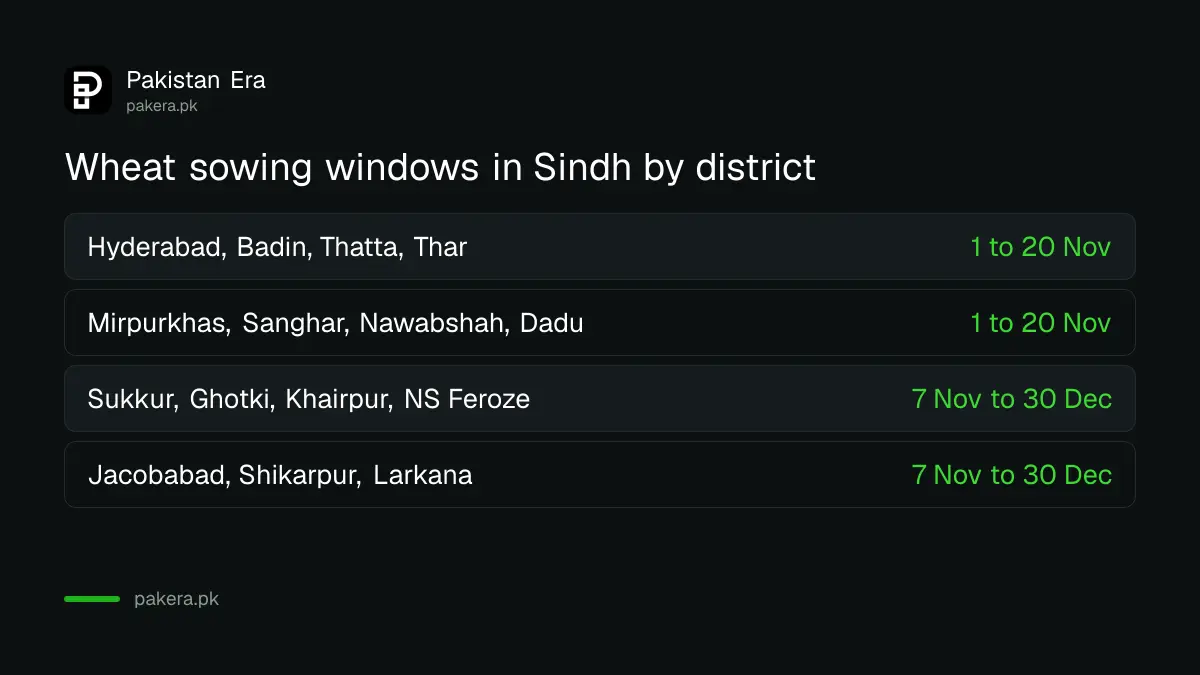
| District | Wheat sowing period |
|---|---|
| Hyderabad, Badin, Thatta, Thar | 1 to 20 November |
| Mirpurkhas, Sanghar, Nawabshah, Dadu | 1 to 20 November |
| Sukkur, Ghotki, Khairpur, Naushahro Feroze | 7 November to 30 December |
| Jacobabad, Shikarpur, Larkana | 7 November to 30 December |
Upper Sindh's window looks generous at almost eight weeks. It is not, really. The department's own crop page says yields fall after 20 November, so a farmer in Khairpur who sows on 25 December is inside the official window but well past the best date.
Early and late varieties have different best dates
A second table on the same page splits the dates by variety type. In south Sindh, early-sown varieties go in from 1 to 20 November and late-sown varieties from 21 November to 15 December. In north Sindh, early varieties go in from 10 to 30 November.
For a late variety in north Sindh, the page prints only "20th November", with no end date. We have reported it as printed rather than guess the rest. The same table gives harvest as the whole of March in south Sindh and the whole of May in north Sindh.
The practical reading is simple. If your cotton or rice will clear the field late, ask the seller for a variety bred for late sowing. Do not put an early variety in on 10 December and expect the same crop.
Sindh sets 50 to 60 kg of wheat seed an acre
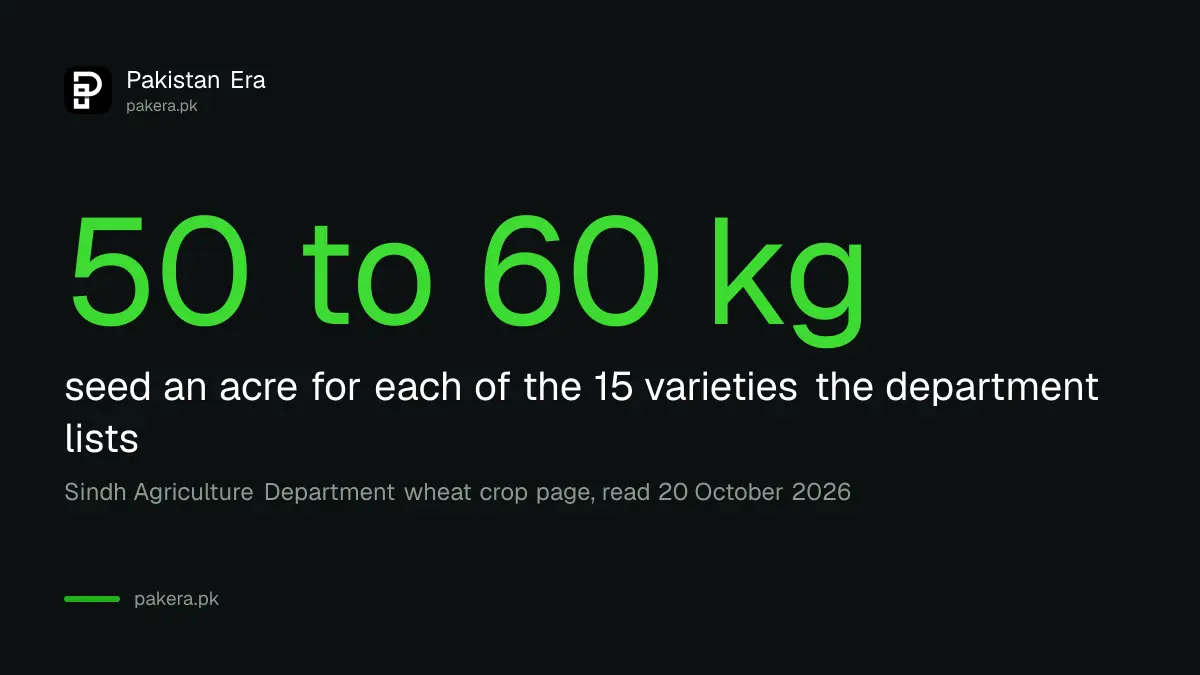
The department's wheat crop page lists 15 varieties, each at a seed rate of 50 to 60 kg an acre. It credits the list to the Pakistan Agricultural Research Council. The varieties include Benazir-13, Hamal-13, Moomal-89, Abadghar-93, Sarsabz, Kiran-95 and TD-1.
The rest of the list is Khirman, Sassui, TJ-83, Anmol-91, Kiran-93, Sakrand-1, Bhitai-1 and Marvi. The page spells some of these differently, for example "Bhatti-1" and "Maraee", and the spellings here are the common ones. Many of these names are more than 20 years old. The page does not say when the list was last updated, so check with your taluka agriculture officer which newer seed is on sale this season.
The page gives no fertiliser dose for wheat. For current bag prices, the latest national averages are in our report on urea and DAP prices, where DAP stood at Rs 17,127.78 a bag in the week to 8 October 2026.
Bury cotton sticks and add half a bag of urea before wheat
The department asks cotton growers to bury at least 80 per cent of their cotton sticks in the soil instead of burning them. It says half a bag of urea an acre, worked in after burial, speeds up rotting. If cotton matures late, wheat can be sown into the standing crop where weeds are low.
- Pick the last cotton and decide when the field will be clear.
- Chop and bury at least 80 per cent of the sticks.
- Work in half a bag of urea an acre to help them rot.
- Sow wheat inside your district window, or into standing cotton if weeds are low.
- In the rice tract, sow straight after the rice harvest.
The page is blunt about the habit of stacking sticks for fuel. It says farmers lose yield by burning them and calls for burial to be made mandatory. That is the department's view. We would add only that a buried stick also does not add to the winter haze.
For rice land, the page suggests putting a large share under gram and lentils instead, saying yields of 1,000 kg an acre are within reach. The sowing detail for those two crops in Punjab is in our pages on gram sowing and lentil sowing.
Register for the 2026 wheat subsidy through your area's field assistant
The Sindh Agriculture Department posted on 11 October 2026 that registration for its Wheat Growers Support Program 2026 is under way. It has published a 37 page list of the officers handling registration, mostly field assistants, by village, union council, taluka and district, with their mobile numbers.
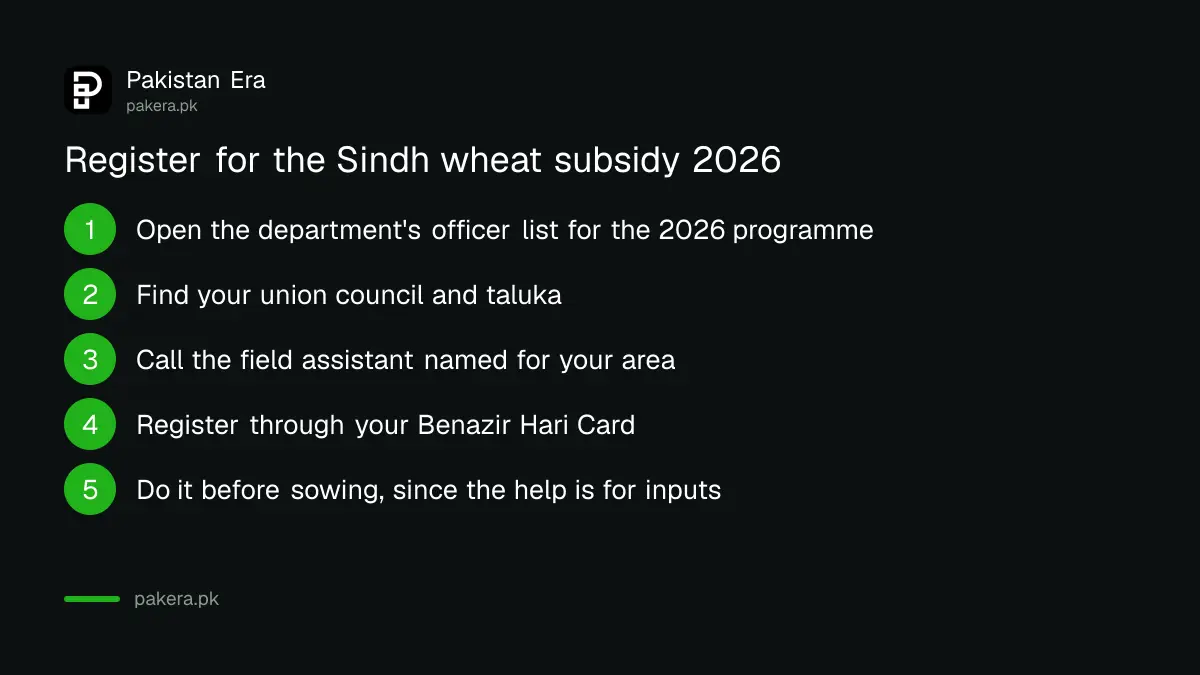
The subsidy is paid through the Benazir Hari Card. The eligibility rules and the package amounts are set out in our report on the Sindh wheat subsidy for 2026. Find your union council in the department's list, call the named officer and register before you sow, since inputs are the point of the scheme.
Water is the other limit this season. The IRSA rabi water shares set how much canal water Sindh can expect through the winter.
Common questions
When is wheat sown in Sindh?
From 1 to 20 November in lower and central Sindh, and from 7 November to 30 December in upper Sindh, according to the Sindh Agriculture Department.
What is the wheat seed rate per acre in Sindh?
50 to 60 kg an acre for every variety on the department's list.
What happens if I sow wheat late in Sindh?
The department says yield starts to fall by about 20 kg a day after 20 November.
Which wheat varieties are listed for Sindh?
Fifteen, including Benazir-13, Hamal-13, Moomal-89, Abadghar-93, Sarsabz, Kiran-95 and TD-1.
How do I register for the Sindh wheat subsidy 2026?
Contact the field assistant named for your union council in the department's published list and register through the Benazir Hari Card.
How we verified this
What we checked, where we read it, and what we could not confirm.
We read the Sindh Agriculture, Supply and Prices Department's sowing period tables, its wheat crop page and its wheat subsidy programme page on 20 October 2026. The officer list is a scanned PDF, which we opened but did not copy here. The pages carry no revision date, and the yield loss figure does not say whether it is per acre or per hectare. We could not find a 2026 fertiliser dose for wheat on any Sindh department page.
About the author

Senior Writer, Public Services and Technology
Shahid joined us in 2024 as an author. He is a senior contributor to Pakistan's leading technology websites. He writes detailed articles, mostly covering his expertise in the latest tech, mobiles, apps, gadgets, and step-by-step guides. His ideology is to help people understand the latest trends and explain complex methods through very easy-to-understand guides.