Gram Sowing in Punjab 2026: Dates by District, 30 kg Seed an Acre and the Fertiliser Dose
Sow gram in Punjab from 15 October to 15 November 2026 by district, with 30 kg seed an acre and 1 bag DAP plus half SOP. See varieties and the Thal deadline.
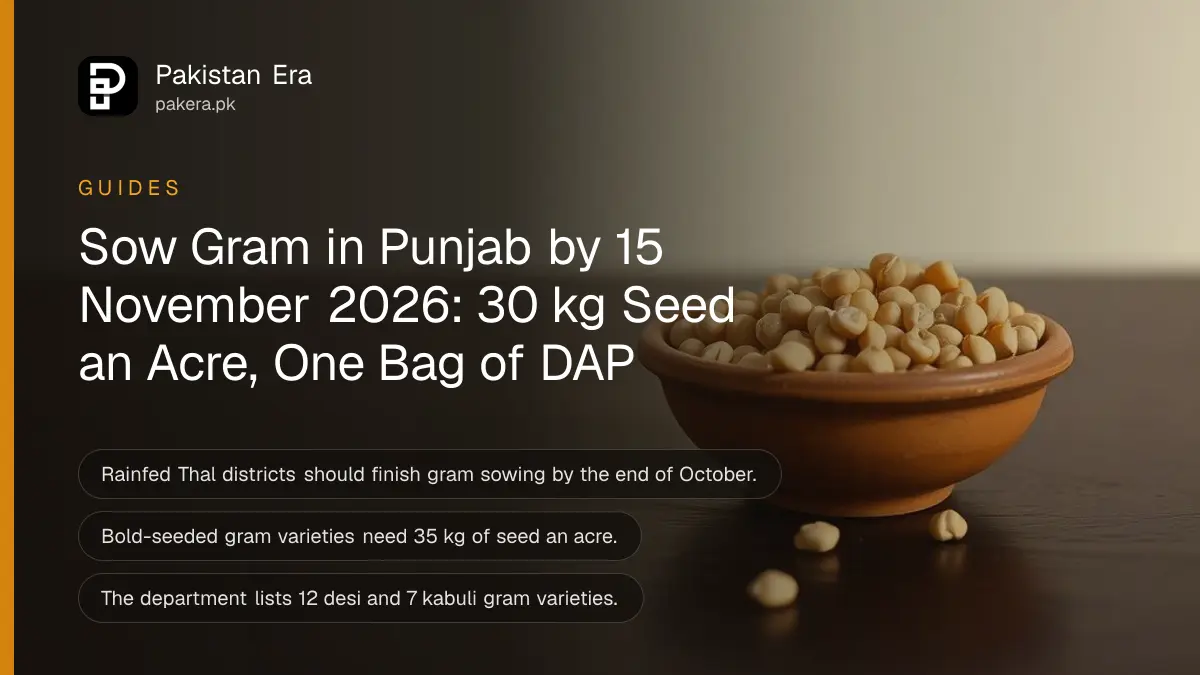
Sow gram (chana) in Punjab between 15 October and 15 November 2026, depending on your district. The Punjab Agriculture Department's advice for 16 to 31 October sets 30 kg of seed an acre for normal varieties, 35 kg for bold-seeded ones, and one bag of DAP with half a bag of SOP at sowing on irrigated land.
Gram, also called chickpea or chana, is the main winter pulse of Punjab's sandy Thal belt, and it is one of the few crops that does well on stored soil moisture with little canal water. That matters this winter, because the canal shortage for Punjab is put at 22 per cent. The dates and doses below come from the department's farm advisory for 16 to 31 October 2026, signed by Shahbaz Akhtar, Director General Agriculture (Extension) Punjab. We read the Urdu original and give it here in plain English.
Gram sowing dates in Punjab depend on your district
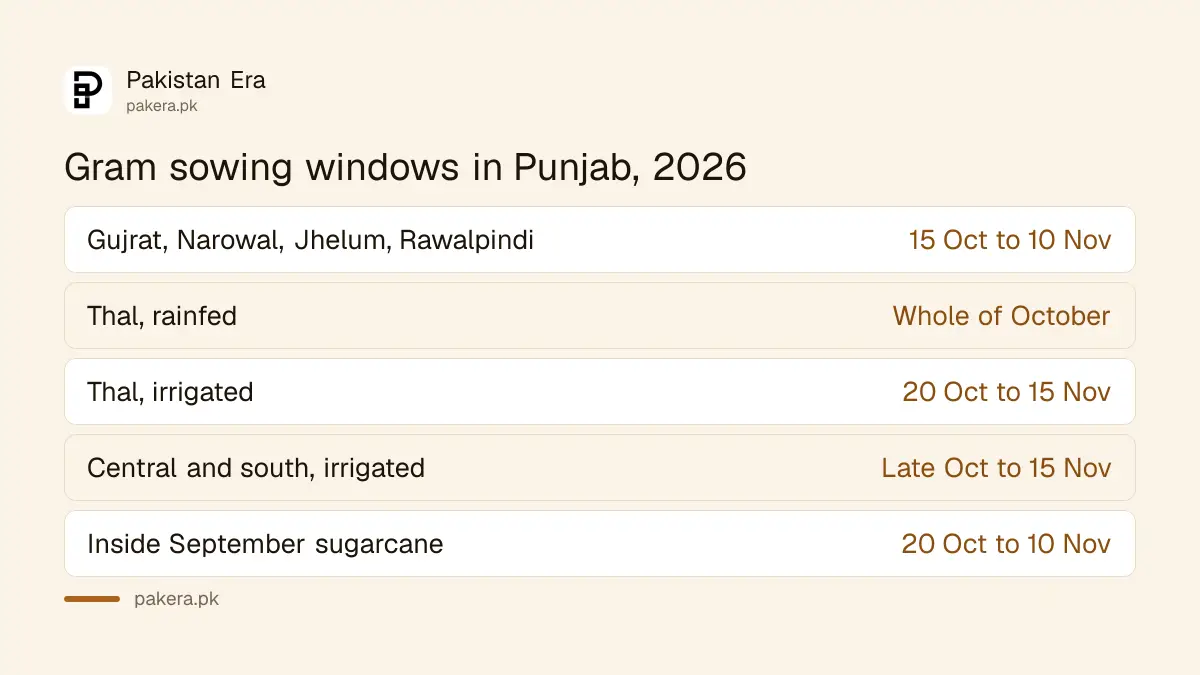
The department gives four sowing windows. Northern districts such as Gujrat and Rawalpindi sow from 15 October to 10 November. Rainfed Thal sows through October. Irrigated central and southern districts sow from late October to 15 November.
| Area | Districts named by the department | Sowing window |
|---|---|---|
| North | Gujrat, Narowal, Jhelum, Rawalpindi | 15 October to 10 November |
| Thal, rainfed | Bhakkar, Khushab, Mianwali, Layyah, Jhang | Whole of October |
| Thal, irrigated | Same Thal districts | 20 October to 15 November |
| Central and south, irrigated | Faisalabad, Sahiwal, Multan, Bahawalpur, Bahawalnagar and others | Late October to 15 November |
| Fertile land, or inside September sugarcane | Anywhere in Punjab | 20 October to 10 November |
Rainfed Thal is the one in a hurry. Its window closes at the end of October, so a Thal farmer reading this on 20 October has about ten days left. Rainfed means the crop depends on rain and soil moisture, with no canal or tubewell water.
Use 30 kg of seed an acre, or 35 kg for bold-seeded types
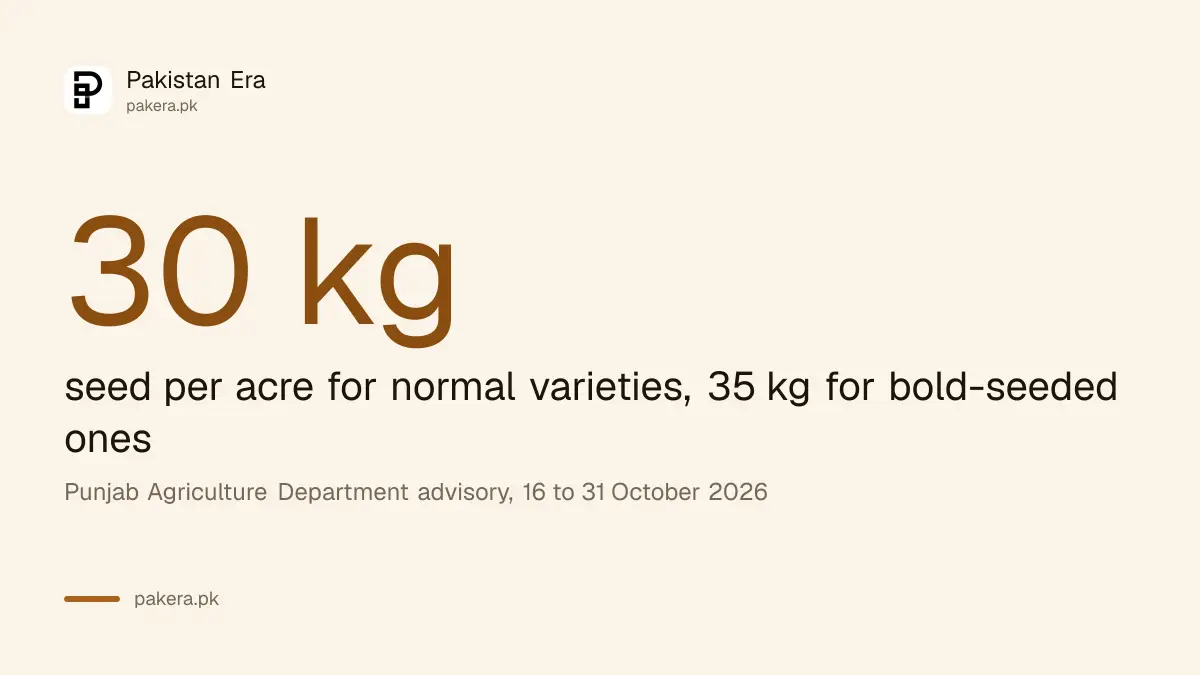
The department sets 30 kg of seed per acre for normal-sized gram varieties and 35 kg for varieties with large grains. Inside September-planted sugarcane, where gram is a second crop, the rate drops to 15 to 20 kg an acre.
Kabuli gram, the large cream-coloured type, usually falls in the bold-seeded group. Desi gram, the small dark type, usually takes the 30 kg rate. Buy certified seed from a licensed dealer and keep the receipt. If you doubt a seed bag, you can get seed and fertiliser tested in Punjab at a government lab.
Sow with a drill in rows one to one and a half feet apart
The department says gram should always be sown with a drill or a pora, a seed tube behind the plough, so the seed falls at the right depth. Rows go one foot apart on sandy loam and medium soils, one and a half feet on loam and in high rainfall areas, with plants six inches apart.
Broadcasting seed by hand leaves some seed too shallow and some too deep, so the stand comes up patchy. That is the reason for the drill rule. Thal's sandy soil also dries fast, which makes depth more important there than anywhere else.
For gram inside September-planted sugarcane, the department says the mixed crop of kabuli gram has done well. Where cane rows are four feet apart, sow two lines of gram on the bed. Where cane rows are two to two and a half feet apart, sow one line.
Irrigated gram needs one bag of DAP and half a bag of SOP at sowing
On irrigated land, the department's first option is one bag of DAP, a quarter bag of urea and half a bag of SOP an acre at sowing. On rainfed land it is one bag of DAP and half a bag of SOP. All of it goes in at sowing.
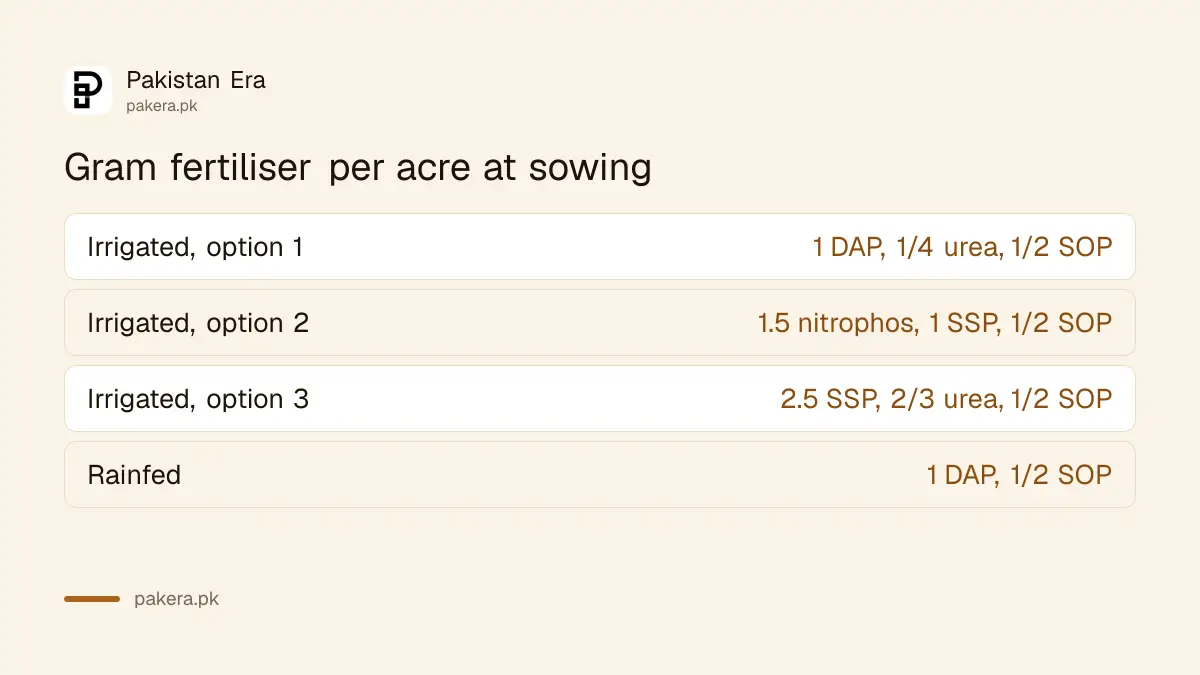
| Land | Fertiliser per acre at sowing, bags of 50 kg |
|---|---|
| Irrigated, option 1 | 1 DAP + 1/4 urea + 1/2 SOP |
| Irrigated, option 2 | 1.5 nitrophos + 1 SSP (18%) + 1/2 SOP |
| Irrigated, option 3 | 2.5 SSP (18%) + 2/3 urea + 1/2 SOP |
| Rainfed | 1 DAP + 1/2 SOP |
Gram needs little nitrogen because its roots fix their own from the air. So the doses are mostly phosphorus, from DAP or SSP, and potash, from SOP. At the average retail prices the Pakistan Bureau of Statistics recorded for the week to 8 October 2026, option 1 costs about Rs 26,034 an acre and the rainfed dose about Rs 24,839. That is our arithmetic, using DAP at Rs 17,127.78, urea at Rs 4,779.51 and SOP at Rs 15,422.22 a bag, the average urea and DAP prices for that week.
Prices in your town will differ. Ask the dealer for a receipt, so you can report fake fertiliser in Punjab if a bag turns out wrong.
The department recommends 12 desi and 7 kabuli varieties
For desi gram the advisory names Balksar 2000, Punjab 2008, Bhakkar 2011, NIAB CH 104, Bittal 2016, NIAB CH 2016, Thal 2020, Bittal 2021, Bahawalpur Chana 21, Bittal 2022, TG Striker and Star Chana. For kabuli gram it names CM 2008, Noor 2009, Noor 2013, Tamman 2013, Noor 2019, Rohi Chana 2021 and Noor 2022.
The names are our English spelling of the Urdu list, so check the exact name on the seed bag with your local extension office. Newer varieties are usually bred for better yield and disease resistance, so pick from the later years where seed is available. Price matters at the other end too: gram sold at Rs 253 a kilo in Lahore and Rs 337 in Peshawar in the week to 8 October, among the pulse prices by city that PBS tracks.
- Find your district's window in the table above and plan to sow inside it.
- Buy certified seed: 30 kg an acre, or 35 kg for bold-seeded kabuli types.
- Buy the fertiliser for your land type and apply it all at sowing.
- Sow with a drill or pora in rows one to one and a half feet apart.
- Ask your local agriculture extension office if you are unsure of a variety.
Common questions
When should I sow gram in Punjab in 2026?
Between 15 October and 15 November, depending on the district. Rainfed Thal should finish by the end of October.
How much gram seed is needed per acre?
30 kg for normal varieties and 35 kg for bold-seeded varieties, or 15 to 20 kg when sown inside sugarcane.
What fertiliser does gram need?
On irrigated land, one bag of DAP, a quarter bag of urea and half a bag of SOP an acre. On rainfed land, one bag of DAP and half a bag of SOP.
Can gram be sown with sugarcane?
Yes. The department says kabuli gram has done well inside September-planted sugarcane, sown from 20 October to 10 November.
Which gram varieties does Punjab recommend?
Twelve desi varieties, including Bittal 2022 and Thal 2020, and seven kabuli varieties, including Noor 2022 and Rohi Chana 2021.
How we verified this
What we checked, where we read it, and what we could not confirm.
We read the Punjab Agriculture Department's farm advisory for 16 to 31 October 2026, listed on its crop advisory page, on 20 October 2026. It is a scanned Urdu document, so we read it page by page and translated it ourselves. Fertiliser prices are the Pakistan Bureau of Statistics weekly averages for 8 October 2026, and the cost per acre is our arithmetic. We could not check seed prices or seed availability for each variety.
About the author

Senior Writer, Public Services and Technology
Shahid joined us in 2024 as an author. He is a senior contributor to Pakistan's leading technology websites. He writes detailed articles, mostly covering his expertise in the latest tech, mobiles, apps, gadgets, and step-by-step guides. His ideology is to help people understand the latest trends and explain complex methods through very easy-to-understand guides.