Compare Rice, Pulses, Milk and Sugar Prices by City in Pakistan: Gram Rs 253 in Lahore, Rs 337 in Peshawar
See what rice, gram, moong, mash, masoor, milk and sugar cost in five Pakistan cities on PBS's weekly sheet, and how to read your own city's price in 4 steps.
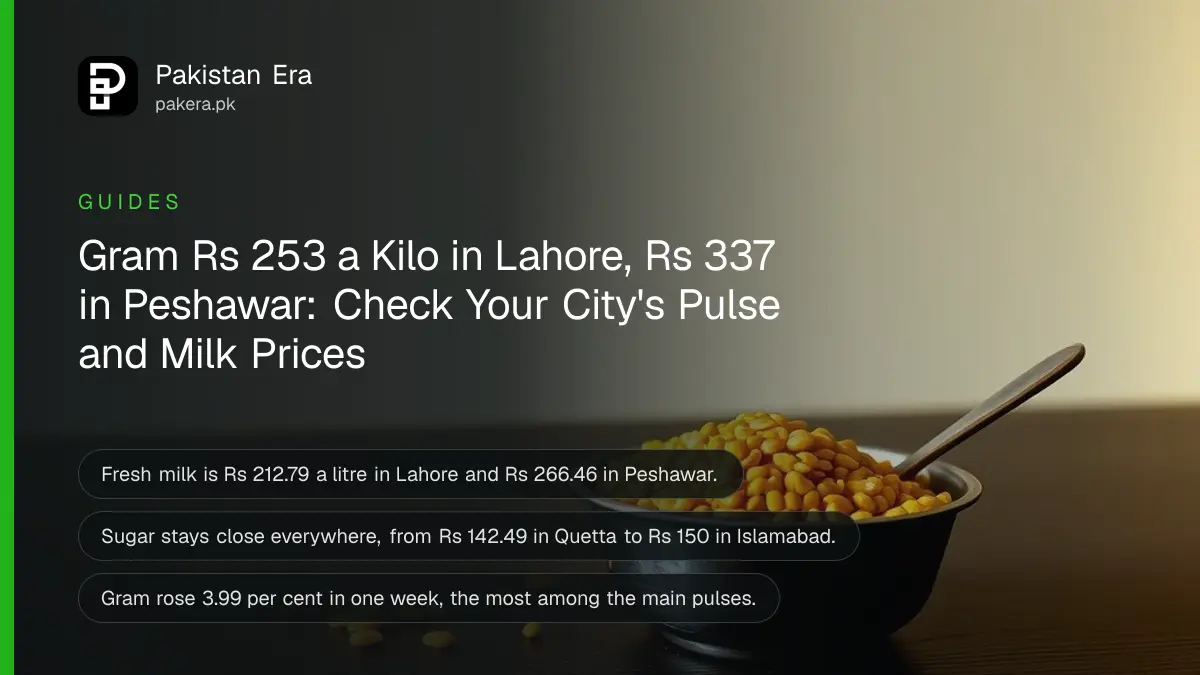
Short answer: The Pakistan Bureau of Statistics (PBS) weekly price sheet shows big gaps between cities. In the week ended 8 October 2026, gram pulse averaged Rs 253.06 a kilo in Lahore and Rs 336.63 in Peshawar, and a litre of fresh milk cost Rs 212.79 in Lahore and Rs 266.46 in Peshawar.
If you buy rice, pulses, milk or sugar every week, a PBS average tells you if your shop is fair. This guide gives the average for five big cities and shows how to find your own.
We read the city annex of PBS's Weekly Sensitive Price Indicator (SPI) for the week ended 8 October 2026 on 13 October. PBS prices are averages from sampled markets, not legal rates and not your shop's price. The same annex also lists chicken, eggs and vegetables.
Gram and moong cost 28 to 33 per cent more in some cities than in Lahore
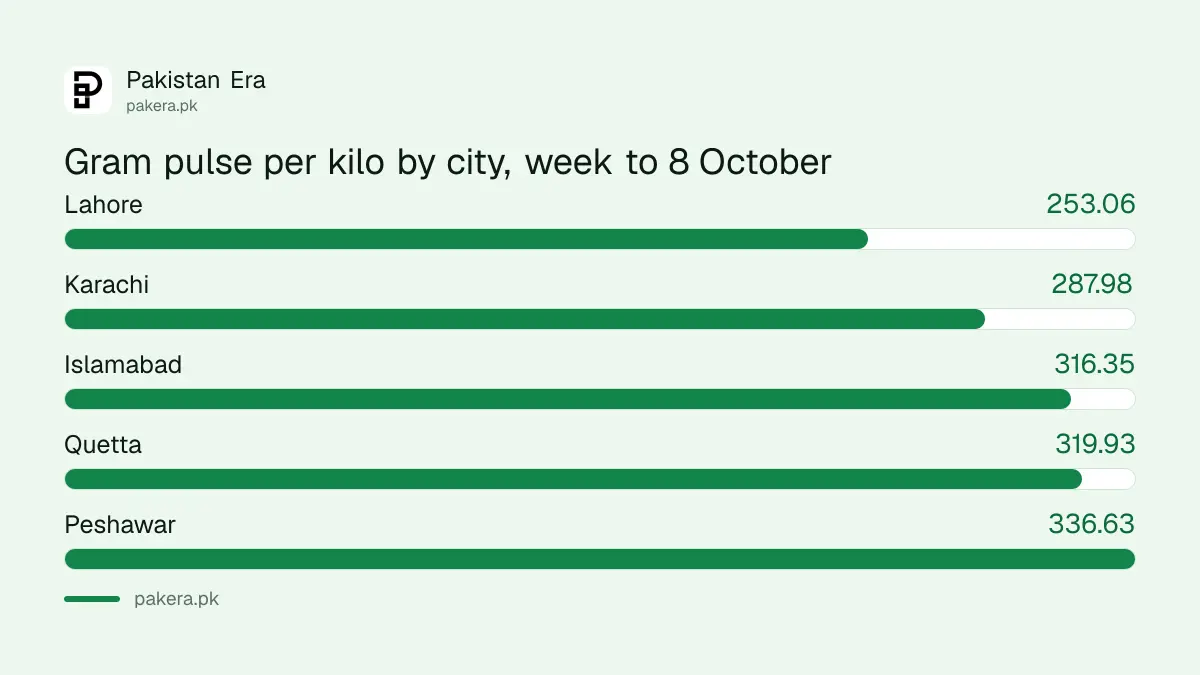
Lahore is the cheapest of the five cities for gram, moong and masoor. Gram is Rs 253.06 in Lahore against Rs 336.63 in Peshawar, a gap of Rs 83.57. Moong is Rs 328.98 in Lahore against Rs 419.95 in Quetta, a gap of Rs 90.97. The national averages were Rs 286.06 for gram and Rs 354.02 for moong.
Mash is the dearest pulse. It averaged Rs 514.68 in Islamabad and Rs 456.35 in Karachi. The national average was Rs 464.49, up 0.91 per cent in a week. Gram rose 3.99 per cent in a week nationally, which is the largest weekly rise among these pulses.
| Item, per kilo unless stated | Karachi | Lahore | Islamabad | Peshawar | Quetta |
|---|---|---|---|---|---|
| Basmati broken rice | Rs 283.54 | Rs 228.47 | Rs 274.83 | Rs 222.18 | Rs 279.93 |
| Fresh milk, 1 litre | Rs 240.00 | Rs 212.79 | Rs 256.56 | Rs 266.46 | Rs 220.00 |
| Masoor pulse | Rs 270.77 | Rs 245.19 | Rs 308.94 | Rs 261.90 | Rs 299.93 |
| Moong pulse | Rs 351.54 | Rs 328.98 | Rs 396.27 | Rs 339.51 | Rs 419.95 |
| Mash pulse | Rs 456.35 | Rs 473.71 | Rs 514.68 | Rs 464.30 | Rs 499.96 |
| Gram pulse | Rs 287.98 | Rs 253.06 | Rs 316.35 | Rs 336.63 | Rs 319.93 |
| Refined sugar | Rs 145.38 | Rs 146.88 | Rs 150.00 | Rs 145.51 | Rs 142.49 |
Milk is Rs 53.67 a litre dearer in Peshawar than in Lahore
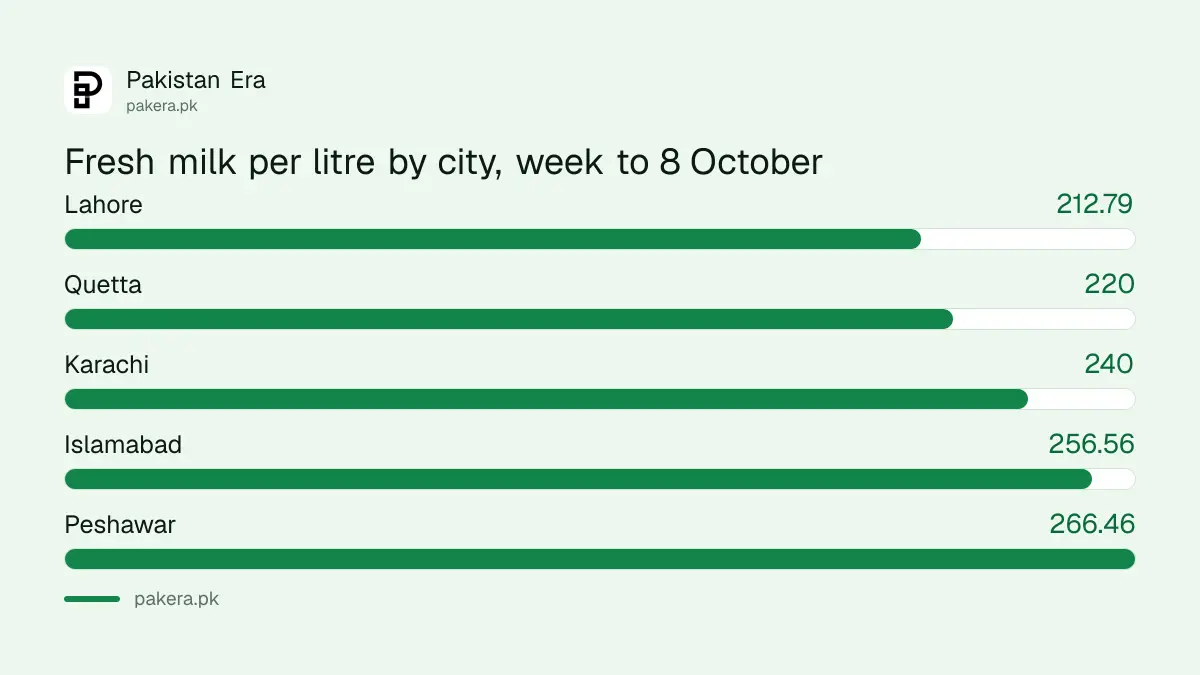
Fresh, unboiled milk averaged Rs 212.79 in Lahore, Rs 220 in Quetta, Rs 240 in Karachi, Rs 256.56 in Islamabad and Rs 266.46 in Peshawar. The national average was Rs 218.89, unchanged in a week and 7.98 per cent above a year ago.
The gap between Lahore and Peshawar is 25 per cent. PBS does not give a reason. The sheet only records what sampled shops charged.
Sugar is nearly the same everywhere, and rice varies by quality
Sugar sits between Rs 142.49 in Quetta and Rs 150 in Islamabad, a gap of only Rs 7.51. The national average was Rs 142.99, down 0.37 per cent in a week. The full sugar story is in the report on the sugar price of 8 October.
PBS lists broken basmati rice of average quality. It was Rs 222.18 in Peshawar and Rs 283.54 in Karachi, a gap of Rs 61.36. The national average was Rs 216.94, unchanged in a week. PBS also lists a 5 litre tin of vegetable cooking oil at Rs 3,090 and a 2.5 kg ghee tin at Rs 1,580 in all five cities, so it shows no city gap for them.
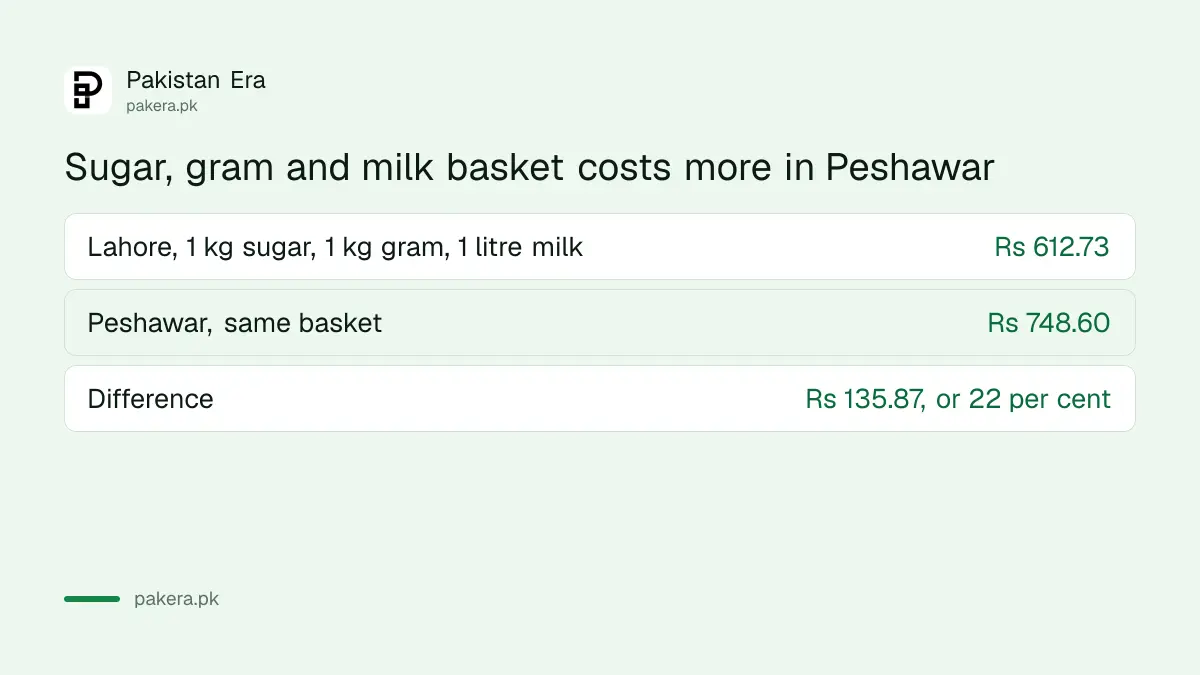
A small basket costs Rs 135.87 more in Peshawar
Take 1 kg of sugar, 1 kg of gram and 1 litre of milk. In Lahore that basket costs Rs 612.73 on PBS averages. In Peshawar it costs Rs 748.60. The difference is Rs 135.87 for three items, or 22 per cent.
To see how the rising cost of food hits your own household, use the steps in how to calculate your own inflation rate.
Find your own city in four steps
- Open PBS's weekly SPI release page and the "Annex" PDF linked there.
- Find your city. Page 1 holds Islamabad to Sargodha. Page 2 holds Multan to Peshawar, with Karachi third. Page 3 starts with Bannu and Quetta.
- Read the AVG figure, not MIN or MAX, for the item you buy.
- Compare it with your shop. If the shop is far above both the AVG and the MAX, ask why.
More on where the official numbers sit is in how to check inflation on official pages. If a shop charges above an official rate, you can complain, as set out in how to report overcharging in Punjab.
Common questions
Where does PBS get city prices from?
PBS collects them from sampled markets in 17 cities each week. The figures are averages and not legal prices.
Which city has the cheapest pulses?
Among the five cities here, Lahore had the lowest average for gram, moong and masoor in the week ended 8 October 2026.
Is the milk price for boiled or loose milk?
PBS lists fresh, unboiled milk per litre. Packaged and boiled milk can cost more, so do not compare them with this figure.
Why is sugar almost the same in every city?
PBS shows a gap of only Rs 7.51 between Quetta and Islamabad. It does not explain it, so we do not either.
Will these prices change next week?
Probably. PBS publishes a new sheet every week, and gram, for example, rose 3.99 per cent in one week nationally.
How we verified this
What we checked, where we read it, and what we could not confirm.
Last checked on 13 October 2026, Pakistan time. We read the PBS weekly SPI release page and its city annex PDF for the week ended 8 October 2026. The city gaps, percentages and basket totals are our own sums. We did not check shop prices, and PBS gives no reasons for the city differences.
About the author

Tax, Bills and Technology Writer
Ali Akhtar is a young and curious voice here at Pakistan Era. He is currently pursuing his A-Levels and has a growing interest in Pakistan’s changing industrial landscape and educational trends. Ali likes to write in a way that helps him explain and explore the world around him. His writing reflects the perspective of the new generation navigating the evolving trends of Pakistan where technology, youth innovation, and shifting opportunities are reshaping the country’s future.