IRSA's Rabi 2026-27 Water Plan: Punjab Gets 15.564 MAF, Sindh 11.748 MAF, 22% Short
IRSA allocated 29.183 MAF for Rabi 2026-27: Punjab 15.564, Sindh 11.748, both 22% short. Chashma closes 26 Dec to 14 Jan. See how to track daily releases.
IRSA has allocated 29.183 million acre feet (MAF) of canal water to Pakistan's four provinces for Rabi 2026-27, the winter season from 1 October 2026 to 31 March 2027. Punjab gets 15.564 MAF and Sindh 11.748 MAF, both with a 22 per cent shortage. Chashma Barrage will close from 26 December 2026 to 14 January 2027.
The Indus River System Authority (IRSA) is the federal body that shares the Indus river water between the provinces under the 1991 Water Apportionment Accord. Its advisory committee met on 6 October 2026 and approved the Rabi plan. We read the signed press release on IRSA's own website on 20 October 2026, together with its daily water sheet for 19 October. A million acre foot is the water needed to cover one million acres to a depth of one foot. For a wheat grower, the useful part is simpler: canal water this winter is short, and the shortage is shared between Punjab and Sindh.
Punjab gets 15.564 MAF and Sindh 11.748 MAF this Rabi
IRSA's committee set provincial shares of 15.564 MAF for Punjab, 11.748 MAF for Sindh, 0.701 MAF for Khyber Pakhtunkhwa through the Chashma Right Bank Canal, and 1.171 MAF for Balochistan. The total is 29.183 MAF, slightly above the ten-year average of 28.73 MAF.
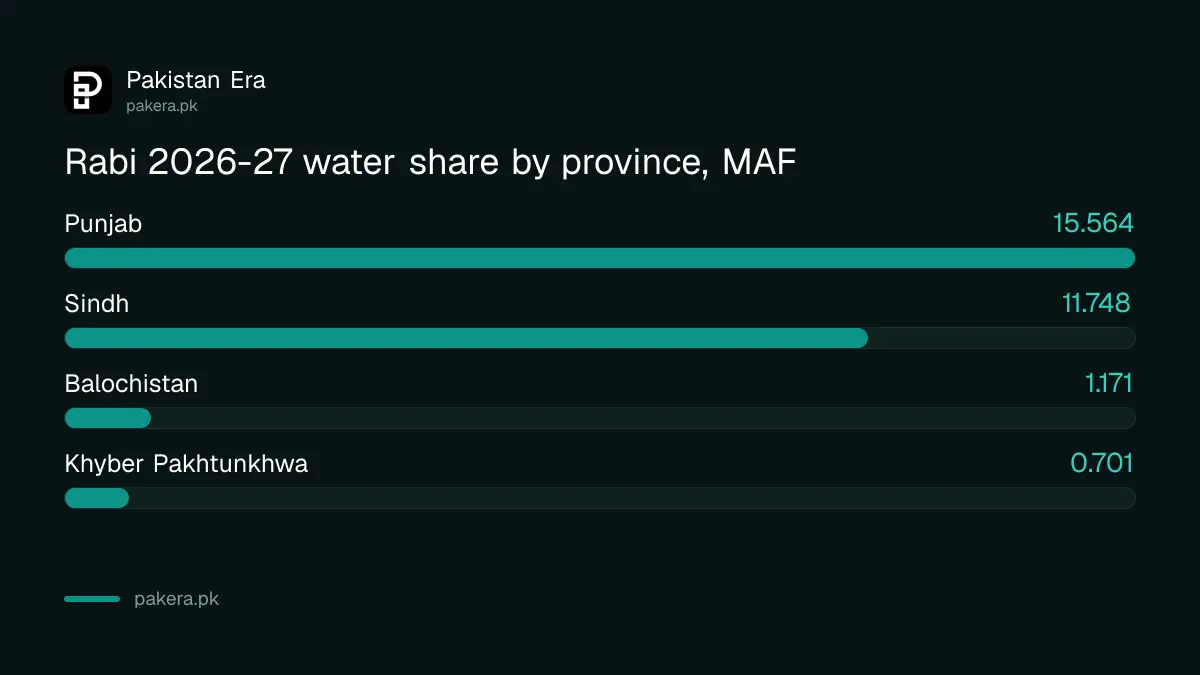
| Province | Rabi 2026-27 share, MAF | Share of the total |
|---|---|---|
| Punjab | 15.564 | 53.3% |
| Sindh | 11.748 | 40.3% |
| Balochistan | 1.171 | 4.0% |
| Khyber Pakhtunkhwa (CRBC) | 0.701 | 2.4% |
| Total | 29.183 | 100% |
The percentages are our arithmetic from IRSA's table. The four shares add to 29.184 MAF, one thousandth more than the printed total, which is a rounding gap in the release. IRSA calls these figures "anticipated (likely)". They are a plan, and IRSA says the shortage will be reviewed from time to time.
Punjab and Sindh face a 22 per cent shortage, the other two are exempt
IRSA worked out an overall shortage of 22 per cent for both Punjab and Sindh this Rabi. Khyber Pakhtunkhwa and Balochistan are exempt from shortages, as IRSA's daily water sheet states in a footnote. So the whole gap falls on the two big canal provinces.
The shortage comes from the expected river flow. IRSA's committee approved likely inflows of 21.268 MAF at the rim stations for the season. The rim stations are the four points where IRSA measures water entering the system: the Indus at Tarbela, the Jhelum at Mangla, the Kabul at Nowshera and the Chenab at Marala. The committee assumed 4 per cent conveyance losses for the Indus zone and none for the Jhelum Chenab zone.
The release says the inflow figure came from running scenarios on a water accord tool built with Australia's CSIRO and a Canadian university's watershed model. The federal agriculture committee used the same 22 per cent figure in its Rabi 2026-27 farm plan on 7 October.
Kharif 2026 river flows were 22 per cent below last year
The summer season that just ended was dry. Actual Kharif 2026 inflows were 95.44 MAF, which IRSA says was 8 per cent below its forecast, 7 per cent below the ten-year average and 22 per cent below last year. Dam storage on 30 September was 9.343 MAF.
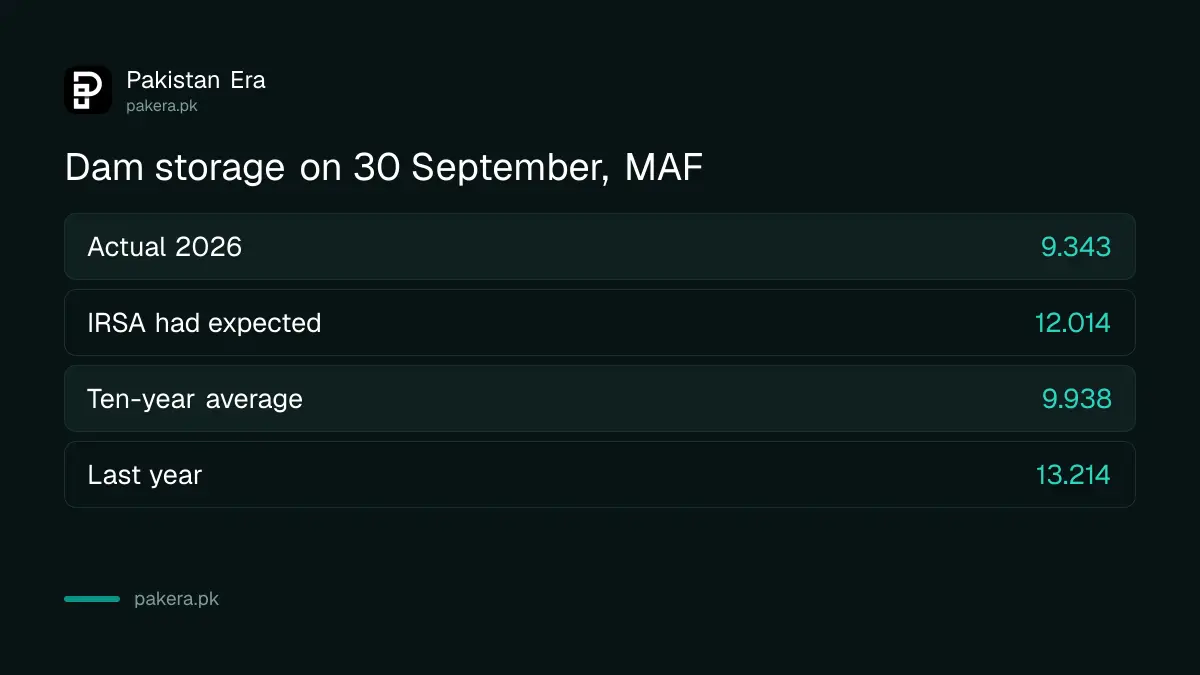
That storage figure matters most for Rabi, because winter crops lean on water saved in Tarbela and Mangla. IRSA had expected 12.014 MAF. The ten-year average is 9.938 MAF and last year it was 13.214 MAF. So the dams started this winter about 3.9 MAF lower than a year ago, by our arithmetic.
Every province also used less than its Accord share in Kharif. Punjab was 11 per cent short of its share, Sindh 7 per cent, Khyber Pakhtunkhwa 28 per cent and Balochistan 58 per cent. Water released below Kotri to the sea was 10.40 MAF, against 30.85 MAF last year. IRSA's annual report shows how much Indus water each province got in 2024-25, for comparison.
Chashma Barrage closes from 26 December 2026 to 14 January 2027
IRSA's committee approved closing Chashma Barrage tentatively from 26 December 2026 to 14 January 2027, a period of 21 days. IRSA says the dates match the provinces' annual canal closure programmes, when canals are shut for cleaning and repair.
Canals fed from Chashma, including the Chashma Jhelum link and the Chashma Right Bank Canal, will be affected. Farmers on those commands should plan a watering before late December. Your irrigation department announces the exact closure for each canal, and that notice is the one to follow.
The committee also noted delays in two WAPDA works at Tarbela, the tunnel 4 low-level outlet and the fifth extension hydropower project. It said these delays had caused shortages for the provinces during Kharif and asked for them to be finished as early as possible.
You can track your province's daily release on IRSA's sheet
IRSA publishes a daily water situation sheet that shows each province's release in cusecs, against the same day last year. On 19 October 2026, Punjab got 48,700 cusecs against 39,900 a year earlier, and Sindh 44,000 against 50,000.
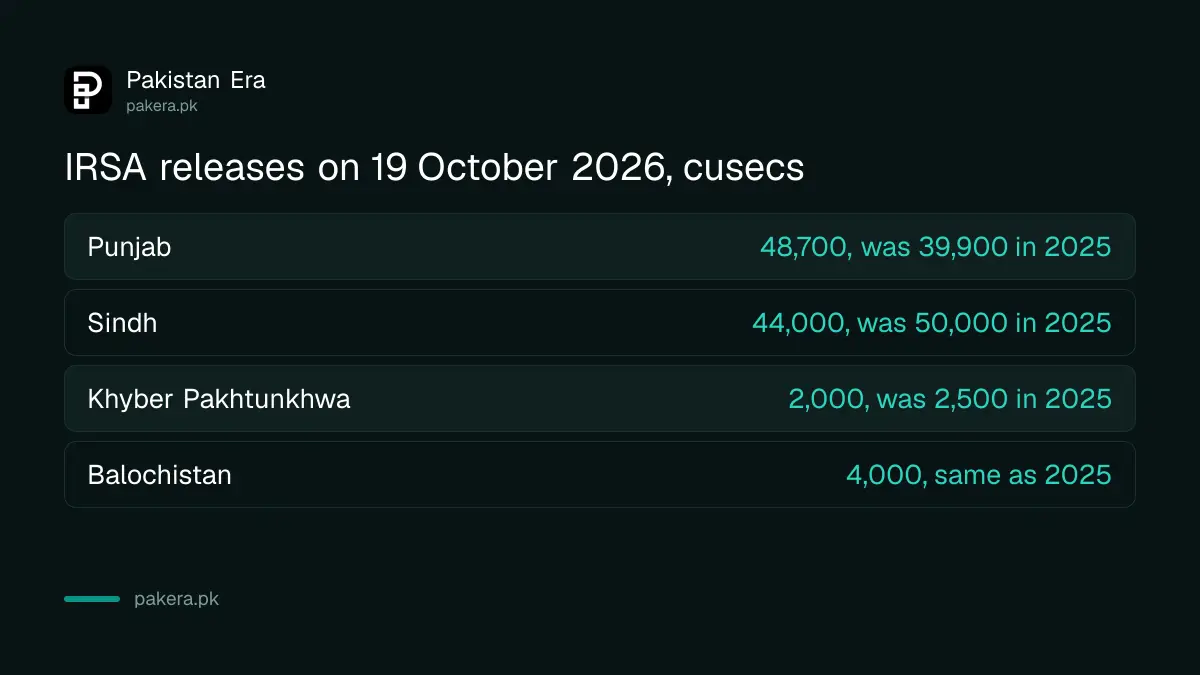
| Province | Release on 19 October 2026, cusecs | Same day 2025, cusecs |
|---|---|---|
| Punjab | 48,700 | 39,900 |
| Sindh | 44,000 | 50,000 |
| Khyber Pakhtunkhwa | 2,000 | 2,500 |
| Balochistan | 4,000 | 4,000 |
- Open the Daily Data page on IRSA's website at pakirsa.gov.pk. The plain http address works when the secure one does not.
- Pick the latest sheet. Each is a PDF named by date, such as Data19-10-2026.
- Find "IRSA Releases" near the bottom right for your province's figure today and last year.
- Read the Tarbela and Mangla levels at the top left, in feet above sea level.
- Compare the rim inflows line with yesterday's to see if water is rising or falling.
On 19 October, Tarbela stood at 1,517.78 feet and Mangla at 1,198.25 feet. Rim inflows were 73,262 cusecs, 4 per cent less than the day before. A cusec is one cubic foot of water flowing every second. The same sheet is the quickest way of checking Tarbela and Mangla levels through the winter.
Common questions
How much water will Punjab get in Rabi 2026-27?
IRSA's anticipated share for Punjab is 15.564 MAF from 1 October 2026 to 31 March 2027, with a 22 per cent shortage.
What is the water shortage for Sindh this winter?
22 per cent, the same as Punjab. Sindh's anticipated share is 11.748 MAF.
Are Khyber Pakhtunkhwa and Balochistan short of water too?
No. IRSA's daily sheet says both provinces are exempt from shortages, so their shares are not cut.
When will Chashma Barrage be closed?
Tentatively from 26 December 2026 to 14 January 2027, for 21 days, in line with provincial canal closure programmes.
Can the 22 per cent shortage change?
Yes. IRSA approved it subject to periodic review, so a wetter or drier winter can change it.
How we verified this
What we checked, where we read it, and what we could not confirm.
We read IRSA's press release of 6 October 2026 on the Rabi 2026-27 anticipated water availability, a scanned signed page at pakirsa.gov.pk, and IRSA's daily water situation sheet for 19 October 2026, both on 20 October 2026. The IRSA press release page lists the release under 6 October 2026. The percentage shares and the storage gap are our arithmetic. We could not read the provincial irrigation departments' canal closure schedules, so the exact closure of each canal is not on this page.
About the author

Senior Writer, Public Services and Technology
Shahid joined us in 2024 as an author. He is a senior contributor to Pakistan's leading technology websites. He writes detailed articles, mostly covering his expertise in the latest tech, mobiles, apps, gadgets, and step-by-step guides. His ideology is to help people understand the latest trends and explain complex methods through very easy-to-understand guides.