Check How Much Indus Water Each Province Got in 2024-25: Punjab 43.92 MAF, Sindh 41.11, in IRSA's Annual Report
IRSA's 2024-25 annual report shows Punjab drew 43.92 MAF, Sindh 41.11, with a 20% Rabi shortage and 30.85 MAF passing Kotri in Kharif. See all the tables.
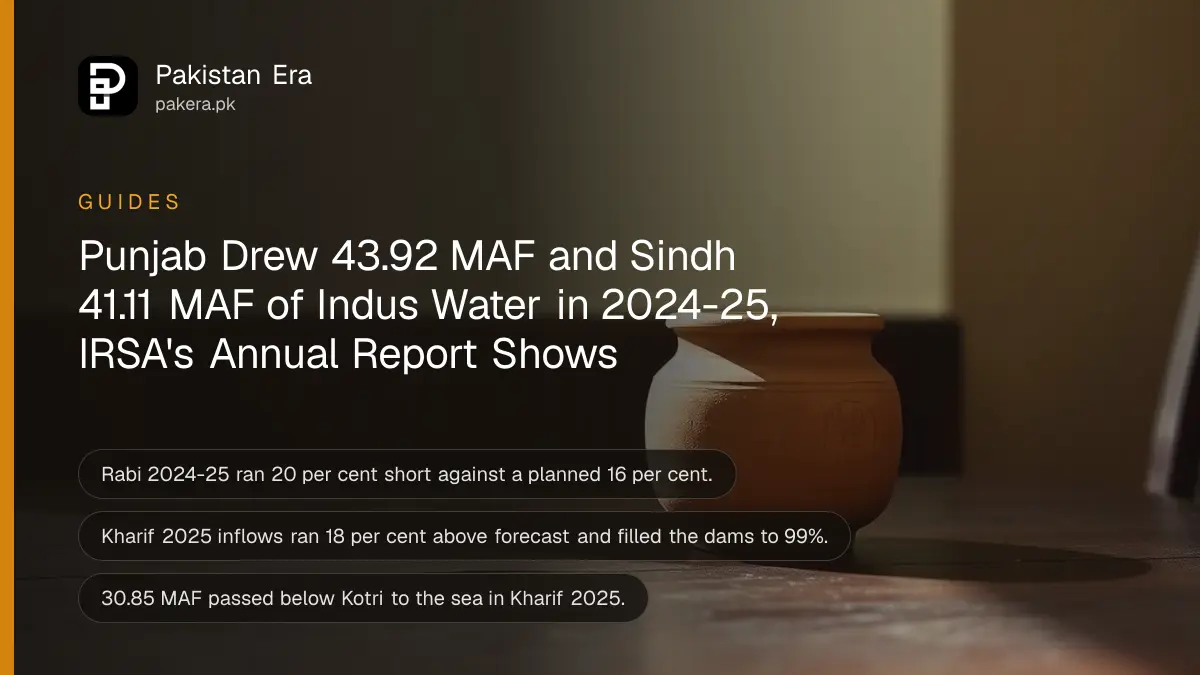
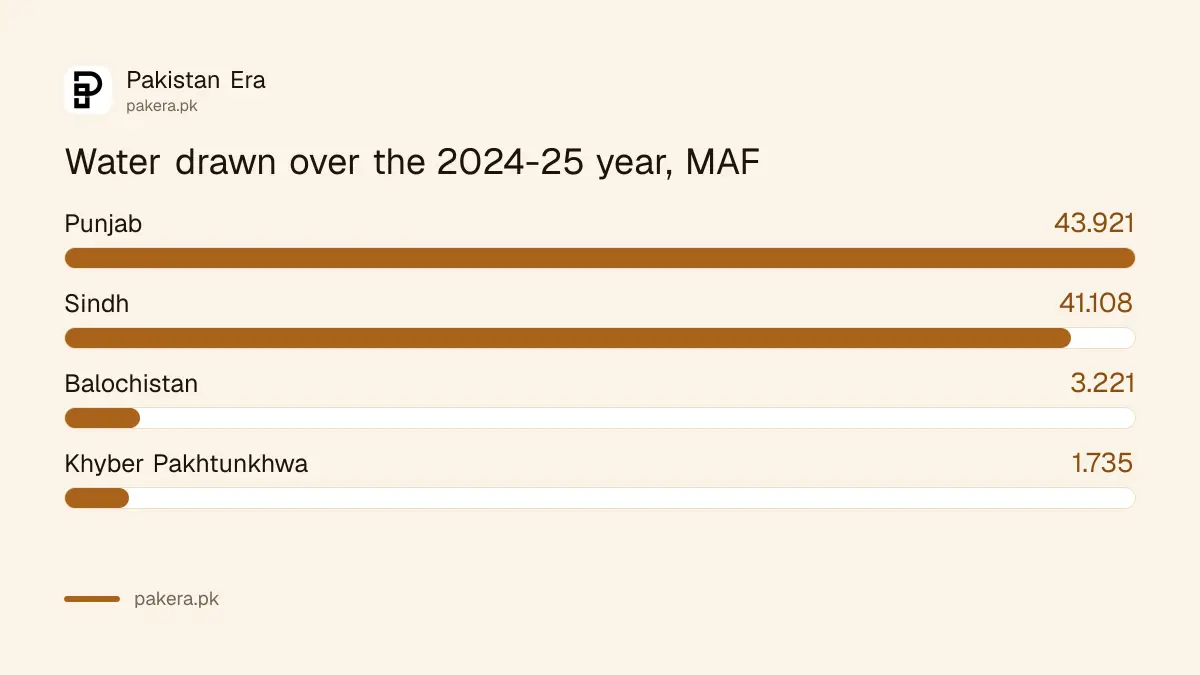
Punjab drew 43.92 million acre feet of Indus system water in the 2024-25 year, Sindh 41.11, Balochistan 3.22 and Khyber Pakhtunkhwa 1.74 through the Chashma Right Bank Canal, according to the Indus River System Authority's annual report for 2024-25. In the Rabi half the provinces got 29.43 MAF against an allocation of 31.14, a shortage of 20 per cent. In the Kharif half the rivers ran 18 per cent above forecast, floods filled the dams to 99 per cent, and 30.85 MAF went past Kotri to the sea.
IRSA is the federal authority that shares river water under the 1991 Water Apportionment Accord. Its annual report, posted on pakirsa.gov.pk on 2 May 2026 and covering Rabi 2024-25 and Kharif 2025, is the only official document that puts each province's allocation, actual withdrawal and the sea escapage for a whole year in one place. We downloaded and read it on 19 October 2026. The yearly totals above are our sums of its two seasonal tables.
The report sits under Latest Updates on pakirsa.gov.pk
The home page of pakirsa.gov.pk lists "IRSA Annual Report, 2024-25" under Latest Updates, dated 2 May 2026, with a More link to the PDF. The file is about 5 MB. Section 1.2 on page 4 gives the seasonal summary in six paragraphs, and sections 4.3 and 4.4 give the provincial tables. The site answered only over plain http in our test, not https.
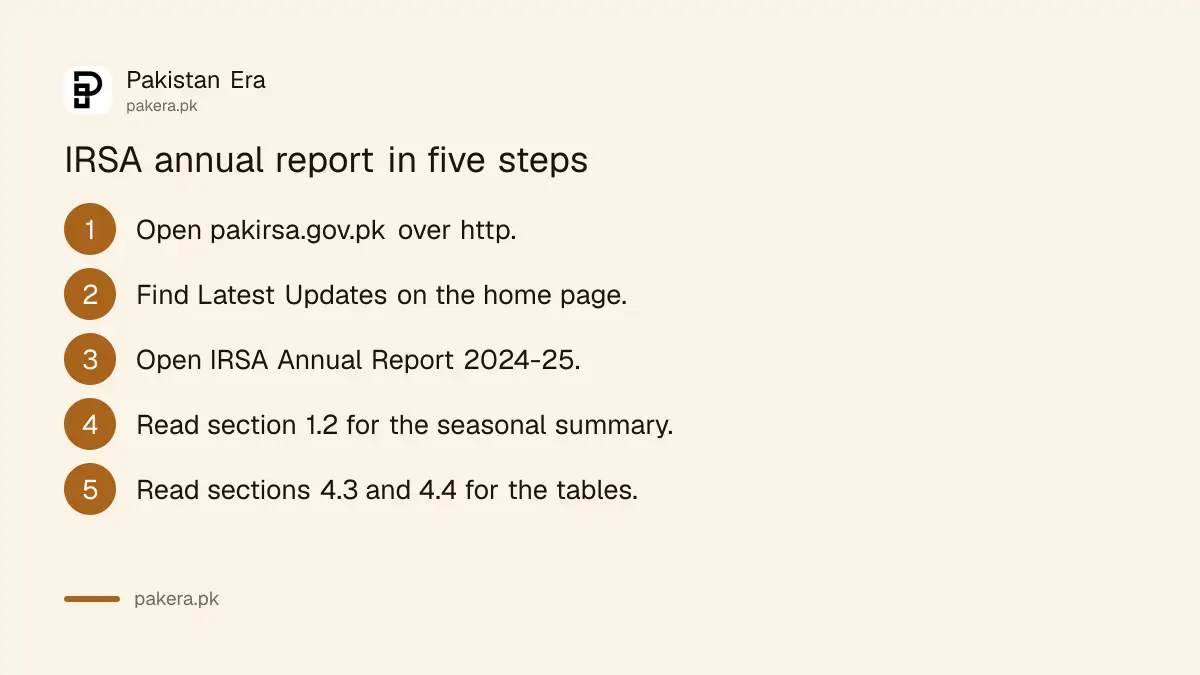
- Open pakirsa.gov.pk and find Latest Updates on the right of the home page.
- Click the IRSA Annual Report 2024-25 link and save the PDF.
- Read section 1.2 for the Rabi and Kharif summaries with allocations and actual use.
- Read section 4.3 for the Rabi provincial table and 4.4.5 for downstream Kotri flows.
- Annex 15 holds the provincial canal withdrawals for every year since 1992-93.
Rabi 2024-25 ran 20 per cent short, worse than the 16 per cent IRSA planned for
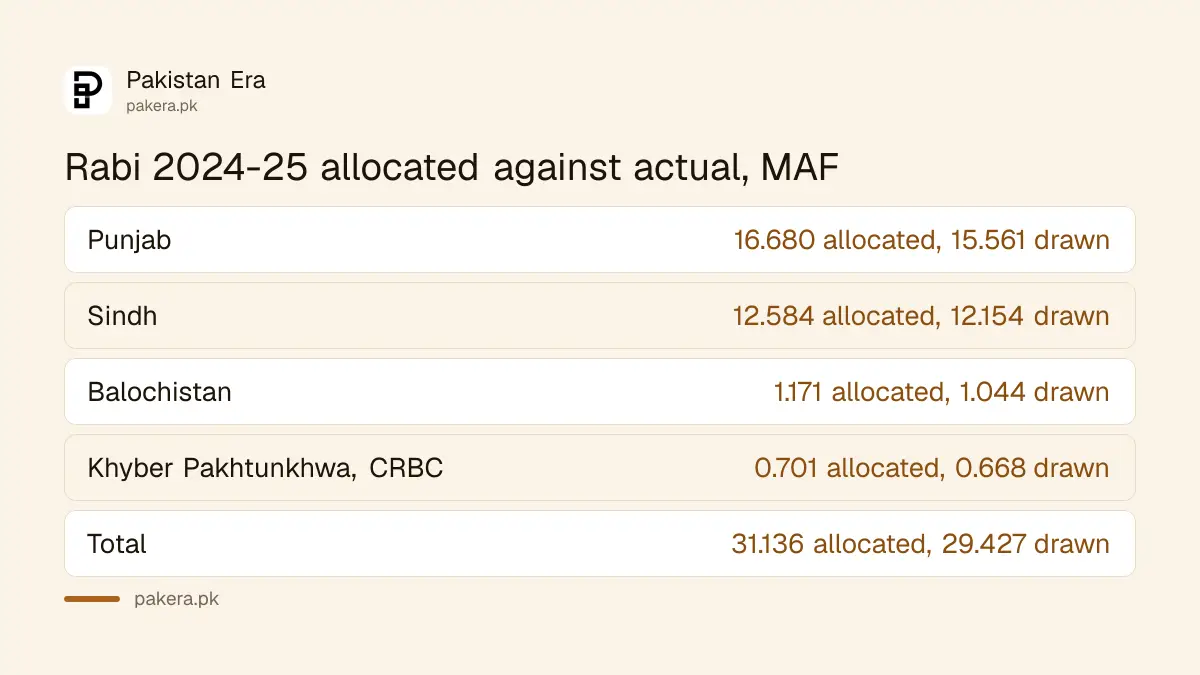
At the start of Rabi on 2 October 2024, IRSA's advisory committee expected 22.98 MAF to arrive at the four rim stations and allocated 31.136 MAF to the provinces, with a projected shortage of 16 per cent against Accord shares. The rivers delivered 20.26 MAF. The Jhelum at Mangla came in 36 per cent below forecast and the Chenab at Marala 23 per cent below, while the Indus at Tarbela matched its forecast exactly.
| Province, Rabi 2024-25 | Allocated, MAF | Actual, MAF | Five-year average, MAF |
|---|---|---|---|
| Punjab | 16.680 | 15.561 | 15.859 |
| Sindh | 12.584 | 12.154 | 12.146 |
| Balochistan | 1.171 | 1.044 | 1.039 |
| Khyber Pakhtunkhwa, CRBC only | 0.701 | 0.668 | 0.515 |
| Total | 31.136 | 29.427 | 29.560 |
By the end of March 2025 the actual shortage was about 20 per cent. Tarbela and Mangla both approached their dead levels. Carryover storage into Kharif was 0.236 MAF against the 0.726 MAF IRSA had hoped for. Only 0.47 MAF escaped below Kotri in the whole season, 58 per cent below the five-year average of 1.13 MAF, though still above the 0.065 MAF IRSA had budgeted for the sea.
The way the shortage is shared is in the report too: Punjab and Sindh carry it between them, while Khyber Pakhtunkhwa and Balochistan are largely exempted because their shares are small. The same rule is printed as a footnote on IRSA's daily water situation sheet, which is where the current season's shortage shows up one day at a time.
Kharif 2025 started at a 43 per cent shortage and ended with full dams
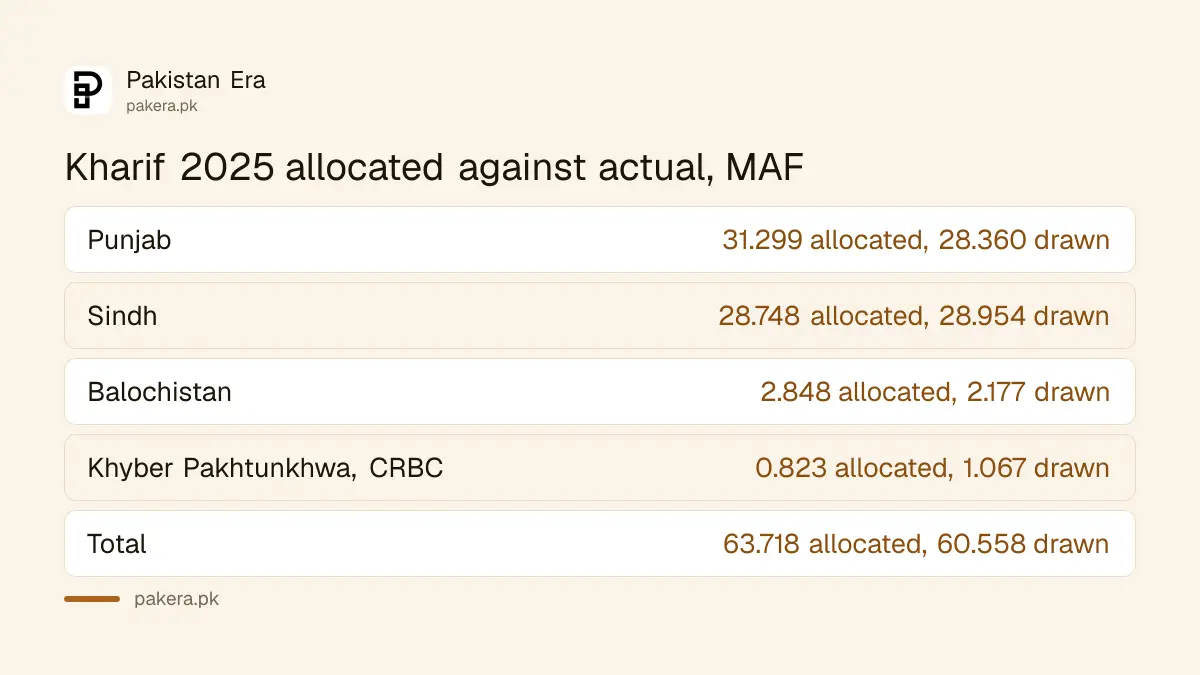
On 1 April 2025 Tarbela and Mangla were near dead level and IRSA estimated a 43 per cent system shortage for April alone, approving water for one month at a time. It revised the early Kharif shortage to about 27 per cent, then 21 per cent to 10 June, with 7 per cent expected for late Kharif. The report records the actual figures as 22 per cent for early Kharif and 15 per cent for late Kharif.
Then the rivers turned. Rim station inflows for the season reached 122.36 MAF against a forecast of 104.03, 18 per cent more, and about 19 per cent above the ten-year average. Late August brought exceptional floods on the Chenab and the eastern rivers. By September 2025 the reservoirs were about 99 per cent full, which is the storage the current Rabi season started with.
| Province, Kharif 2025 | Allocated, MAF | Actual, MAF |
|---|---|---|
| Punjab | 31.299 | 28.360 |
| Sindh | 28.748 | 28.954 |
| Balochistan | 2.848 | 2.177 |
| Khyber Pakhtunkhwa, CRBC only | 0.823 | 1.067 |
| Total | 63.718 | 60.558 |
Provinces drew less than allocated because the rain did their irrigating for them. Sindh and Khyber Pakhtunkhwa were the two that drew more than their allocation. The report gives the collective Kharif use as 60.558 MAF in one place and about 62.394 MAF in another; we use the table figure and flag the gap.
30.85 MAF went to the sea below Kotri in Kharif 2025
Escapages below Kotri are the water that reaches the delta. In Kharif 2025 they measured 30.848 MAF against the 9.956 MAF IRSA had anticipated and a five-year average of 18.034 MAF, 71 per cent above average. The report attributes it to the Chenab and eastern river floods. During the peak, on Sindh's request, IRSA cut Tarbela outflows and Chashma releases to hold Guddu below 600,000 cusecs.
Put the two seasons together and about 31.3 MAF reached the sea in the year, almost all of it in late summer. In the current Rabi, by contrast, IRSA's 16 October daily sheet showed Kotri passing nothing downstream at all. For the flood side of the same rivers, the PMD flood limits in cusecs explain what 600,000 at Guddu means.
Punjab and Sindh took 94 per cent of the year's water between them
Adding the two seasons, the provinces drew 89.985 MAF against 94.854 allocated. Punjab's 43.921 MAF is 48.8 per cent of the total and Sindh's 41.108 is 45.7 per cent. Balochistan's 3.221 MAF is 3.6 per cent and Khyber Pakhtunkhwa's 1.735, counted only through the Chashma Right Bank Canal, is 1.9 per cent. Those sums are ours; the report prints the seasons separately.
The report also carries the Accord itself at pages 87 and 88, the IRSA Act 1992 at pages 90 to 99, and a long annex of rim station inflows since 1976-77 and provincial withdrawals since 1992-93. It notes that Pakistan has 77 million acres of arable land, 54 million of them cultivated, with the rest waiting on water. The telemetry project to meter 27 key sites was 79 per cent built by 30 September 2026, per IRSA's project page, which should make future reports less dependent on provincial reconciliation.
For this season's plan, IRSA warned of a 22 per cent Rabi shortage in October, as set out in our report on the Rabi 2026-27 plan. For the canal at the end of your watercourse, the irrigation helpline in the guide to reporting canal water theft in Punjab is the first call.
Common questions
How much water did Punjab get in 2024-25?
15.561 MAF in Rabi 2024-25 and 28.360 MAF in Kharif 2025, 43.921 MAF in all, against allocations of 16.680 and 31.299, per IRSA's annual report.
How much did Sindh get?
12.154 MAF in Rabi and 28.954 MAF in Kharif, 41.108 MAF in all. Sindh drew slightly more than its Kharif allocation of 28.748.
What was the water shortage in Rabi 2024-25?
About 20 per cent by the end of March 2025, against the 16 per cent IRSA projected in October 2024, because the Jhelum and Chenab ran well below forecast.
How much water reached the sea?
0.47 MAF below Kotri in Rabi 2024-25 and 30.848 MAF in Kharif 2025, the latter 71 per cent above the five-year average because of floods.
Where is the IRSA annual report?
Under Latest Updates on pakirsa.gov.pk, dated 2 May 2026, as a PDF. The site answered only over http in our test.
Are the yearly totals in the report?
No. The report gives Rabi and Kharif separately. The yearly sums and percentages here are our arithmetic from its two tables.
How we verified this
What we checked, where we read it, and what we could not confirm.
Last checked 19 October 2026. All allocations, actual withdrawals, five-year averages, inflow figures, shortage percentages, carryover storage, Kotri escapages and the flood management note come from the IRSA Annual Report 2024-25, listed on pakirsa.gov.pk on 2 May 2026, which we downloaded and read on 19 October 2026. The telemetry progress figure is from IRSA's Projects page, read the same day. The yearly totals, percentages and the sea total are our arithmetic. We could not reconcile the report's two Kharif use figures of 60.558 and 62.394 MAF and say so above.
About the author

Senior Writer, Public Services and Technology
Shahid joined us in 2024 as an author. He is a senior contributor to Pakistan's leading technology websites. He writes detailed articles, mostly covering his expertise in the latest tech, mobiles, apps, gadgets, and step-by-step guides. His ideology is to help people understand the latest trends and explain complex methods through very easy-to-understand guides.