How to Get Farm Loan Repayment Relief After a Flood or Drought in Pakistan: Up to One Year Under SBP Rules
After floods, heavy rain or a water shortage, SBP lets banks relax a farm loan schedule by up to a year, not counted as default. See how to ask in writing.

If floods, heavy rain or a water shortage hit your crop, SBP's agriculture rules let your bank give you up to one year of relief on a farm loan repayment, and the relief period is not counted as default. In a heavy calamity such as a flood or earthquake, banks are encouraged to stop recovery at once and defer mark-up.
A farmer whose wheat seed washed away in a flood still gets the instalment reminder. The rule that protects you sits in a State Bank of Pakistan document most branch staff never show customers. We read the Prudential Regulations for Agriculture Financing, updated on 12 February 2024, on 21 October 2026. Regulation R-5 covers relief and R-11 covers classification and rescheduling. Everything below comes from that document unless we say otherwise.
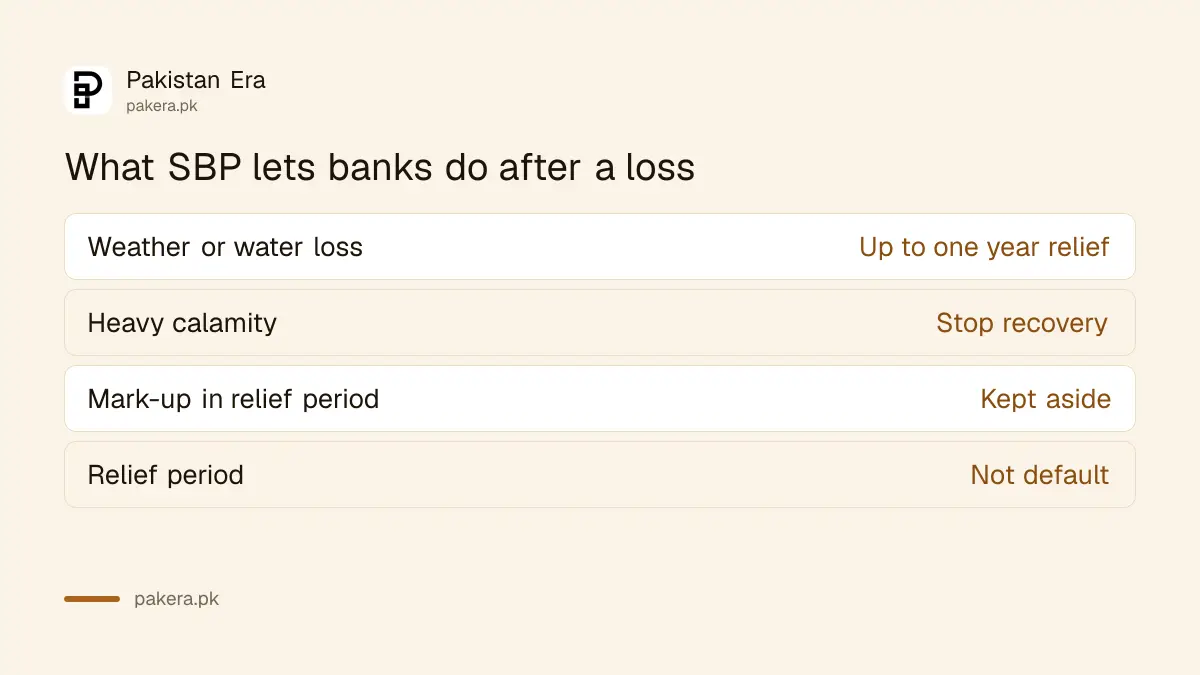
A bank may give up to one year of relief for weather or water losses
R-5 allows banks to relax the repayment schedule by up to one year for borrowers hit by unforeseen causes outside a farmer's control, such as weather or the availability of water. It can be done case by case or for all borrowers in an affected area at once.
The key word is "allowed". The rule gives banks the power, and it does not give the farmer an automatic claim. So go with a written request and facts. Say what happened, which crop and which acres, and ask the branch whether it has treated your area as affected. The wider rights for farm borrowers are in SBP's farm loan rules.
| Event | What the SBP rule says banks may do |
|---|---|
| Weather or water shortage | Relax the repayment schedule by up to one year |
| Heavy calamity (flood, earthquake, heavy rain, epidemic) | Stop recovery, defer mark-up, even waive amounts where recovery is not possible |
| Relief granted | The relief period does not count toward default |
In a major disaster banks are encouraged to stop recovery and may waive amounts
For earthquakes, floods, heavy rains and epidemic diseases, R-5 encourages banks to stop recovery immediately and suspend or defer mark-up. Where recovery is not possible after a heavy calamity, banks may issue instructions to waive outstanding mark-up or principal.
The text says "encouraged" and "may", not "must". A waiver is a bank board decision, not a right. Still, a branch that sends a recovery officer to a flooded village is going against the spirit of the rule, and you can say so in your letter. If the visits turn into pressure, the recovery agent rules set a notice period and conduct limits.
The relief period does not count as default and does not change your class
When a bank grants relief under R-5, the relief period is not counted toward the default period, and non-payment during it does not change the loan's classification. The mark-up accrued meanwhile is not credited to income but kept in a memorandum account.
That memorandum account is the bank's book entry. Your debt is not deleted. Ask the branch for a written schedule showing the new due dates and what happens to the accrued mark-up. A loan that was already classified stays in its category, and the relief does not lift it.
Overdue farm loans move to classified status after one year
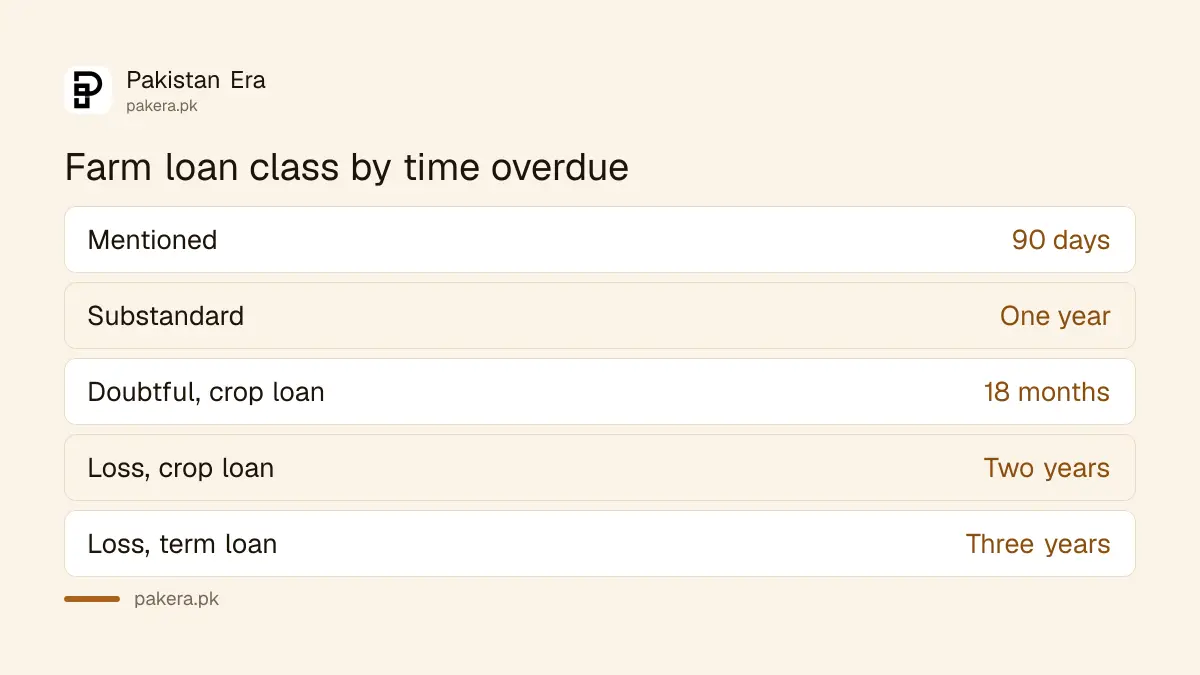
In SBP's agriculture table, an overdue amount is flagged "other assets especially mentioned" at 90 days. It becomes substandard at one year, doubtful at 18 months for a production loan or two years for a term loan, and loss at two or three years respectively.
These timelines are slower than for business loans, which fits a crop cycle. Production or working capital loans and development or term loans use different clocks. Banks must set aside provisions as the loan ages, but that is the bank's accounting, not a pardon. The table below shows the clocks.
| Class | Production or working capital loan | Development or term loan |
|---|---|---|
| Other assets especially mentioned | 90 days overdue | 90 days overdue |
| Substandard | One year overdue | One year overdue |
| Doubtful | 18 months overdue | Two years overdue |
| Loss | Two years overdue | Three years overdue |
Rescheduling after the relief needs 10% cash and one year of on-time payments
If the bank later reschedules a non-performing farm loan, R-11 says its classification stays unless at least 10% of the outstanding amount is paid in cash and the new terms are met for at least one year. The credit report may show "rescheduled" instead of "default".
After that, any fresh loan to you is watched separately and judged on its own terms. A farm borrower who reschedules is not shut out of credit by the rule. To see how your record appears, use the Tasdeeq and eCIB credit report check.
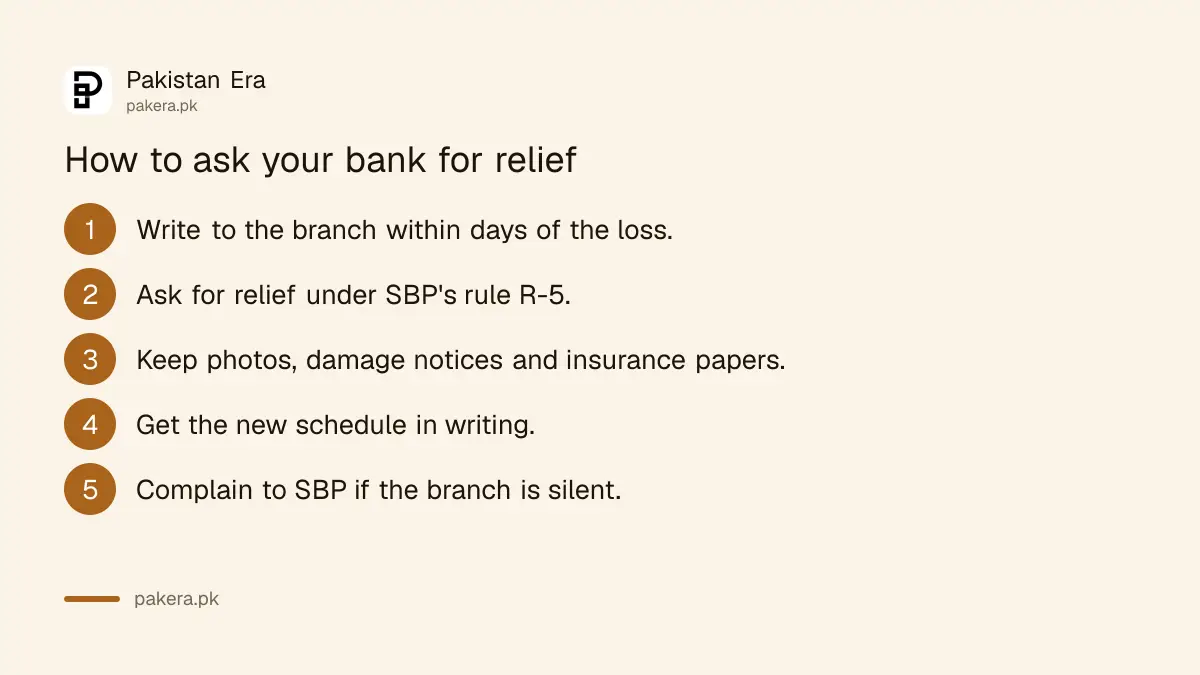
- Write to the branch within days of the loss, describing the event and your acreage.
- Ask whether your area is treated as affected and request relief under R-5.
- Keep photographs, any official damage notice and your crop insurance papers.
- Ask for the new schedule in writing, including what happens to mark-up.
- If the branch refuses to answer, file a complaint with SBP.
Crop loan insurance is a separate protection. R-1 refers to the Crop Loan Insurance Scheme 2008, and the steps for a payout are in the crop loan insurance claim guide.
Common questions
Is relief automatic after a flood?
No. SBP's rule allows banks to give it and encourages them in a heavy calamity. You must ask in writing and keep the reply.
Does relief wipe out my mark-up?
Not by itself. Mark-up accrued during relief is kept in a memorandum account. A waiver is possible in a heavy calamity but is the bank's decision.
Can I get relief on a loan that is already classified?
The rule says a loan already classified stays in its category when relief is given. Relief does not lift the class.
Which loans does this cover?
The rule is in the general part of SBP's agriculture regulations, so it applies to farm credit from banks and development finance institutions that follow them. It is not a rule for traders.
Who do I complain to if the bank ignores me?
Start with the branch manager, then file a complaint with SBP through its Sunwai portal.
How we verified this
What we checked, where we read it, and what we could not confirm.
We read SBP's Prudential Regulations for Agriculture Financing (updated 12 February 2024) on sbp.org.pk on 21 October 2026, including R-1, R-5, R-11 and Annexure II. We did not read any bank's own relief policy, and we could not confirm which districts any bank has treated as affected this year. SBP or provincial governments may have issued later relief notices that we did not find.
About the author

Public Services and Education Journalist
Fajr Riaz is a journalist and content writer at Pakistan Era, based in Lahore. She covers the questions people meet in everyday life in Pakistan: how a public service works, what a change in the rules means, and where to find a reliable answer.