Check Your Farm Loan Rights in Pakistan: Written Decision in 10 Working Days, Rs 5 Million Without Collateral
SBP's farm loan rules give a written decision within 10 working days and cap loans without security at Rs 5 million per person. Check what the bank must do.
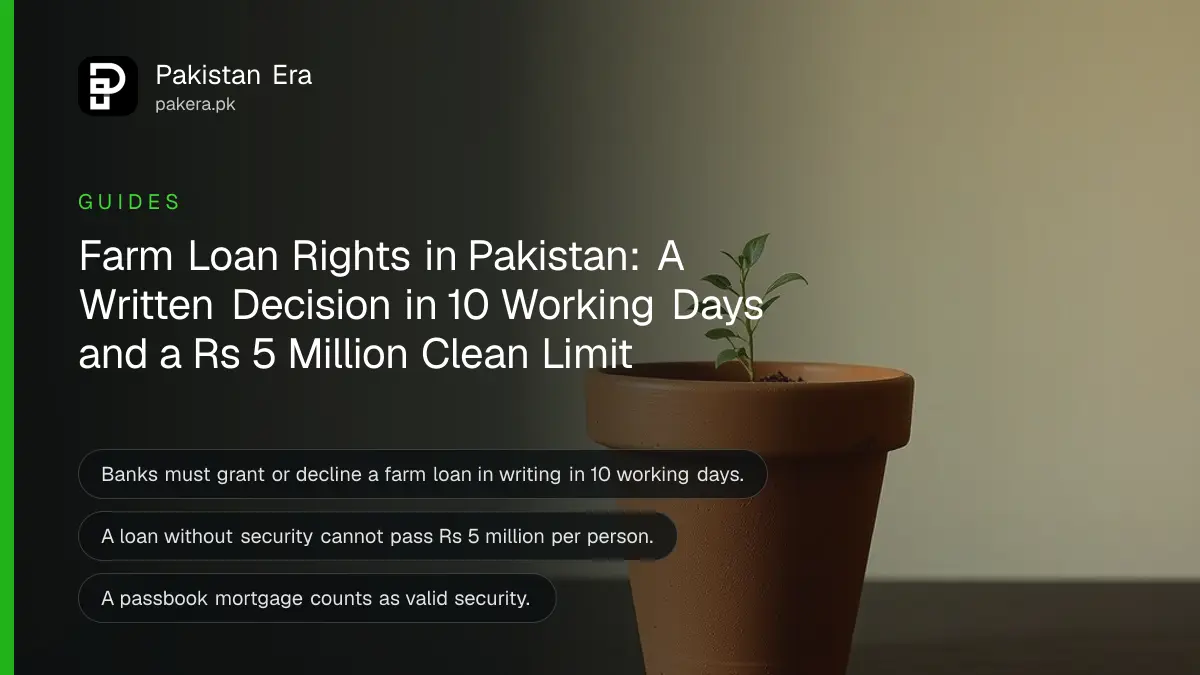
Under SBP's agriculture financing rules, a Pakistani bank must tell you in writing whether it grants or declines your farm loan within 10 working days of receiving the application, and it can lend at most Rs 5 million without collateral to one person. Anything above Rs 5 million must be secured, for example by a mortgage on your land recorded in the revenue passbook.
A farmer who files a loan application in September wants seed and fertiliser money in October, not a promise to "come back next week". We read the State Bank of Pakistan's Prudential Regulations for Agriculture Financing, updated on 12 February 2024, on 21 October 2026. Everything below comes from that document unless we say otherwise.
The bank must answer in writing within 10 working days
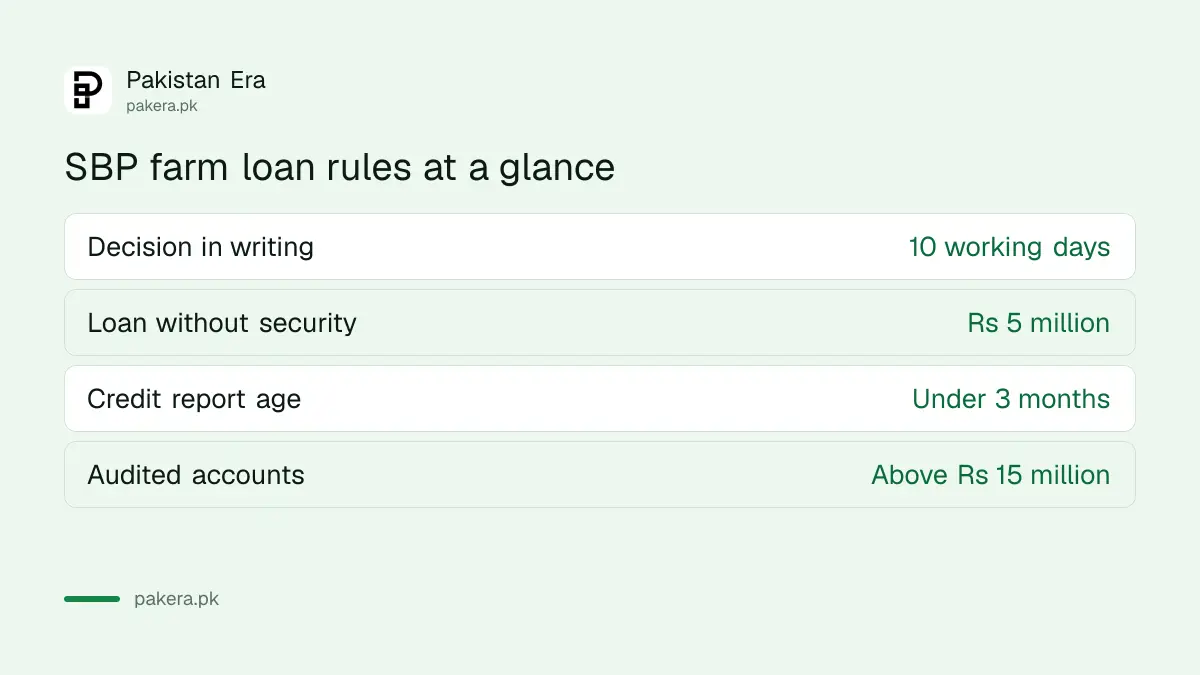
Regulation R-2 says banks must process agriculture loan applications quickly and convey the decision to grant or decline in writing within 10 working days of receiving the application. It also points to SBP's turnaround time instructions for loan processing.
Ask for a stamped or numbered receipt on the day you submit the form. The ten days run from receipt. If no letter arrives, take the receipt to the branch manager and then file a complaint on the Sunwai portal. We did not find the separate turnaround circular on the page, so this article relies only on the ten day rule that is written in the regulations.
| Step | What SBP's rule says |
|---|---|
| Decision on application | Written grant or decline within 10 working days |
| Credit report | From SBP's credit bureau, not older than three months at approval |
| Fact sheet | Borrower basic fact sheet, which can be part of the loan form |
| Loan without security | Up to Rs 5 million per person |
A loan without security cannot pass Rs 5 million to one person
R-4 caps clean financing, meaning loans without security or backed only by personal guarantees, at Rs 5 million to any one person. The bank must also take a written declaration that you, in your name or a family member's name, have not taken more clean loans from other banks.
That declaration matters. If you sign that you hold no other clean borrowing and it is untrue, you have given the bank a document that can be used against you. Count honestly. Loans above Rs 5 million must be properly secured, and SBP says land mortgaged by a bank's charge on the passbook, registered in the revenue records, counts as valid security.
Your credit report and repayment capacity are checked first
Before approving a limit, the bank must give due weight to your report from SBP's credit bureau and keep it no older than three months. It must also look at your total debts and disposable income, so the loan stays within your repayment capacity under its own approved policy.
If you have an overdue record, the bank can still lend, but it must follow its risk policy and write down the reasons on the approval form. To see what the bureau holds on you before you apply, use the eCIB credit report explainer.
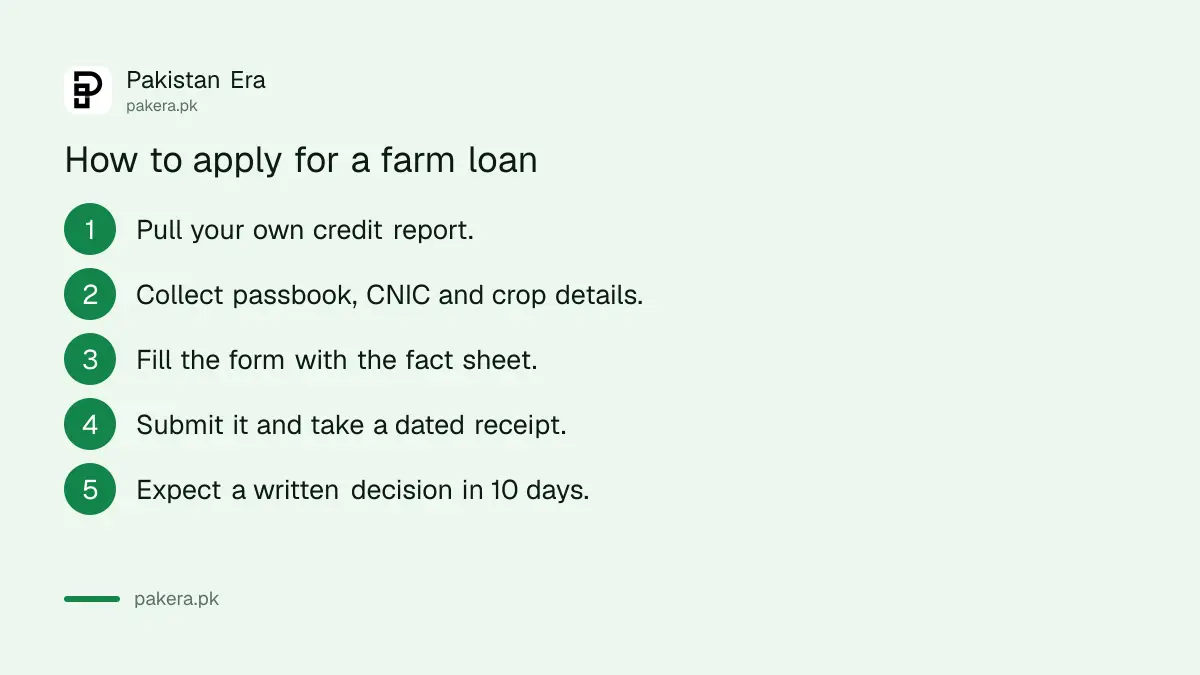
- Pull your own credit report and fix any wrong entries.
- Collect your passbook (the land ownership record), CNIC and recent crop details.
- Fill the loan form, including the borrower fact sheet.
- Submit it and take a dated receipt.
- Expect a written decision within 10 working days.
The bank may pay your supplier directly and rolls revolving credit by harvest
R-6 encourages banks to check that a loan is used for its stated purpose, and to pay suppliers directly where suitable. This does not apply to farmers under a Revolving Credit Scheme. For revolving credit, banks can ask for at least 50% repayment after each Rabi and Kharif harvest.
So a bank may hand an input dealer a payment instead of cash. Do not read that as a refusal. For a revolving limit, the rule lets repayments through the year equal to the maximum amount used count as clearing the account. The ZTBL revolving farm loan shows how one lender applies this.
Banks may not roll a new loan over an old one to hide an overdue account
R-9 prohibits any adjustment lending, meaning a fresh loan used to clear an old one so it avoids classification or meets a target. Running finance is the exception: if the mark-up is paid, the principal may be renewed without counting as adjustment lending.
This protects you from a loan that grows through quiet rollovers. For overdue farm loans, relief during a flood or drought is covered in farm loan repayment relief, and crop insurance claims are in the crop loan insurance guide.
Traders are outside the farm loan rules
SBP defines agriculture financing as inputs, farm development, machinery, fisheries and livestock, and says it does not cover loans to traders and middlemen who deal in or process farm goods. Those loans fall under commercial banking or SME rules instead.
The definition does allow farmers, partnerships and corporate farms to be financed for farming and for processing, packing and marketing of produce. If you only buy and sell crops, expect SME terms. The SME loan guide shows those routes.
Common questions
Is the 10 working days rule for every bank?
It applies to banks and development finance institutions covered by SBP's agriculture regulations. We read the rule as written but did not check how each bank applies it.
What counts as clean financing?
A loan with no collateral or one backed only by personal guarantees. SBP caps it at Rs 5 million per person under R-4.
Is a passbook mortgage accepted?
Yes. SBP's definition says land mortgaged through a bank's charge on the passbook, registered in the revenue books, counts as tangible security.
Can the bank collect cash from my farm?
R-8 lets banks collect cash outside their branches but says they must keep strict controls against fraud. Ask for a receipt from the bank every time.
Do I need audited accounts?
The corporate farming rule (R-20) asks for audited accounts from limited companies or where the bank exposure is above Rs 15 million. It can be waived where exposure net of liquid assets is not above Rs 15 million.
How we verified this
What we checked, where we read it, and what we could not confirm.
We read SBP's Prudential Regulations for Agriculture Financing (updated 12 February 2024) on sbp.org.pk on 21 October 2026, including R-2, R-4, R-6, R-7, R-8, R-9 and the definitions. The document notes amendments up to September 2022. We did not find a newer version, but SBP may have issued later circulars. We did not read any bank's loan product terms.
About the author

Public Services and Education Journalist
Fajr Riaz is a journalist and content writer at Pakistan Era, based in Lahore. She covers the questions people meet in everyday life in Pakistan: how a public service works, what a change in the rules means, and where to find a reliable answer.