SME Loan in Pakistan: Who Qualifies, Limits, Bank Rates and How to Apply
SBP's SME rules explained: who counts as small or medium, the Rs 100 million limit, collateral, and the terms HBL, UBL and Alfalah publish, with a cost example.
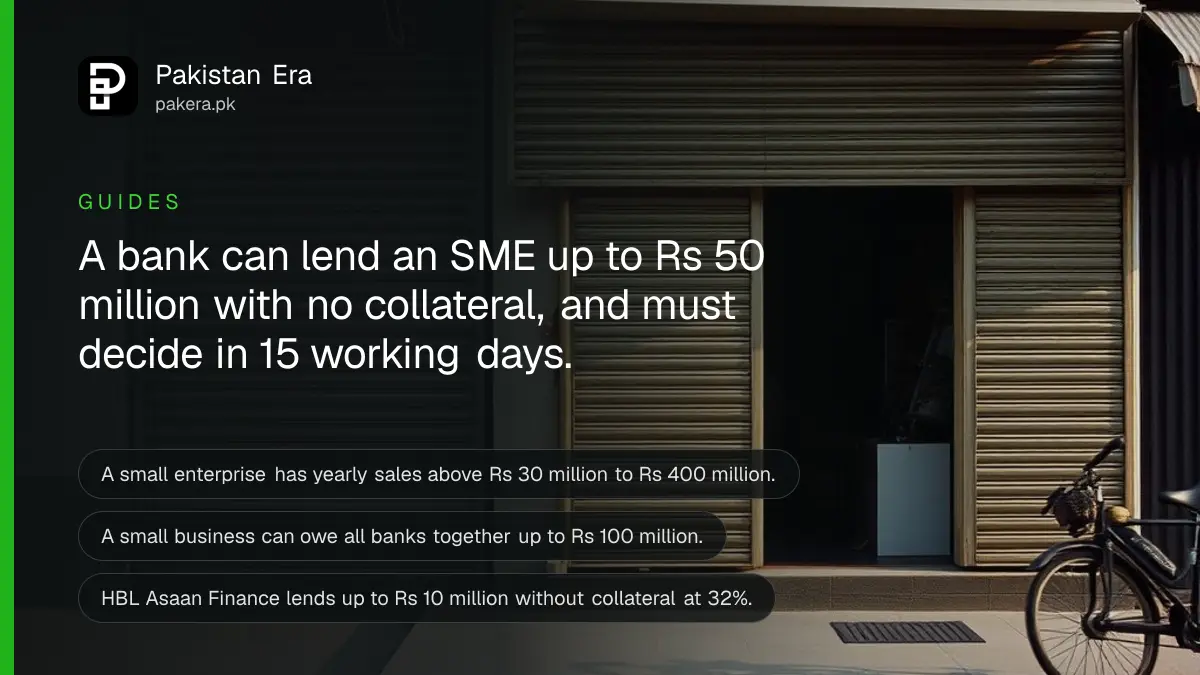
In Pakistan, the State Bank counts a business as a small enterprise if its yearly sales are above Rs 30 million and up to Rs 400 million. A small business can borrow up to Rs 100 million in total. Without collateral, a bank can lend at most Rs 50 million against a personal guarantee. HBL's no-collateral Asaan Finance publishes a 32% rate.
Most shop owners and small manufacturers never ask what an SME loan is, because the bank staff use the word and nobody explains it. The definition decides which rules and schemes apply to you.
We read the State Bank of Pakistan's (SBP) SME financing rules, updated on 16 July 2026, and the SME pages of HBL, UBL and Bank Alfalah on 7 October 2026. KIBOR, the interbank rate banks price from, was 12.68% for 1 year on the SBP home page on 5 October 2026.
SBP defines an SME by yearly sales
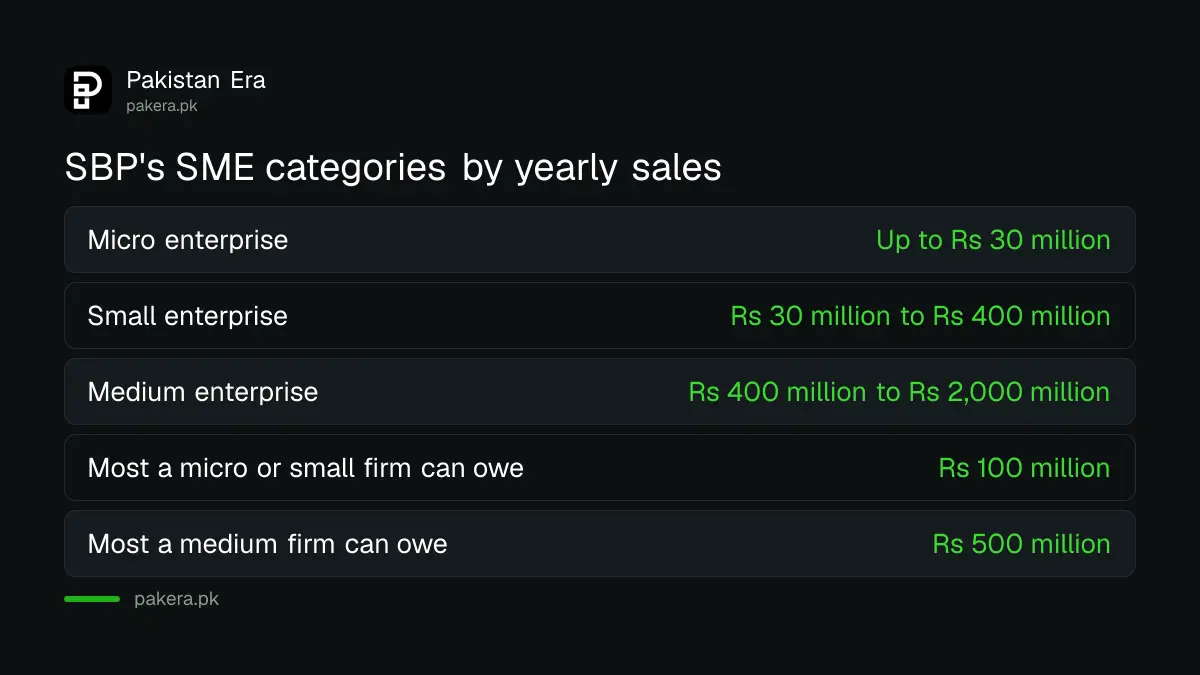
Under SBP's rules, a micro enterprise sells up to Rs 30 million a year. A small enterprise sells above Rs 30 million up to Rs 400 million. A medium enterprise sells above Rs 400 million up to Rs 2,000 million. A start-up is any of these that is up to 5 years old.
| Category | Yearly sales turnover | Most you can owe all banks |
|---|---|---|
| Micro enterprise | Up to Rs 30 million | Rs 100 million |
| Small enterprise | Above Rs 30 million to Rs 400 million | Rs 100 million |
| Medium enterprise | Above Rs 400 million to Rs 2,000 million | Rs 500 million |
| Start-up | Any of the above, up to 5 years old | As per its category |
The 2026 text uses yearly sales only, not staff numbers. The limit covers funded and non-funded facilities, such as guarantees and letters of credit, from one bank or all banks together.
Collateral is required except for a Rs 50 million clean limit
SBP lets a bank lend to an SME without collateral, based only on cash flow and a personal guarantee. This "clean" lending cannot pass Rs 50 million for one SME. Every other facility must be secured, and each bank sets its own margin.
In practice, most banks ask for property. UBL's Karobar Loan lends up to 75% of the forced sale value of a house, shop or factory. Third-party property is allowed. HBL's Asaan Finance is the main collateral-free product we found.
Banks that publish SME loan terms
HBL, UBL and Bank Alfalah each publish limits and eligibility on their own pages. Only HBL prints a rate for one product: 32% a year on Asaan Finance. Its other SME loans are priced as KIBOR plus a spread the bank does not print.
| Bank and product | Limit and security | Who qualifies | Rate |
|---|---|---|---|
| HBL Asaan Finance | Up to Rs 10 million, no collateral, running finance | Age 25 to 55, 3 years in business, HBL account for 2 years, clean e-CIB | 32% a year |
| HBL Small Business Finance | Up to Rs 20 million against property, demand finance up to 3 years | Age 25 to 65, 3 years in business | KIBOR plus spread, not printed |
| UBL Karobar Loan | Small: Rs 25 million, medium: Rs 40 million, up to 75% of forced sale value | Age 21 to 65, 3 years in business | Not published |
| Bank Alfalah Karobar Finance | Up to 70% of the property's market value | Age 23 to 60, 3 years in business, 3 times the limit as turnover | "Competitive", no figure |
| Bank Alfalah Quick Finance | Rs 50,000 to Rs 300 million against savings certificates, bonds or deposits, up to 90% | Age 18 to 65 | Not published |
Notice the common thread. Every bank wants at least 3 years of business history, and most want to see turnover through a bank account. A new business has a harder path, which is why SBP's refinance schemes exist.
A Rs 1 million running finance limit costs up to Rs 336,000 a year at 32%
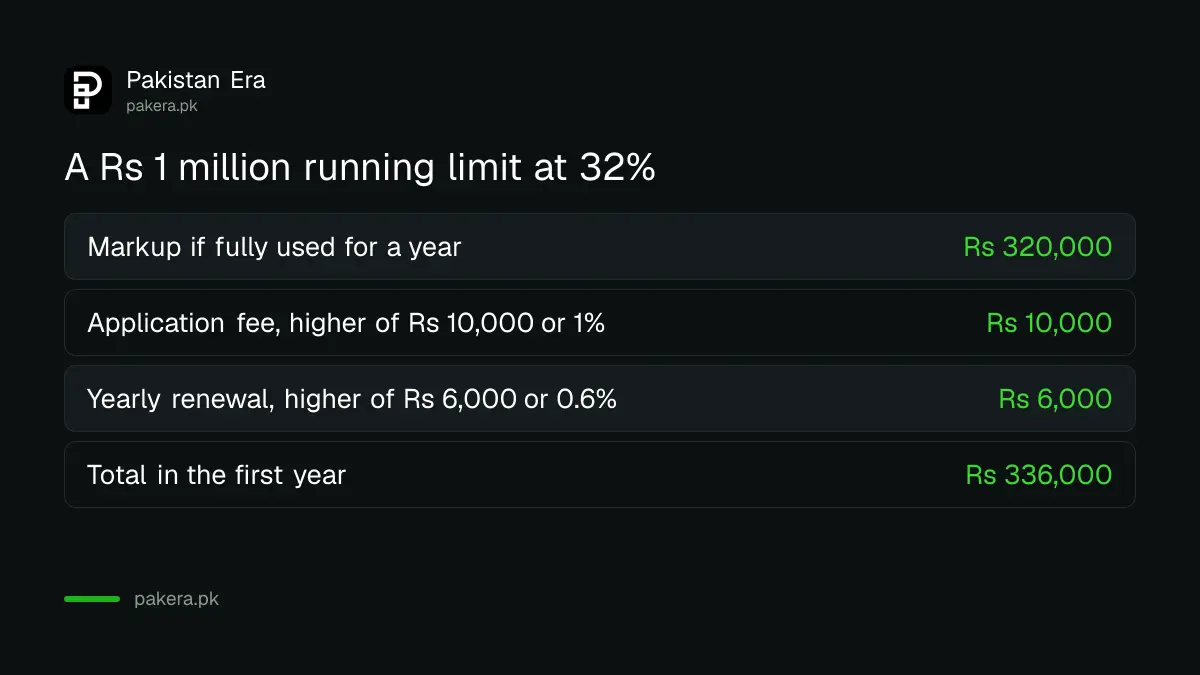
Running finance works like an overdraft. You pay markup only on the amount you use, each day. HBL's Asaan Finance charges 32% a year. If you use the full Rs 1 million all year, the markup is Rs 320,000, or about Rs 26,667 a month.
- Markup: Rs 1,000,000 x 32% = Rs 320,000 a year.
- Application fee: Rs 10,000 or 1% of the limit, whichever is higher. At Rs 1 million, that is Rs 10,000.
- Yearly renewal: Rs 6,000 or 0.6% of the limit, whichever is higher. At Rs 1 million, that is Rs 6,000.
- Total in the first year at full use: Rs 336,000.
If you use only half the limit on average, the markup halves. The fees do not. That is why a collateral-free loan is costly: you pay for the bank's risk. Check whether a property-backed limit at KIBOR plus a spread is cheaper before you accept it.
SBP refinance schemes offer 5% to 6%, with limits
SBP also runs subsidised schemes that banks lend under. HBL's page lists a working capital scheme for small enterprises and medium ones with sales up to Rs 300 million. It lends up to Rs 25 million and Rs 50 million for 1 year at 6%, and a women entrepreneurs scheme up to Rs 5 million at 5%.
Both carry "or as per latest SBP directives", so the rate can change. We could not confirm that either scheme is open today. Ask the bank in person. For Punjab's own programme, see Asaan Karobar Finance. For the federal youth scheme, see the PM Youth Business Loan.
What SBP requires banks to do for you
SBP's July 2026 rules give borrowers five protections. A bank must decide a complete application within 15 working days. It must give you a standard application form and a list of documents up front. It must explain terms in English and Urdu. It must check your e-CIB credit report. And it must run an SME helpline.
If the bank misses a deadline, you can complain through the SBP Sunwai portal. Keep the acknowledgement number that every application should receive.
Documents you need and how to apply
Expect to bring your CNIC, 12 months of bank statements, proof of the business, and property papers if you pledge property. Papers that prove the business exists help. A trade licence and, for a sole proprietor, FBR registration make the application stronger. An NTN is useful too.
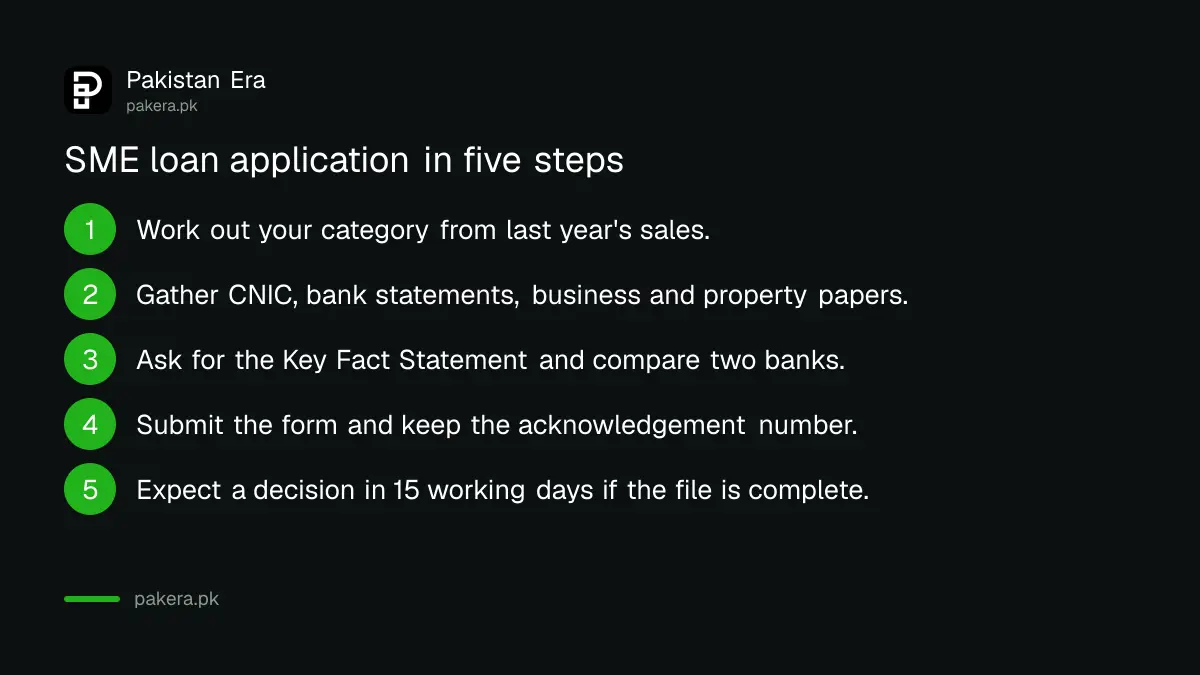
- Work out your category from last year's sales.
- Gather the CNIC, bank statements, business proof and property papers.
- Ask the bank for its Key Fact Statement and compare two banks.
- Submit the form and keep your application acknowledgement number.
- Expect a decision within 15 working days if your file is complete.
A smaller loan can start from a personal product. Our personal loan bank comparison shows those rates. If you are selling online first, how to start an online store needs little capital.
Common questions
What counts as an SME in Pakistan?
A business with yearly sales above Rs 30 million and up to Rs 2,000 million. Up to Rs 30 million is micro, above Rs 400 million is medium.
Can I get an SME loan without collateral?
Yes, up to Rs 50 million under SBP's clean limit. HBL Asaan Finance offers up to Rs 10 million with no collateral at 32%.
How long does a bank take to approve an SME loan?
SBP's rule is 15 working days for a complete application with full KYC and financial data.
Do I need a bank account for the loan?
Usually yes. HBL's Asaan Finance requires an HBL account for 2 years, and Bank Alfalah's Karobar Finance wants 3 times the limit as turnover in your account.
Can a start-up get an SME loan?
SBP's rules classify any enterprise up to 5 years old as a start-up. The bank pages we read still ask for 3 years of business history, so ask about SBP refinance schemes.
How we verified this
What we checked, where we read it, and what we could not confirm.
Last checked 7 October 2026. The definitions, limits and turnaround times come from the State Bank of Pakistan Prudential Regulations for SME Financing, updated 16 July 2026, Part I and Regulations R-5, R-9, R-13 and R-16. Bank terms come from HBL's Asaan Finance, Small Business Finance and SBP refinance schemes pages, UBL's Karobar Loan page and FAQ, and Bank Alfalah's Karobar Finance and Quick Finance pages. KIBOR is from the SBP home page (5 October 2026). Banks not listed either did not publish SME terms we could open or blocked our check. Rates and fees change, so confirm in the Key Fact Statement. This is not financial advice.
About the author

Senior Writer, Public Services and Technology
Shahid joined us in 2024 as an author. He is a senior contributor to Pakistan's leading technology websites. He writes detailed articles, mostly covering his expertise in the latest tech, mobiles, apps, gadgets, and step-by-step guides. His ideology is to help people understand the latest trends and explain complex methods through very easy-to-understand guides.