Sindh Drought Relief: Rs 8,000 a Family for Tharparkar and Umerkot, First Instalment by 1 December
Sindh orders Rs 5.3 billion drought relief: Rs 8,000 a family in Tharparkar and Umerkot in three instalments via BISP, first by 1 December. How to check.
یہ صفحہ اردو میں پڑھیں
Sindh Chief Minister Syed Murad Ali Shah on 22 November 2026 ordered the immediate release of a Rs 5.3 billion drought relief package for Tharparkar and the desert areas of Umerkot. Each eligible family gets Rs 8,000 in three instalments, due by 1 December, 1 January and 1 February, paid through the BISP payment system.
The package was first announced by the Sindh government this week, at the launch of its wheat growers programme. The 22 November meeting at CM House in Karachi set the timetable and told officials to start work. Farmers in the area also get a fertiliser subsidy and an extra payment for wheat.
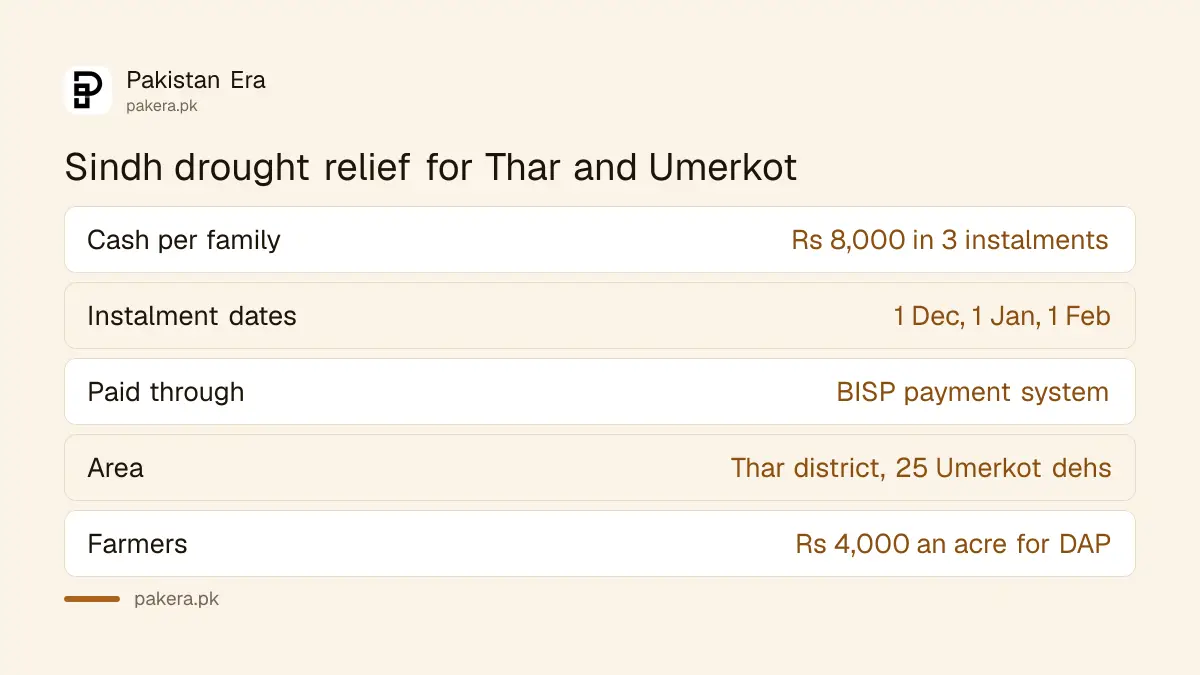
Rs 8,000 a family, in three instalments by 1 February
The cash part pays Rs 8,000 to each eligible household in the drought areas. It is split into three instalments. The first is due by 1 December 2026, the second by 1 January 2027 and the third by 1 February 2027. The money is meant for flour and animal fodder.
| Point | What the Sindh government announced |
|---|---|
| Total package | Rs 5.3 billion |
| Cash per family | Rs 8,000, in three instalments |
| First instalment | By 1 December 2026 |
| Second instalment | By 1 January 2027 |
| Third instalment | By 1 February 2027 |
| Payment channel | BISP payment system, as announced |
| Area in Tharparkar | Whole district except 9 canal-irrigated dehs of Kaloi taluka (proposed) |
| Area in Umerkot | 25 desert dehs (proposed) |
| Farmers | Rs 4,000 an acre for DAP, Rs 2,000 a maund extra for wheat sold to the Food Department |
A deh is the smallest revenue unit in Sindh, roughly a village area. The list of dehs is part of a proposed calamity declaration, which the Board of Revenue and the Relief Department are working on. Once it is notified, it fixes exactly which villages are covered.
This is a change from what was known on 11 November. Then, BISP's chairperson said Sindh had a package ready, but gave no amount or date. Our earlier report on the Tharparkar drought aid and the BISP score cut-off covers that first statement and the BISP tehsil offices in the district.
Families in the BISP database are the ones being counted
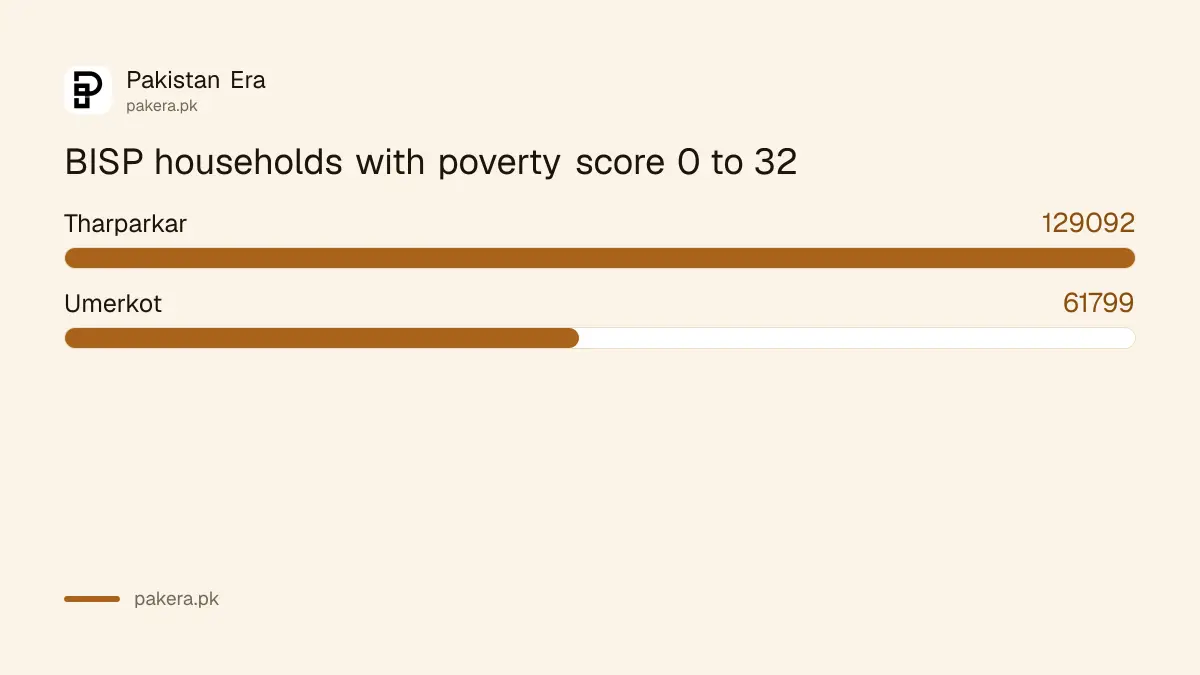
The Sindh government is using BISP's household survey to choose families. At the 22 November meeting, officials reviewed BISP data for Tharparkar and Umerkot by poverty score, known as the PMT score, and were told to check it and avoid paying the same family twice.
BISP scores every surveyed home from 0 to 100. A lower score means a poorer home. The figures reviewed at the meeting were:
| District | Households with score 0 to 32 | Households with score 0 to 40 |
|---|---|---|
| Tharparkar | 129,092 | 192,931 |
| Umerkot | 61,799 | 80,735 |
The Sindh government has not announced which of these two bands will be paid. In practice, a family that is not in the BISP survey at all cannot be picked, whatever the band. So the first job is to make sure your household is on the BISP record with a current survey. BISP's normal Kafaalat line is a score below 32, as set out in the guide to the BISP Kafaalat cut-off score.
How to check your family before 1 December
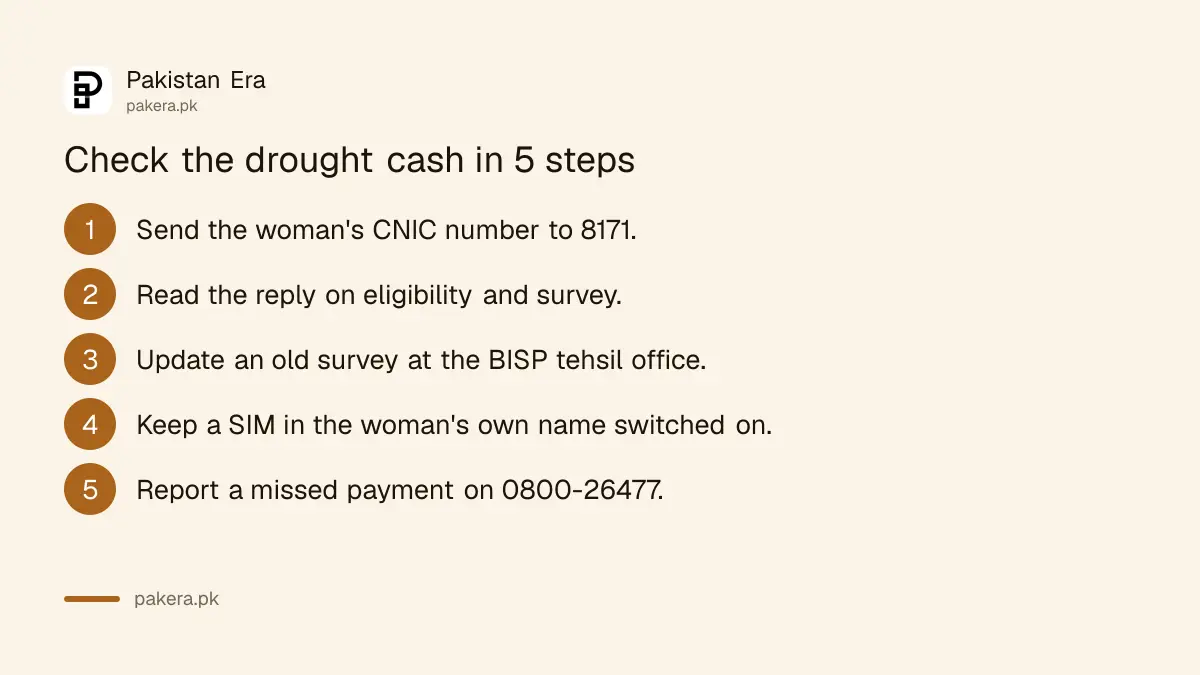
There is no separate form for the drought cash. Families are being picked from BISP's data, so the check is your BISP record. Send the woman head of family's CNIC number to 8171, BISP's only official SMS number, and read the reply.
- Type the 13 digit CNIC number of the woman head of the family, with no dashes, in an SMS.
- Send it to 8171 from any mobile network.
- Read the reply. It tells you whether your household is eligible for BISP and whether your survey needs updating.
- If your survey is old or missing, go to your BISP tehsil office with the CNICs of all family members and get the dynamic survey done.
- Keep a SIM registered in the woman's own name and keep it switched on, because BISP sends payment messages from 8171.
Each reply message is explained in the guide to the BISP 8171 eligibility check. Ignore any SMS that offers drought money from another number. BISP warns that only 8171 is its own.
Farmers get Rs 4,000 an acre for DAP and Rs 2,000 a maund on wheat
The second part of the relief is for growers. Wheat farmers with up to 25 acres get Rs 4,000 an acre to buy DAP fertiliser, based on their checked wheat area. Farmers who sell wheat to the Sindh Food Department get Rs 2,000 a maund extra on what they actually deliver.
These two payments are part of the Sindh Wheat Growers Support Programme 2026 to 27, which covers the whole province, not only the drought areas. The government also set a wheat buying price of Rs 4,500 a maund for this season. The 22 November meeting confirmed that drought-hit growers in Thar and Umerkot receive the same support.
Last year the programme paid farmers through the Benazir Hari Card. Registration rules and eligibility are in the guide to the Sindh wheat growers subsidy, and the card check is in the Benazir Hari Card status check.
What to do if you are left out or an agent asks for money
If the 8171 reply says you are not eligible, or your survey is missing, visit the BISP tehsil office first. If the first instalment has not arrived by early December, ask there too, or call the BISP helpline 0800-26477. Never pay anyone for a place on the list.
The Chief Minister asked for transparent and timely payment and told the Chief Secretary to coordinate the Relief Department, Board of Revenue, Finance Department, the district administrations and BISP. Complaints about cuts at the payment point are covered in the guide to illegal BISP deductions by agents. The full Rs 8,000 is yours. No agent may keep any part of it.
Common questions
How much is the Sindh drought relief for Tharparkar?
Rs 8,000 for each eligible family, paid in three instalments, from a Rs 5.3 billion package that also covers the desert areas of Umerkot.
When will the first instalment come?
By 1 December 2026. The second is due by 1 January 2027 and the third by 1 February 2027.
Do I need to apply for the drought money?
No form has been announced. Families are being chosen from BISP's household data, so a current BISP survey is what matters.
Is Umerkot city included?
The proposal covers 25 desert dehs of Umerkot district, not the whole district. The final list comes with the calamity notification.
Will this stop my BISP Kafaalat payment?
No. The drought cash is a Sindh government payment made through BISP's system. It is extra to Kafaalat, not a replacement.
Where do I complain if I am missed?
At your BISP tehsil office, on the BISP helpline 0800-26477, or at the district administration in Mithi or Umerkot.
How we verified this
What we checked and where we read it.
The package, the instalment dates, the dehs, the household figures and the farmer payments are from the Sindh government's announcement at the Wheat Growers Support Programme launch and the Chief Minister's review meeting at CM House, Karachi, on 22 November 2026, as reported on 21 to 23 November 2026. Delivery through BISP is as announced. We checked the BISP website and the PDMA Sindh website on 23 November 2026. PDMA's latest drought item there is the 12 November review of drought preparedness for Tharparkar and Umerkot. Last checked 23 November 2026, 20:30 PKT.
About the author

Public Services and Education Journalist
Fajr Riaz is a journalist and content writer at Pakistan Era, based in Lahore. She covers the questions people meet in everyday life in Pakistan: how a public service works, what a change in the rules means, and where to find a reliable answer.