Pakistan Reports 4,616 Suspected Hepatitis B, C and D Cases in a Week, Sindh 4,363
Pakistan reported 4,616 suspected hepatitis B, C and D cases in week 39 of 2026, up from 4,048, NIH says. Sindh sent 4,363. See lab results and free tests.
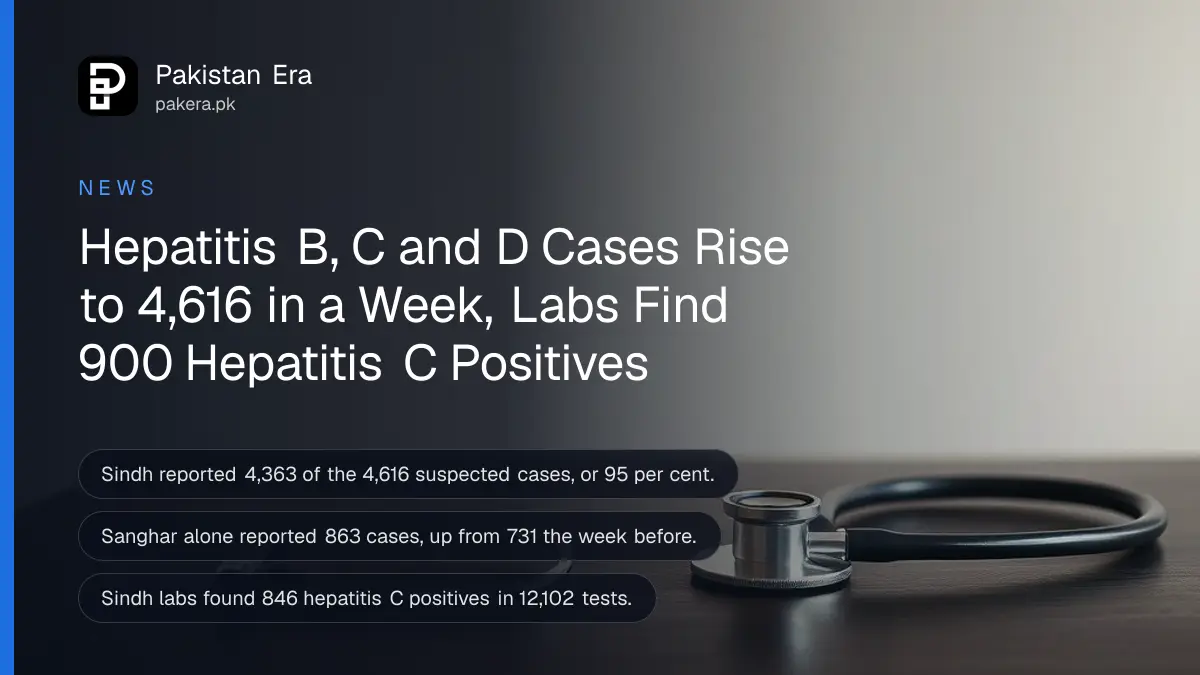
Short answer: Pakistan reported 4,616 suspected hepatitis B, C and D cases in week 39 of 2026, up from 4,048 the week before, the National Institutes of Health (NIH) says. Sindh sent 4,363 of them, or 95 per cent, and Sanghar alone reported 863. Labs found 900 hepatitis C positives in one week. A free blood test is the next step for anyone who has never been screened.
The NIH put the week 39 bulletin online on Friday 16 October 2026. We downloaded the week 39 and week 38 PDFs and read every table ourselves. The NIH reports the three blood-borne viruses as one group, called VH (B, C and D). Punjab did not report its case counts, so the national total leaves out the largest province.
Hepatitis B, C and D rose to 4,616 cases in week 39
The national count went from 4,048 in week 38 to 4,616 in week 39, a rise of 568, or 14 per cent, our arithmetic. Week 37 had 4,693, so the week 38 fall has been almost fully reversed. The bulletin lists viral hepatitis B, C and D among the diseases that increased this week at national level and in Khyber Pakhtunkhwa and Sindh.
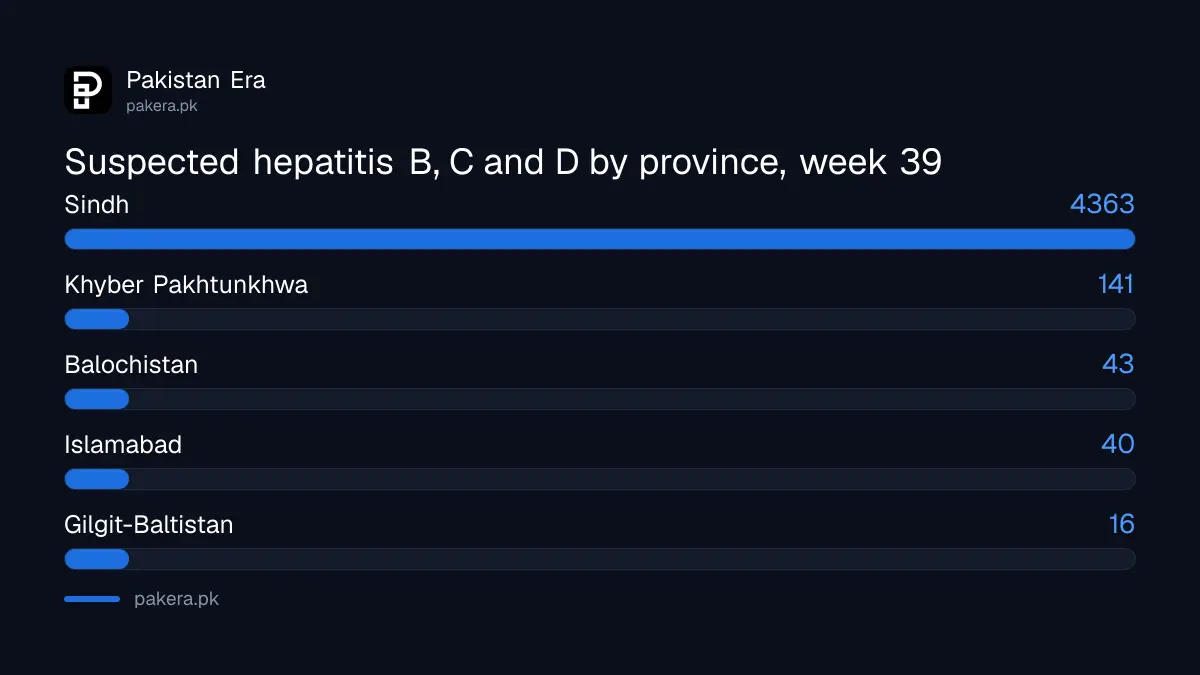
| Province or area | Week 38 | Week 39 | Change |
|---|---|---|---|
| Sindh | 3,794 | 4,363 | up 569 |
| Khyber Pakhtunkhwa | 123 | 141 | up 18 |
| Balochistan | 67 | 43 | down 24 |
| Islamabad | 10 | 40 | up 30 |
| Gilgit-Baltistan | 39 | 16 | down 23 |
| Azad Jammu and Kashmir | 15 | 13 | down 2 |
| Punjab | not reported | not reported | |
| Pakistan | 4,048 | 4,616 | up 568 |
On the standard week calendar, week 39 runs from 21 to 27 September 2026. Sindh's dominance in this table is partly real and partly a reporting effect. The province has by far the most reporting sites and the highest compliance, at 100 per cent in week 39, so it counts more of what it sees. The week 38 hepatitis count showed the same pattern.
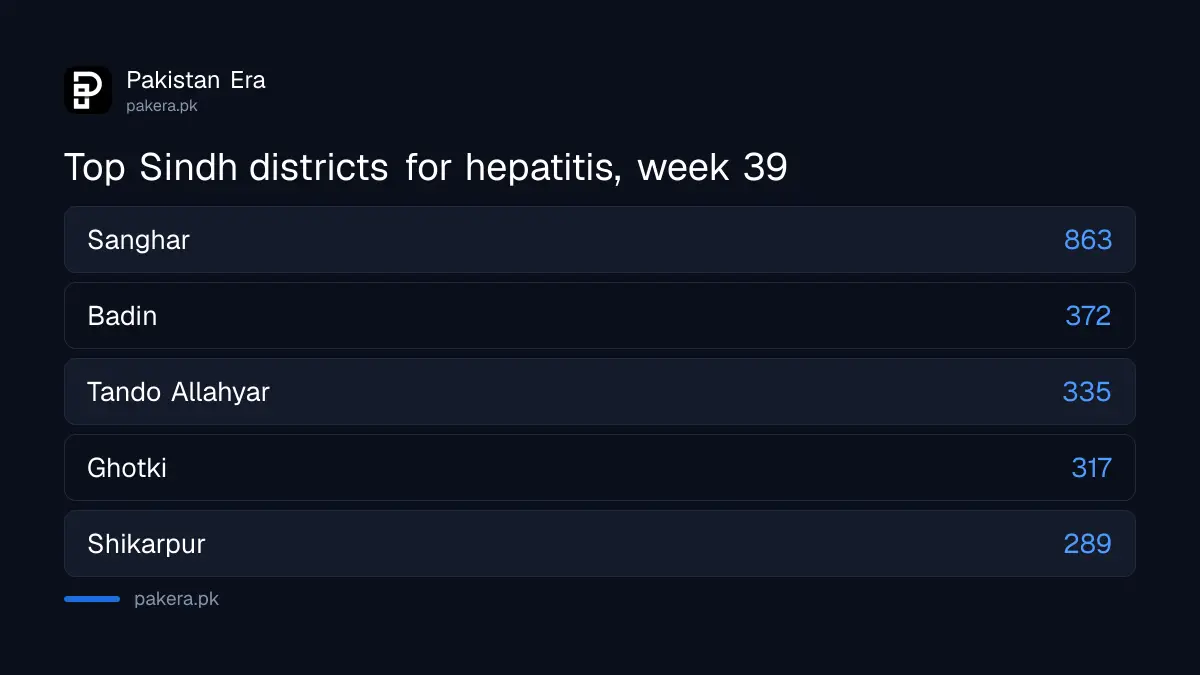
Sanghar alone reported 863 cases
Sanghar sent 863 of Sindh's 4,363 suspected cases, almost a fifth of the province. Badin reported 372, Tando Allahyar 335, Ghotki 317 and Shikarpur 289. The top five districts together reported 2,176 cases, half of Sindh's total, our arithmetic. Karachi's seven districts reported only 90 between them.
| Sindh district | Week 39 cases |
|---|---|
| Sanghar | 863 |
| Badin | 372 |
| Tando Allahyar | 335 |
| Ghotki | 317 |
| Shikarpur | 289 |
| Dadu | 280 |
| Sukkur | 271 |
| Khairpur | 223 |
| Jacobabad | 200 |
| Matiari | 187 |
| Karachi, all seven districts | 90 |
Sanghar's 863 is up from 731 in week 38, and it has led the table in both weeks. Within Karachi, Central reported 58, West 17, East and Malir 7 each, Korangi 1, and Keamari and South none. The gap between rural Sindh and Karachi is the same one seen in the malaria and diarrhoea tables, and it reflects where the reporting sites are as much as where the virus is.
Labs found 900 hepatitis C positives across four regions
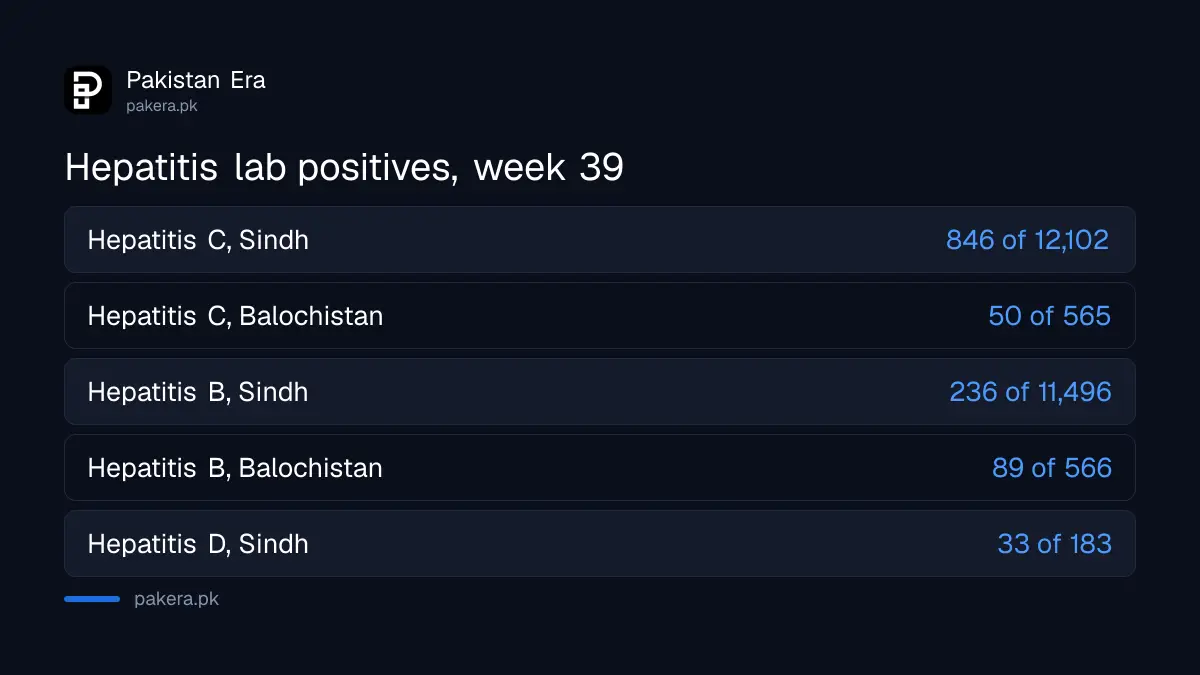
Public health laboratories tested 24,426 samples for hepatitis C in week 39 and found 900 positive, our sum across the four regions that report. Sindh's labs found 846 positives in 12,102 tests, a rate of 7 per cent. Balochistan found 50 in 565, Gilgit-Baltistan 3 in 1,725 and Azad Kashmir 1 in 34.
| Virus and lab region | Tested | Positive |
|---|---|---|
| Hepatitis C, Sindh | 12,102 | 846 |
| Hepatitis C, Balochistan | 565 | 50 |
| Hepatitis C, Gilgit-Baltistan | 1,725 | 3 |
| Hepatitis B, Sindh | 11,496 | 236 |
| Hepatitis B, Balochistan | 566 | 89 |
| Hepatitis B, Gilgit-Baltistan | 1,943 | 18 |
| Hepatitis D, Sindh | 183 | 33 |
For hepatitis B the four regions found 344 positives: 236 in Sindh, 89 in Balochistan, 18 in Gilgit-Baltistan and 1 in Azad Kashmir. Balochistan's hepatitis B rate of 16 per cent, 89 of 566, is the highest in the table. Hepatitis D, which only infects people who already have hepatitis B, was positive in 33 of 183 Sindh samples and 18 of 93 in Balochistan.
Hepatitis A and E fell to 595
The water-borne viruses, hepatitis A and E, are counted separately as AVH (A and E). They fell from 631 in week 38 to 595 in week 39. Sindh reported 380, Khyber Pakhtunkhwa 186, Balochistan 20 and Azad Kashmir 9. Sindh's lab found 60 hepatitis A positives in 251 tests and 4 hepatitis E positives in 85.
These two viruses spread through dirty water and food, cause jaundice, and clear on their own in most people. Hepatitis E is dangerous in pregnancy. What jaundice and dark urine mean, and when to go to hospital, is in the guide on how to check jaundice for hepatitis A or E.
Get a free test and the hepatitis B vaccine
Hepatitis B and C spread through blood: unsterilised syringes, razors at the barber, unscreened transfusions and dental tools. Most people carry the virus for years without symptoms, which is why the World Health Organization (WHO) says testing is the first step. These steps are ours, built on the WHO fact sheets and the free programmes we have checked.
- Get a free screening test at a government hospital or a hepatitis control programme clinic.
- If the screening is positive, ask for a PCR test to confirm active infection before treatment.
- Hepatitis C is cured in most people with a three-month tablet course, provided free under the provincial programmes.
- Hepatitis B is controlled, not cured, with daily tablets, and your household should be vaccinated.
- Get the three-dose hepatitis B vaccine if you have never had it. Babies get it free in the EPI schedule.
Where the free clinics are and what to bring is in the guide to free hepatitis tests and treatment. The adult vaccine doses and where to get them are in the adult vaccine schedule.
Common questions about the week 39 hepatitis figures
How many hepatitis cases did Pakistan report in week 39 of 2026?
4,616 suspected hepatitis B, C and D cases, up from 4,048 in week 38, according to the NIH bulletin published on 16 October 2026. Punjab is not included.
Why is Sindh so high?
Sindh reported 4,363 of the 4,616. It has the most reporting sites and 100 per cent reporting compliance, so it counts more of what it sees. Rural districts such as Sanghar and Badin lead.
How many were confirmed by a lab?
Labs in four regions found 900 hepatitis C positives, 344 hepatitis B positives and 51 hepatitis D positives in week 39.
Is hepatitis C curable?
Yes. WHO says more than 95 per cent of people are cured with a course of direct-acting antiviral tablets, which the provincial programmes provide free.
Is there a hepatitis C vaccine?
No. There is a vaccine for hepatitis B, given in three doses, and it also protects against hepatitis D. There is none for hepatitis C.
How we verified this
What we checked, where we read it, and what we could not confirm.
Last checked 19 October 2026. All case counts and lab results come from Table 1, Table 2 and Table 5 of the NIH Integrated Disease Surveillance and Response bulletins for weeks 38 and 39 of 2026, listed on the NIH weekly bulletin page. The week 39 PDF carries a server date of 16 October 2026. The lab sums, percentages and district totals are our own arithmetic. Treatment and vaccine facts are from the WHO hepatitis C fact sheet and the WHO hepatitis B fact sheet. We could not verify why Punjab sends no case count, or the exact dates of the reporting week.
About the author

Tax, Bills and Technology Writer
Ali Akhtar is a young and curious voice here at Pakistan Era. He is currently pursuing his A-Levels and has a growing interest in Pakistan’s changing industrial landscape and educational trends. Ali likes to write in a way that helps him explain and explore the world around him. His writing reflects the perspective of the new generation navigating the evolving trends of Pakistan where technology, youth innovation, and shifting opportunities are reshaping the country’s future.