Pakistan's July 2026 Interest Bill Hit Rs 792.9 Billion, Up 62 Percent
Finance Division data shows federal interest payments of Rs 792.9 billion in July 2026, up from Rs 490.4 billion. See the deficit and the primary surplus too.
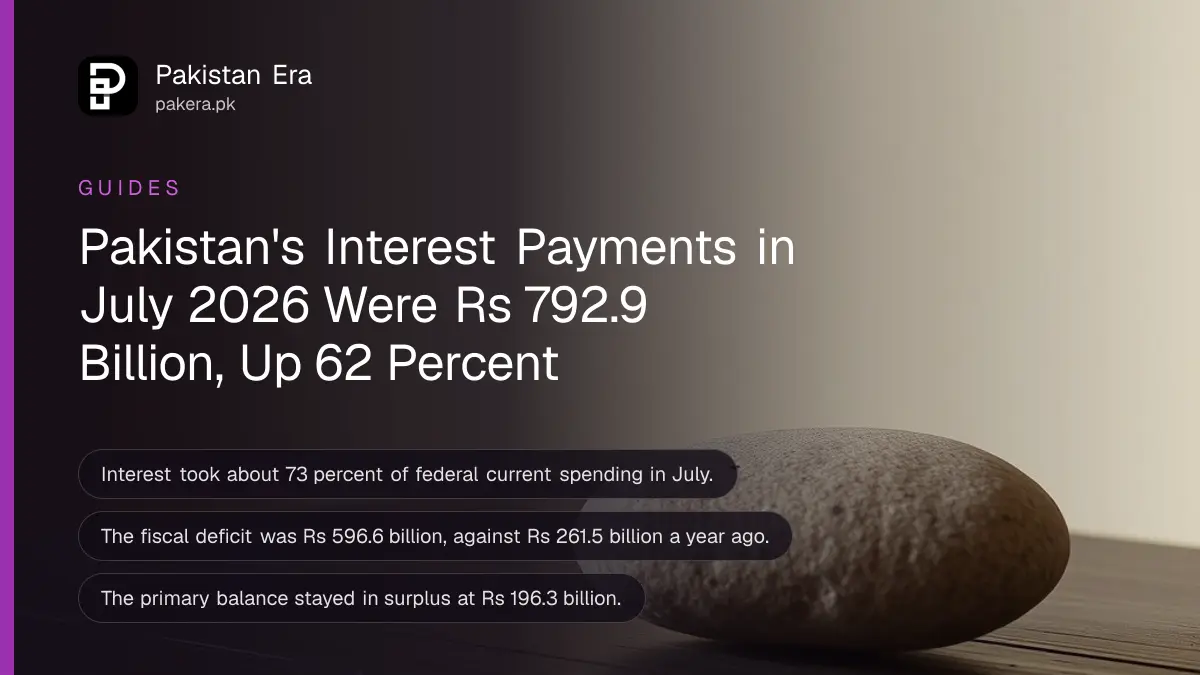
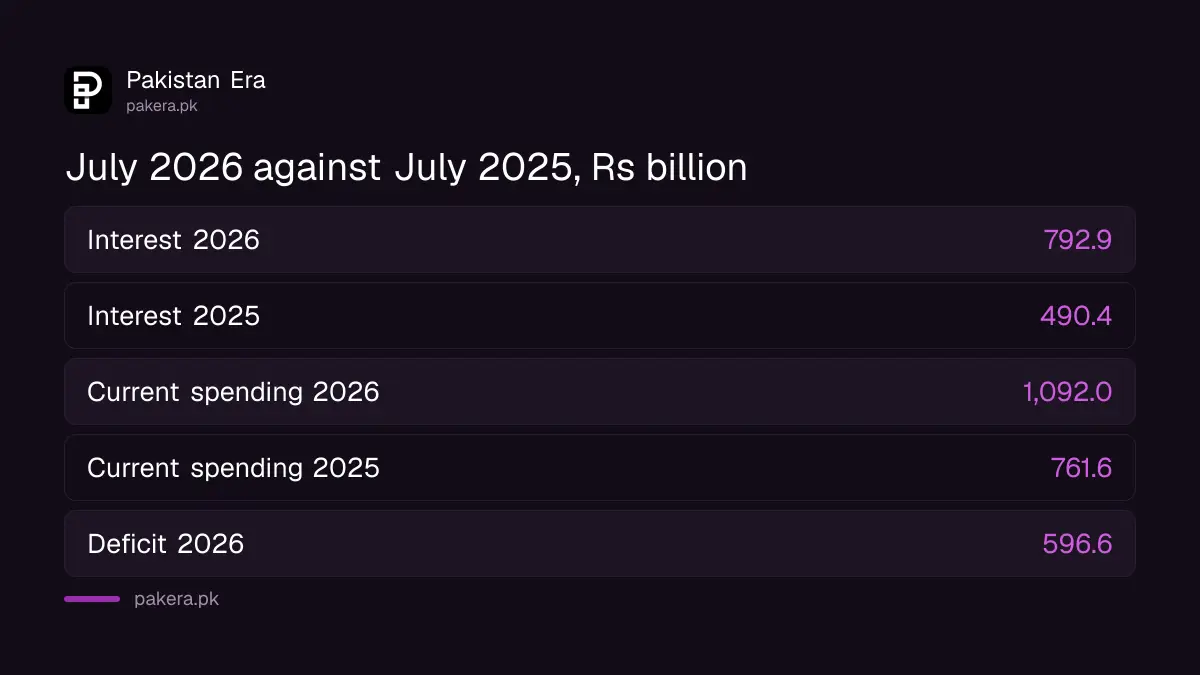
Pakistan's federal government paid Rs 792.9 billion in interest in July 2026, up about 62 percent from Rs 490.4 billion in July 2025. That is roughly 73 percent of all current federal spending for the month, according to the Finance Division.
Interest, also called markup, is what the government pays on its borrowing. We read the Finance Division's Monthly Economic Update and Outlook for September 2026 on 21 October 2026. All figures cover July, the first month of the 2026-27 fiscal year, unless we say otherwise.
Interest rose from Rs 490.4 billion to Rs 792.9 billion in a year
The Finance Division reports current federal spending of Rs 1,092.0 billion in July 2026, against Rs 761.6 billion a year earlier. Interest payments alone were Rs 792.9 billion. Non-interest current spending was Rs 299.1 billion, up 10.3 percent.
| July, Rs billion | 2025 | 2026 |
|---|---|---|
| Interest payments | 490.4 | 792.9 |
| Other current spending | n/a | 299.1 |
| Total current spending | 761.6 | 1,092.0 |
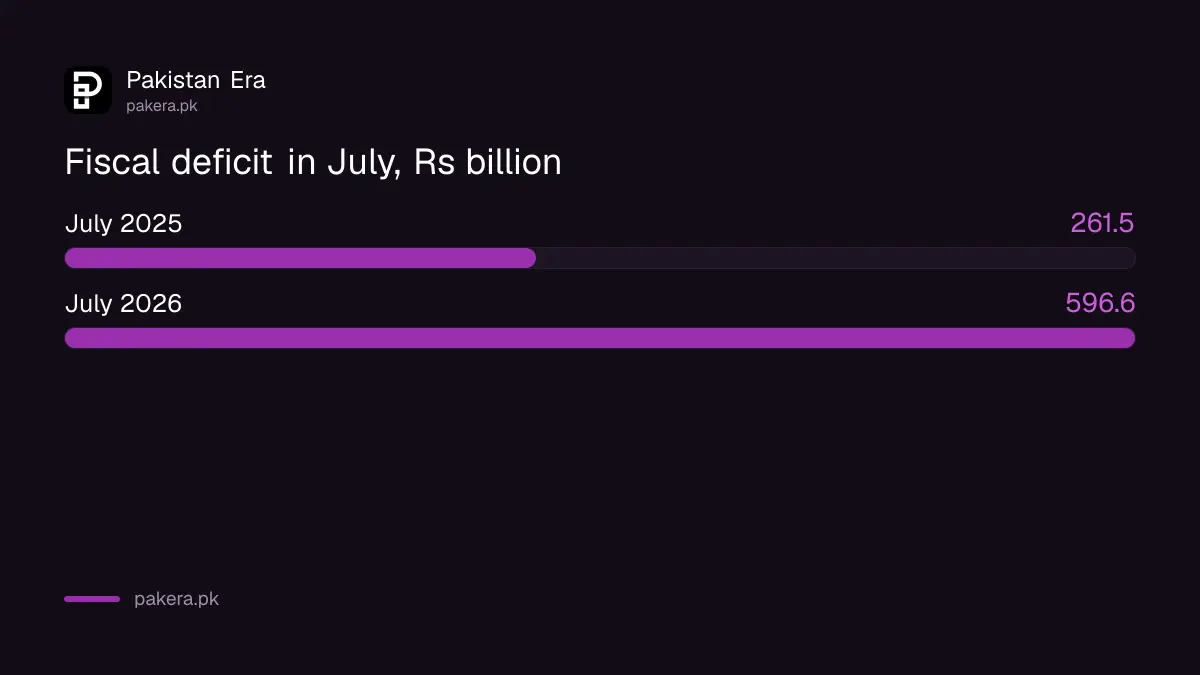
| Fiscal deficit | 261.5 | 596.6 |
| Primary surplus | 228.9 | 196.3 |
Our arithmetic: 792.9 divided by 490.4 is 1.617, so interest grew 61.7 percent. Total current spending grew 43.4 percent. Interest is 72.6 percent of the July 2026 total. In plain terms, almost three of every four rupees of current spending went to lenders.
The deficit more than doubled but the primary balance stayed positive
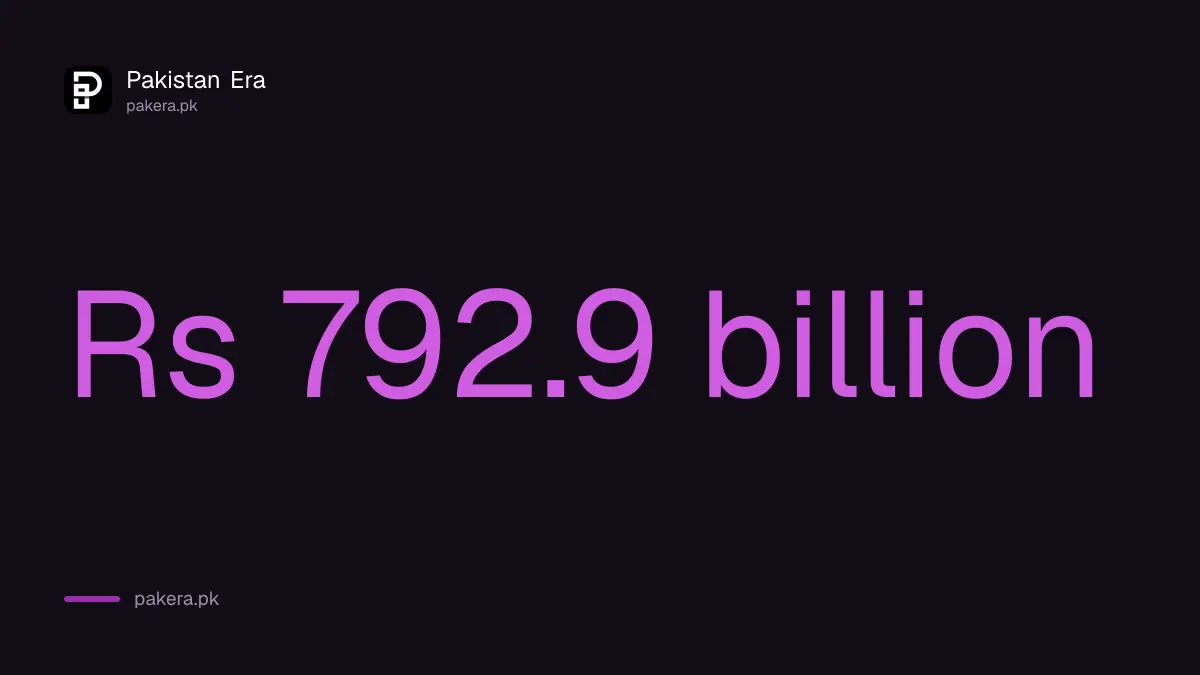
The consolidated fiscal deficit was Rs 596.6 billion, or 0.4 percent of GDP, against Rs 261.5 billion, or 0.2 percent, a year earlier. The primary balance, which leaves out interest, stayed in surplus at Rs 196.3 billion.
The primary surplus means revenue covered all spending except interest. It was Rs 228.9 billion in July 2025, so it is lower this year. The Finance Division says the higher deficit comes from substantially larger markup payments.
One month is not a full year, and timing may matter
July is a single month. The update says only that markup payments rose substantially, and it does not explain the timing. Some payments can fall in one month this year and another month last year. We have not checked that, so we do not call this a trend.
For the full-year picture, our report on the budget's Rs 8.05 trillion interest plan shows what the government expects to pay across 2026-27. The stock of debt behind it is in our report on central government debt in August 2026.
Revenue growth was mostly sales tax
FBR net tax collection was Rs 1,722.4 billion in July and August, up 3.7 percent from Rs 1,661.5 billion. Sales tax rose 13.8 percent to Rs 718.9 billion. Direct tax fell 2.9 percent to Rs 689.6 billion, and customs fell 4.0 percent to Rs 195.9 billion.
So revenue is growing far more slowly than interest. That is why the deficit widened even with a primary surplus. Last year's full picture is in our report on the 2025-26 fiscal deficit of Rs 3.31 trillion.
Markup is the cost of past borrowing, so it is hard to cut quickly
Interest is what the government owes on money it has already borrowed. It cannot be skipped or delayed without serious consequences, so when it rises, other spending has to give way or revenue has to rise. That is why a large interest line limits what any budget can do for schools, hospitals or roads.
The July numbers show the squeeze in miniature. Non-interest current spending was only Rs 299.1 billion, less than half the interest bill. For every rupee spent on running government services and subsidies in July, about two and a half rupees went to lenders. That ratio is our arithmetic, 792.9 divided by 299.1, and it covers current spending only, not development projects.
The Finance Division presents the primary surplus as proof that the government is living within its means before interest. That is a fair reading of its numbers. Both facts are true at once: the government covered its running costs, and its debt costs are heavy.
Read a fiscal table in four steps
Anyone can read these tables without a finance degree.
- Find the total current spending line for the month.
- Find the interest line and divide it by the total.
- Compare the primary balance with the fiscal deficit: the gap is interest.
- Always check the same month a year earlier, not the month before.
Common questions
How much interest did Pakistan pay in July 2026?
The federal government paid Rs 792.9 billion, up from Rs 490.4 billion in July 2025, per the Finance Division.
What was the fiscal deficit in July 2026?
It was Rs 596.6 billion, or 0.4 percent of GDP, against Rs 261.5 billion a year earlier.
Is there still a primary surplus?
Yes. The primary surplus was Rs 196.3 billion in July 2026, lower than Rs 228.9 billion a year ago.
Why did interest payments jump?
The Finance Division reports a substantial increase in markup payments but gives no reason. We did not verify the timing of payments.
Does this affect ordinary taxpayers?
Interest is paid from government revenue, so more interest leaves less for other spending. The effect on any one household is not measured in the source.
How we verified this
What we checked, where we read it, and what we could not confirm.
On 21 October 2026 we read the Finance Division's Monthly Economic Update and Outlook for September 2026, listed on the Finance Division website with the date 30 September 2026. We could not confirm why interest jumped in July, and we did not check August figures.
About the author

Global Affairs & Political Economy Writer
Muhammad Hatim is a book lover who started writing because he enjoys it. At Pakistan Era he writes about international relations, geopolitics and the global economy, with a particular interest in South Asia and the forces behind current events.