Three Pakistani Sailors Killed in a Red Sea Attack on Their Ship
Deputy PM Ishaq Dar confirmed the deaths on a commercial vessel struck in Bab el-Mandeb. Some reports say two. What is known so far.
Three Pakistani sailors have been killed in an attack on a commercial ship in the Red Sea, Deputy Prime Minister and Foreign Minister Ishaq Dar confirmed.
The vessel was struck while navigating Bab el-Mandeb, the narrow strait at the southern mouth of the Red Sea. A fire broke out and the ship took extensive damage. One Indonesian crew member was also killed.
Then, as rescuers were evacuating the ship, it was struck a second time.
What is confirmed
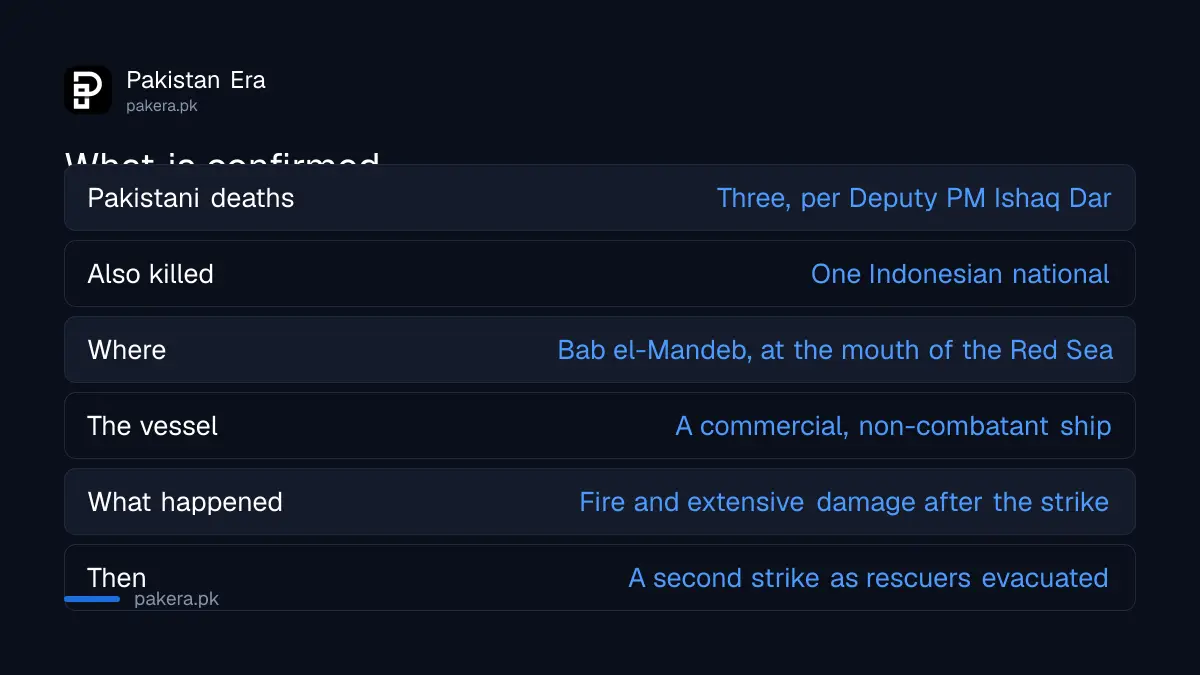
| Detail | Position |
|---|---|
| Pakistani deaths | Three, per Ishaq Dar |
| Other deaths reported | One Indonesian national |
| Location | Bab el-Mandeb strait |
| Vessel type | Commercial, non-combatant |
| Damage | Fire and extensive damage |
| Second strike | During the evacuation |
Dar condemned the attack, saying it endangered innocent lives, violated international law and posed a serious threat to freedom of navigation, maritime security and the safety of commercial shipping in the Red Sea.
Some reports say two, not three
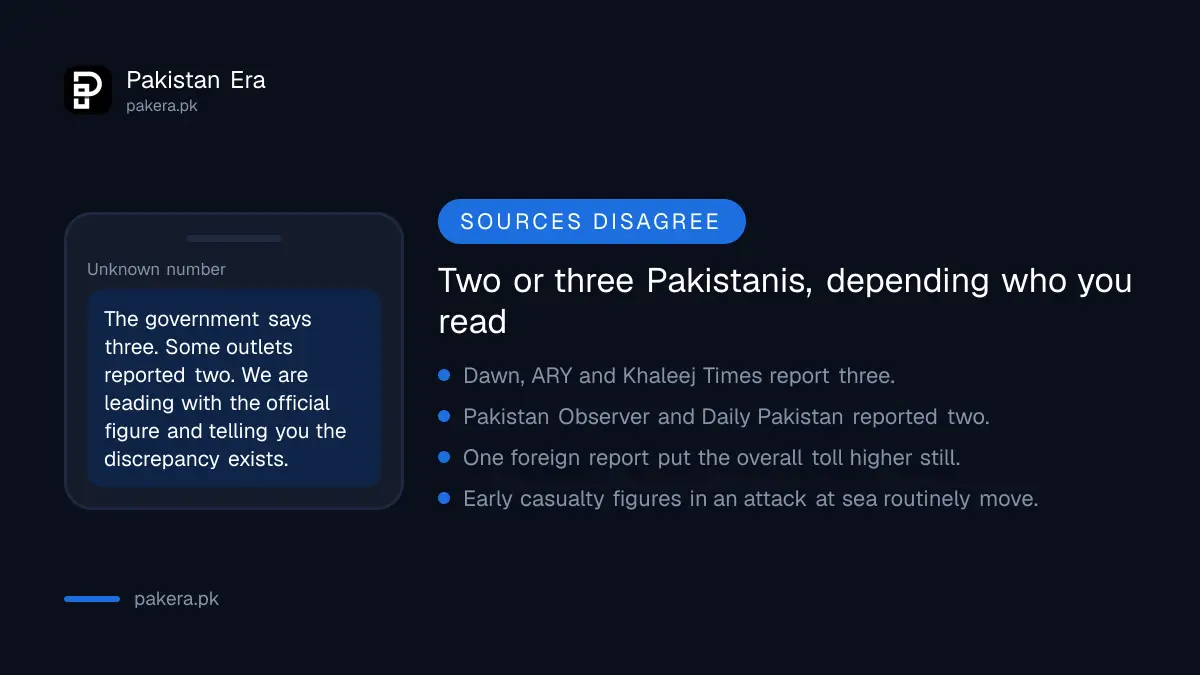
We are being straight with you about a discrepancy rather than picking the version that reads better.
Dawn, ARY News, Khaleej Times and Al Bawaba report three Pakistani nationals killed, which is the figure Pakistan's own foreign minister gave.
Pakistan Observer and Daily Pakistan reported two.
A separate foreign report put the overall death toll on the vessel higher than the Pakistani and Indonesian deaths combined.
We are leading with the government's own number because it is the most authoritative available. Early casualty counts after an attack at sea move often, particularly when some of the crew are injured or missing rather than confirmed dead, and it would not be surprising if this figure changes again.
We are not naming the ship or the dead
You may see a vessel name and crew details circulating. We are leaving both out.
The ship's nationality is described differently in different reports and we could not confirm it. More importantly, naming seafarers before we know their families have been informed is not something we do, and a name confirmed by nobody is how a family learns from Facebook.
If the Foreign Office or the operator releases details, that becomes a different article.
Why ships keep sailing through that strait
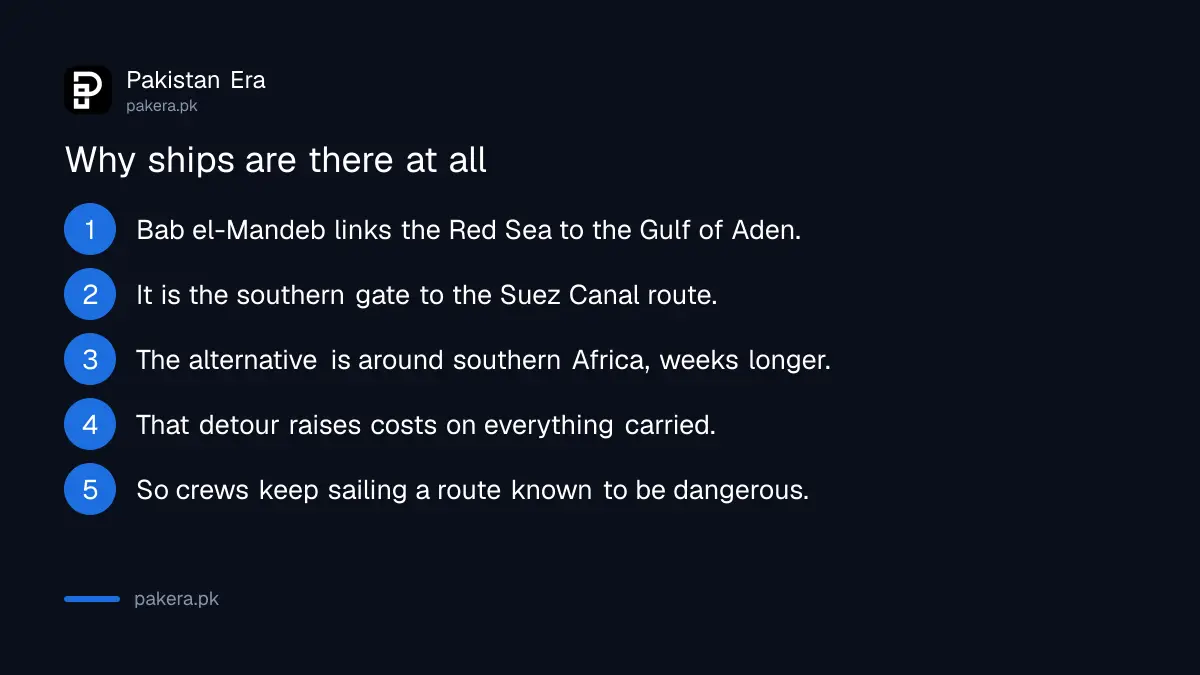
The obvious question is why a commercial vessel was in a waterway known to be dangerous. The answer is geography and money.
- Bab el-Mandeb connects the Red Sea to the Gulf of Aden. It is roughly twenty miles wide at its narrowest.
- It is the southern gate to the Suez Canal. Everything moving between Asia and Europe by that route passes through it.
- The alternative is around southern Africa. That adds thousands of miles and, depending on the route, one to two weeks.
- Those weeks cost money. Fuel, crew time, charter rates and insurance all rise, and the cost lands on the goods carried.
- So ships keep going. The decision is made in an office. The risk is carried by the crew.
That last point is the reason this is a Pakistani story rather than a foreign one.
The people at risk are workers
Pakistanis work throughout the world's merchant fleet, as officers, engineers and ratings, on ships owned and flagged anywhere.
They are not party to any conflict. They are employees on a vessel whose route was decided commercially, and when a missile hits, the nationality of the crew is incidental to whoever fired it.
We are not going to put a number on how many Pakistanis are at sea at any moment, because we could not verify one. What can be said without a statistic is that seafaring is a significant source of foreign earnings for Pakistani families, and that the risk attached to it changed when this route became a target.
Whether Pakistani crews on foreign-flagged vessels have any practical protection, or any right to refuse a route, is a real question and not one this article can answer today.
For workers leaving Pakistan through formal channels, the state body responsible is the Protector of Emigrants, whose role and limits we set out in our guide to the Protector of Emigrants. Seafarers recruited directly by foreign operators frequently sit outside that system entirely, which is part of the problem.
Families of Pakistanis working abroad often deal with documentation issues at exactly the worst moment, and the identity papers involved are covered in NICOP and POC for overseas Pakistanis.
What happens next
Pakistan has condemned the attack through its foreign minister. What that produces in practice is unclear, since the vessel, the operator and the waters involved are all outside Pakistani jurisdiction.
The things worth watching are whether the Foreign Office confirms the final toll and the identities, whether any support is arranged for the families, and whether Pakistan raises the safety of its seafarers with the shipping industry rather than only condemning the attack.
We will update this piece as the position becomes clearer, and we will say so on the page when we do, as set out in our corrections policy.
Questions readers are asking
How many Pakistanis were killed?
Deputy Prime Minister and Foreign Minister Ishaq Dar confirmed three Pakistani nationals killed. Some outlets reported two. Early casualty figures after an attack at sea frequently change.
Where did the attack happen?
In the Bab el-Mandeb strait, the narrow waterway connecting the Red Sea to the Gulf of Aden.
Was the ship a warship?
No. It is described as a commercial, non-combatant vessel, which is the basis of Pakistan's condemnation.
Was there really a second attack?
According to the reporting, a second strike targeted the vessel while rescue workers were carrying out an evacuation.
Why was the ship in a dangerous area?
Bab el-Mandeb is the southern approach to the Suez Canal. Avoiding it means routing around southern Africa, which adds thousands of miles and considerable cost.
Have the victims been named?
Not in anything we could verify. We are not publishing names or the vessel's identity until they are officially released.
What has Pakistan said?
Dar condemned the attack as endangering innocent lives, violating international law and threatening freedom of navigation and maritime security.
About the author

Senior Writer, Public Services and Technology
Shahid joined us in 2024 as an author. He is a senior contributor to Pakistan's leading technology websites. He writes detailed articles, mostly covering his expertise in the latest tech, mobiles, apps, gadgets, and step-by-step guides. His ideology is to help people understand the latest trends and explain complex methods through very easy-to-understand guides.