How to Pay a Customs Fine to Keep Confiscated Goods in Pakistan: Section 181
When Customs orders goods confiscated, the officer may let you pay a fine in lieu under section 181. See your notice rights, the total you pay and appeal time.
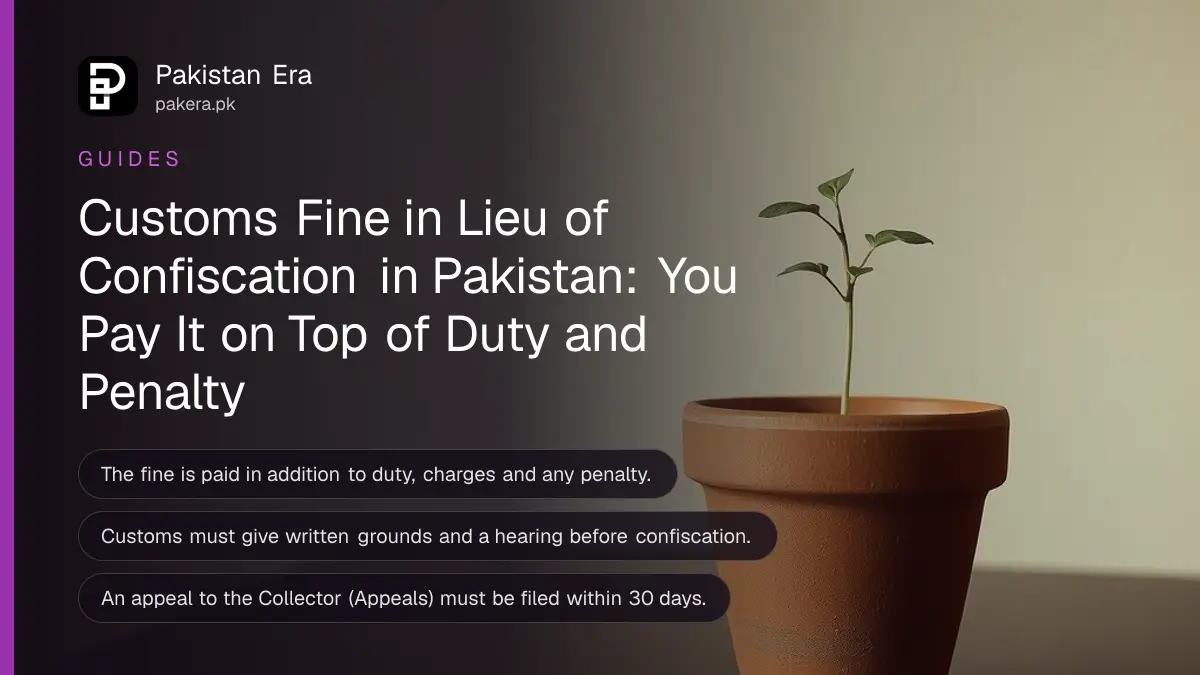
When Customs orders your goods confiscated, the officer may give you the option to pay a fine and keep them. This is section 181 of the Customs Act, 1969. The fine is on top of the duty and any penalty, and the officer must first give you a written show cause notice and a hearing under section 180.
A trader's container is held, or a traveller's imported items are seized. The order says confiscation. The next question is whether the goods are lost or can be redeemed. The Act gives the officer a discretion, not a right to you, and it sets out when that discretion can be narrowed.
We read sections 180 to 182 and 193 of the Customs Act, 1969, as amended up to 30 June 2026, on FBR's website on 21 October 2026. We did not find an FBR page that lists fine amounts, so none are given here.
Customs must warn you and hear you before it confiscates
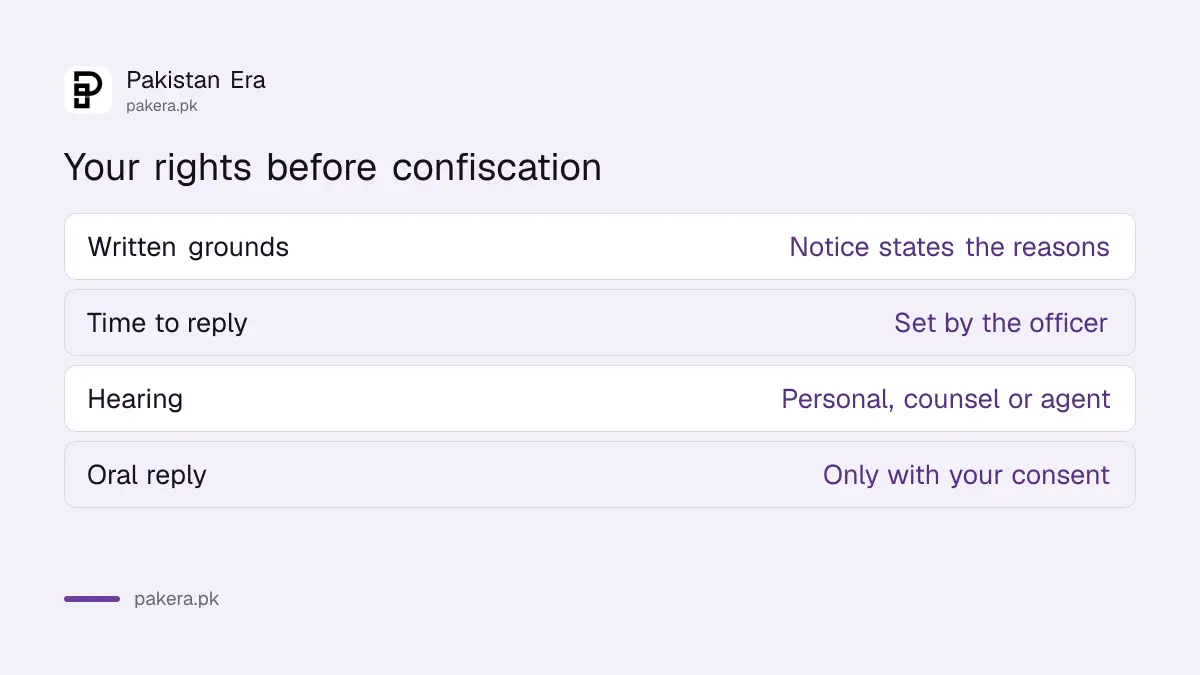
Section 180 says no order for confiscation or penalty may be passed unless the owner is told in writing of the grounds, gets a chance to answer in writing within a reasonable time the officer sets, and gets a reasonable chance to be heard personally or through a counsel or authorised agent.
If you consent in writing, the notice or the answer may be oral. Do not give that consent casually. A written reply is the record you will rely on later, as the guide on contesting an overstayed cargo penalty shows.
| Right under section 180 | What it means for you |
|---|---|
| Written grounds | The notice must say why Customs proposes confiscation or penalty |
| Time to reply | A reasonable period set by the officer |
| Hearing | You, a counsel or an authorised agent may be heard |
| Oral shortcut | Only if you consent or prefer it in writing |
The fine in lieu is the officer's choice, not your right
Section 181 says that whenever a confiscation order is passed, the officer may give the owner an option to pay a fine in place of confiscation, as the officer thinks fit. The word is may. The Act sets no fixed percentage or scale.
The first proviso lets the Board, by order, name goods or classes of goods for which the option shall not be given. The second proviso lets the Board fix the fine for goods imported in violation of section 15 or of a notification under section 16, or in violation of other provisions of the Act or other law. In those cases the amount may already be set.
You pay the fine plus the duty and any penalty
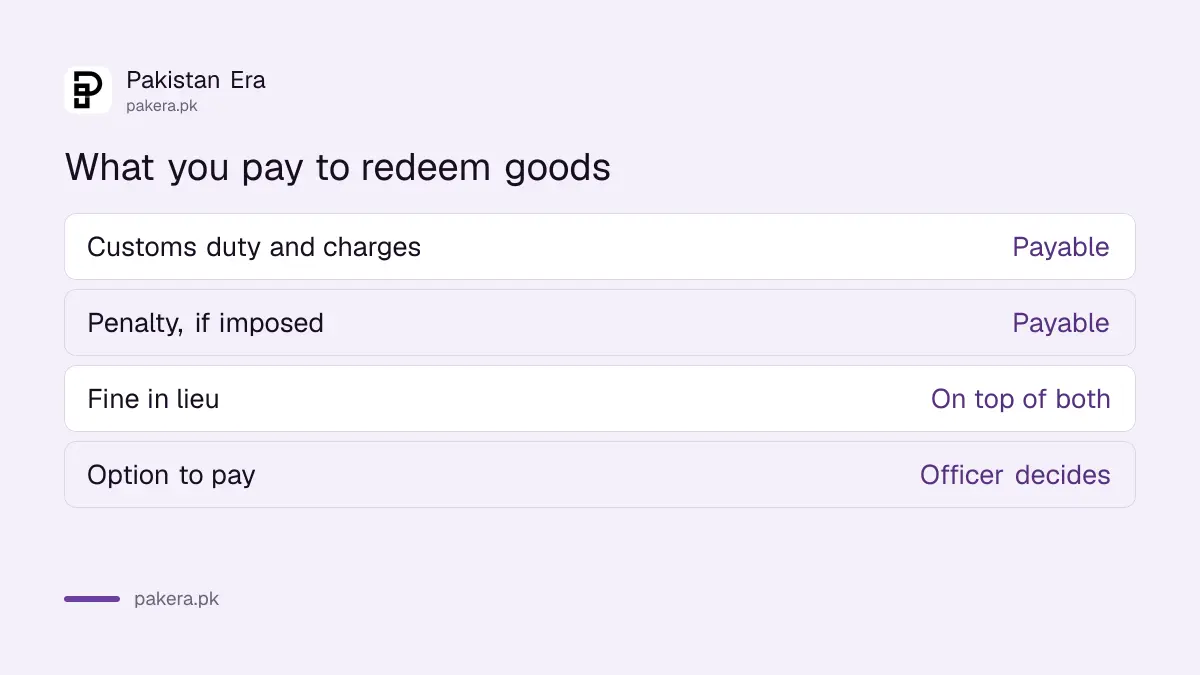
The Explanation to section 181 says the fine in lieu is in addition to the duty and charges payable on the goods, and to any penalty imposed along with confiscation. So the total is duty, plus penalty if any, plus the fine.
Take a made-up example, not a real rate: goods with Rs 300,000 of duty, a penalty of Rs 50,000 and a fine of Rs 200,000 cost Rs 550,000 to redeem. The point is that the fine alone is not the price of release.
If you do not get the option, confiscated goods vest in the government
Section 182 says confiscated goods vest in the Federal Government once confiscated, and an authorised officer takes and holds possession. After that they are no longer yours. They can later be sold, as described in the guide to bidding in a Customs auction.
So the order is the moment to act. Read it for three things: whether the option was given, the amount of the fine, and the time allowed to pay. If the option was not given and the goods are not on the Board's list of excluded goods, that is a ground to raise on appeal.
You can appeal the order within 30 days
Section 193 lets a person aggrieved by an order under section 179, by an officer below the rank of Additional Collector, appeal to the Collector (Appeals) within 30 days of communication. The fee is Rs 1,000. The full steps are in the guide to a Collector (Appeals) appeal.
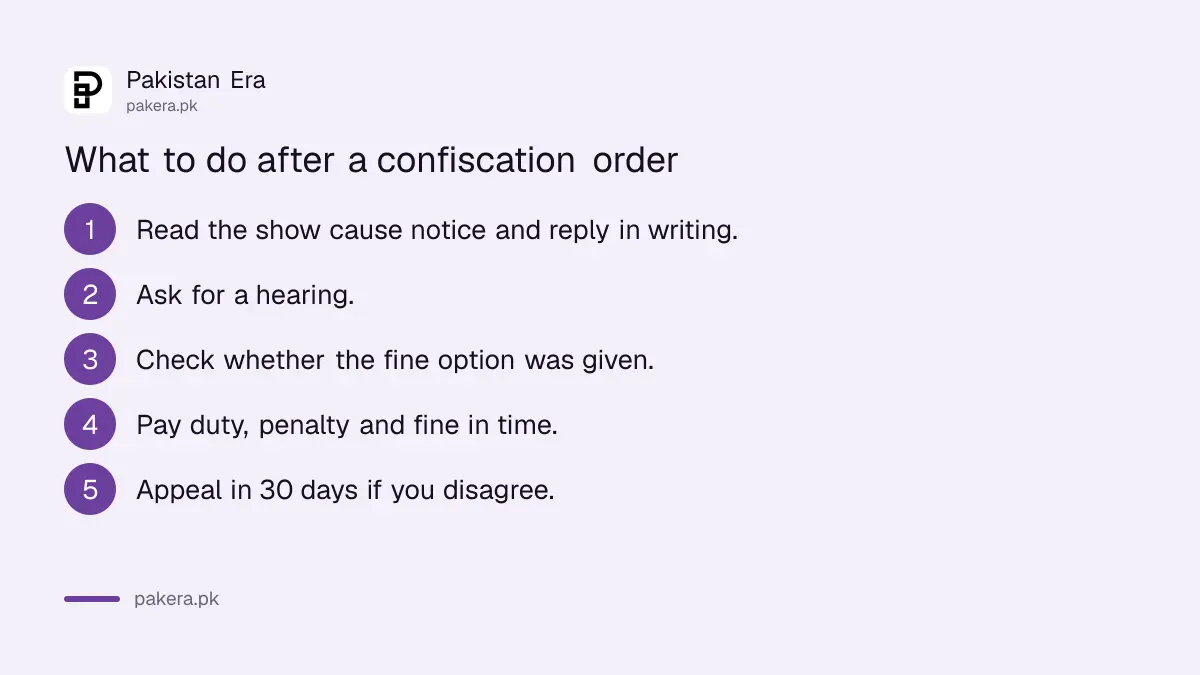
- Read the show cause notice and mark the reply date.
- Reply in writing and ask for a personal hearing through a counsel or agent.
- Keep invoices, the goods declaration and payment proof ready.
- When the order arrives, check whether the option to pay a fine was given.
- If it was, pay duty, penalty and fine in the time allowed and get a receipt.
- If you disagree, appeal within 30 days with the Rs 1,000 fee.
Common questions about the fine in lieu of confiscation
What is a fine in lieu of confiscation?
It is a payment that lets you keep goods Customs has ordered confiscated, under section 181 of the Customs Act, 1969.
Can Customs refuse to give the option?
Yes. The section says the officer may give it, and the Board can bar the option for named goods.
Is the fine the only amount I pay?
No. The Explanation says it is in addition to duty, charges and any penalty.
Does Customs have to give me a notice first?
Yes. Section 180 requires written grounds, time to reply and a chance to be heard before a confiscation or penalty order.
How long do I have to appeal?
30 days from communication of the order to the Collector (Appeals), if the officer was below Additional Collector rank.
Who decides the amount of the fine?
The officer passing the order, unless the Board has fixed it for goods imported in violation of section 15 or a section 16 notification.
How we verified this
What we checked, where we read it, and what we could not confirm.
Last checked 21 October 2026. We read sections 180, 181, 182 and 193 of the Customs Act, 1969 on FBR's website on that date. We could not verify any Board order listing goods excluded from the option, or any Board order fixing fine amounts, because we did not find one published. The example in the body is our own made-up arithmetic, not a real case. Ask a customs clearing agent or lawyer about your own goods.
About the author

Senior Writer, Public Services and Technology
Shahid joined us in 2024 as an author. He is a senior contributor to Pakistan's leading technology websites. He writes detailed articles, mostly covering his expertise in the latest tech, mobiles, apps, gadgets, and step-by-step guides. His ideology is to help people understand the latest trends and explain complex methods through very easy-to-understand guides.