PCB Coaching Courses 2026-27: How to Become a Certified Cricket Coach in Pakistan, Level 1 to 3
The PCB plans 6 Level 1, 2 Level 2 and 1 Level 3 coaching course in 2026-27, and Level 1 now lasts 5 years. See who each course is for and how to apply.
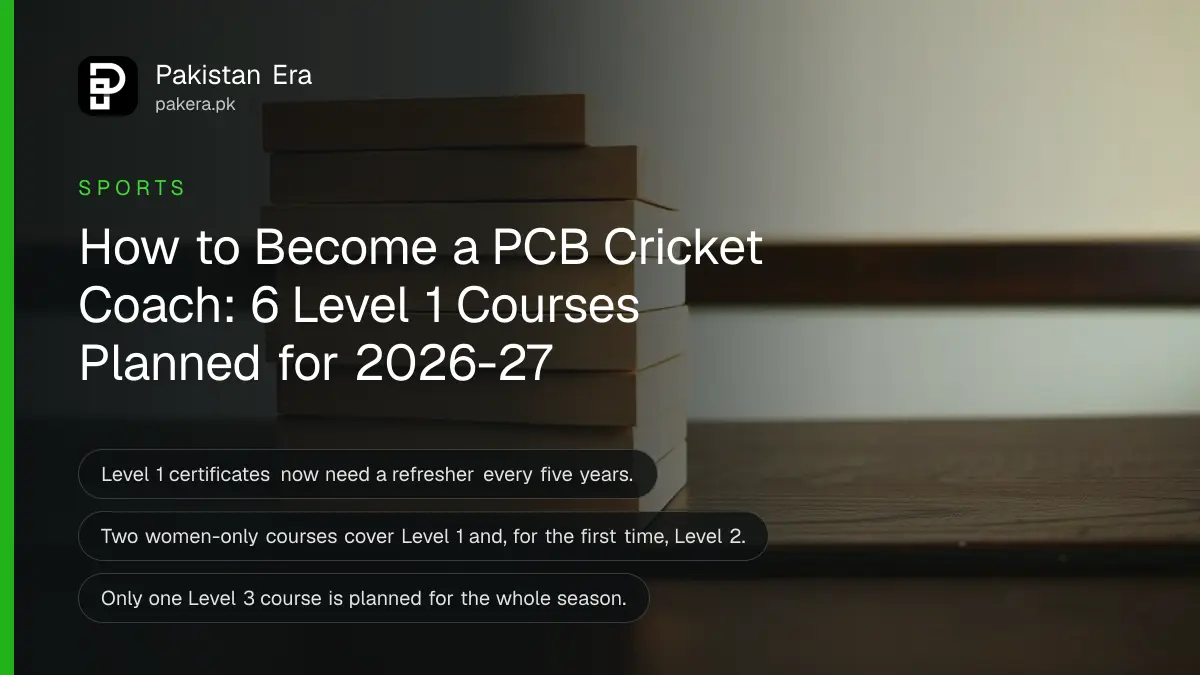
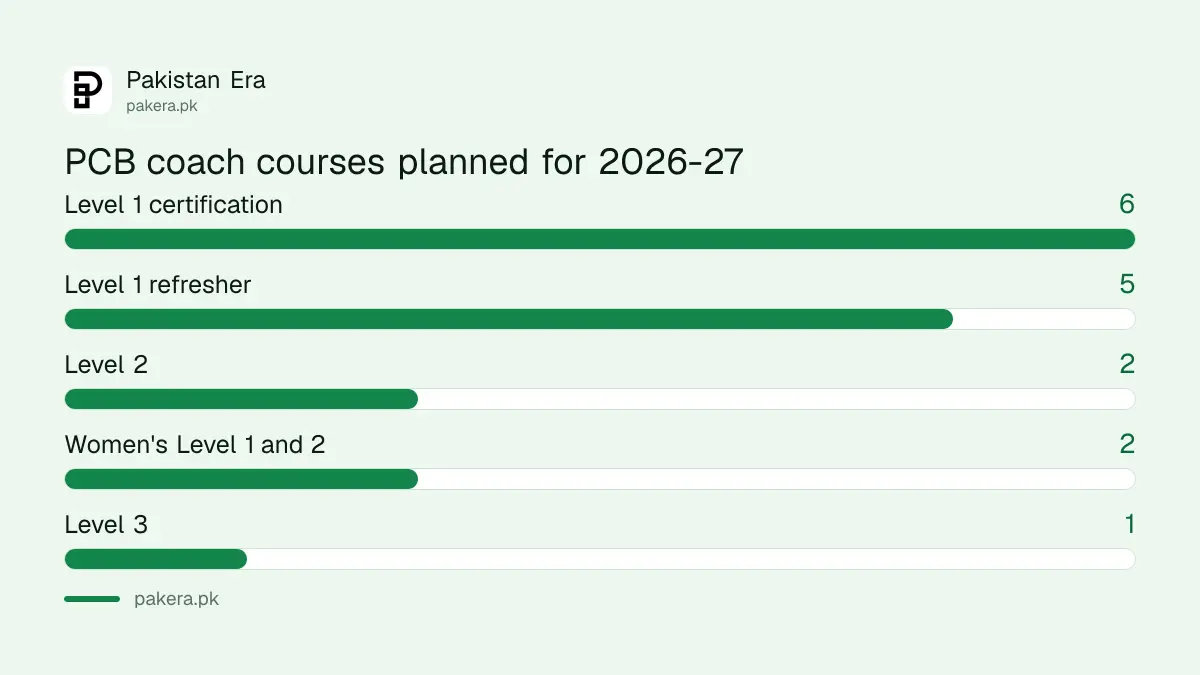
To become a certified cricket coach in Pakistan, you start with the PCB Level 1 course, then move to Level 2 and Level 3. The Pakistan Cricket Board (PCB) plans 6 Level 1 courses for the regions in 2026-27, 2 Level 2 courses, 1 Level 3 course and, for the first time, 5 Level 1 refresher courses because Level 1 now has 5 years' validity.
We read the PCB Coach Education page and its 2026-27 schedule on 20 October 2026. The schedule gives the number of courses, not the dates, venues or fees. Those you have to get from the PCB's Coach Education department, and we explain how below.
The PCB plans 21 coach courses and events in 2026-27
The 2026-27 schedule lists nine kinds of course or event. Added up, that is 21 sessions across the season, from a two-phase tutor workshop at the National Cricket Academy (NCA) in Lahore to the PCB's first coaching conference.
| Course or event, 2026-27 | How many | Who it is for |
|---|---|---|
| Level 1 certification course (revamped) | 6 | New coaches, held for the regions |
| Level 1 refresher course (new) | 5 | Level 1 coaches renewing their licence |
| Level 2 coaching course (revamped) | 2 | Certified Level 1 coaches |
| Level 1 and 2 courses for women | 2 | Women coaches; Level 2 for women is new |
| Level 1 course for school coaches (new) | 2 | Teachers, in Lahore, Karachi and Rawalpindi |
| Level 3 coaching course | 1 | Elite, high performance and first-class coaches |
| Tutor training workshop, two phases, at the NCA | 1 | Coaches who teach the Level 1 and 2 courses |
| Skill coaches specialist course (new) | 1 | Batting, bowling and fielding specialists |
| PCB coaching conference (first ever) | 1 | Coaches and tutors from across Pakistan |
The figure of 21 is our sum of the PCB's numbers. Note how thin the top of the ladder is. Six Level 1 courses feed into just two Level 2 courses and one Level 3 course, so the step up gets harder each time.
Level 1 is the starting point for every new coach
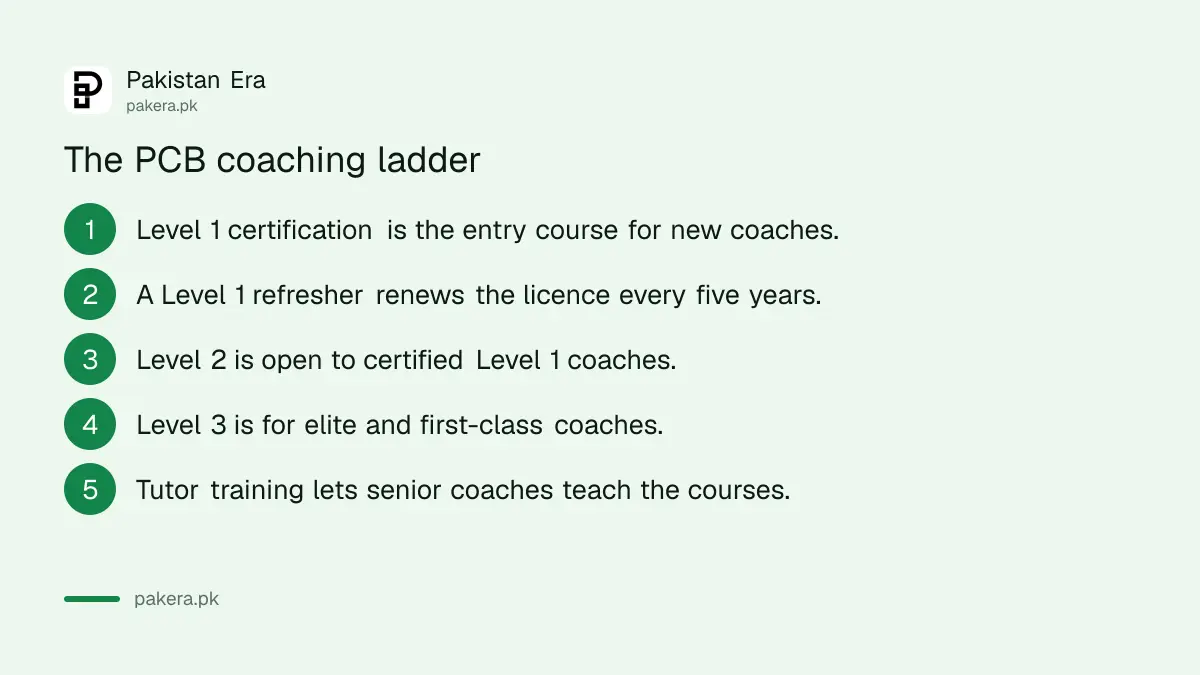
The PCB calls Level 1 the entry-level qualification for new coaches. The revamped course covers batting, bowling, fielding, wicketkeeping, session planning and player safety. You need it before you can take Level 2, and the PCB plans six of these courses for the regions in 2026-27.
Level 1 also matters outside coaching. The PCB's rules for clubs say an Associate Member club must have a coach with at least PCB Level 1 certification. So a club that wants voting rights in its city cricket association needs a Level 1 coach on its books.
Teachers get their own version. The Level 1 course for school coaches is "adapted for teachers", the PCB says, and focuses on safe group management, modified games and spotting talent. Two are planned, at Lahore, Karachi and Rawalpindi. If you run school cricket, this is the one to ask about.
Level 1 now lasts five years and needs a refresher
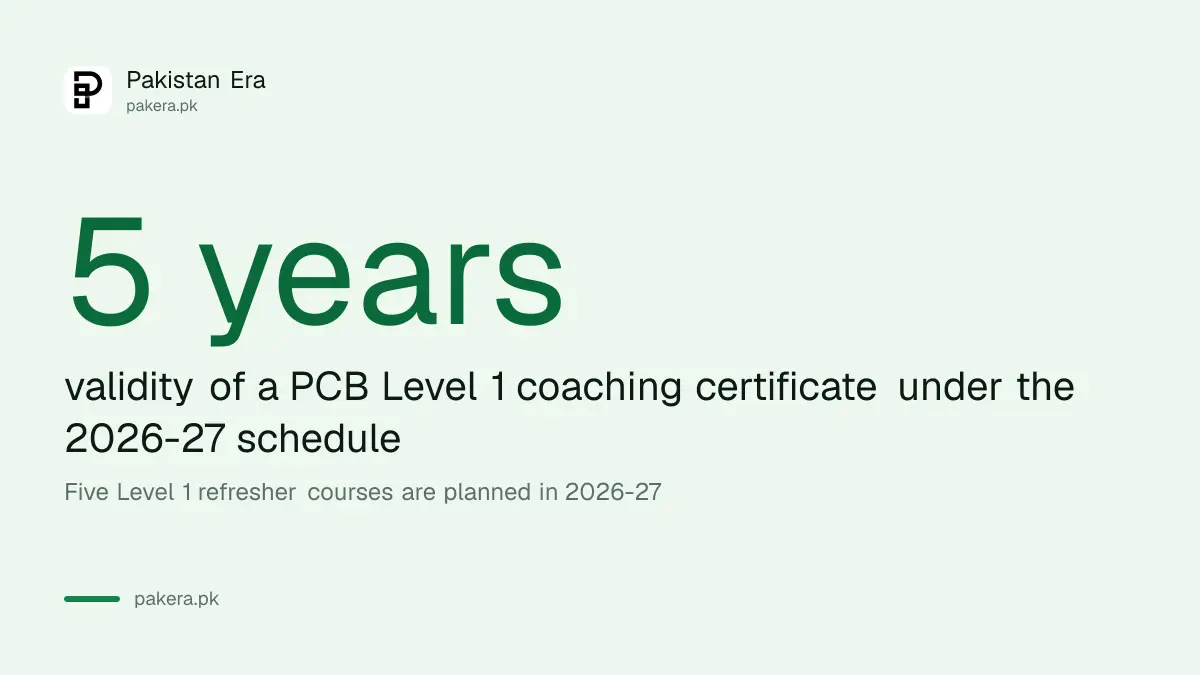
The 2026-27 schedule marks the Level 1 refresher course as a new initiative, with "5 years validity". That means a Level 1 certificate now needs renewing every five years. The refresher covers core content, syllabus changes and on-field practice. Five refreshers are planned.
If you took Level 1 years ago, check the date on your certificate. The PCB page does not say what happens to older certificates or when they lapse, so ask the Coach Education department before you apply for a coaching job or a Level 2 place.
Level 2 and Level 3 are for working coaches
Level 2 is for certified Level 1 coaches and covers technical analysis, tactics, physical and mental preparation and the Athlete Management System. Level 3 is the top course, for elite, high performance and first-class coaches, with video and data analysis and leadership.
The general Coach Education page also lists a Level 2 refresher and final assessment course, which it calls a crucial step for certification. That course is not in the 2026-27 schedule we read. The same page lists a "Level VI" course, which looks like a typing slip, since no Level 4, 5 or 6 appears anywhere else.
Experienced coaches have a shortcut. The PCB offers Recognition of Current Competency (RCC). That means coaches with existing qualifications or long experience can apply to be placed higher on the ladder instead of starting from Level 1.
Women coaches get Level 1 and Level 2 courses of their own
Two courses in 2026-27 are only for women, covering Level 1 and, for the first time, Level 2. The PCB says the content and standards are the same as the open courses. The aim is a bigger pool of qualified women coaches for the women's game in the regions.
The general page also lists an elementary coaching course for women and teachers, for PE teachers and recreational coaches new to cricket. It is not a separate line in the 2026-27 schedule, so ask whether one is running near you. Young players looking for the next step after school can see the PCB U15, U17 and U19 trials, and in Punjab there is help to join a cricket academy.
How to apply for a PCB coaching course
The PCB does not post an online form for these courses. Its Coach Education page asks you to contact the department by email for course dates, places, eligibility and refunds. Write early, because each level runs only once or twice a year.
- Decide your level: Level 1 if you are new, the refresher if your Level 1 is old, Level 2 if you hold Level 1.
- Open the PCB Coach Education page and note the department's email address.
- Email with your full name, CNIC, city, region and any coaching certificate you hold.
- Ask for the next course date and venue, the fee, the eligibility rules and the refund policy.
- If you have years of coaching behind you, ask about Recognition of Current Competency.
- Keep the reply. It is your record if a place or a fee is disputed later.
The PCB page says detailed course locations, eligibility and the refund policy are in policy documents, but the link to them was not working when we checked. So email is, for now, the only route. For other sports, the Pakistan Sports Board runs its own coaching centres in Karachi, Lahore and Peshawar.
Common questions
How do I become a cricket coach in Pakistan?
Take the PCB Level 1 certification course first. It is the entry-level qualification, and six are planned for the regions in 2026-27.
What is the fee for the PCB Level 1 coaching course?
The PCB does not publish it on its website. Ask the Coach Education department by email.
How long is a PCB Level 1 certificate valid?
Five years, under the new refresher scheme in the 2026-27 schedule.
Can women take PCB coaching courses?
Yes. Two women-only courses, for Level 1 and Level 2, are planned in 2026-27. The PCB page does not mark the other courses as men-only.
Do I need Level 1 before Level 2?
Yes. The PCB says Level 2 is for certified Level 1 coaches, unless you are placed higher through Recognition of Current Competency.
Where are PCB coaching courses held?
Level 1 and 2 courses are held for the regions, and tutor training at the NCA in Lahore. Exact venues are not published.
How we verified this
What we checked, where we read it, and what we could not confirm.
We read the PCB Coach Education page and the PCB Coach Education and Development Schedule 2026-27 on 20 October 2026, and the PCB's FAQ on the model constitution for cricket clubs for the Level 1 rule for Associate clubs. We could not find any course dates, venues, fees, the policy documents the page refers to, or how older Level 1 certificates are treated under the five-year rule.
About the author

Tax, Bills and Technology Writer
Ali Akhtar is a young and curious voice here at Pakistan Era. He is currently pursuing his A-Levels and has a growing interest in Pakistan’s changing industrial landscape and educational trends. Ali likes to write in a way that helps him explain and explore the world around him. His writing reflects the perspective of the new generation navigating the evolving trends of Pakistan where technology, youth innovation, and shifting opportunities are reshaping the country’s future.