Pakistan to Clear Cheques by Image From 15 October 2026: What PECS Changes
SBP launches the Pakistan Express Clearing System on 15 October 2026. See the three phases, how a cheque is scanned and cleared, and what your rights are.
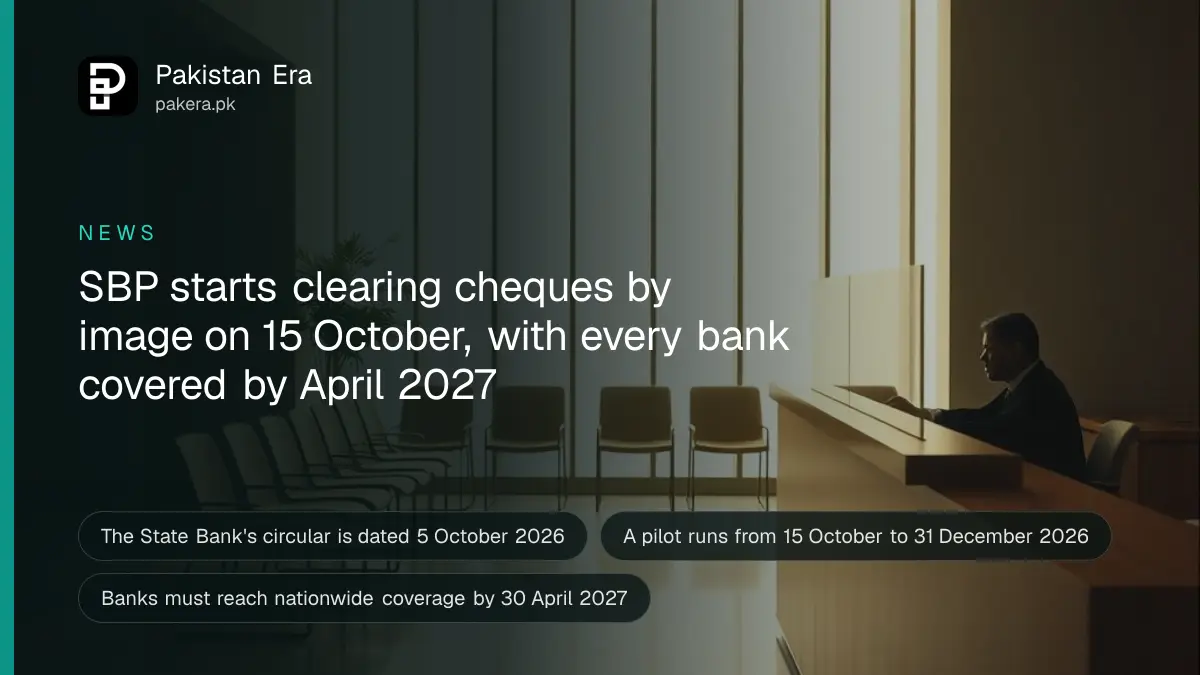
The State Bank of Pakistan will start clearing cheques by image from 15 October 2026. Under the new Pakistan Express Clearing System (PECS), the bank where you deposit a cheque scans it and sends the image on, instead of moving the paper. The first phase is a pilot, and nationwide coverage is due by 30 April 2027.
The State Bank announced PECS in DI&SD Circular No. 2 of 2026, dated 5 October 2026, sent to all members of the clearing house run by NIFT. We read the circular and its three annexures on sbp.org.pk on 7 October. The system is called cheque truncation, which means the paper stops travelling and the picture takes over.
Nothing changes at your branch on 15 October unless it is in the pilot. We could not find a list of pilot banks or branches in the circular, so we cannot say where it starts.
PECS clears cheques from scanned images, starting 15 October 2026
PECS is the State Bank's cheque truncation system. The bank that takes your cheque captures its image, sends it to the clearing house, and the clearing house passes it to the bank that issued the cheque. That bank decides on the image whether to pay it. Only rupee cheques and similar instruments are covered.
The circular says the aim is to strengthen digital payments and make cheque clearing and settlement more efficient. It gives no clearing time in days or hours, so we do not promise that cheques will clear faster. The Rules cover rupee cheques, payment orders and banker's cheques. Instruments that need the original paper, and cheques settled inside one bank, stay outside the new flow.
The rollout runs in three phases to 30 April 2027
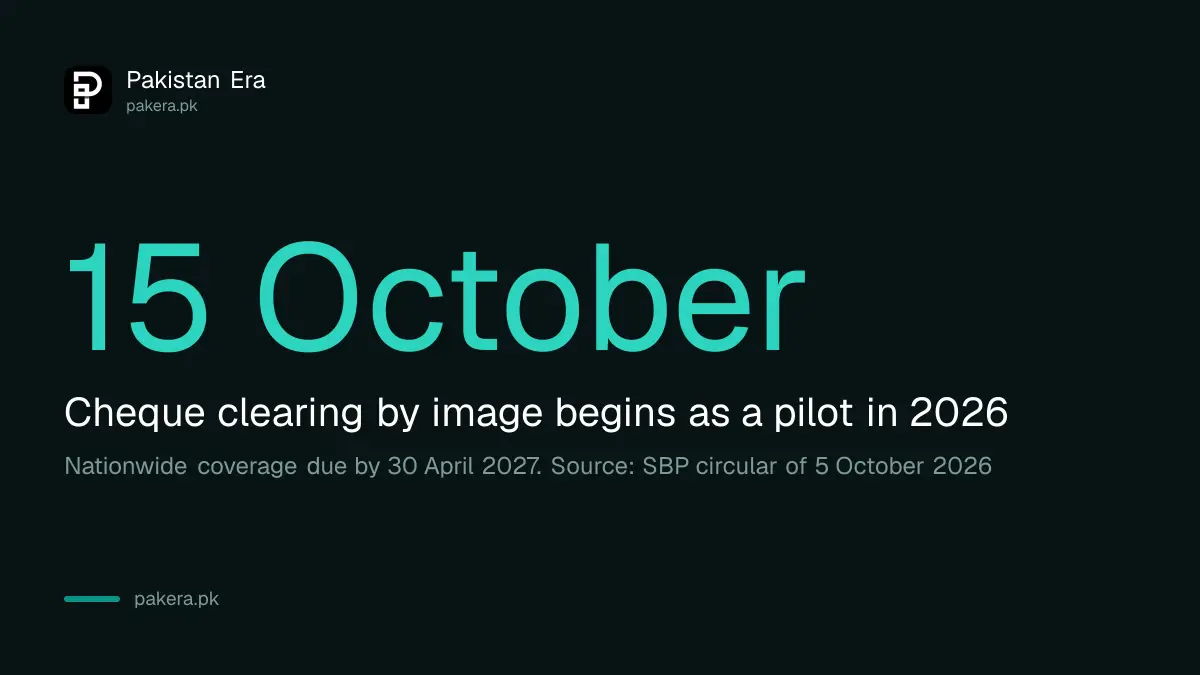
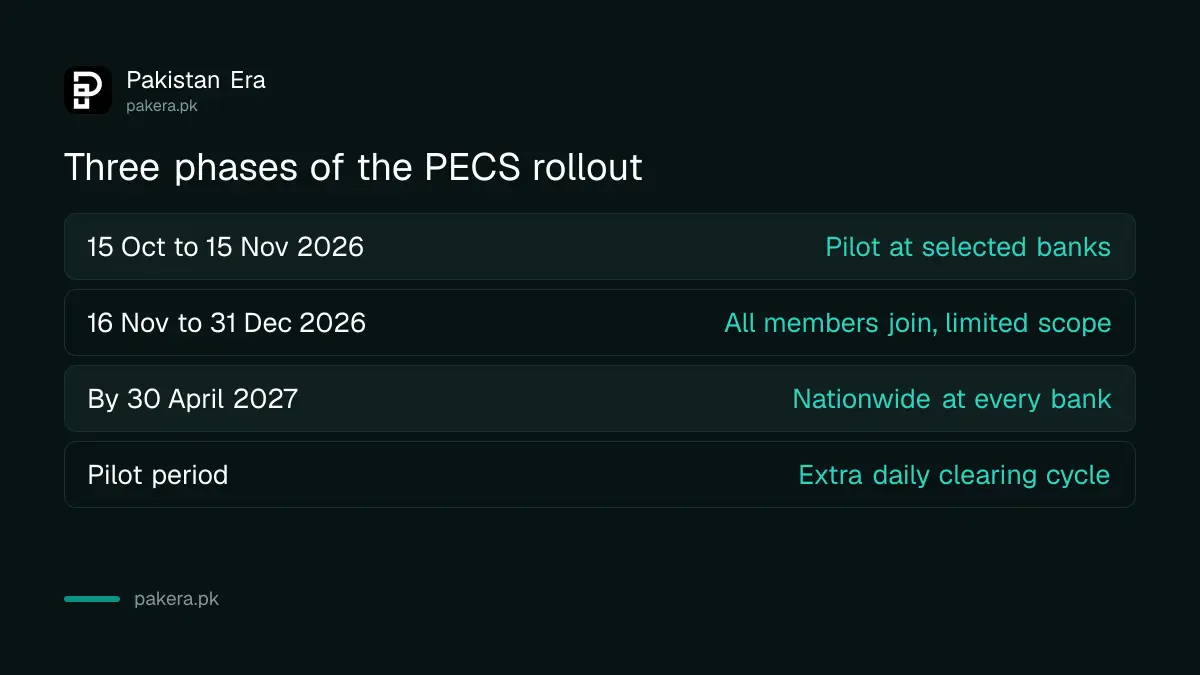
The pilot starts on 15 October 2026 at selected banks chosen by the State Bank. All participating banks join from 16 November. Every bank must reach nationwide coverage by 30 April 2027. During the pilot, a new clearing cycle runs every day alongside the usual ones.
| Phase | Dates | Who takes part |
|---|---|---|
| Pilot, limited scope | 15 October to 15 November 2026 | Selected banks named by the State Bank |
| Wider pilot, limited scope | 16 November to 31 December 2026 | All clearing house members |
| Full rollout | By 30 April 2027 | All banks, nationwide |
Banks must also train their staff and run public awareness through print, electronic and social media, so expect notices at branches.
A cheque moves through PECS in six steps
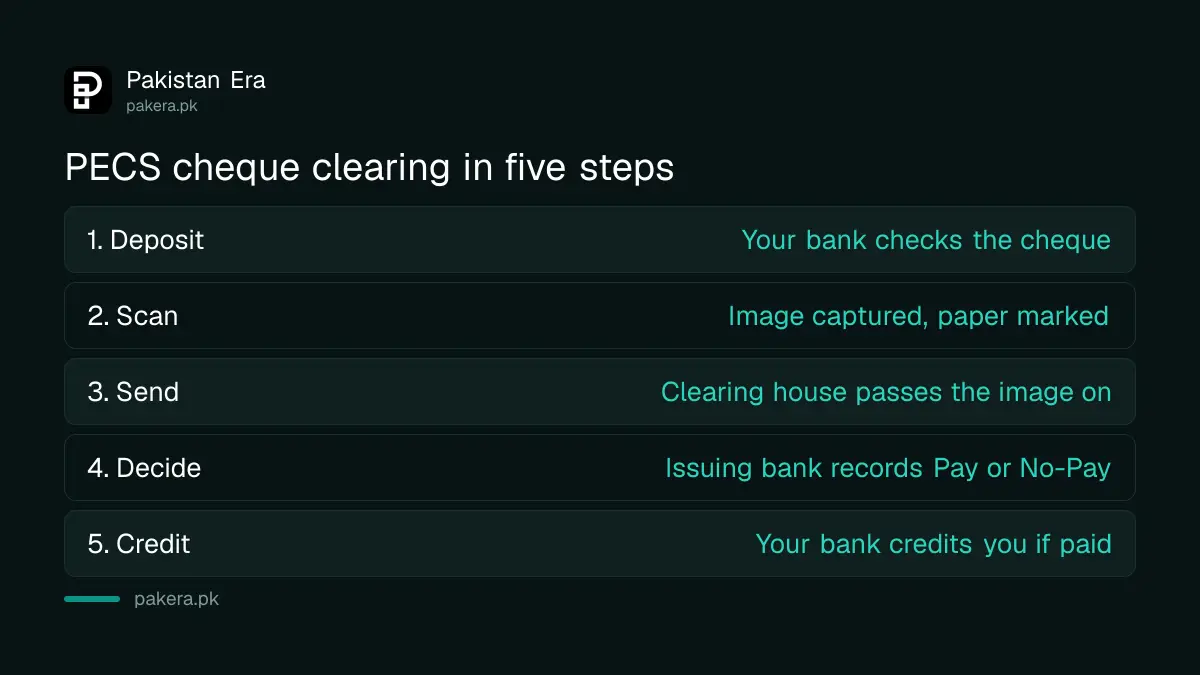
You hand the cheque to your bank. The bank checks it, scans it and marks the paper. The image goes to the clearing house, then to the issuing bank. That bank decides Pay or No-Pay. If it pays, your bank must credit your account without delay once the payment is final.
- You deposit the cheque at your branch. Staff check the date, the amount in words and figures, the signature, any alterations and the crossing.
- A cheque that fails this check is handed back to you with the reason. It is not scanned.
- Your branch scans the cheque. If it has no approved scanner, the cheque goes to the nearest designated branch or to the clearing house's own scanning service.
- The bank marks the paper cheque as presented for truncation, so it cannot be presented again.
- The issuing bank sees the image, checks the signature, balance and any stop instruction, and records Pay, No-Pay or Defer for Physical.
- On a Pay decision, the issuing bank debits the drawer and sends an online notification. Your bank credits you without delay once the payment is final.
The issuing bank can ask for the paper only for set reasons
An issuing bank can mark a cheque Defer for Physical only if the image is not clear enough, an alteration is suspected, or the signature cannot be checked reliably. The Rules ban using it to delay clearing and call that a serious compliance failure.
That matters if you have waited days for a cheque for no clear reason. A returned cheque must carry a standard reason code, and your bank must tell you why it came back.
The procedures also bar banks from using Defer for Physical to gain time or to meet internal targets. If a cheque is returned unpaid, our guide on what to do when a cheque bounces covers the next steps.
Writers of cheques get a new check in their banking app
Banks must build a feature in their mobile app and internet banking where you can enter a cheque's date, payee name and amount before it is presented. If the cheque that arrives does not match, the bank cannot mark it Pay until it resolves the difference. The Rules link this to cheques above Rs 500,000.
The paying bank must also show you the image of a paid cheque in your app. Bigger cheques get extra verification before payment. That can mean a call back or a second login step. The State Bank or each bank will set the value limit.
We have not seen any bank's app with this feature yet, since the circular only requires banks to build it. If you write large cheques, ask your bank when it will be ready. If you ever need to dispute a payment, the steps for an online fraud refund and bank dispute still apply.
You have a right to compensation, a copy and an answer
If you lose money through no fault of your own, and you were neither part of a fraud nor grossly careless, the responsible bank must pay you back. It must acknowledge your claim within 2 business days and settle it within 10 calendar days after that.
If your own bank is late crediting a good cheque, the State Bank's rules on late electronic transfers apply. Banks must also tell you your rights, including a certified copy of a paid cheque and the time limit for disputing a wrong payment. Each bank must display its cut-off time for presenting cheques at every branch and on its website.
If you fail to get an answer, escalate through your bank's own complaint process first. The bank fraud complaint deadlines show how long you have to complain once something goes wrong.
What to check before you write or deposit a cheque
Write clearly and make sure the amount in words matches the figures. Sign the same way every time. Check the date and the crossing. A cheque with a cut, an overwrite or an unsigned correction can be handed back at the counter or held for a physical check.
- Keep the writing clear and the cheque unfolded, because the image must be readable.
- After 15 October, ask your branch whether it scans cheques on site.
- Ask your bank if its app has the pre-notification feature for cheques you issue.
Common questions
What is the Pakistan Express Clearing System?
It is the State Bank's cheque truncation system, in which banks clear cheques using scanned images instead of moving the paper between banks.
When does PECS start?
On 15 October 2026 as a pilot at selected banks. Every bank must be covered nationwide by 30 April 2027.
Will my cheque clear faster under PECS?
The State Bank has not published a clearing time. It says the aim is a more efficient clearing and settlement process.
Do I still keep the paper cheque?
No. You hand it to your bank. The bank marks it as presented for truncation and keeps it until the clearing house collects it.
Does PECS cover cheques in dollars?
No. The Rules apply to rupee cheques and similar instruments such as payment orders and banker's cheques.
Who do I complain to if my cheque is wrongly handled?
Start with your own bank's grievance process. The Rules say an unresolved complaint can be escalated through it.
How we verified this
What we checked, where we read it, and what we could not confirm.
Last checked on 7 October 2026 at about 9:00pm PKT. The circular and its three annexures are on the State Bank's website: DI&SD Circular No. 2 of 2026, with the implementation plan, the PECS Rules and the operating procedures attached. The dates, phases, scope, customer rights and compensation timelines come from those documents. The circular does not say which banks join the pilot or how fast clearing will be, so this page does not either.
About the author

Senior Writer, Public Services and Technology
Shahid joined us in 2024 as an author. He is a senior contributor to Pakistan's leading technology websites. He writes detailed articles, mostly covering his expertise in the latest tech, mobiles, apps, gadgets, and step-by-step guides. His ideology is to help people understand the latest trends and explain complex methods through very easy-to-understand guides.