PIB Auction 4 November 2026: Rs 350 Billion Target, Coupons and Every 2026 Cut-Off Yield in Pakistan (Full List)
SBP's PIB auction on 4 November 2026 targets Rs 350 billion across 2 to 15 year bonds. See coupons, tenor targets and every 2026 cut-off yield by auction.
The State Bank of Pakistan holds its next Pakistan Investment Bond (PIB) auction on Wednesday 4 November 2026, aiming to raise Rs 350 billion across 2, 3, 5, 10 and 15 year bonds, with settlement on 5 November. At the last auction on 7 October, the cut-off yields were 12.75% for 3 years, 12.90% for 5 years and 12.85% for 10 years. Below are the targets for 4 November and every 2026 PIB cut-off yield so far.
We read SBP's PIB auction calendar for October to December 2026 and downloaded its auction-wise PIB data file on 1 November 2026. The yields in this article come from that file.
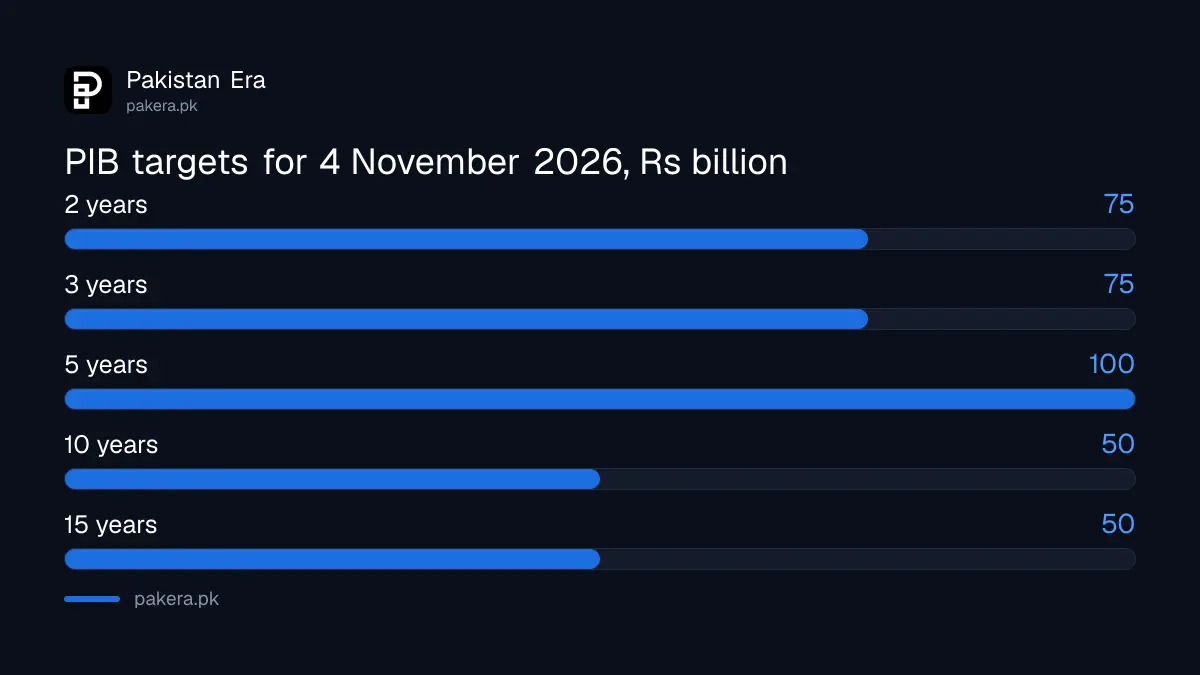
The 4 November PIB auction targets Rs 350 billion
SBP's calendar splits the target by tenor. The 3, 5 and 10 year bonds are reopenings of issues first sold on 19 May 2026, so they keep their original coupons. The 2 and 15 year bonds pay no coupon and are sold below face value.
| Tenor | Target (Rs billion) | Coupon | Original issue date |
|---|---|---|---|
| 2 years | 75 | Zero coupon | 5 Aug 2026 |
| 3 years | 75 | 12.00% | 19 May 2026 |
| 5 years | 100 | 12.25% | 19 May 2026 |
| 10 years | 50 | 12.50% | 19 May 2026 |
| 15 years | 50 | Zero coupon | 5 Aug 2026 |
| Total | 350 |
The calendar has three PIB auctions this quarter, each with a Rs 350 billion target: 7 October, 4 November and 16 December. This is the first PIB auction since the State Bank raised its policy rate to 12% from 27 October 2026.
Every 2026 PIB cut-off yield: the full list
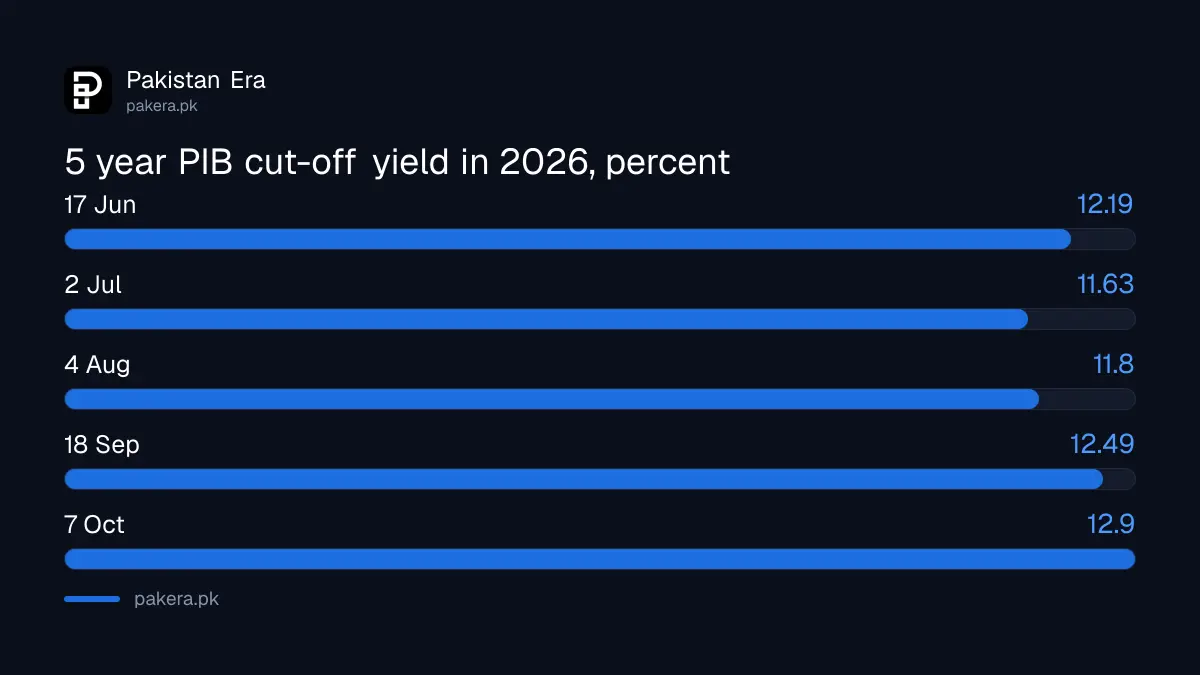
The cut-off yield is the highest yield the government accepted at each auction. Here are the 3, 5 and 10 year cut-offs for every fixed-rate PIB auction of 2026, from SBP's file.
| Auction date | 3 years | 5 years | 10 years |
|---|---|---|---|
| 14 Jan 2026 | 10.14% | 10.53% | 11.00% |
| 6 Feb 2026 | 10.25% | 10.75% | 11.24% |
| 26 Mar 2026 | 12.50% | 12.50% | Bids rejected |
| 28 Apr 2026 | All bids rejected | ||
| 18 May 2026 | 13.25% | 12.95% | 12.95% |
| 17 Jun 2026 | 12.09% | 12.19% | 12.61% |
| 2 Jul 2026 | 11.49% | 11.63% | 12.14% |
| 4 Aug 2026 | 11.75% | 11.80% | 12.30% |
| 18 Sep 2026 | 12.49% | 12.49% | 12.50% |
| 7 Oct 2026 | 12.75% | 12.90% | 12.85% |
Yields started the year near 10% to 11%, jumped to 12.5% to 13.25% in March to May, eased to about 11.5% in July and have risen at each auction since. The 5 year cut-off went from 11.63% on 2 July to 12.90% on 7 October, a rise of 1.27 points by our arithmetic.
A yield is not the same as the coupon. The coupon is fixed when a bond is first issued. The yield is what a buyer earns at the price paid today. When yields rise above the coupon, as now, new buyers pay a little less than face value for the 3, 5 and 10 year bonds, so their return matches the market.
The 7 October auction raised Rs 376.7 billion
At the last auction, on 7 October 2026, the government accepted Rs 376.7 billion against a Rs 350 billion target, counting both competitive and non-competitive bids. Most of it came in the 3 year bond, at Rs 220.5 billion, and the 5 year, at Rs 130.6 billion.
Bids for the 15 year bond were rejected, and only Rs 0.7 billion of 2 year bonds was accepted. The details are in the 7 October PIB auction.
Treasury bill yields give a hint of where rates are heading. At the 28 October T-bill auction, the 12 month cut-off was 12.89%, after the policy rate rise. That result is in the 28 October T-bill auction.
How an individual can buy a PIB
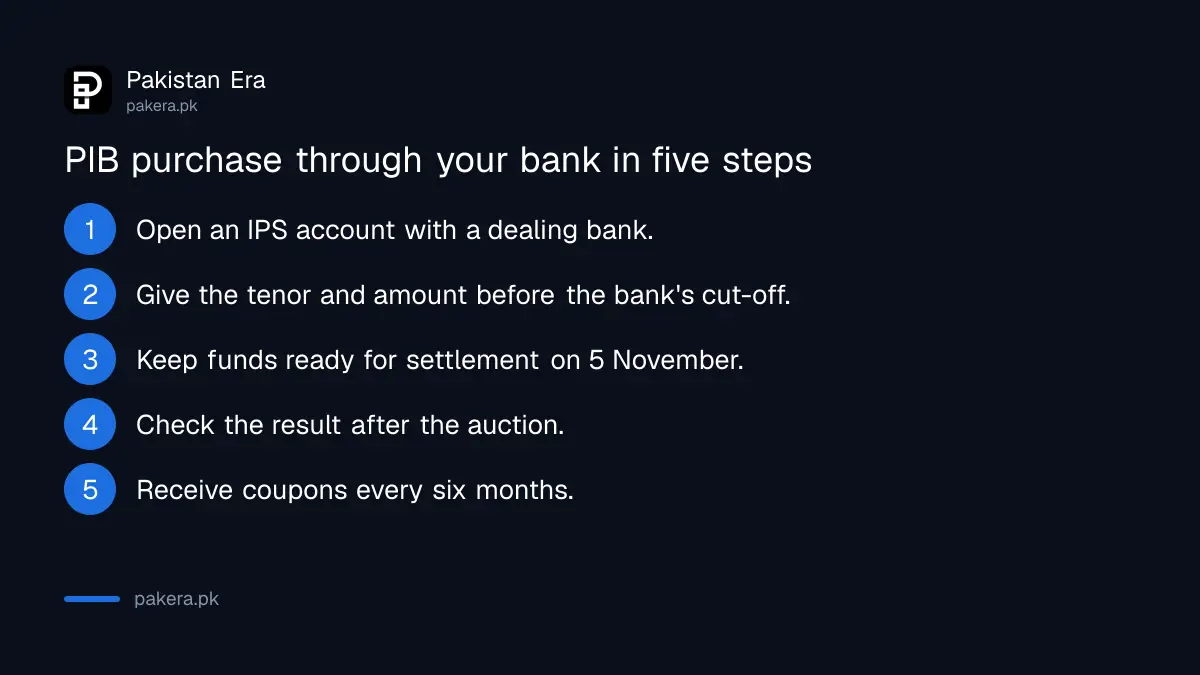
Individuals usually take part through a non-competitive bid placed by their bank. A non-competitive bid gets the weighted average price set at the auction, so you do not have to guess a yield.
- Open an Investor Portfolio Securities (IPS) account with a bank that deals in government securities.
- Tell the bank the tenor and amount before its own cut-off time, which is earlier than SBP's 12 noon close.
- Keep the money in your account for settlement on 5 November.
- Check the result on SBP's site after the auction on 4 November.
- Coupons on the 3, 5 and 10 year bonds are paid every six months into your account.
Limits, fees and the IPS process are set out in buying a PIB through an IPS account.
Common questions
When is the next PIB auction?
Wednesday 4 November 2026, with settlement on Thursday 5 November. The one after is on 16 December 2026.
How much will the government borrow on 4 November?
The target is Rs 350 billion. SBP can accept more or less than the target, as it did on 7 October, when it took Rs 376.7 billion.
What coupon does the 5 year PIB pay?
12.25% a year, paid in two halves each year. The 3 year pays 12.00% and the 10 year 12.50%.
What was the PIB yield at the last auction?
On 7 October 2026: 12.80% for 2 years, 12.75% for 3 years, 12.90% for 5 years and 12.85% for 10 years.
Why were all bids rejected on 28 April 2026?
SBP's file records the rejection but gives no reason. SBP's treasury bill calendar notes that bids can be rejected without any reason being given.
Where will the 4 November result appear?
On the State Bank's website, in the PIB auction result posted after the auction closes on 4 November.
How we verified this
What we checked, where we read it, and what we could not confirm.
Last checked 1 November 2026. Targets, tenors, coupons and dates come from SBP's PIB auction target calendar for October to December 2026, and every yield and amount comes from SBP's auction-wise PIB data file (Pakinvestbonds.xlsx, sheet "New Format"), both downloaded from sbp.org.pk on 1 November 2026. The 12 month T-bill cut-off comes from SBP's auction result of 28 October. Rounded yields and the size of each change are our arithmetic. Bank cut-off times and fees vary and were not checked. More on government securities is on the State Bank of Pakistan website.
About the author

Global Affairs & Political Economy Writer
Muhammad Hatim is a book lover who started writing because he enjoys it. At Pakistan Era he writes about international relations, geopolitics and the global economy, with a particular interest in South Asia and the forces behind current events.