Pakistan Raises Rs 376.7 Billion in PIB Auction as Yields Rise to 12.90%
Pakistan raised Rs 376.7 billion in PIBs on 7 October 2026 as yields rose up to 41 basis points. See each bond yield, the bids and how savers can buy.
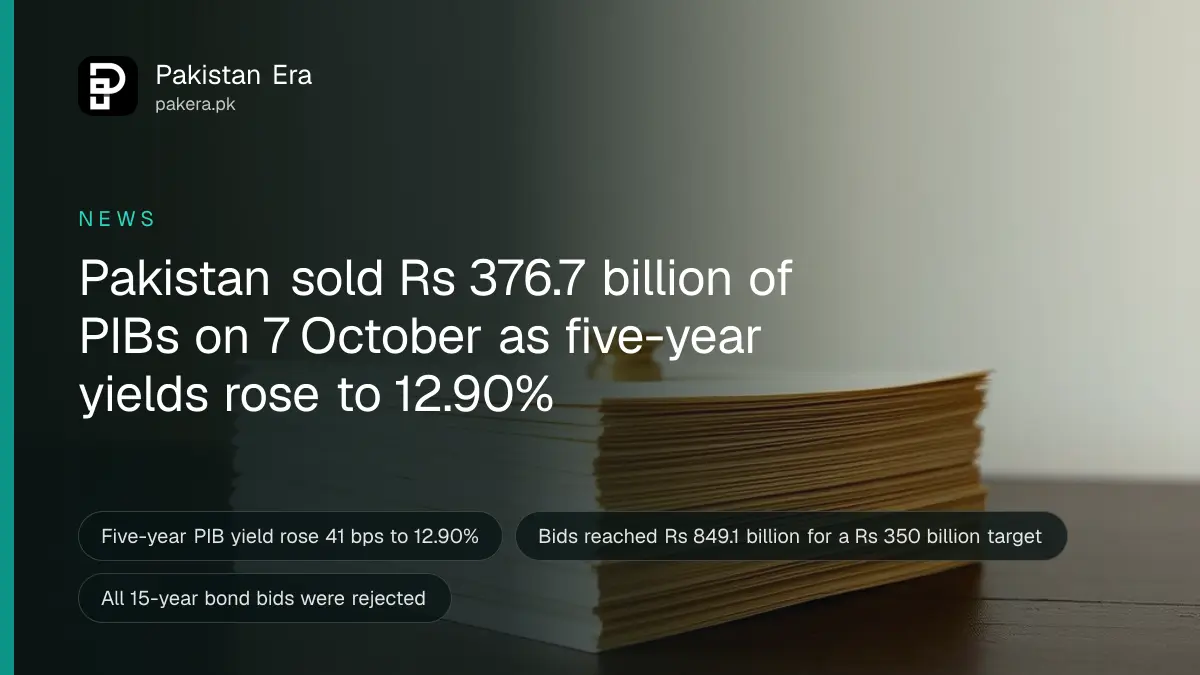
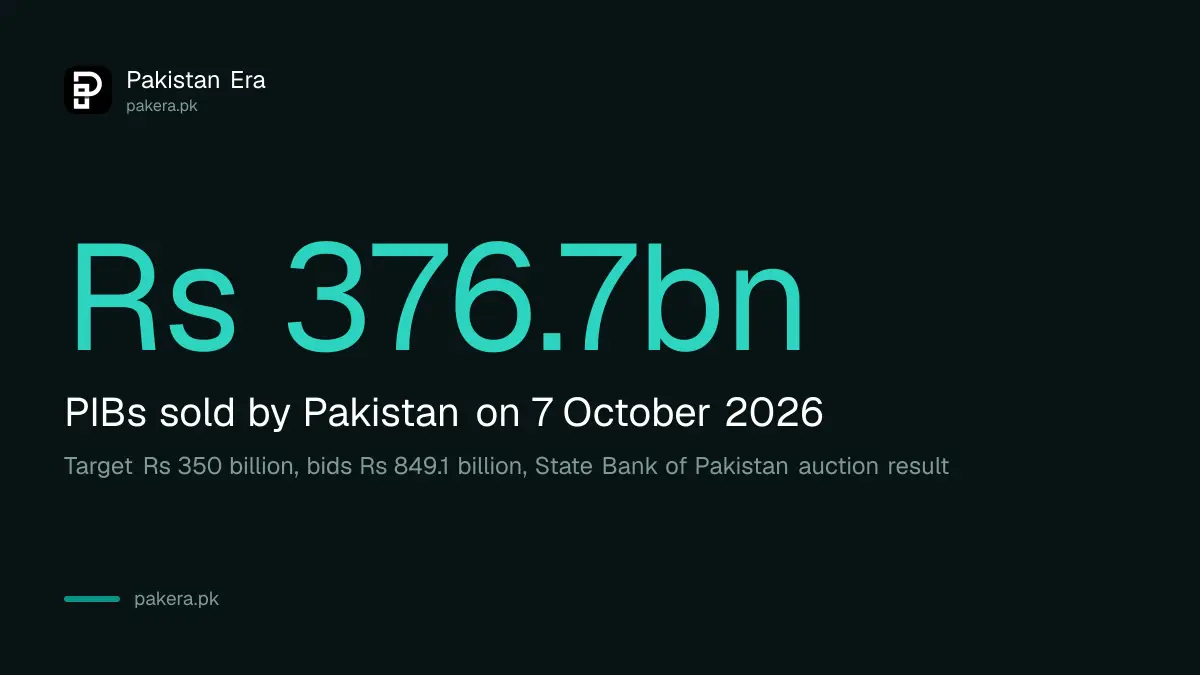
Pakistan's government sold Rs 376.7 billion of Pakistan Investment Bonds (PIBs) on 7 October 2026, against a target of Rs 350 billion. It paid more to borrow than three weeks earlier. Cut-off yields rose by 26 to 41 basis points, to between 12.75 and 12.90 per cent.
We read the State Bank of Pakistan's auction result, its bid report and its auction history file. Banks and other primary dealers offered Rs 849.1 billion, more than twice what the government wanted. It took less than half of that.
The government raised Rs 376.7 billion in PIBs
The PIB auction on 7 October 2026 raised Rs 376.7 billion at face value, settled on 8 October. Of that, Rs 342.3 billion came from competitive bids by primary dealers and Rs 34.5 billion from non-competitive bids, which is the route most individual savers use.
A PIB is a fixed-rate government bond. The government borrows the money and pays it back on a set date, with interest. Banks hold most of them, but anyone with an account at a bank that offers them can buy.
Yields rose by up to 41 basis points from September
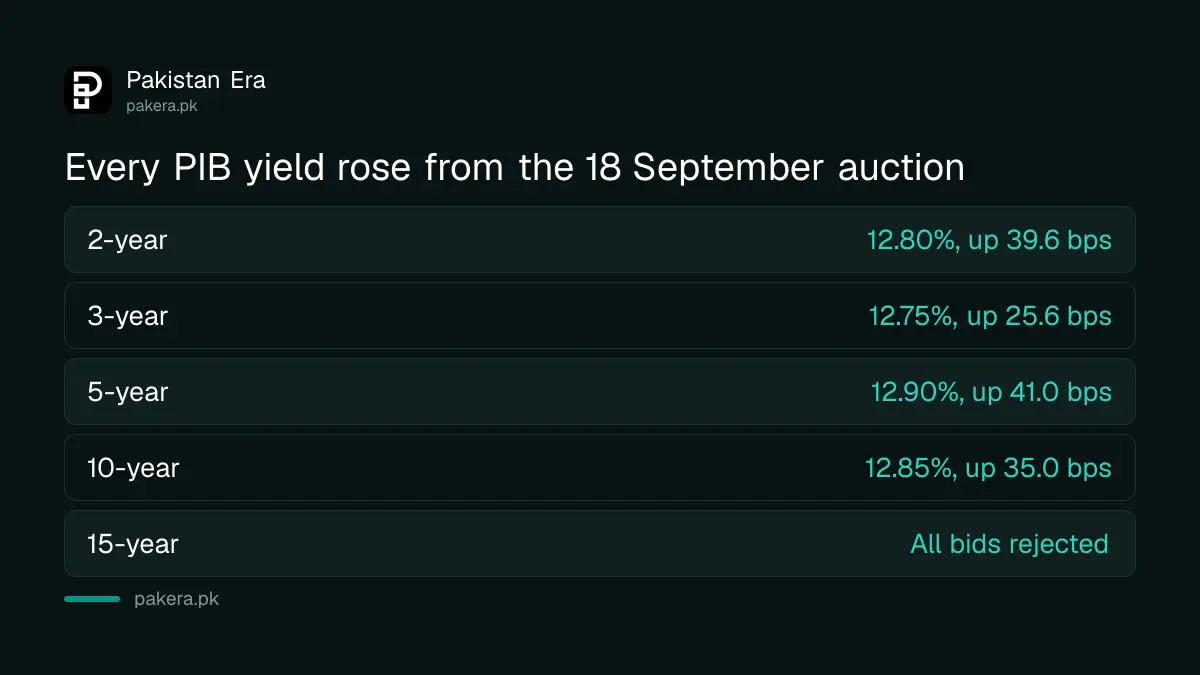
Every bond the government accepted cost more than at the previous auction on 18 September 2026. The five-year bond rose most, by 41 basis points to 12.90 per cent. A basis point is one hundredth of a percentage point, so 41 basis points is 0.41 per cent.
| Bond | Cut-off yield, 7 October | Cut-off yield, 18 September | Change |
|---|---|---|---|
| 2-year (zero coupon) | 12.7950% | 12.3990% | +39.6 bps |
| 3-year (12.00% coupon) | 12.7460% | 12.4900% | +25.6 bps |
| 5-year (12.25% coupon) | 12.8998% | 12.4900% | +41.0 bps |
| 10-year (12.50% coupon) | 12.8500% | 12.5000% | +35.0 bps |
| 15-year (zero coupon) | All bids rejected | All bids rejected | None |
The changes are our arithmetic from the State Bank's auction history file. All of these yields are above the State Bank's policy rate of 11.5 per cent, by 1.25 to 1.40 percentage points.
The three-year bond took almost three times its target
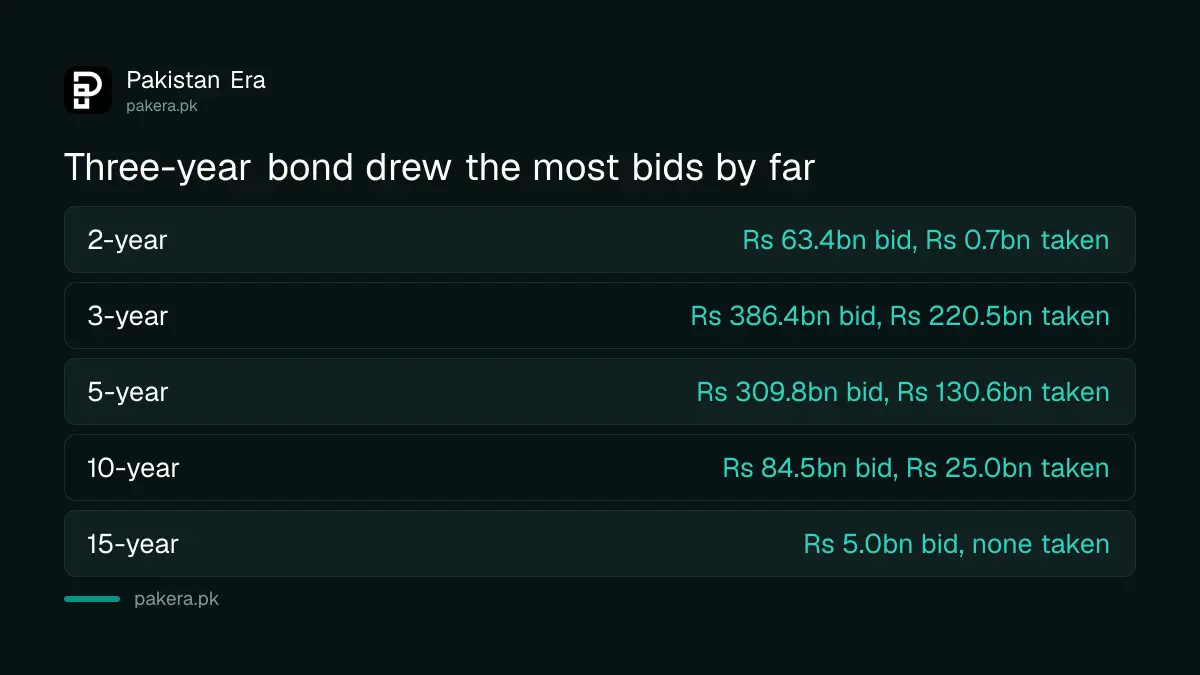
The government's target for the three-year bond was Rs 75 billion. It accepted Rs 220.5 billion. Lenders offered Rs 386.4 billion for this one bond, the most of any tenor.
The two-year bond went the other way. Dealers bid Rs 63.4 billion, but the government accepted only Rs 0.7 billion, because most bids asked for yields above 12.8 per cent. For the 15-year bond, it rejected all Rs 5.0 billion of bids.
| Bond | Target | Bids offered | Accepted |
|---|---|---|---|
| 2-year | Rs 75bn | Rs 63.4bn | Rs 0.7bn |
| 3-year | Rs 75bn | Rs 386.4bn | Rs 220.5bn |
| 5-year | Rs 100bn | Rs 309.8bn | Rs 130.6bn |
| 10-year | Rs 50bn | Rs 84.5bn | Rs 25.0bn |
| 15-year | Rs 50bn | Rs 5.0bn | Rejected |
| Total | Rs 350bn | Rs 849.1bn | Rs 376.7bn |
Higher yields point to fewer rate cuts ahead
Lenders asking for more usually means they do not expect interest rates to fall soon. The State Bank's own minutes, published on 9 October, show three of its ten policy committee members voted to raise the rate in September. The same minutes say bond yields traded between banks rose by 10 to 68 basis points between July and September.
That matters beyond banks. Higher government borrowing costs feed into KIBOR, the rate most bank loans follow, and into what banks can afford to pay savers. Anyone with a floating-rate car or home loan should note the direction. The full vote is in the SBP minutes for September.
Savers can buy PIBs at the same yield
Individuals do not bid against banks. They place a non-competitive bid through a bank and get the average price accepted at the auction. Here is how one works:
- Open an Investor Portfolio Securities (IPS) account at a bank that offers one.
- Ask for a non-competitive bid for the PIB tenor you want before the bank's cut-off for the next auction.
- The bank buys at the non-competitive price the State Bank publishes on auction day.
- Coupon bonds pay interest into your account every six months. Zero coupon bonds pay nothing until maturity, when you get the full face value.
For example, at the 7 October non-competitive price of 98.3709, Rs 100,000 of the three-year bond cost about Rs 98,371, plus interest already built up since the last coupon date. It pays Rs 6,000 every six months, because the coupon is 12 per cent a year, and returns Rs 100,000 on 19 May 2029. The minimums, bank steps and tax are set out in buying T-bills and PIBs from Rs 5,000.
The next PIB auction is on 4 November 2026, also with a Rs 350 billion target. The next Treasury bill auction is on 14 October 2026, with a Rs 550 billion target.
Common questions
How much did Pakistan raise in the PIB auction on 7 October 2026?
Rs 376.7 billion at face value, including Rs 34.5 billion of non-competitive bids. The target was Rs 350 billion.
What were the PIB cut-off yields on 7 October 2026?
12.7950 per cent for two years, 12.7460 per cent for three years, 12.8998 per cent for five years and 12.8500 per cent for ten years. All 15-year bids were rejected.
Did PIB yields go up or down?
Up. Compared with the 18 September auction, yields rose by 25.6 to 41.0 basis points.
When is the next PIB auction?
On 4 November 2026, according to the State Bank's auction calendar, followed by 16 December 2026.
Can an individual buy PIBs in Pakistan?
Yes. Open an IPS account at a bank and place a non-competitive bid, which is filled at the average price accepted at the auction.
How we verified this
What we checked, where we read it, and what we could not confirm.
Last checked on 9 October 2026. Amounts, cut-off prices and yields are from the State Bank of Pakistan's PIB fixed rate auction result for 7 October 2026 and its bid report of the same date. The 18 September yields are from the State Bank's PIB auction history file. Targets and the next auction dates are from the PIB and Treasury bill auction calendars on the State Bank's financial market data page. Non-competitive prices are from the same result. Basis point changes and the Rs 100,000 example are our arithmetic.
About the author

Global Affairs & Political Economy Writer
Muhammad Hatim is a book lover who started writing because he enjoys it. At Pakistan Era he writes about international relations, geopolitics and the global economy, with a particular interest in South Asia and the forces behind current events.