Police Search of Your Home in Pakistan: Witnesses, List and Your Rights
Police must call two local witnesses, sign a list of what they take and give you a copy on request (section 103). See the rules for a search without a warrant.
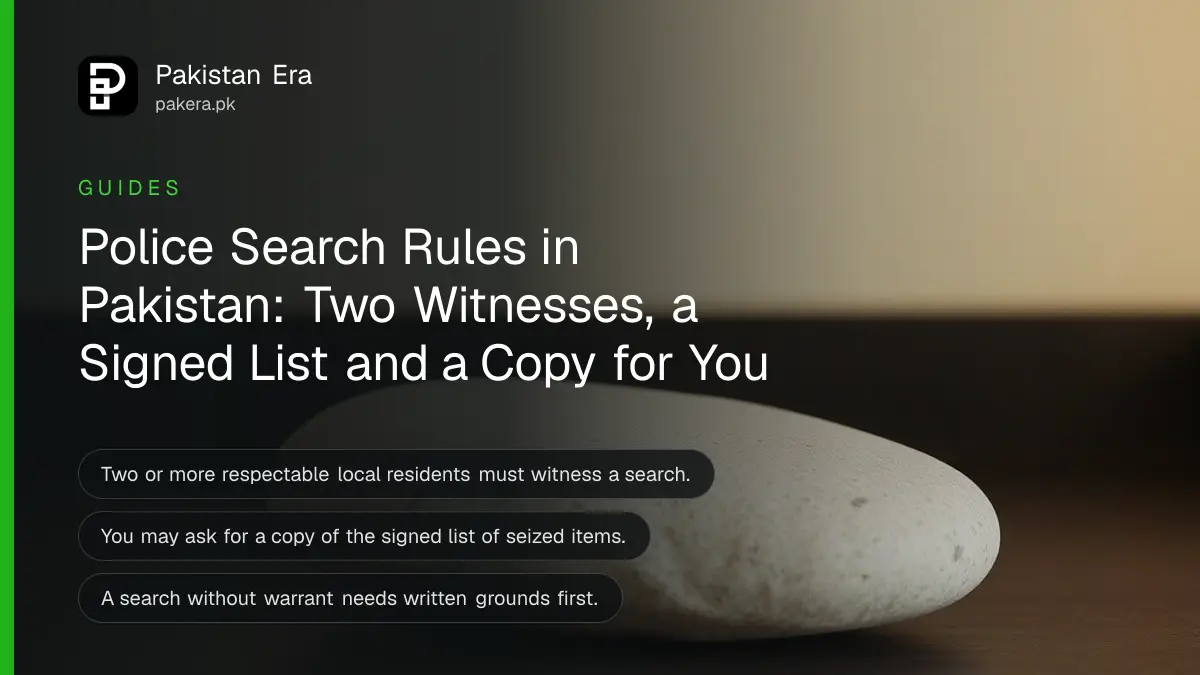
Before police search your home, two respectable local residents must be called to witness it, a list of everything taken must be signed by them, and you may ask for a copy of that list. Section 103 of the Code of Criminal Procedure sets this rule. Section 165 adds written grounds for a search without a warrant.
A police search is frightening, and families often do not know what they may ask. We read sections 102, 103, 52, 165 and 166 of the Code of Criminal Procedure, 1898, on 21 October 2026. These are the rules the Code sets down. Whether police followed them in a given case is for a court to decide, not for us. For arrest rules, see your rights when arrested in Pakistan.
Two respectable locals must witness a search
Section 103(1) says that before a search the officer must call two or more respectable inhabitants of the locality to attend and witness it, and may order them in writing to do so. The search must then be made in their presence.
Section 103(5) makes it an offence under section 187 of the Pakistan Penal Code for a person who is called by written order to refuse to attend without reasonable cause. A witness does not have to appear in court unless the court summons him specially.
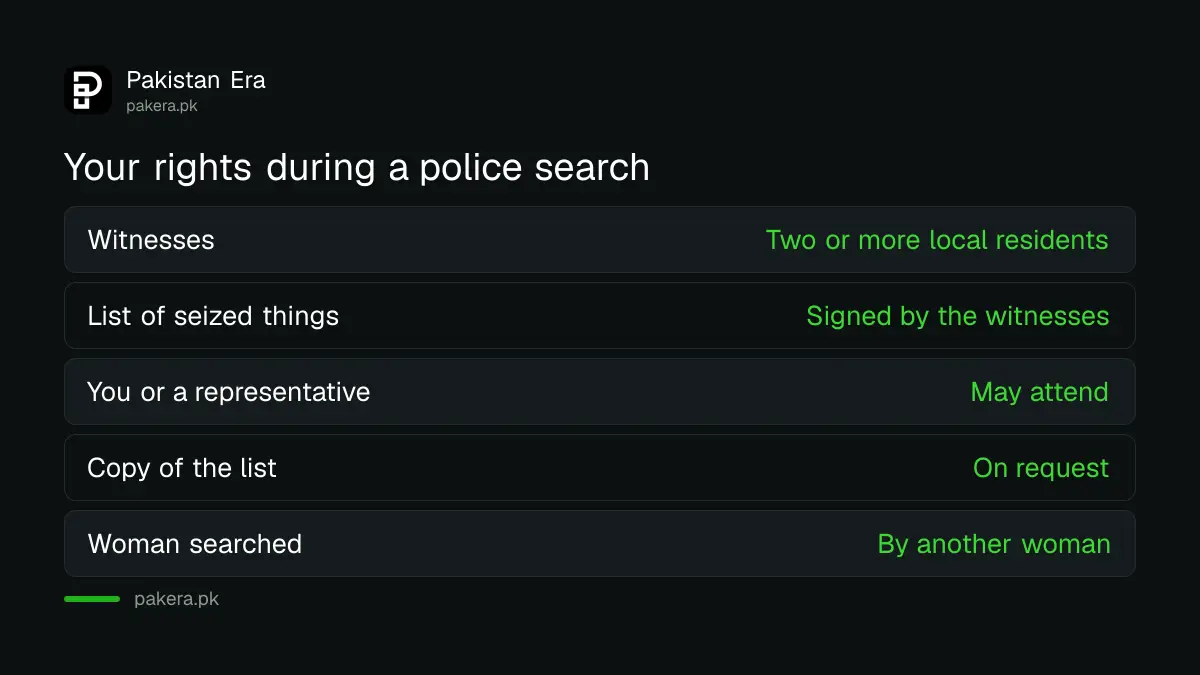
| Your right | Where it comes from |
|---|---|
| Two or more local witnesses present | Section 103(1) and (2) |
| A list of things seized, signed by witnesses | Section 103(2) |
| You or your representative may attend | Section 103(3) |
| A copy of the signed list on request | Section 103(3) |
| A woman searched only by another woman | Section 52 |
| Grounds recorded in writing, no warrant | Section 165(1) |
You or someone for you may watch and ask for the list
Section 103(3) says the occupant of the place, or a person on his behalf, must in every instance be allowed to attend during the search. A copy of the signed list must be given to the occupant or that person at his request.
Ask for the list in the room, before the officers leave. Check it line by line against what is taken: item, number, colour, make. If a person is searched under section 102(3), a list of things taken from him must also be prepared and a copy given on request.
Police can search without a warrant only after writing down their grounds
Section 165(1) lets an officer in charge of a police station, or a police officer making an investigation, search without a warrant if he has reasonable grounds to believe something needed for the investigation is in the place and cannot be obtained without undue delay.
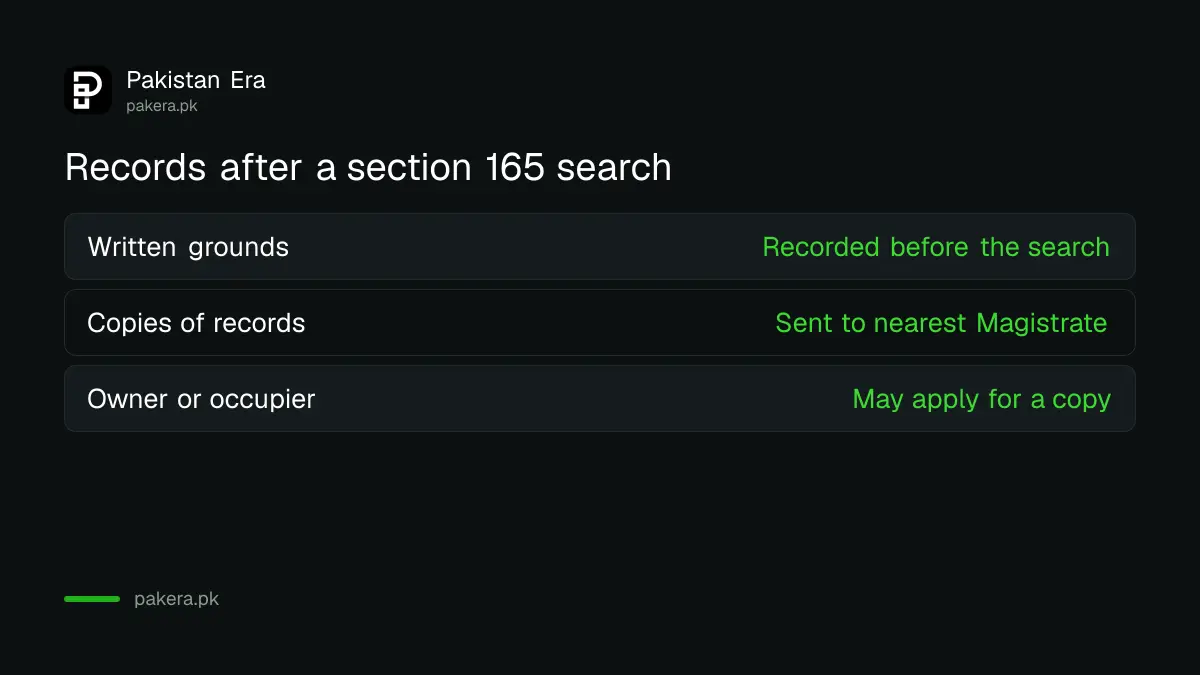
He must first record his grounds in writing and, as far as possible, name the thing he is looking for. He should search in person where practicable. If not, he gives a subordinate a written order naming the place and the thing. Sections 102 and 103 apply to such a search under section 165(4).
A woman must be searched by another woman
Section 52 says that whenever a woman needs to be searched, the search must be made by another woman, with strict regard to decency. Section 102(3) lets a person suspected of hiding an article be searched, and refers to section 52 for women.
If this is not followed, note it with the time and the names of anyone present, and tell your lawyer. Do not resist physically. The place to challenge a search is the court, not the doorstep.
- Ask who is in charge and for his name and rank.
- Ask whether there is a warrant, or written grounds under section 165.
- Ask that two local witnesses are present, and note their names.
- Stay present, or send a family member to watch each room.
- Check the list of seized items and ask for a signed copy.
- Photograph the scene afterwards and call a lawyer the same day.

Bank records and other stations have extra rules
The proviso to section 165 says police may not search for things held by a bank that relate to a person's bank account, except with prior written permission: of a Sessions Judge for listed offences, and of the High Court in other cases.
Section 166 lets police search within another station's limits when delay might lead to evidence being hidden or destroyed. The officer must send notice to that station, a copy of the section 103 list and the written records to the nearest Magistrate. Under section 165(5) the owner or occupier can apply to that Magistrate for a copy, and pays for it unless the Magistrate decides otherwise.
If seized items are not returned, see how to get seized property back through the court.
Common questions
Can police search my house without a warrant?
Only under section 165, after recording written grounds and naming the thing sought, and only for an offence they are investigating.
Must the witnesses be from my own neighbourhood?
Section 103 says respectable inhabitants of the locality where the place to be searched is situated.
Can I refuse entry?
Section 102 says the person in charge of a closed place must, on production of a warrant, allow free ingress. We advise against physical resistance. Raise your objection in court.
Am I entitled to a copy of the seizure list?
Yes, if you ask. Section 103(3) says it must be delivered to the occupant or his representative at his request.
What if police take my phone or papers?
They go on the list like any other item. Telephone searches under cyber law have their own rules, in our guide on phone seizure under PECA.
How we verified this
What we checked, where we read it, and what we could not confirm.
Last checked 21 October 2026. We read sections 52, 102, 103, 165 and 166 of the Code of Criminal Procedure, 1898, in the Pakistan Code PDF marked as last amended on 16 February 2017, from a copy saved earlier this week. The Pakistan Code portal did not open for us on the day, so later amendments are unchecked. We did not read court rulings or provincial police rules.
About the author

Global Affairs & Political Economy Writer
Muhammad Hatim is a book lover who started writing because he enjoys it. At Pakistan Era he writes about international relations, geopolitics and the global economy, with a particular interest in South Asia and the forces behind current events.