IEE and EIA Report Checklist for Punjab: What an EIA Adds
EPA Punjab publishes IEE and EIA checklists. See what both share, the three blocks an EIA adds and the six-part management plan that reviewers expect to see.
An EIA report in Punjab has to cover everything an IEE report does, plus a scoping section, a comparison of site, design, environmental and economic alternatives, and a named method for judging impacts. EPA Punjab publishes one checklist for each report type. Both follow the Pak-EPA Guidelines for Preparation and Review of Environmental Reports, 1997, and both come with a "lacking" column the reviewer fills in.
An IEE is the shorter Initial Environmental Examination. An EIA is the full Environmental Impact Assessment. We opened both checklists on the EPA Punjab website on 22 October 2026 and compared them line by line. If your report misses a listed item, the reviewer can mark it "lacking" and send the file back.
Both checklists start with the same seven-point executive summary
The executive summary must give the project title and location, the proponent, the organisation that wrote the report, a short outline of the proposal, the major impacts, mitigation recommendations and the proposed monitoring. That is seven items, identical in the IEE and EIA lists.
Write this part last, in plain words. Reviewers read it first, and a clear summary makes the rest easier to trust. Each checklist also carries a file tracking number at the top of every page, which EPA fills in.
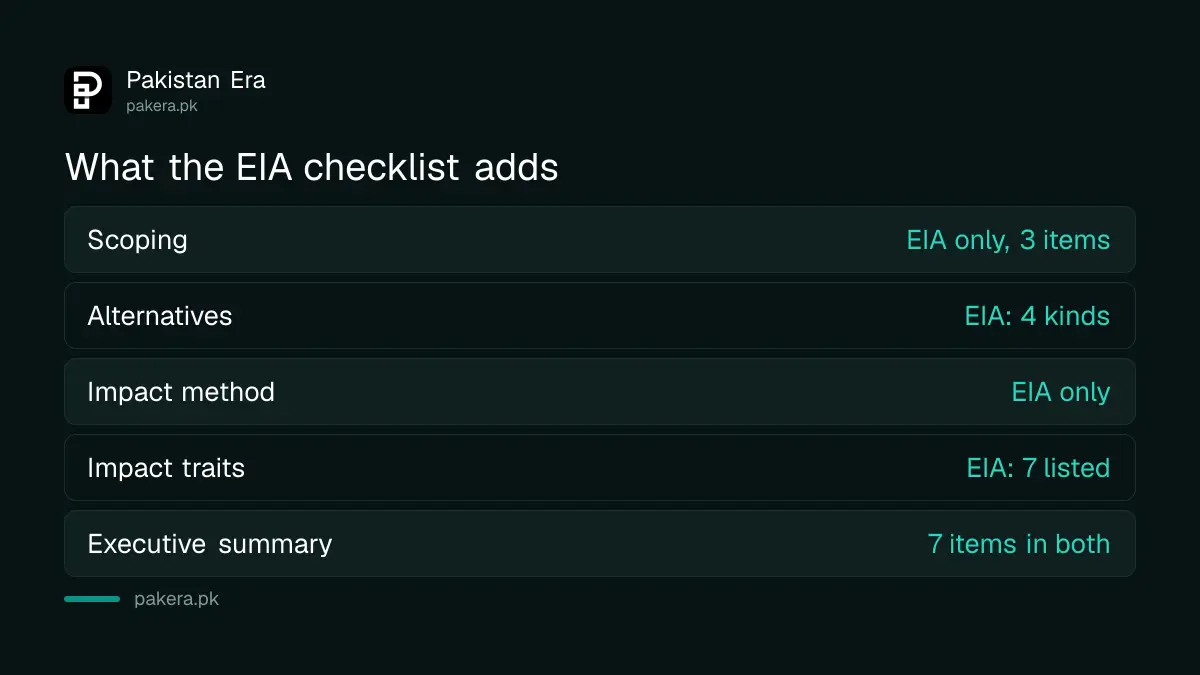
The EIA checklist adds scoping, four kinds of alternatives and an impact method
These three blocks are the real gap between the two lists. The EIA adds scoping, a full alternatives section and a methodology section. The IEE asks only for alternatives "considered realistically" inside the project description.
| Report section | IEE checklist | EIA checklist |
|---|---|---|
| Executive summary (7 items) | Yes | Yes |
| Screening: IEE or EIA needed? | Yes | Yes |
| Scoping (boundaries, issues, key impacts) | No | Yes, 3 items |
| Alternatives | Inside project description | Own section: site, design or technology, environmental, economic |
| Impact method (checklists, matrices, networks, overlays, GIS) | No | Yes |
| Impact characteristics (7 listed) | No | Yes |
| Management and monitoring plan (6 parts) | Yes | Yes |
| Stakeholder consultation | Yes | Yes |
| Appendices (7 items) | Yes | Yes |
An EIA must describe seven characteristics of each impact
The EIA list names seven: nature, magnitude, extent and location, timing, duration, reversibility and risk. The IEE list does not. Write one short line for each impact against these seven headings so the reviewer can tick them quickly.
It also lists the tools you may use to find impacts: checklists, matrices, networks, overlays, and GIS and computer expert systems. The list says "one or more", so you do not need all five.
The project description and baseline sections are the same length in both
Both lists ask for the type and category of project, objectives, site layout, land use, road access, vegetation, cost, schedule, process description and restoration plans. For the baseline, both want physical, ecological and socio-economic detail, lab reports and a site suitability check.
Lab reports are where many files stall. Use a laboratory that holds an EPA certificate, as listed in the guide to EPA Punjab certified labs. The agency's own site lists them and their approval certificates.
The management plan has six parts, and every part must have a name or a budget
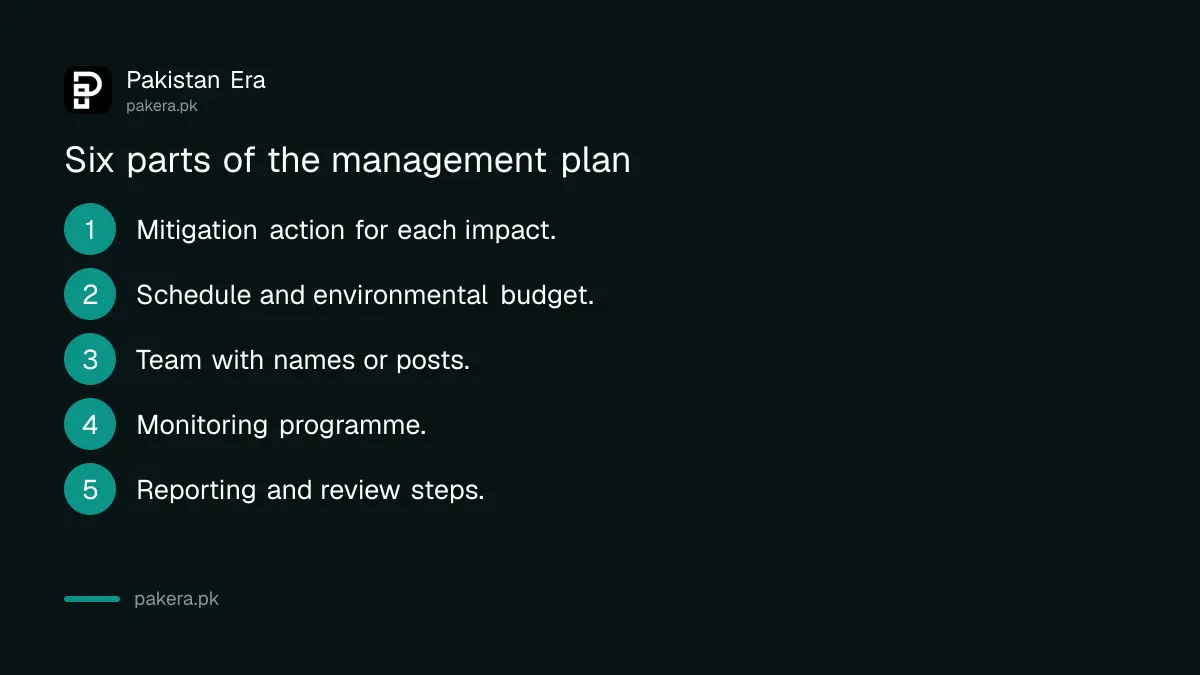
Both checklists ask for the same management plan: proposed mitigation actions, a schedule with an environmental budget, the team with roles, a monitoring programme, reporting procedures and training needs. That is six parts.
- List each mitigation action against each impact.
- Give a date and a budget for each action.
- Name the people or posts responsible.
- Set out what you will measure and how often.
- Say who receives the monitoring reports.
- Note any staff training needed to run the plan.
Seven appendices close both reports: a glossary, abbreviations, a list of people consulted with their written feedback, data sources, terms of reference, team names and qualifications, and approvals from other departments. The full process and timings are in the guide to Punjab environmental approval.
Common questions about IEE and EIA checklists
Which projects need an IEE and which need an EIA?
The checklists do not say. They tell you to screen the project against the IEE and EIA regulations. We did not read those schedules, so ask EPA Punjab on 1373.
Is there a different checklist for each sector?
EPA Punjab also lists sector guidelines. Some of those files carry an older 2004 heading from another province's agency, so check with EPA Punjab that your sector file applies.
What does "lacking" mean on the checklist?
It is a column where the reviewer marks any required item that your report does not contain. The page number column shows where each item sits in your report.
Do I need an IEE for a small shop?
We cannot say. The category depends on the schedules, which we did not read. The checklist only tells you to screen the project first.
How many copies of the report do I submit?
EPA Punjab's timeline sheet says 10 paper copies and 2 electronic copies, with the application and fee receipt.
Who do I call with questions?
EPA Punjab's helpline is 1373. Its office phones are +92-42-99231818 and +92-42-99232236, and the email is ddisepa@punjab.gov.pk.
How we verified this
What we checked, where we read it, and what we could not confirm.
Last checked 22 October 2026. We read the IEE checklist and the EIA checklist published on epd.punjab.gov.pk, plus the agency's contact page. Both files show a 2022 date. We did not read the IEE and EIA regulations or their schedules, so which projects need which report is not covered. The comparison table is our own reading of the two lists.
About the author

Tax, Bills and Technology Writer
Ali Akhtar is a young and curious voice here at Pakistan Era. He is currently pursuing his A-Levels and has a growing interest in Pakistan’s changing industrial landscape and educational trends. Ali likes to write in a way that helps him explain and explore the world around him. His writing reflects the perspective of the new generation navigating the evolving trends of Pakistan where technology, youth innovation, and shifting opportunities are reshaping the country’s future.