Prove Your Imports Are Free of Forced Labour: Pakistan's SRO 704 Ban Explained
Pakistan's April 2026 Import Policy Order change bans goods made by forced labour. See who must show evidence, what is unclear and how to prepare your file.
Short answer: Pakistan bans imports made wholly or partly by forced labour. The ban sits in the Import Policy Order, 2022, which the Ministry of Commerce amended in April 2026 through SRO 704. Importers of goods from countries the government later notifies must give evidence that the goods are free of forced labour. We have not seen a notified list yet.
Most importers have never been asked for this paper. That may change, so the sensible move is to build the file before a customs officer or a bank asks for it.
The April 2026 amendment bans forced labour goods
The amendment says imports of goods mined, produced or manufactured wholly or partly by forced labour are prohibited. It sits under the Imports and Exports (Control) Act, 1950. The wording below is quoted from the United States Trade Representative (USTR) report, which cites SRO 704.
USTR dates the amendment to 29 April 2026. The text was not available for us to read on the Ministry of Commerce site, so we rely on USTR's quotation of it. The amendment is titled "Amendment in the Import Policy Order, 2022 in Pursuance of the Determinations of the ILO". ILO means the International Labour Organization.
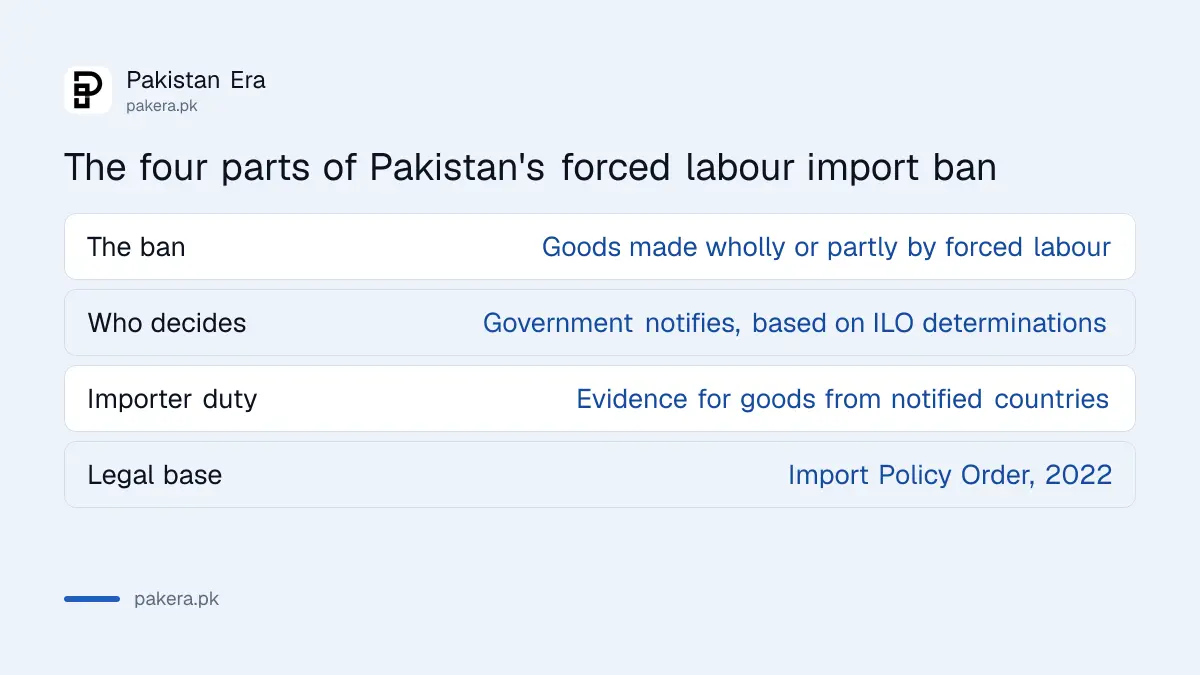
| Element | What USTR quotes or says |
|---|---|
| The ban | Imports of goods mined, produced or manufactured wholly or partly by forced labour are prohibited |
| Who decides what is covered | The government, "pursuant to determinations by the ILO", notifies goods, entities and countries of origin from time to time |
| What importers must do | Importers from notified countries furnish evidence that their goods are free of forced labour |
| Legal base | Import Policy Order, 2022, under the Imports and Exports (Control) Act, 1950 |
Evidence is needed only for goods the government notifies
The duty to show evidence applies to goods, entities and countries the federal government notifies, based on ILO determinations. It is not a blanket paper for every shipment. Until a notification names your supplier or origin, no certificate is fixed by the order itself.
That reading comes from USTR's summary of the order. Check the Ministry of Commerce notification page and your clearing agent before each large shipment, because a notification could land at any time.
USTR says the rule is new and not yet enforced
In the same report, USTR found Pakistan "has only recently imposed" the ban and saw no evidence of investigations, seizures or other enforcement action to date. This is one reason the United States applied its Section 301 tariff. Our report on the 10 per cent US tariff on Pakistani goods explains what exporters must check.
USTR also noted that the order does not define forced labour and is unclear on the ILO's role. It said the decisions that matter, at importer or shipment level, would suit Pakistan's customs authorities better. These are USTR's observations and not a Pakistani ruling.
A later change was reported but we could not read it
A further amendment was reported to have been approved by the Economic Coordination Committee in mid July 2026. It was said to adopt the wording "forced or compulsory labour", taken from ILO Convention No. 29. We could not find the notified text, so treat this as reported and unconfirmed.
If it is notified, the wording would answer one of USTR's complaints, the missing definition. It would not by itself create a list of banned origins or a form for importers.
Build your evidence file before anyone asks
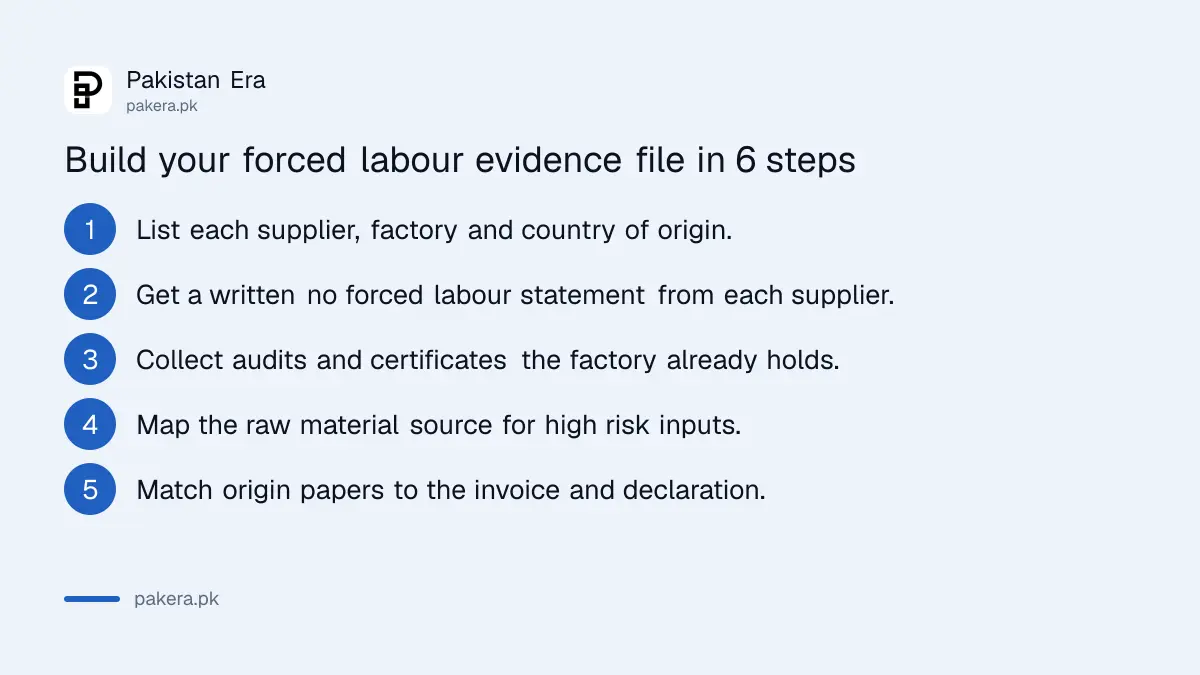
The steps below are our practical advice. The order does not prescribe them, and a notification may set its own list of papers. Keep each item for every supplier you buy from, and keep it for the years you keep other customs records.
- List each supplier, factory and country of origin for the goods you import.
- Ask each supplier for a written statement that no forced labour was used in making the goods.
- Collect audit reports or certificates the factory already holds, such as social compliance audits.
- Map the raw material source for cotton, polysilicon, seafood or similar high-risk inputs.
- Match origin papers to the invoice and the goods declaration, so the three agree.
- Store everything with the import file and tell your clearing agent where it is.
If you also file declarations on WeBOC, a mismatch between papers is the easiest thing to be questioned on. See the guide to choosing between WeBOC and PSW for the filing side.
A clean supplier file helps exporters too
The import ban is about what comes into Pakistan, but the same supplier file is useful if you also sell abroad. Labour standards matter to other markets as well, as the note on EU GSP+ requirements from 2027 shows.
Common questions about the forced labour import ban
Do I need a forced labour certificate for every import?
Not on the text USTR quotes. The order asks for evidence from importers of goods from notified countries, and we have not seen a notified list. Ask your clearing agent before each shipment.
What counts as forced labour under the order?
The April text does not define it, according to USTR. A later amendment was reported to use the ILO Convention No. 29 wording, but we could not read it.
Who enforces the ban?
The order is issued by the Ministry of Commerce. USTR said it would suit customs authorities to make shipment level decisions, but we saw no published enforcement procedure.
Does this ban affect Pakistani exports?
It covers imports into Pakistan. Exports to the United States face a separate 10 per cent tariff set by USTR after its finding on enforcement.
Where can I read the order?
It is published as SRO 704 on the Ministry of Commerce website. USTR cites the file under the April 2026 uploads of commerce.gov.pk.
How we verified this
What we checked, where we read it, and what we could not confirm.
Last checked 11 October 2026. We read the USTR report on its Section 301 forced labour investigations, including its findings on Pakistan, which quote and summarise SRO 704. We could not open the SRO file itself on commerce.gov.pk because the site blocked our request. The mid July amendment is reported and unconfirmed. The evidence file list is our own advice.
About the author

Global Affairs & Political Economy Writer
Muhammad Hatim is a book lover who started writing because he enjoys it. At Pakistan Era he writes about international relations, geopolitics and the global economy, with a particular interest in South Asia and the forces behind current events.