EU GSP+ Rules From 2027: Pakistan Must Reapply by the End of 2028
The EU's new GSP rules start 1 January 2027. Pakistan keeps GSP+ until the end of 2028 but must reapply and meet 32 conventions. What exporters should check.
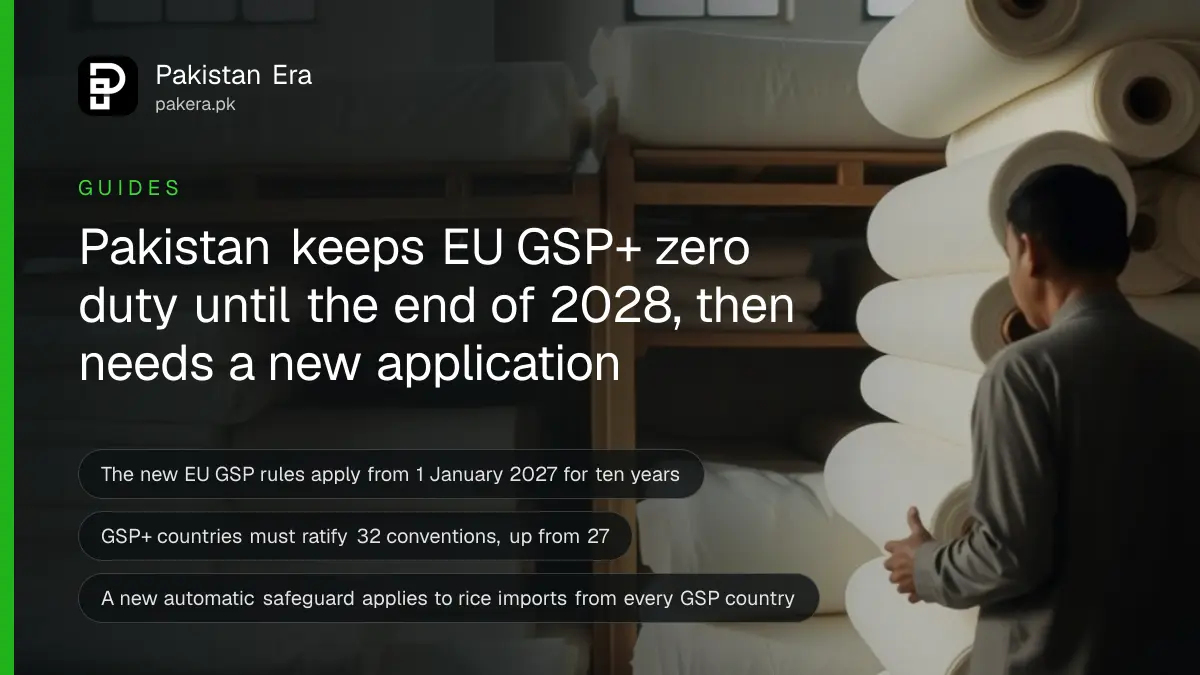
The EU's new trade preference rules apply from 1 January 2027. Pakistan keeps its GSP+ zero-duty access during a transition, but must reapply under the new rules before the end of 2028, ratify 32 international conventions instead of 27, and submit a plan of action. A new automatic safeguard on rice imports also applies to every beneficiary country.
GSP+ is the EU scheme that lets Pakistani goods such as cotton cloth, bed linen and garments enter the European Union at zero or low customs duty. For many mills in Faisalabad, Lahore and Karachi, it is the difference between winning and losing a European order.
We read the European Commission's own pages on the new scheme on 9 October 2026, including its question and answer note. Here is what changes, what does not, and what an exporter in Pakistan should check now.
The new EU GSP rules start on 1 January 2027
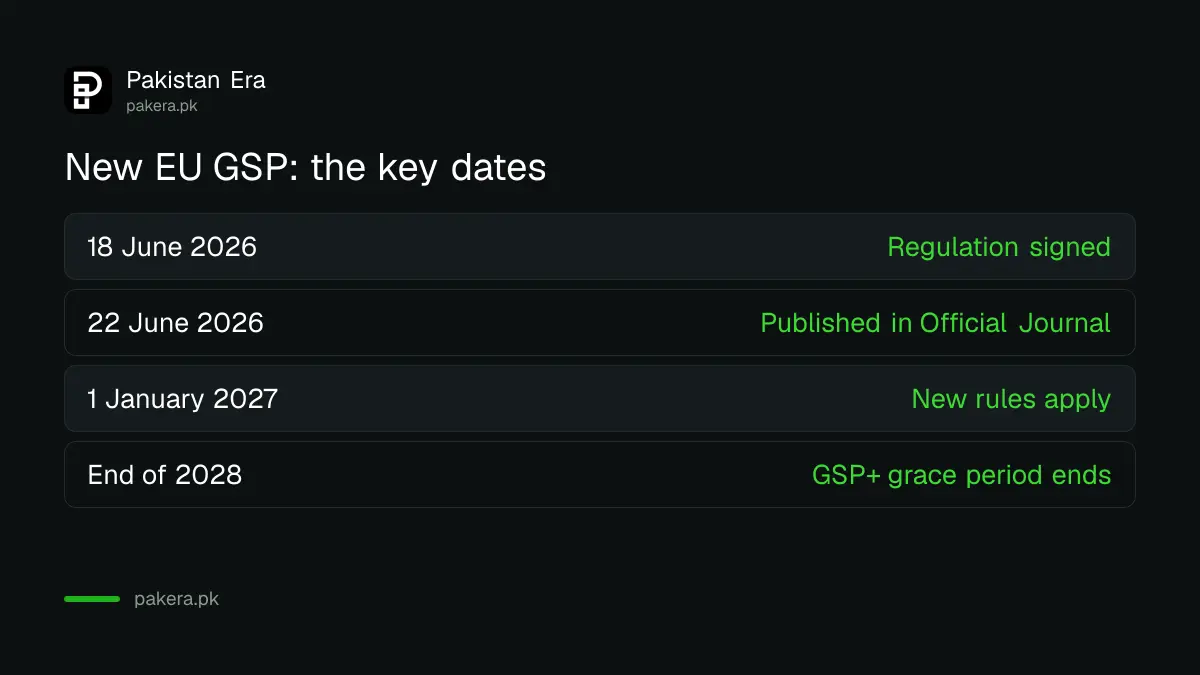
The EU signed its new Generalised Scheme of Preferences regulation on 18 June 2026 and published it in its Official Journal on 22 June 2026. The European Commission says the new rules apply from 1 January 2027 for the next ten years.
GSP stands for Generalised Scheme of Preferences. It is the EU's one-way trade deal for developing countries. The EU cuts or removes import duties, and the partner country does not have to cut its own duties in return.
There are three levels. Standard GSP gives partial or full duty cuts on about two-thirds of tariff lines. GSP+ cuts those same duties to zero for countries that ratify and apply a list of international conventions. Everything But Arms gives the poorest countries duty-free access for all goods except weapons. Pakistan is in the GSP+ group, and the Commission's latest monitoring report for 2023 to 2025 includes a Pakistan country annex.
Pakistan must reapply for GSP+ before the end of 2028
Current GSP+ countries, including Pakistan, do not move across automatically. The Commission says they must reapply because the entry rules changed. They keep their GSP+ preferences during a two-year grace period, until the end of 2028, while they prepare and submit the new application.
That is the most important point for exporters. Nothing changes at the border on 1 January 2027 for a Pakistani shipment that already qualifies. The risk sits further out. If the application is late, weak or rejected, zero-duty access could end after the grace period.
The Commission says the exact application process will be set out in a separate procedural regulation. It also says the Commission, the EU External Action Service and EU Delegations will help each country through the process.
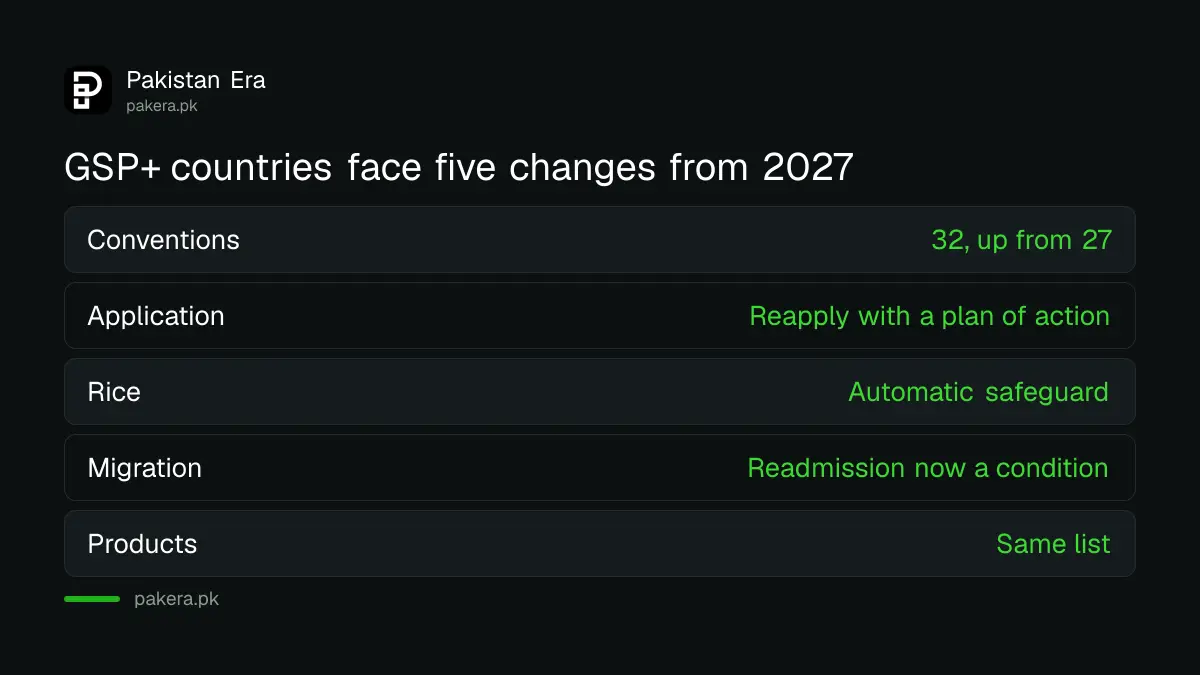
| Item | Current GSP | New GSP from 2027 |
|---|---|---|
| Conventions a GSP+ country must ratify | 27 | 32 |
| Climate treaty on the list | Kyoto Protocol | Paris Agreement |
| Plan of action with the application | Not required | Required |
| Rice imports | General safeguards | New automatic rice safeguard |
| Products covered | Same list | Same list, a few reclassified |
| Urgent withdrawal for grave violations | No | Yes |
Five new conventions are added to the GSP+ list
The new list has 32 conventions on human rights, labour rights, environment and climate, and good governance. Five are new, and the Paris Agreement replaces the Kyoto Protocol. A GSP+ applicant must ratify all of them and send a forward-looking plan of action for applying them.
The Commission names the five new conventions:
- The Optional Protocol to the Convention on the Rights of the Child on children in armed conflict (2000).
- The Convention on the Rights of Persons with Disabilities (2007).
- ILO Convention No. 81 on Labour Inspection (1947).
- ILO Convention No. 144 on Tripartite Consultations (1976).
- The UN Convention against Transnational Organised Crime (2000).
Two of these are about labour. Labour inspection means government inspectors checking factories for safety, wages and child labour. Tripartite consultation means the government, employers and workers' groups talking together on labour rules. Both reach directly into the mills and workshops that sell to Europe.
We did not check which of the 32 conventions Pakistan has already ratified. That is a question for the Ministry of Commerce and the relevant ministries, and the new plan of action will show it.
Rice exporters face a new automatic safeguard
The new rules add an automatic safeguard for rice that applies to every GSP country. If rice imports from one country rise well above its average of past imports, the EU suspends the lower duty for the rest of that year above a set volume, and applies a quota the next year.
Pakistan sells basmati and other rice to Europe, so this matters to growers and millers in Punjab and Sindh. The Commission's example compares imports with the average over ten years. A sharp jump in one year could trigger full EU duty on the extra volume.
The Commission did not give the exact trigger volume for Pakistan in the pages we read. Exporters should watch for it in the regulation's annexes and any EU notice. The EU already has a safeguard on ethanol from Pakistan, which its GSP page lists, so these tools are not only on paper.
Migration cooperation is now a condition too
The new GSP links trade preferences to whether a country takes back its own nationals who are in the EU without permission. The Commission says withdrawal is a last resort, used only after other EU engagement under its visa rules has failed.
The Commission calls this readmission conditionality. It applies to all GSP countries, with the poorest getting two extra years. For Pakistan, it means trade access and migration cooperation are now formally linked in EU law.
What a Pakistani exporter should do now
An exporter to the EU should keep shipping under the current rules, confirm the product's duty on the EU's Access to Markets portal, and watch for Pakistan's GSP+ reapplication. Buyers often ask about labour and environmental compliance, and the new rules make that more important.
Practical steps:
- Check your product code and the GSP+ duty on the EU Access to Markets portal, which the Commission links from its GSP page.
- Keep your Pakistani export setup current, from WeBOC and TDAP registration to origin paperwork your EU buyer asks for.
- Keep records of labour inspections, wages and environmental checks. These are the issues the 32 conventions cover.
- If you sell rice, track your volumes to the EU against past years.
- Ask your trade body or the Ministry of Commerce for the timeline of Pakistan's reapplication.
Growing EU sales can also count toward the 1% or 2% export rebate on extra exports at home.
Common questions
Will Pakistan lose GSP+ on 1 January 2027?
No. The European Commission says current GSP+ countries keep their preferences during a grace period until the end of 2028, while they reapply under the new rules.
How many conventions must Pakistan meet under the new GSP+?
32, up from 27. Five conventions were added, and the Paris Agreement replaced the Kyoto Protocol.
Which products get zero duty under GSP+?
The product list stays the same under the new rules, with a few items reclassified. You can check a product's duty on the EU Access to Markets portal.
What is the new rice safeguard?
An automatic EU measure. If a country's rice exports to the EU rise well above its past average, the lower duty is suspended above a set volume for that year, and a quota applies the next year.
Has Pakistan submitted its new GSP+ application?
We found no public record of it on the EU pages we read. The Commission says the application process will be set out in a separate procedural regulation.
How long will the new GSP last?
Ten years from 1 January 2027, according to the European Commission.
How we verified this
What we checked, where we read it, and what we could not confirm.
Last checked 9 October 2026. We read the European Commission's Generalised Scheme of Preferences page and its questions and answers on the new GSP. The regulation is Regulation (EU) 2026/1395 in the EU Official Journal. We did not check Pakistan's ratification status for each convention, and we found no statement from Pakistan's Ministry of Commerce on the reapplication timetable.
About the author

Global Affairs & Political Economy Writer
Muhammad Hatim is a book lover who started writing because he enjoys it. At Pakistan Era he writes about international relations, geopolitics and the global economy, with a particular interest in South Asia and the forces behind current events.