The Basmati Ruling Blocks India, It Does Not Give Pakistan a Trademark
An Australian court refused India's exclusive claim to the word Basmati. That is not the same as Pakistan gaining one, and the gap matters.
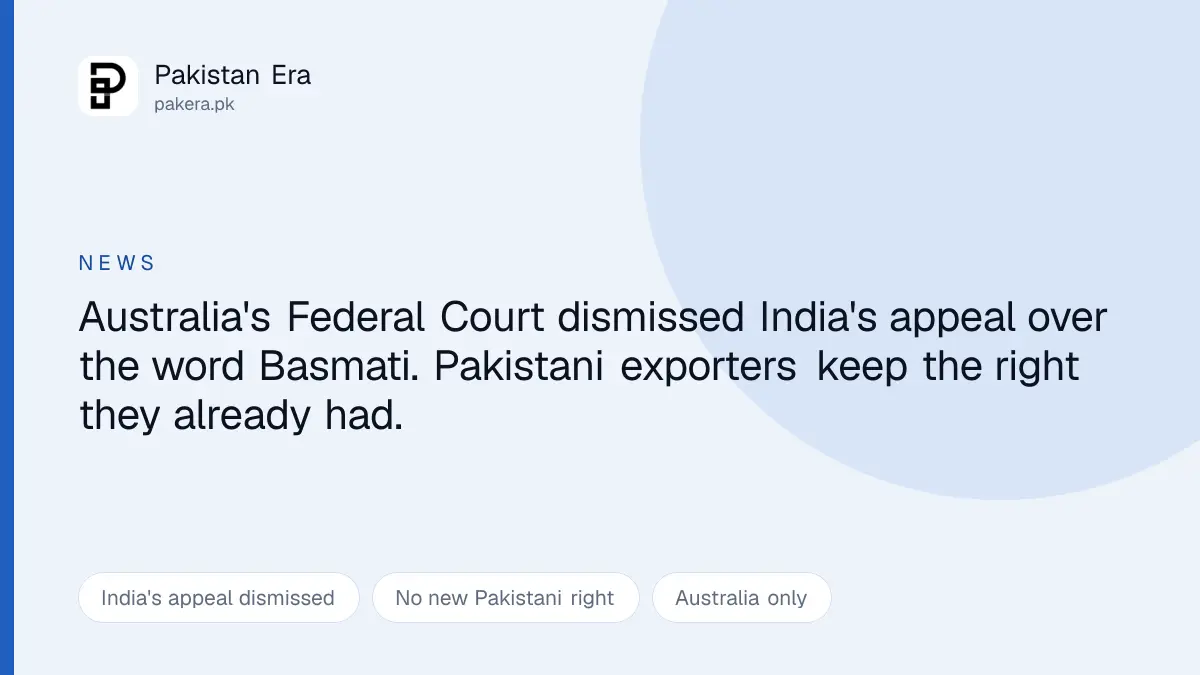
Australia's Federal Court has dismissed an appeal by India's export authority over the word Basmati. The headlines here have called it a win for Pakistan.
It is a good outcome. It is also being described as something it is not, and the difference decides what any of it means for a rice exporter.
What the court actually decided
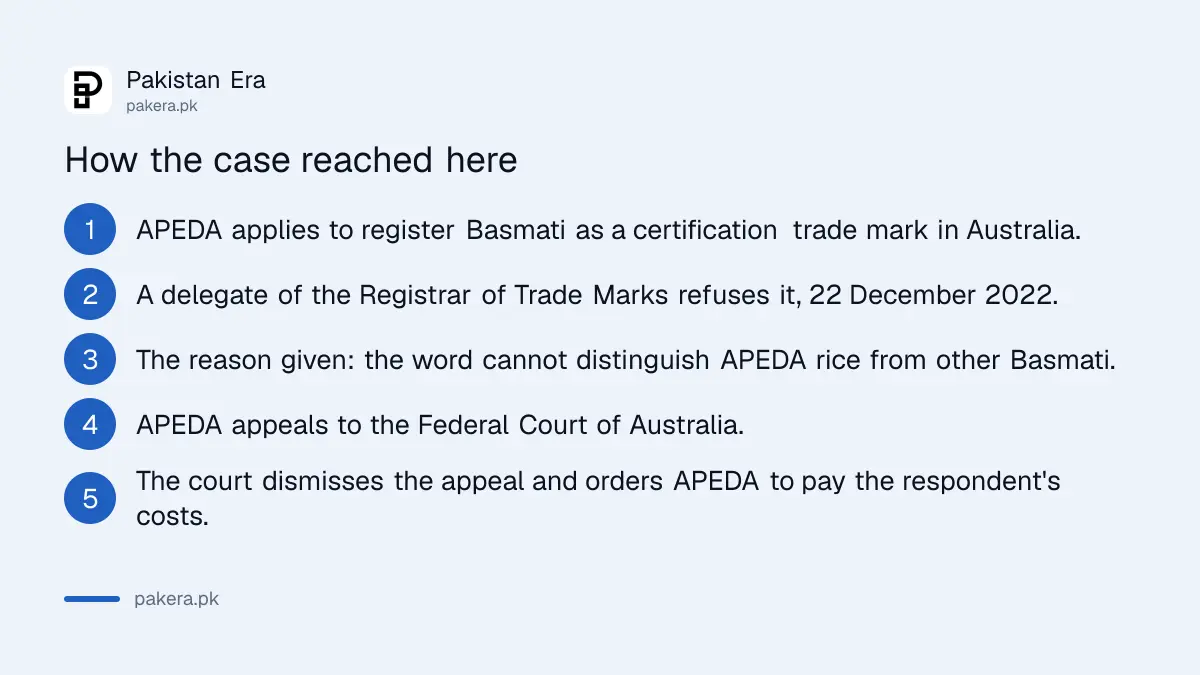
The sequence matters, so here it is in order.
- India's Agricultural and Processed Food Products Export Development Authority applied to register the word Basmati as a certification trade mark for rice in Australia.
- A delegate of the Australian Registrar of Trade Marks refused it on 22 December 2022.
- The reason given was that the word could not distinguish rice certified by that authority from Basmati rice legitimately produced and marketed by other traders.
- The authority appealed to the Federal Court of Australia.
- The court dismissed the appeal and ordered the authority to pay the respondent's costs.
Pakistan's commerce ministry welcomed the outcome, noting that the registrar's decision expressly recognised that Basmati is also grown in Pakistan and that Pakistani traders have an equally valid claim to the term.
Refusing one claim is not granting another
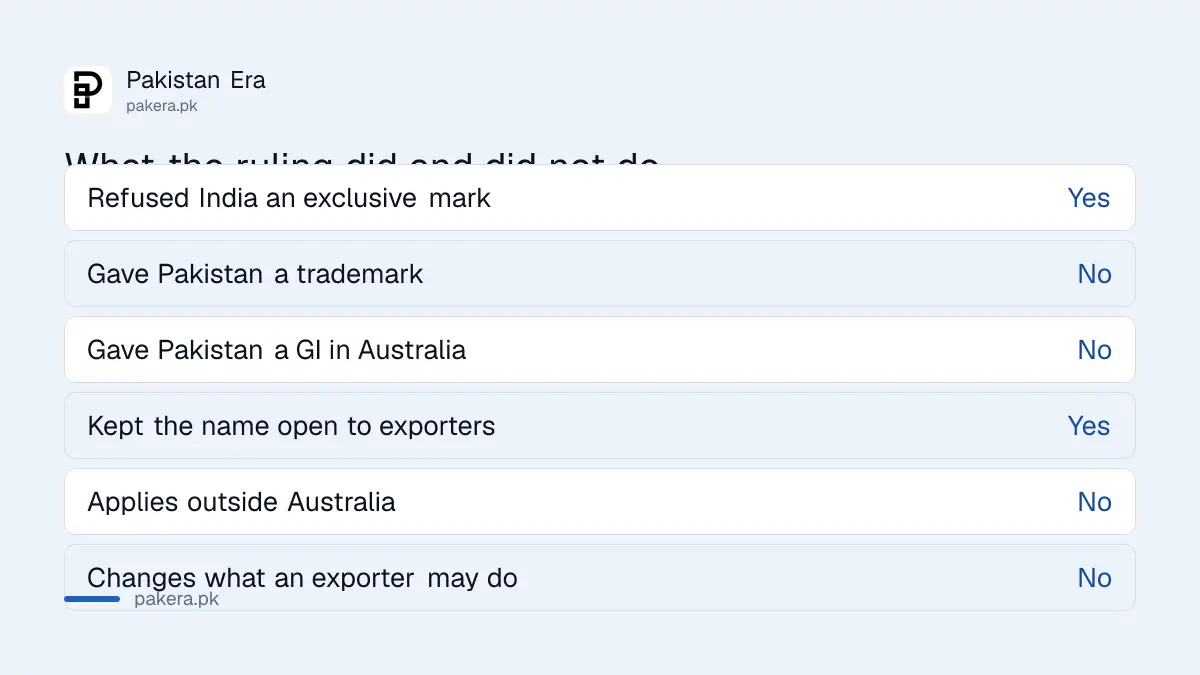
| Question | Answer |
|---|---|
| Did it refuse India an exclusive mark? | Yes |
| Did it give Pakistan a trade mark? | No |
| Did it give Pakistan a geographical indication in Australia? | No |
| Does the name stay open to exporters? | Yes |
| Does it apply outside Australia? | No |
This is the whole point. A court refusing to give one party an exclusive right does not hand that right to anybody else. It leaves the word where it was, available to everyone with a legitimate claim to it.
That is a real result and worth having. Pakistani exporters can keep selling Basmati as Basmati in Australia, which is exactly what they could do last week. The status quo was defended, not improved.
What a certification trade mark is
Worth explaining, because the term is doing a lot of work in this story.
An ordinary trade mark identifies one company's goods. A certification trade mark is different. It says that goods carrying it meet a standard set by whoever owns the mark, and that owner controls who may use it.
So if the application had succeeded, the Indian authority would have decided who could sell rice labelled Basmati in Australia, and on what terms. That is what was refused, and it explains why the refusal matters to a Pakistani exporter even though it grants them nothing.
One thing nobody has reported
The court ordered the Indian authority to pay the respondent's costs. A respondent is the party that opposed the appeal.
We read the coverage across several outlets and none of them names that party. We could not confirm whether it was the Government of Pakistan, the Rice Exporters Association of Pakistan, or a private trader.
We are flagging this rather than filling it in. When a case is reported as Pakistan winning, it is reasonable to ask who stood up in court, and we do not know. If it was a private business carrying that cost, the credit is being distributed rather loosely.
Why Basmati keeps ending up in court
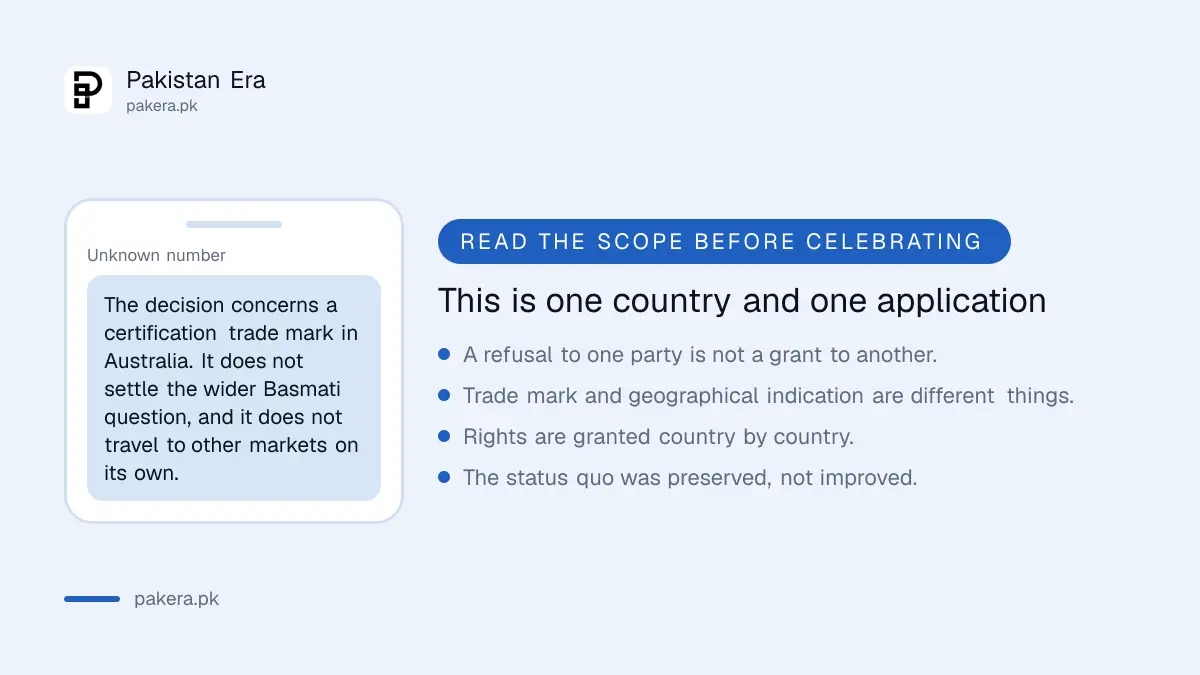
Rights like these are granted country by country. There is no single global register that settles a name everywhere at once.
So a decision in Australia binds Australia. The same argument can be run again in another market, in front of another registrar, under another country's law, and the answer there does not have to match. That is why this dispute has surfaced repeatedly in different places rather than being resolved once.
Basmati also sits awkwardly in the rules because the growing region spans a border. Most protected names belong to one country. This one does not, which is the underlying difficulty no court is going to remove.
What we could not establish
We do not know the status of any Pakistani geographical indication registration in Australia, so we are not claiming one exists and not claiming one does not.
We are not publishing Basmati export figures, for Australia or overall, because we did not read them at source. Round numbers get repeated until they become facts, and this is a story where the numbers are already being stretched.
We also make no comment on India's decision to appeal. A court refused an application and then refused an appeal against that refusal. That is the story, and dressing it up as a contest between countries adds heat rather than information.
What it means if you are in the trade
Nothing changes in your paperwork tomorrow. You may describe Pakistani Basmati as Basmati in Australia, as you could before.
What has changed is a risk that did not materialise. Had the application succeeded, exporters would have faced a gatekeeper in one of their markets, with certification terms set by another country's authority. That did not happen, and the cost order suggests the opposing party recovers what it spent making sure of it.
For the wider export picture, our coverage of the industrial policy tariff cuts sets out where the government says it wants exports to go, and the Pakistan and Iran trade target covers another market being pushed. Support available to growers is in our guide to Punjab's agriculture schemes.
Questions readers are asking
Did Pakistan win the Basmati case?
India's appeal was dismissed and its application refused. Pakistan was not granted a trade mark or a geographical indication in Australia by that decision.
What was India trying to register?
The word Basmati as a certification trade mark for rice in Australia, which would have let its export authority control who may use the name there.
Why was the application refused?
The registrar's delegate found the word could not distinguish rice certified by that authority from Basmati rice legitimately produced and marketed by other traders.
Does this ruling apply in other countries?
No. Trade mark and geographical indication rights are granted country by country, so the same question can be argued again elsewhere.
Can Pakistani exporters now use the name freely?
They can continue to, as they could before. The decision preserved that position rather than creating it.
Who paid the legal costs?
The court ordered India's authority to pay the respondent's costs. The reporting we read does not name the respondent, and we could not confirm who it was.
Is Basmati a Pakistani or an Indian rice?
It is grown on both sides of the border in a historically recognised region, which is why no single authority has been able to claim the name exclusively.
About the author

Tax, Bills and Technology Writer
Ali Akhtar is a young and curious voice here at Pakistan Era. He is currently pursuing his A-Levels and has a growing interest in Pakistan’s changing industrial landscape and educational trends. Ali likes to write in a way that helps him explain and explore the world around him. His writing reflects the perspective of the new generation navigating the evolving trends of Pakistan where technology, youth innovation, and shifting opportunities are reshaping the country’s future.