Pakistan and Iran Renew a $10 Billion Trade Target, With Sanctions Left Unmentioned
Islamabad and Tehran recommitted to a $10 billion trade goal and an FTA under negotiation. What was agreed, and the obstacle nobody named.
Prime Minister Shehbaz Sharif met a six member Iranian delegation in Islamabad today, and both sides renewed their commitment to a $10 billion bilateral trade target, with technical negotiations on a free trade agreement described as continuing.
If that figure sounds familiar, it should. It has been the target for years. Which makes the interesting question not what was agreed, but why the same number keeps being agreed.
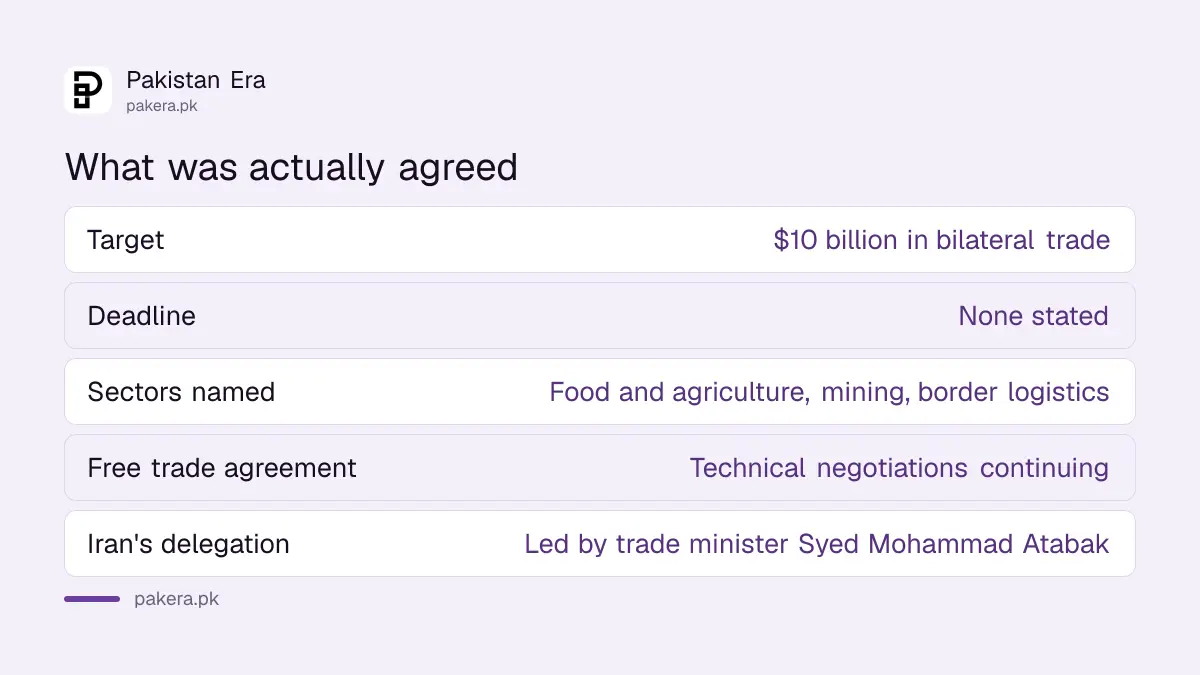
What was actually agreed
| Detail | |
|---|---|
| Target | $10 billion in bilateral trade |
| Deadline | None stated |
| Current volume | Not disclosed in the announcement |
| Sectors named | Food and agriculture, mining, border trade logistics |
| Free trade agreement | Technical level talks continuing |
| Iran's delegation | Led by Minister of Industry, Mine and Trade Syed Mohammad Atabak |
The mining detail is the most concrete thing in it: cooperation specifically on processing and value addition of precious stones, which is a real industry on both sides of that border and one where Pakistan exports raw and imports finished, losing the margin in between.
Border trade logistics and customs coordination is the other substantive line, and it is the one most likely to produce visible change, because it addresses the crossings that already work rather than a market that does not yet exist.
One thing the announcement did not mention
No energy. No gas. No barter arrangement.
We are pointing that out because a great deal of coverage will import the Iran-Pakistan gas pipeline into this story, and it was not in it. Pakistan's energy relationship with Iran is a long, unresolved question with its own history, and today's meeting was about food, minerals and customs.
That absence is itself informative, given what this year has done to Pakistan's energy position. The US and Iran conflict is precisely what disrupted Qatari LNG cargoes, forced Pakistan onto the spot market at a decade high gas price, and pushed the power system toward coal. The same neighbour is simultaneously a trade partner being courted and the origin of this year's energy shock. Nobody said that out loud today either.
Why the target keeps being renewed rather than reached
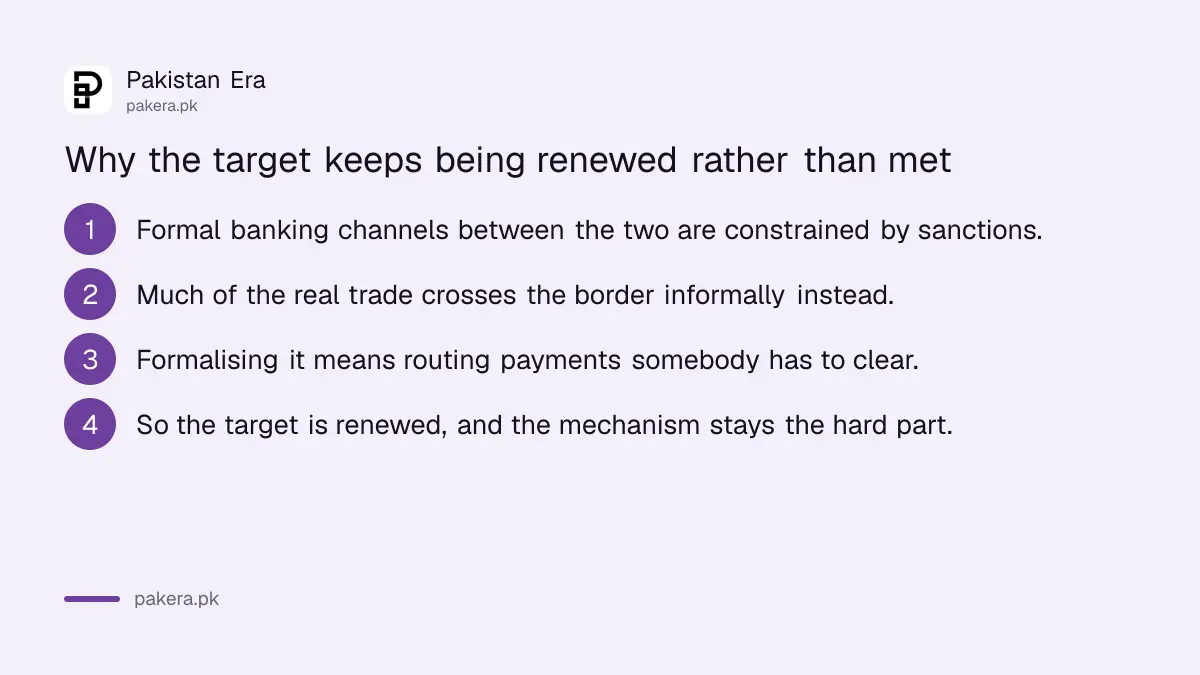
The honest answer is banking, and it is a structural problem rather than a lack of will.
Formal trade requires payments to clear through banks. Iran's position in the international financial system makes that difficult for institutions that also need access to dollar clearing, and Pakistani banks are not in a position to take that risk lightly. So the goods move, in both directions, across a long land border, and a large share of the trade that actually happens does so informally, where no one counts it and no target captures it.
That is why the number is renewed rather than reached. It is not that traders do not want to trade; it is that formalising the trade means finding a payment channel somebody is willing to operate, and no meeting communiqué solves that.
The free trade agreement matters for the same reason. An FTA sets tariff terms, which is useful, but tariff terms are not the binding constraint here. If the technical negotiations produce a workable settlement mechanism alongside the tariff schedule, that would be the genuinely new development, and it is the thing to watch for in the eventual text.
Why Pakistan is doing this now
Because the economy needs trade of any description. FBR is chasing a Rs 15.264 trillion target, exports are concentrated in a narrow band of textiles going to a small number of markets, and the search for new corridors is a standing policy priority rather than a response to today's meeting.
Iran is a neighbour with a long shared border, complementary agricultural seasons, and demand for things Pakistan grows. On pure geography it should be a significant trading partner, and the gap between what geography suggests and what the numbers show is the whole story of this relationship.
It is worth reading alongside the other direction Pakistan has been courting: Saudi investment interest and the defence relationship with Riyadh. Balancing Tehran and Riyadh simultaneously is a permanent feature of Pakistani foreign policy, not a new tightrope.
What would make this real
Three things, none of which happened today.
A settlement mechanism that banks will actually operate. A signed FTA rather than continuing technical talks. And trade figures that move, which requires the current volume to be published in the first place so that progress can be measured against something.
Until then, the accurate description is a renewed intention between two governments that would both like this to work, constrained by a financial system neither of them controls.
The wider trade and security picture
Trade targets sit inside a set of arrangements that moved considerably this year.
On the Iran border itself, crossings have moved to round the clock operation at named points, which is the practical change traders will feel first. That is covered in the 24 hour border crossings.
Further west, an Australian court refused India an exclusive claim to the word Basmati. It is being reported here as a win for Pakistan, and what it actually decided is narrower, which we set out in the Basmati ruling.
Two more. Pakistan, Saudi Arabia and Turkey signed a defence agreement in Makkah and are now forming the bodies to run it, covered in the joint defence mechanisms. And shipping risk became real for Pakistani crews in the Red Sea attack.
Questions readers are asking
What did Pakistan and Iran agree?
To strengthen bilateral trade toward a $10 billion target, improve border connectivity and customs coordination, and expand cooperation in mining, particularly processing of precious stones. No deadline was stated.
Is there a free trade agreement?
Not yet. Iran's trade minister said technical level negotiations on a proposed FTA are continuing.
Was the gas pipeline discussed?
Not according to the announcement, which contains no mention of energy, gas or barter arrangements. Coverage that adds them is importing them from elsewhere.
What is current Pakistan-Iran trade worth?
The current volume was not disclosed in the announcement, which is one reason the $10 billion target is hard to assess as ambitious or modest.
Why has this target not been met before?
Chiefly because formal payments between the two are constrained by Iran's position in the international banking system, so much of the real trade happens informally across the land border and never appears in official figures.
Does this change Pakistan's energy situation?
No. Nothing about energy was announced, and Pakistan's gas position this year has been shaped by the disruption to Qatari cargoes and the shift toward coal rather than by anything involving Iranian supply.
About the author

Senior Writer, Public Services and Technology
Shahid joined us in 2024 as an author. He is a senior contributor to Pakistan's leading technology websites. He writes detailed articles, mostly covering his expertise in the latest tech, mobiles, apps, gadgets, and step-by-step guides. His ideology is to help people understand the latest trends and explain complex methods through very easy-to-understand guides.