Pakistan Iran Border Will Stay Open 24 Hours
Pakistan and Iran agreed to keep border crossings open round the clock, with harmonised customs and better logistics. What that changes.
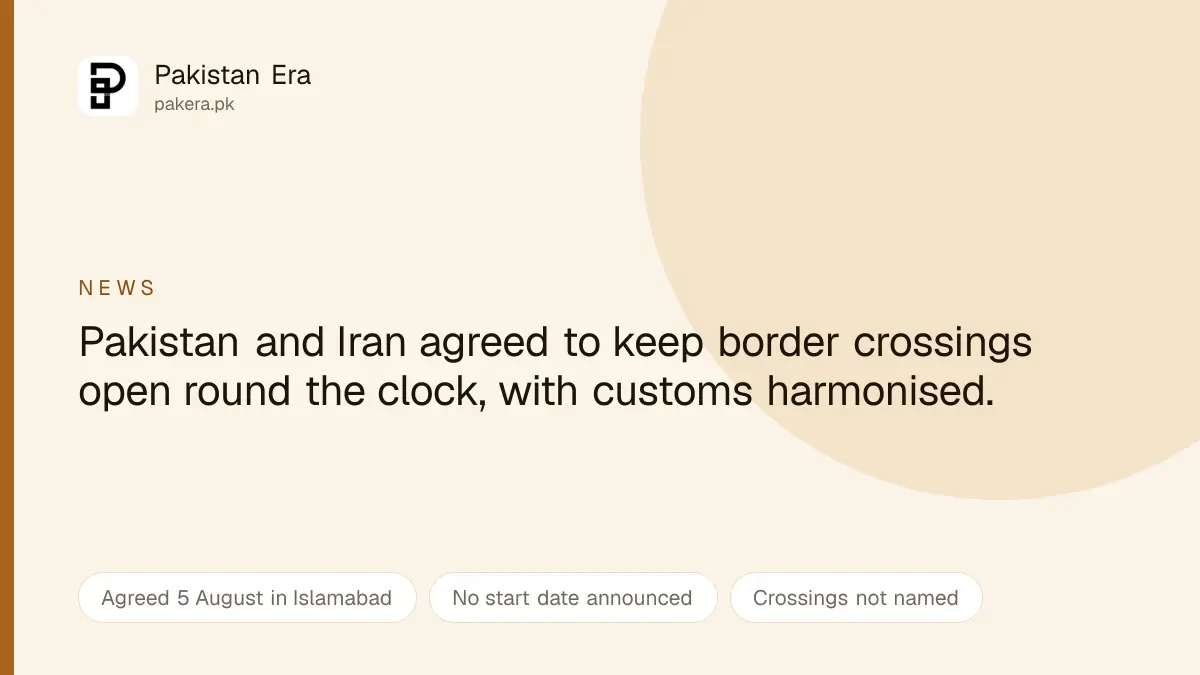
Pakistan and Iran have agreed to run their border crossings round the clock.
That was the concrete outcome when Prime Minister Shehbaz Sharif met a six-member Iranian delegation in Islamabad on 5 August 2026, led by Iran's Minister of Industry, Mine and Trade, Syed Mohammad Atabak. Alongside it: improved border facilities, stronger logistics infrastructure, and harmonised customs procedures.
Of everything announced, the 24-hour opening is the one that changes an actual working day.
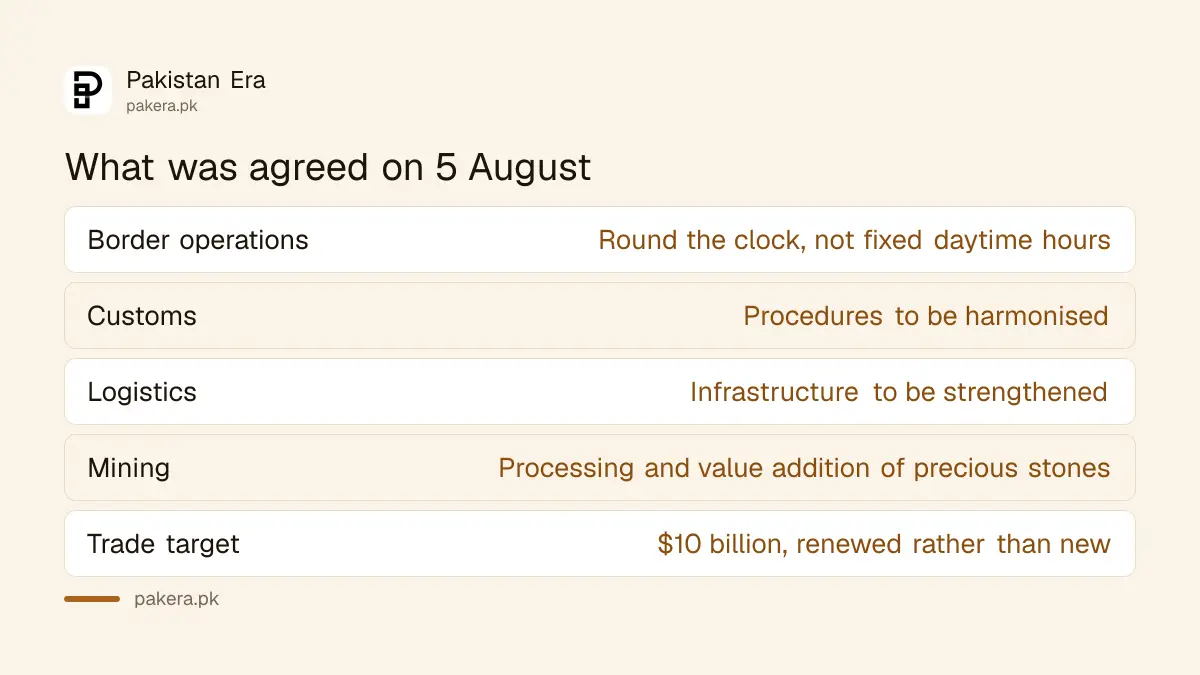
What was agreed
| Item | Detail |
|---|---|
| Border operations | Round the clock, rather than fixed daytime hours |
| Border facilities | To be improved |
| Logistics | Infrastructure to be strengthened |
| Customs | Procedures to be harmonised between the two sides |
| Mining | Cooperation on processing and value addition of precious stones |
| Trade target | $10 billion, renewed |
The $10 billion figure is the headline everyone will report, and we have already set out why that number keeps being renewed rather than reached, and the obstacle nobody names, in the piece on the trade target. This article is about the smaller commitment that is more likely to matter.
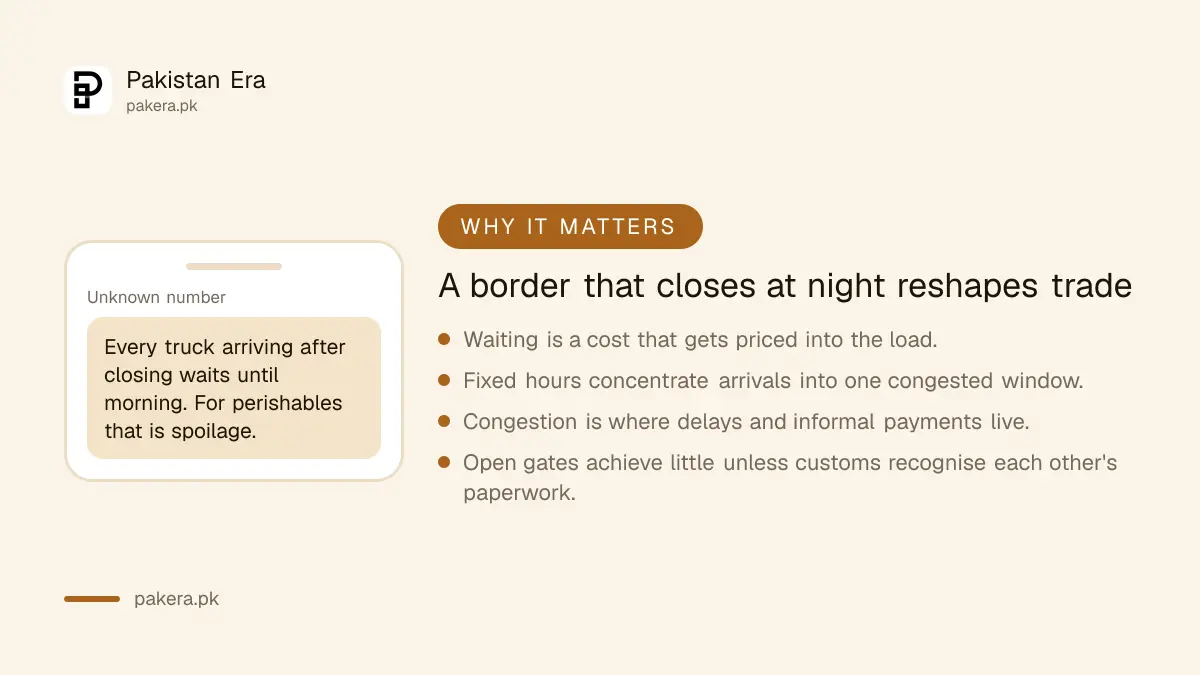
Night closing costs traders real money
A border that shuts at night does not just pause trade. It changes how trade works.
Every truck that arrives after closing waits until morning. The driver waits, the goods wait, and the money tied up in them waits. For fruit and vegetables that means waste. For everything else it is a cost that gets added to the price. Over a season, it is a reason to send goods by another route.
Fixed hours also push every truck into the same few hours. That creates a rush. And a rush at a border crossing is where delays, bribes and queue jumping happen. Spreading traffic over 24 hours reduces all three.
Harmonised customs is the other half of the same idea. Open gates do not help if the paperwork has to be done twice. Longer hours only speed things up if each side accepts the other side's documents.
This is a Balochistan jobs story too
This is the part that gets left out of trade coverage written from Islamabad.
The Pakistan-Iran frontier runs through Balochistan, and border trade there is not an abstraction about bilateral targets. It is a substantial part of how the local economy functions, in districts with limited formal employment and limited alternatives.
Longer opening hours and better facilities are, in practice, a Balochistan livelihoods measure as much as a foreign policy one. That is worth saying plainly, because the province's relationship with resource and trade decisions taken elsewhere is the argument underneath a great deal else, including the Reko Diq project and the political dispute we set out in the 11 August explainer.
The gemstone deal is about cutting, not digging
The two sides agreed to cooperate on mining, and specifically on the processing and value addition of precious stones.
Those last two words matter. Pakistan has long sold gemstones close to how they come out of the ground. The cutting, polishing and grading that raise the price happen in other countries. A deal about processing, not digging, aims at the part where the money is.
Whether it materialises is a separate question. But it is a more considered ask than another memorandum about volumes.
Banks are the real problem, and nobody said so
Every Pakistan-Iran trade commitment runs into the same wall, and it is not logistics.
Iran is under extensive international sanctions, and the practical consequence for legitimate bilateral trade is banking. A Pakistani exporter can have a signed order, an open border and a cleared truck, and still find that no bank will process the payment, because the correspondent banking relationships that settle international transactions are the part sanctions bite hardest.
That is why trade between two neighbours with a long land border, complementary energy and agriculture profiles and a renewed target has stayed so far below what geography would predict. It is also why so much of the actual commerce runs informally, which is the trade that does not appear in either country's figures.
Round-the-clock crossings and harmonised customs are real improvements to the physical side of trade. They do not touch the financial side, and nobody at the meeting said they would.
Four things that would make this real
- A start date. Round-the-clock operation needs staffing, lighting, scanning and security in place at each crossing. None of that was announced.
- Which crossings. The agreement was described in general terms rather than named points, and the two are not the same commitment.
- Customs harmonisation in writing. Recognising each other's documentation requires an instrument, not an intention.
- Freight volumes a year out. That is the only honest measure of whether hours changed behaviour.
We are not going to pretend more was announced than was. No timeline, no cost, no named crossings and no notification have been made public, and this was a meeting outcome rather than an operative instrument.
Questions readers are asking
What did Pakistan and Iran agree on 5 August 2026?
To enhance cross-border trade through round-the-clock border operations, improved border facilities, stronger logistics infrastructure and harmonised customs procedures, alongside mining cooperation and a renewed $10 billion trade target.
Who led the Iranian delegation?
Iran's Minister of Industry, Mine and Trade, Syed Mohammad Atabak, heading a six-member delegation that met Prime Minister Shehbaz Sharif in Islamabad.
When do the borders start operating 24 hours?
No start date was announced. Round-the-clock operation requires staffing, lighting and scanning capacity at each crossing, and none of that was detailed.
Why does opening around the clock matter?
Because a truck arriving after closing waits until morning, which is spoilage for perishables and a cost on everything else. It also spreads arrivals instead of concentrating them into one congested window.
What is the mining cooperation about?
Processing and value addition of precious stones, meaning the cutting and finishing stages rather than extraction. That is where most of the value in the gemstone chain sits.
Is the $10 billion target new?
No. It was renewed rather than set. It has been restated repeatedly without being reached.
About the author

Tax, Bills and Technology Writer
Ali Akhtar is a young and curious voice here at Pakistan Era. He is currently pursuing his A-Levels and has a growing interest in Pakistan’s changing industrial landscape and educational trends. Ali likes to write in a way that helps him explain and explore the world around him. His writing reflects the perspective of the new generation navigating the evolving trends of Pakistan where technology, youth innovation, and shifting opportunities are reshaping the country’s future.