US Adds 10% Tariff on Pakistani Goods: What Exporters Must Check
The US charges an extra 10% Section 301 duty on most Pakistani goods since 24 July 2026. See what is exempt, the textile quota gap and five checks to run.
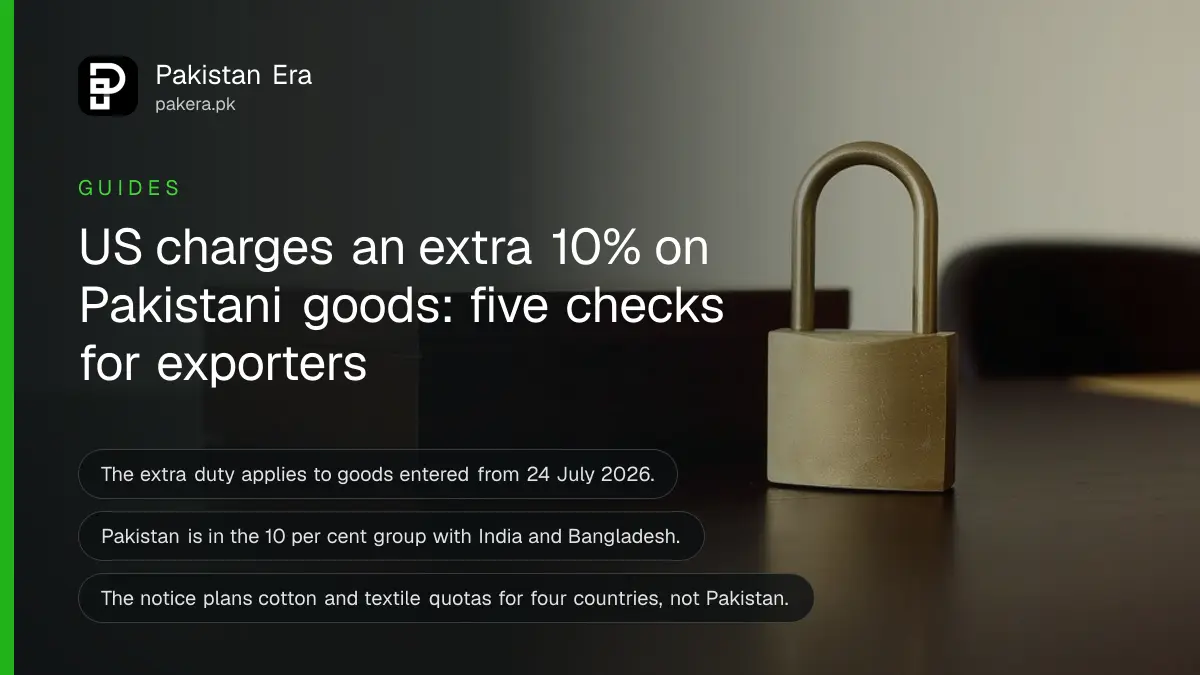
Short answer: Since 24 July 2026 the United States charges an extra 10 per cent duty on most goods made in Pakistan. It is added to the normal US duty on the product. The US Trade Representative (USTR) set it under Section 301 of the Trade Act of 1974, after finding that Pakistan does not effectively enforce a ban on imports made with forced labour. Whether your shipment pays depends on its product code.
Update, 11 October 2026: Pakistan's own forced labour import ban under SRO 704 is explained too.
The duty is now more than two months old, and many exporters still ask what it covers. We read USTR's final action notice, which the Federal Register published on 28 July 2026, and the part that names Pakistan. This article sets out what the notice says, what it leaves out, and the checks to run before the next shipment leaves Karachi, Lahore or Faisalabad.
The extra 10 per cent applies to goods entered from 24 July 2026
The duty applies to Pakistani goods entered for US consumption, or taken out of a bonded warehouse, on or after 12:01 a.m. US Eastern time on 24 July 2026. It is charged on top of the duty already listed for the product, not instead of it.
The notice gives one grace rule. Goods that were already loaded on a vessel and in transit before that moment are not charged, if they were entered before 12:01 a.m. on 28 July 2026. Anything entered after that date pays, even if it sailed in July.
The date that counts is the day of US entry, not the invoice date or the day the container left Pakistan. A shipment that sailed in mid July and lands in August pays the new duty unless it met the in-transit rule above.
The tariff follows a finding that Pakistan does not enforce its forced labour import ban
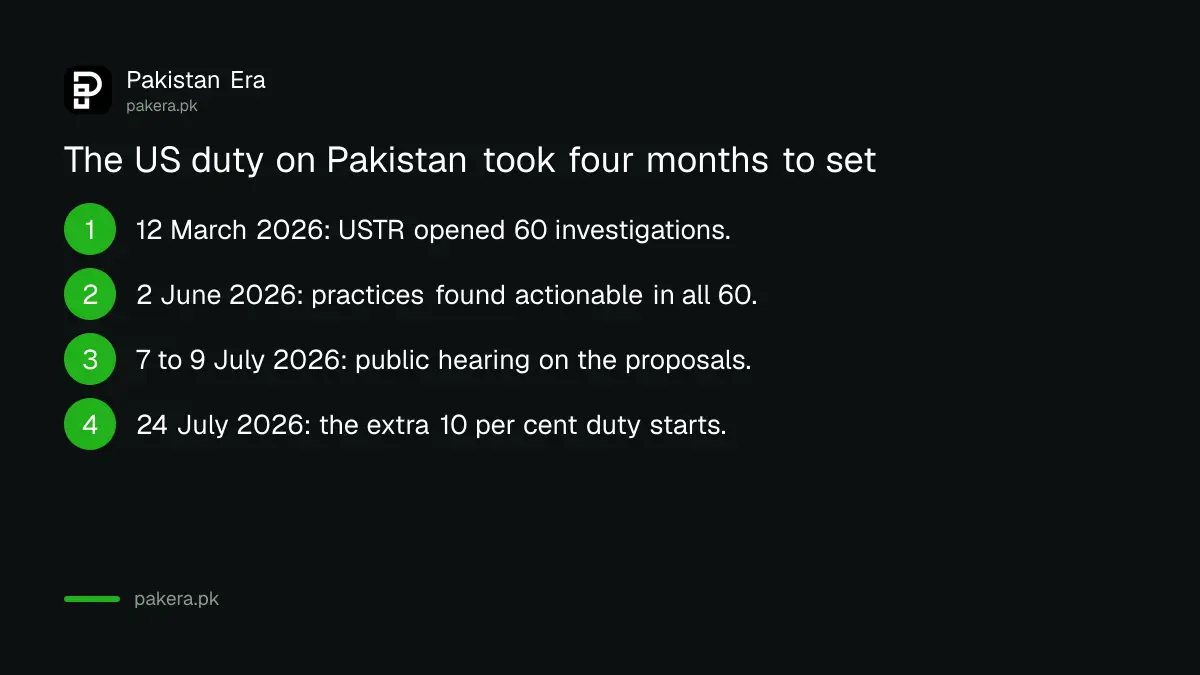
USTR opened 60 investigations on 12 March 2026, one per economy. It found that Pakistan, along with five others, had failed to effectively enforce a ban on imports made with forced labour. The tariff is the response to that finding, not a charge on Pakistani products themselves.
Pakistan's final determination is item 41 in the notice. It says Pakistan "has failed to effectively enforce its forced labor import prohibition" and sets 10 per cent tariffs on products of Pakistan, except as provided in two annexes. The notice does not accuse any Pakistani factory of using forced labour.
| Date | Step in the USTR process |
|---|---|
| 12 March 2026 | 60 investigations opened, including Pakistan |
| 2 June 2026 | Practices found actionable in all 60 cases |
| 5 June 2026 | Proposed tariffs published for comment |
| 7 to 9 July 2026 | Public hearing, after more than 1,600 written comments |
| 24 July 2026 | Final duty starts |
Pakistan gets only the general exemptions in the notice
The notice exempts informational materials, donations, accompanied baggage, and goods already covered by US Section 232 tariffs. It also exempts product groups listed in its annexes. Pakistan's entry cites only the general lists, Annex I and Annex II Part A.
Product groups added to the exempt lists in the final notice include certain animal products, seeds, fertilizer and pesticide inputs, certain animal hides and leather, certain pharmaceuticals and pharmaceutical ingredients, worn clothing, and certain antiques and art. The word "certain" matters. Exemption works by tariff line, so a leather jacket and a raw hide are not the same line.
Some other economies have extra annex parts written into their entries, for example Bangladesh and El Salvador. Pakistan does not. If a product code is not on the general lists, it pays the 10 per cent.
Pakistan pays the same rate as India and Bangladesh but has no cotton quota
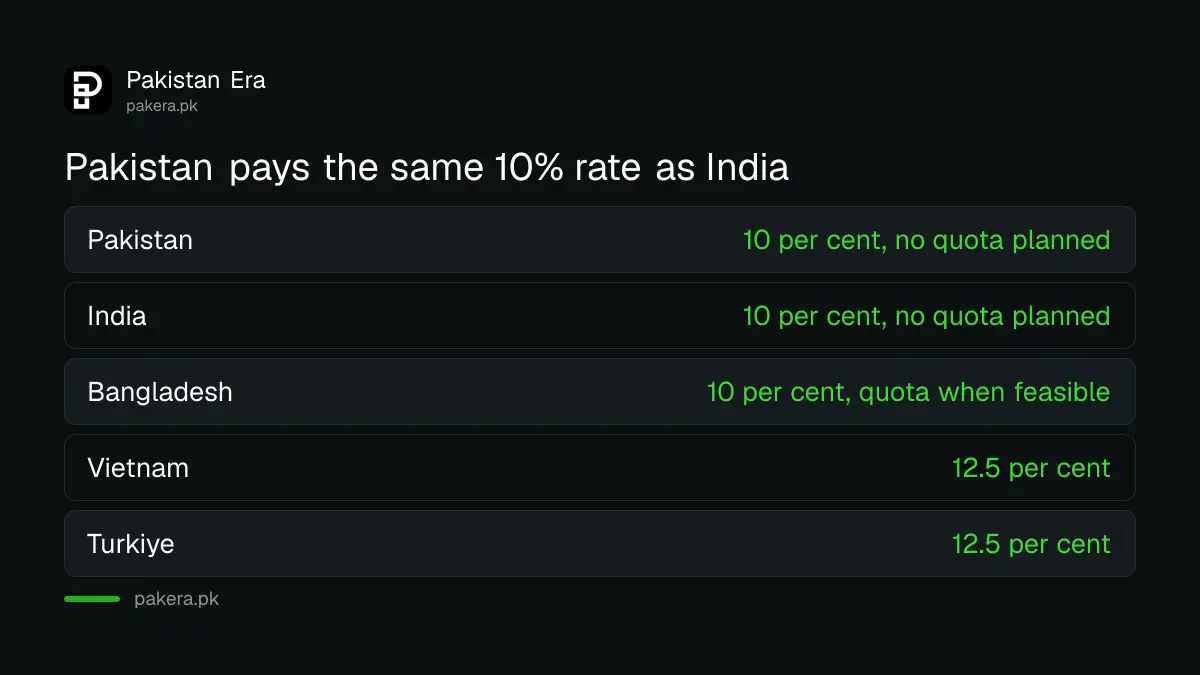
Pakistan sits in the 10 per cent group with India, Bangladesh, Sri Lanka and several others. Economies outside the lists pay 12.5 per cent. The notice plans tariff-rate quotas, meaning a fixed volume at a lower rate, for Bangladesh, Cambodia, Indonesia and Malaysia, but not for Pakistan.
The quotas are tied to how much US cotton and textile inputs each country buys. The notice says they will be set up "when feasible", so they are not running yet. The notice describes the quota idea as a mechanism that lets a set volume of apparel and textiles enter at a reduced Section 301 rate. Pakistan is outside it for now, so Pakistani apparel pays the full 10 per cent.
| Economy | Section 301 rate in the notice | Quota planned |
|---|---|---|
| Pakistan | 10 per cent | No |
| India | 10 per cent | No |
| Bangladesh | 10 per cent | Yes, when feasible |
| Sri Lanka | 10 per cent | No |
| Vietnam | 12.5 per cent | No |
| Turkiye | 12.5 per cent | No |
Pakistan sold the United States far more than it bought in the last financial year, as Pakistan's trade with America in FY26 shows. That is why a duty on the US side matters to exporters here more than to the US importer.
Exporters should run five checks before the next shipment
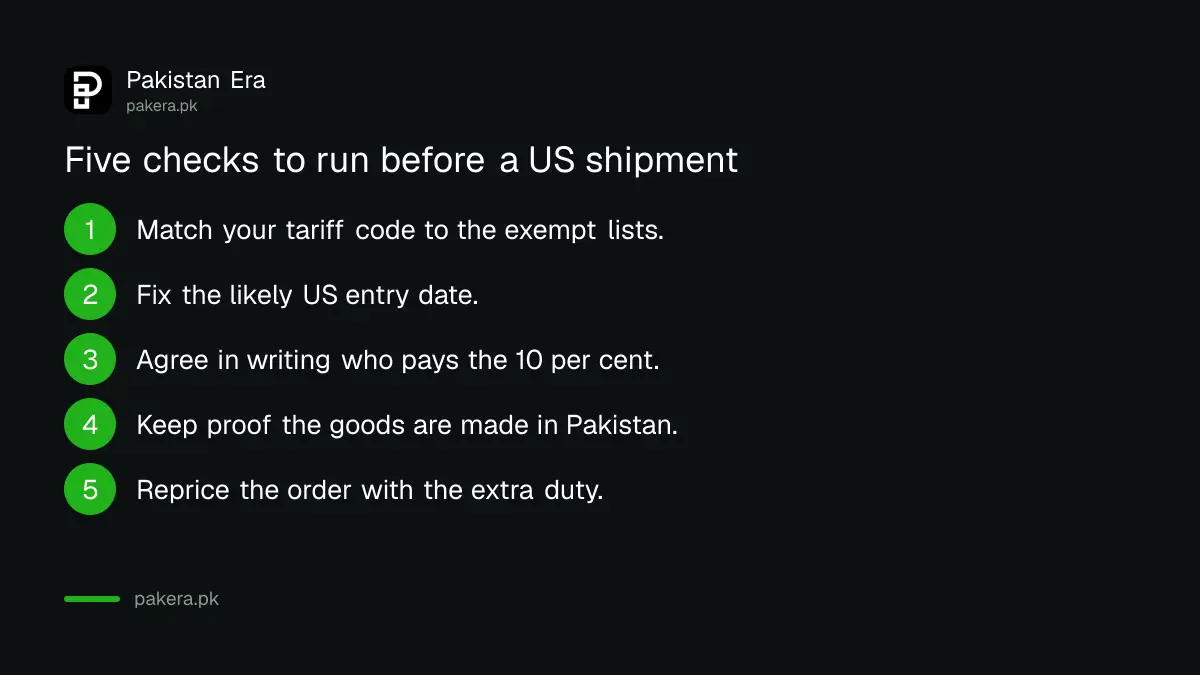
Before you ship, match your product code to the exempt lists, fix the entry date, agree in writing who pays the duty, keep origin papers ready, and reprice. Each check takes minutes and one wrong assumption can cost a full container margin.
- Find the tariff code printed on your commercial invoice and compare it with the exempt lists in the notice. Exemption is by tariff line, so ask your buyer's customs broker to confirm the exact line.
- Work out the likely US entry date. Goods entering on or after 24 July 2026 pay, unless they met the in-transit rule.
- Settle in the contract who carries the extra 10 per cent. In US trade the importer pays duty at entry, so a buyer may ask for a discount or a split.
- Keep proof that the goods are made in Pakistan, because the duty applies to products of Pakistan. A shipment mixed with inputs from elsewhere needs clear origin papers.
- Reprice. A 10 per cent duty on a product that already carries a normal rate adds to that rate, so the landed cost for your buyer rises by the full 10 points of value.
Exporters new to US sales should first register as an exporter through WeBOC and TDAP. If a buyer delays payment because of the new cost, export credit insurance from EXIM Bank covers unpaid invoices. Exporters in the EU market should also read the GSP Plus rules that start in 2027.
Common questions
Does the 10 per cent duty apply to all Pakistani exports to the US?
No. It applies to products of Pakistan except those on the exempt lists in the notice, such as certain pharmaceuticals, hides, seeds, worn clothing and goods already under Section 232 tariffs.
Who pays the duty, the Pakistani exporter or the US buyer?
The notice sets the duty on goods entered into the US, so it is collected at the US border. Who bears the cost is a matter of your sales contract, and many buyers ask for a price cut.
When did the duty start?
It applies to goods entered or withdrawn from warehouse on or after 12:01 a.m. US Eastern time on 24 July 2026. Goods in transit before that time were spared until entries before 28 July.
Will Pakistan get a textile quota like Bangladesh?
The notice names only Bangladesh, Cambodia, Indonesia and Malaysia for quotas, and says they will be set up when feasible. Pakistan is not named, so none is planned in the text we read.
Does the notice say Pakistani factories use forced labour?
No. The finding is about Pakistan not effectively enforcing its import ban on forced labour goods, so the action concerns government enforcement, not named producers.
Where can I read the notice myself?
Search the Federal Register for "Notice of Actions in Section 301 Investigations" published on 28 July 2026, docket numbers USTR-2026-0265 and USTR-2026-0266. Pakistan is item 41.
How we verified this
What we checked, where we read it, and what we could not confirm.
Last checked on 11 October 2026. We read the USTR final notice of action in the Section 301 forced labour investigations, as published by the Federal Register, including the summary, the dates section and item 41 on Pakistan. We did not check individual tariff lines against the annexes, so confirm your product code with a customs broker.
About the author

Global Affairs & Political Economy Writer
Muhammad Hatim is a book lover who started writing because he enjoys it. At Pakistan Era he writes about international relations, geopolitics and the global economy, with a particular interest in South Asia and the forces behind current events.