Raast Works Inside Pakistan Only, and FATF Did Not Flag It, Says SBP
SBP said on 4 September 2026 that FATF raised no specific concern about Raast and that it does not carry cross-border transfers. What that means for you.
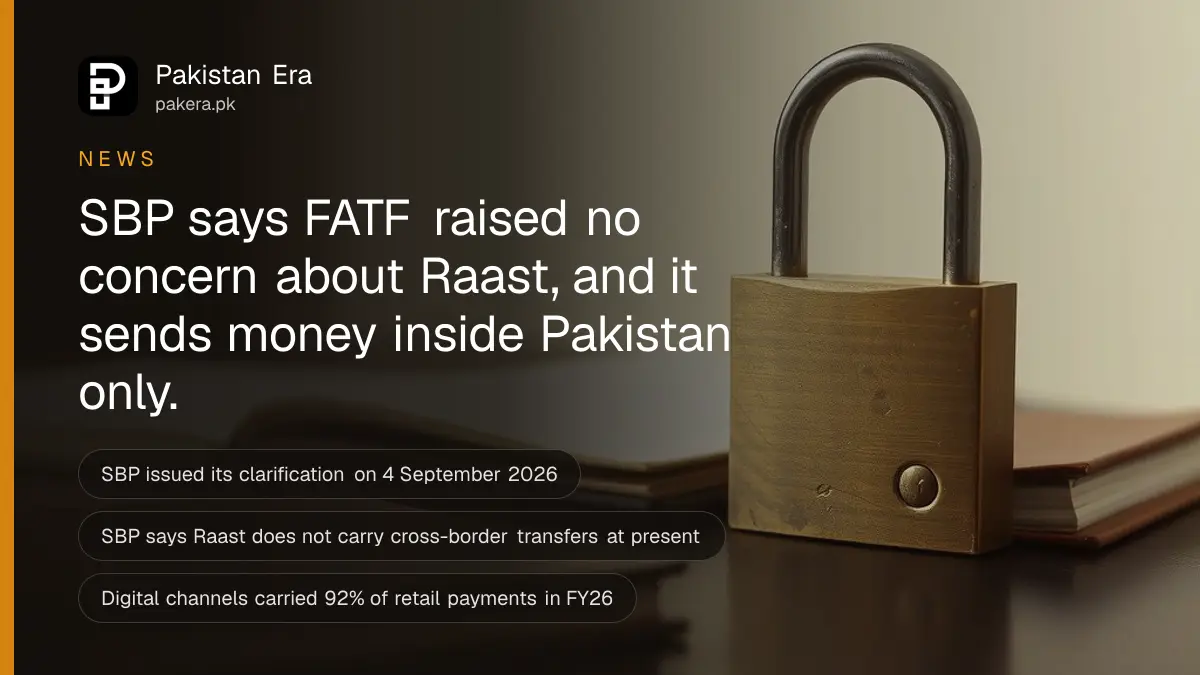
Raast is safe to use for domestic payments, and it does not move money across the border. On 4 September 2026 the State Bank of Pakistan (SBP) said a Financial Action Task Force (FATF) report "neither identifies Raast as a money-laundering mechanism nor raises any specific concern" about its integrity. The SBP also said Raast "does not currently facilitate cross-border transfers".
A social media headline had claimed the opposite. The SBP called it misleading and issued a short clarification. This explainer sets out what the SBP actually said, what that means for ordinary users, and one rule that follows from it: if someone offers to send your money abroad "through Raast", it is not a Raast service.
Read what the SBP said on 4 September 2026
The SBP clarification, numbered ECD/M&PRD/PR/01/2026-67, makes four points.
- A social media post suggested that FATF had identified Raast as a channel for money laundering. The SBP calls the headline misleading.
- The FATF report does not name Raast as a money-laundering mechanism and raises no specific concern about the Raast system.
- The report discusses how formal banking and payment channels can be misused by underground banking and hawala networks, in many countries.
- Raast is mentioned only as the legitimate domestic channel used for domestic payments and transfers.
We did not read the FATF report itself for this piece, so we rely on the SBP's own description of it. If you need the report's exact wording, read it on the FATF website.
Understand what Raast does and does not do
Raast is the SBP's instant payment system. It moves rupees between bank and wallet accounts inside Pakistan. People use it to pay a friend by mobile number, to pay a shop by QR code and, since September 2026, to pay some government fees. Our step by step page on how to use Raast shows how to set it up.
It is a payment pipe, not a bank. The money stays in your account until you send it, and the receiving bank or wallet is a regulated institution. That is why a Raast payment leaves a record at both ends.
Use is now large. In its annual payments report on 6 October 2026, the SBP said digital channels carried 92 per cent of retail payment transactions in fiscal year 2025-26, up from 88 per cent a year earlier. Our summary of the SBP payment systems review has the other figures.
Learn why hawala sits behind the FATF concern
Hawala is an informal way of moving value without moving money through banks. Someone here pays cash to a dealer. A partner abroad pays the receiver. The dealer and partner settle later, outside the banking system. There is no bank record, no tax record and no protection if the dealer disappears.
The SBP says the FATF report is about such networks misusing banks and payment channels in many countries. It is not a finding against Raast. A criminal can pay a person through any channel, including a bank branch. Misuse of a channel by some users is a different thing from a flaw in the channel.
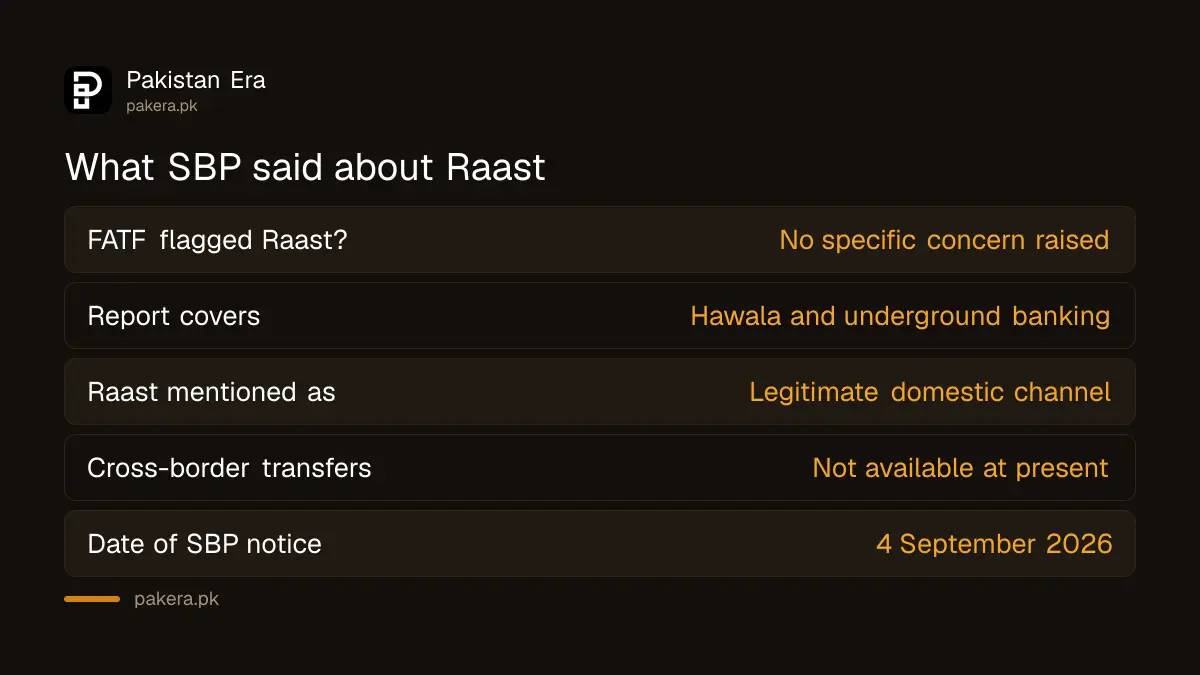
| Question | What the SBP says |
|---|---|
| Did FATF flag Raast as a laundering channel? | No. The report raises no specific concern about it. |
| What does the report discuss? | Misuse of formal channels by underground banking and hawala networks. |
| Where does Raast work? | Domestic payments and transfers only. |
| Does it send money abroad? | Not at present. |
Apply one rule: Raast never sends money abroad
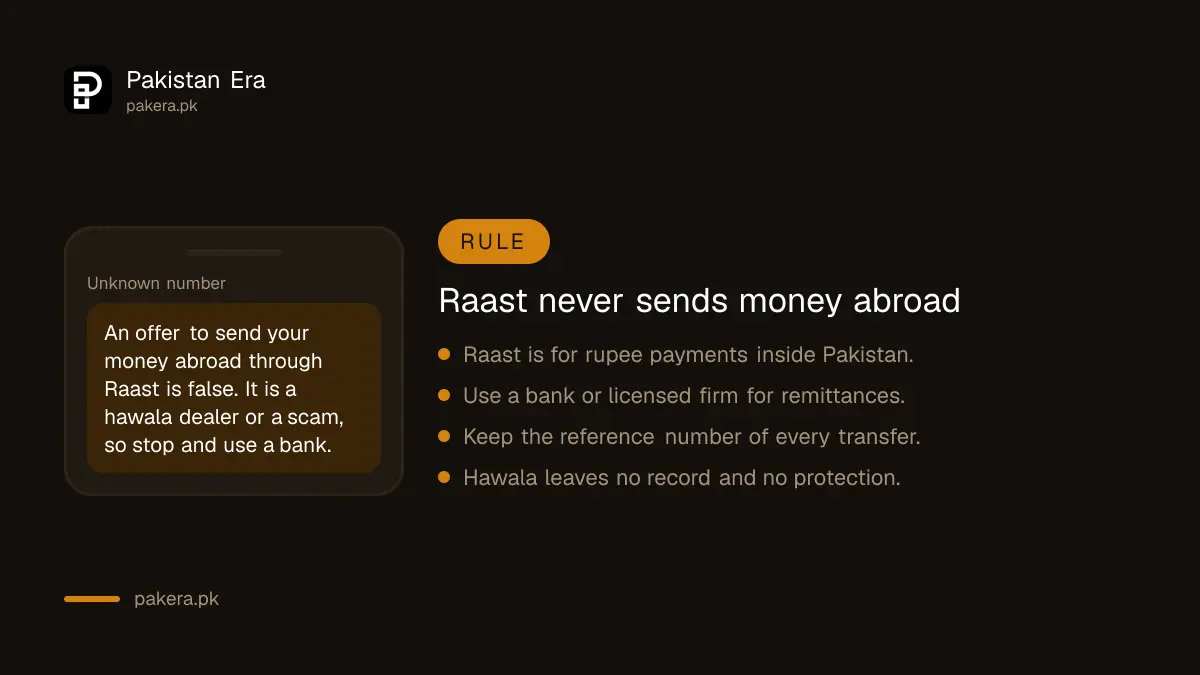
Raast does not currently carry cross-border transfers, so any offer to "send your money to Dubai or the UK by Raast" is false. It is either a hawala dealer using Raast to collect rupees, or a scam. Either way, stop.
The legal route for sending money to Pakistan is through a bank, an exchange company or a licensed remittance firm. The SBP's reward scheme for remittances also works only through formal channels, as we explained in our piece on how your family qualifies for the Pasban prize draw.
Formal remittances are large and rising. Our note on remittances in September 2026 shows how much came in through banks that month.
Protect yourself when you receive a Raast payment
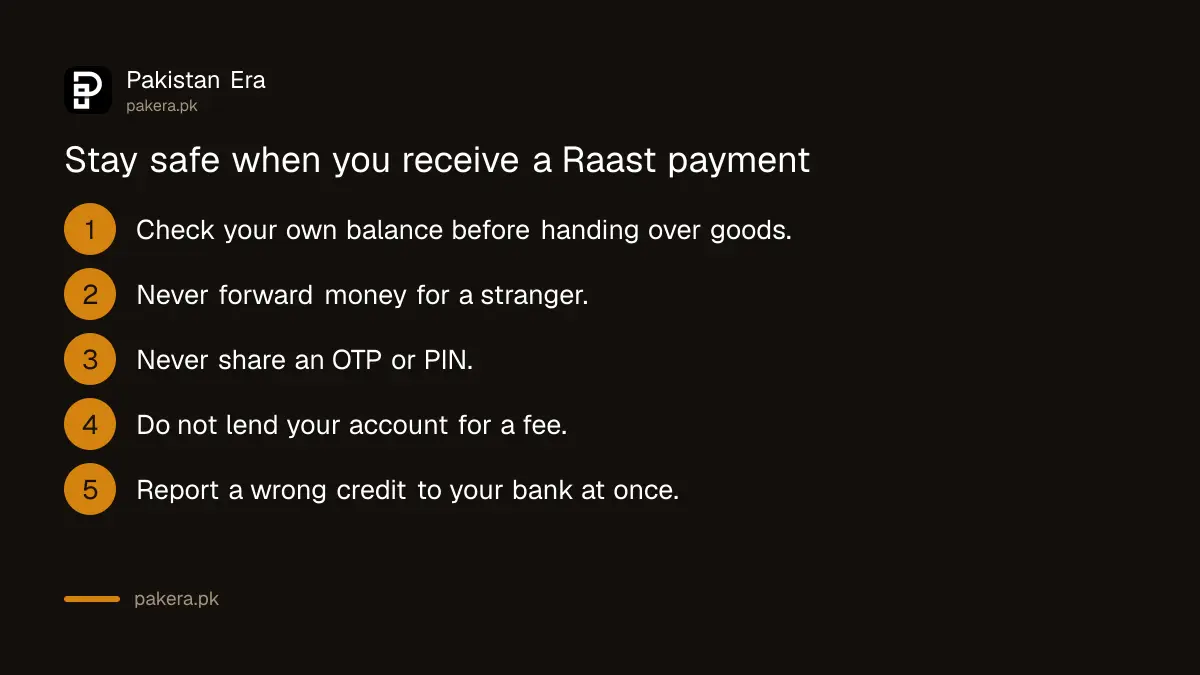
A fake Raast screenshot is the common trick, not a Raast failure. Before you hand over goods, check your own account balance or wallet. Our guide on how to verify a payment before you hand over goods lists the steps.
Also be careful about who you give your Raast ID to. Your Raast ID is your mobile number linked to an account. Share it only with people you trust, because anyone who has it can send money to you, and a stranger who asks you to "receive and forward" money may be using your account to move stolen funds.
- Never forward money for a stranger.
- Never lend your account for a fee.
- Never share an OTP, even with someone who says they are from Raast or the bank.
- Report a wrong or suspicious credit to your bank straight away.
Common questions
Did FATF say Raast is used for money laundering?
No, according to the SBP. It says the report neither identifies Raast as a money-laundering mechanism nor raises any specific concern about it.
Can I send money abroad through Raast?
Not at present. The SBP says Raast does not currently facilitate cross-border transfers.
What is hawala?
It is an informal way of moving value across borders without using banks. It leaves no bank record and gives you no protection.
Is it safe to share my Raast ID?
It is safe with people you trust, because the ID only lets someone send you money. Do not share an OTP or PIN, and never forward money for a stranger.
How do I send money home legally?
Use a bank, an exchange company or a licensed remittance firm, and keep the reference number.
How we verified this
What we checked, where we read it, and what we could not confirm.
Last checked 11 October 2026. We opened the SBP press release of 4 September 2026, "SBP Clarification on Misleading Media Reports About Raast", and the SBP press release of 6 October 2026 on the Annual Payment Systems Review of FY26, on sbp.org.pk. The quotations and the 92 per cent figure come from those releases. We did not read the FATF report and we did not test Raast. Rules and services change, so confirm on sbp.org.pk.
About the author

Technology Journalist & Multimedia Producer
Ahmad Ali is a technology journalist and multimedia producer at Pakistan Era, joining the team in October 2026. He covers consumer technology and digital life for Pakistani readers, combining research with hands-on product testing.