Railway Board Bill 2026 in Pakistan: 13 Member Board, 7 Independent Members and What Changes for Pakistan Railways
The Railway Board Bill 2026 would scrap the 1962 Railways Order and give Pakistan Railways a 13 member board. Who sits on it, its powers and where the bill is.
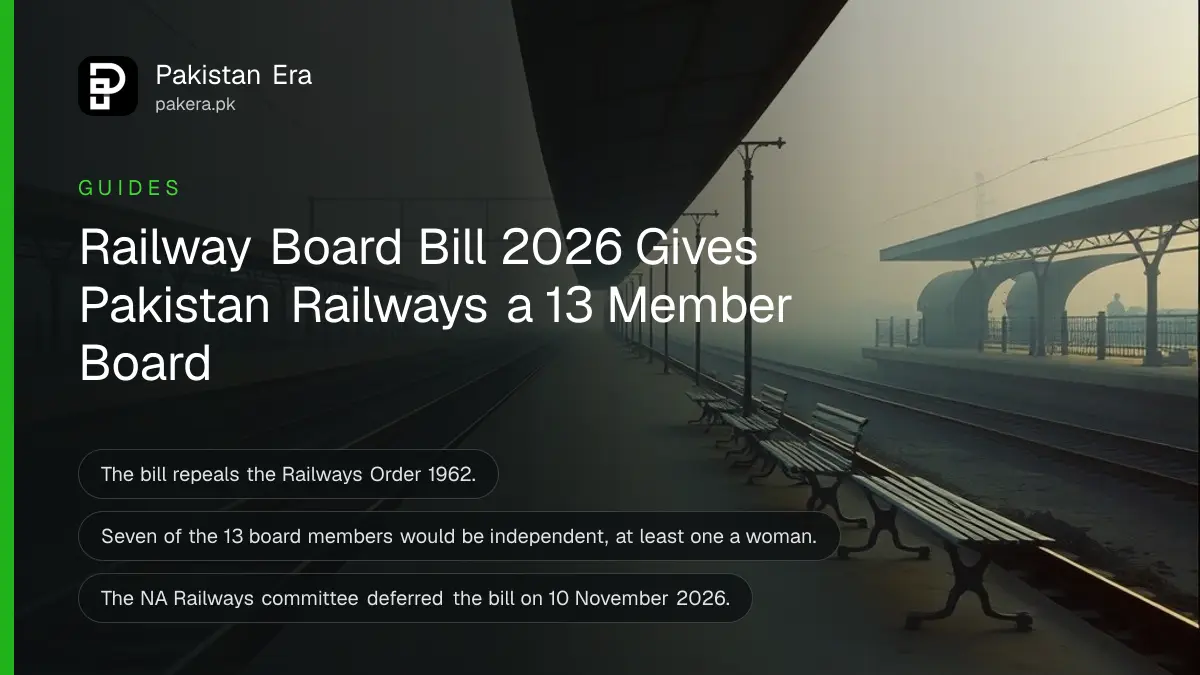
Short answer: The Railway Board Bill 2026 would scrap the Railways Order 1962 and rebuild the Railway Board of Pakistan under the State-Owned Enterprises Act 2023. The new board would have 13 members: 6 officials, including the four provincial chief secretaries, and 7 independent members, at least one of them a woman. It would approve Pakistan Railways' budget and business plans, and pick a panel for the Prime Minister to choose the railway's chief executive. The bill is not law yet.
The bill was introduced in the National Assembly on 28 October 2026 by Railways Minister Muhammad Hanif Abbasi. On 10 November, the Assembly's Standing Committee on Railways deferred it to its next meeting. We read the full bill on na.gov.pk on 11 November 2026, all 17 sections and the statement of objects. Below is what it would change, section by section, in plain words.
The Railway Board Bill 2026 replaces a 1962 order
The bill repeals the Railways Order 1962, which its own statement of objects describes as issued under the martial law regime of the time. In its place, it sets up a Railway Board that must follow the State-Owned Enterprises (Governance and Operations) Act 2023, the law that already governs boards of most federal companies.
The SOEs Act sets rules for independent directors, business plans, audits and published reports. Pakistan Railways is run through the Railways Division rather than as a company. The bill names Pakistan Railways a "strategic state-owned enterprise" and plugs it into those rules.
Why does that matter to a passenger? Because the board, not the ministry, would approve the budget, the business plan and decisions to open or close a railway line. Fares are not mentioned in the bill at all.
The new Railway Board would have 13 members
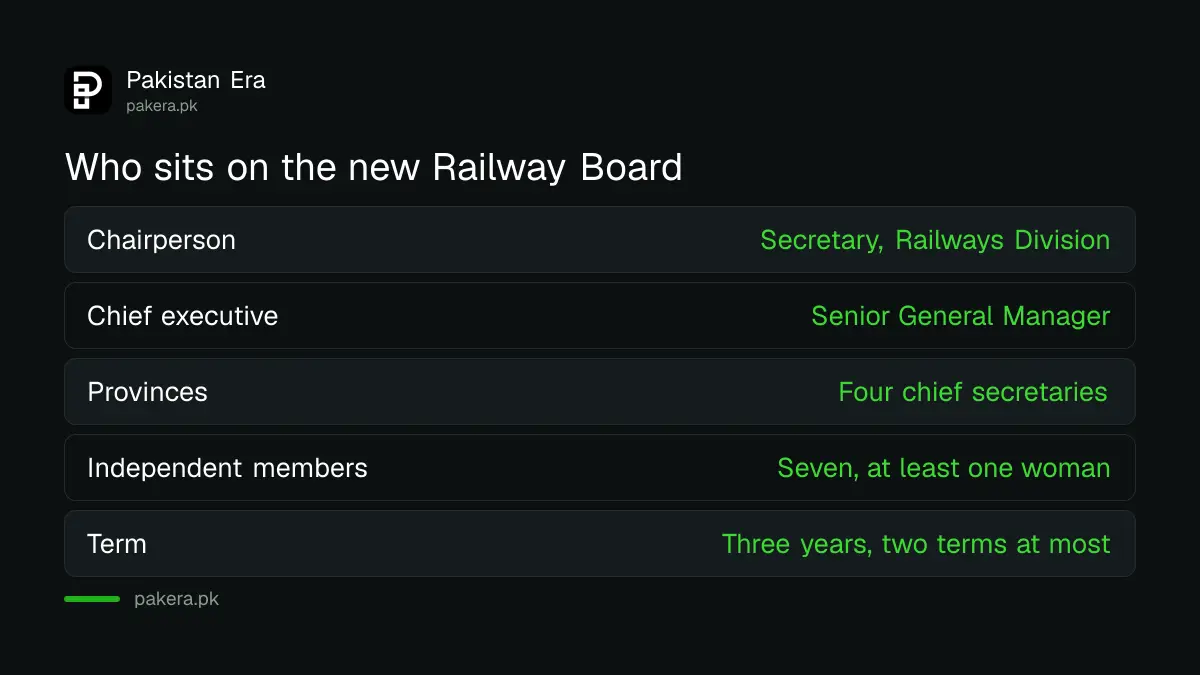
The board would have 6 ex officio members, meaning people who sit because of their job, and 7 independent members picked by the federal government. The Secretary of the Railways Division would chair it. Here is the full list from section 3 of the bill:
| Seat | Who fills it |
|---|---|
| Chairperson | Secretary, Railways Division |
| Executive member | Senior General Manager, Pakistan Railways (also its chief executive) |
| Balochistan | Chief Secretary, or the Transport Secretary in his absence |
| Khyber Pakhtunkhwa | Chief Secretary, or the Transport Secretary in his absence |
| Punjab | Chief Secretary, or the Transport Secretary in his absence |
| Sindh | Chief Secretary, or the Transport Secretary in his absence |
| Independent members | 7, at least one woman, appointed by the federal government |
Independent members serve three years and can be reappointed, but for no more than two terms in a row. They must meet the SOEs Act's "fit and proper" test and can be removed only on the grounds that law sets out. They are paid a meeting fee set by the board, whether they attend in person or online.
Quorum needs at least four independent members
A normal board meeting needs 7 members present, including at least 4 independent members and 2 ex officio members. Decisions are by majority, and the chair has a casting vote in a tie. Some decisions need a three-fourths majority under the SOEs Act. For those, the quorum rises to 10 members, with at least 6 independent ones.
In plain terms, the officials cannot run a meeting on their own. That is the main point of the design.
The board would approve the railway's budget and business plan
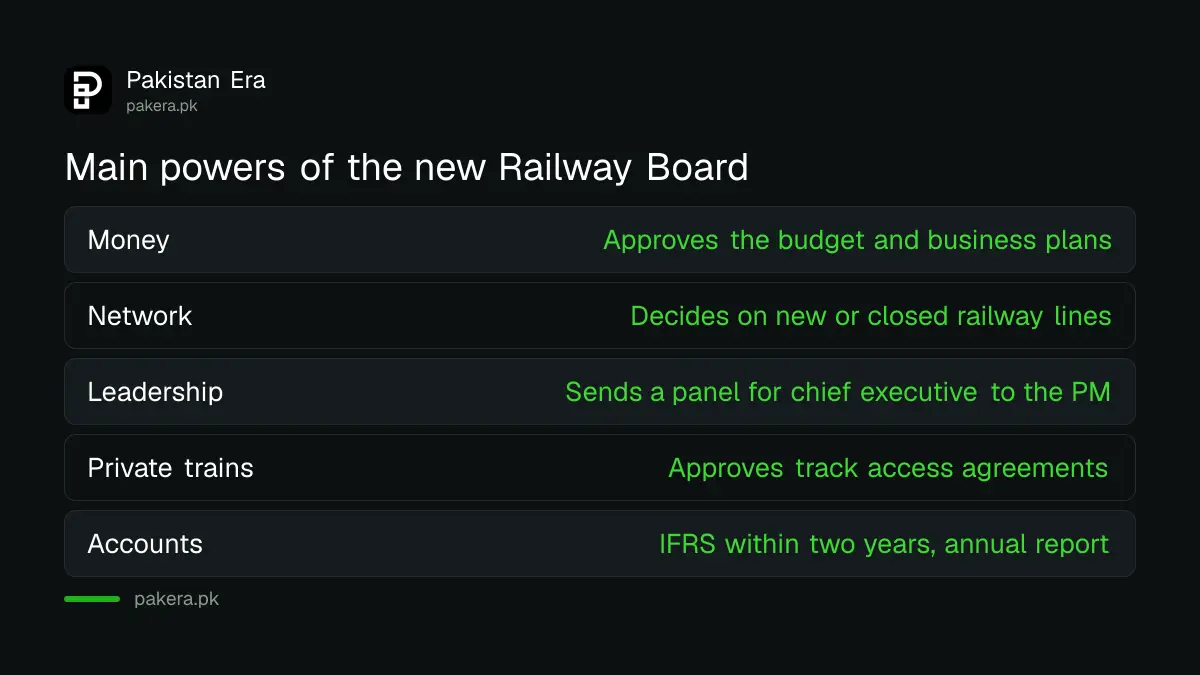
Section 5 gives the board the general policy direction of Pakistan Railways. It lists 18 powers. The ones most likely to touch passengers and freight users are these:
- Approve the budget of Pakistan Railways.
- Approve and adopt business plans, covering the next three financial years.
- Decide on building new railway lines, or changing, closing or dismantling any line.
- Approve and sign the Public Service Obligation (PSO) framework, the deal under which the government pays for services run for the public good rather than profit.
- Approve technical standards for track and rolling stock, and plans to make more parts locally.
- Set a code of conduct for board members and railway employees.
There is one limit. The board cannot change defence traffic contracts or priorities, or close or modify a defence line, without the Ministry of Defence's approval.
The Prime Minister would pick the chief executive from a board panel
The Senior General Manager would be Pakistan Railways' chief executive. Under section 9, the board recommends a panel to the Prime Minister by a three-fourths majority, and the chair's vote must be part of it. The Prime Minister appoints from that panel.
The panel can be serving railway officers in grade 21 or 22, private sector candidates, or a mix of both. Removal works the same way: the Prime Minister acts on a three-fourths board recommendation. Section 10 also keeps the two jobs apart. The chair leads the board and stays out of day-to-day work, and the Senior General Manager runs the railway.
Below the board sits a Senior Management Committee of six: the Senior General Manager, three Additional General Managers (traffic, infrastructure, mechanical), the Financial Adviser and the Chief Personnel Officer. It carries out the board's decisions on train running, punctuality, safety and buying in line with procurement rules.
Private operators could run trains through track access deals
Section 12 lets the board approve "track access agreements", under which a party pays track access charges to run its own trains on the Pakistan Railways network. It also allows "rail development agreements" for building railway infrastructure. The Railways Division signs them after board approval.
These deals can be made with foreign governments under inter-governmental commercial law, with investors in qualified investments under the Foreign Investment Act 2022, with federal or provincial bodies, or through competitive bidding. Procurement law applies only to the bidding route.
The bill also says the Railway Regulatory Authority, which exists in a 2002 ordinance but has not been set up, could never cancel or change such deals once signed. Until that authority exists, the board itself would oversee them. That is the part of the bill most worth watching in committee.
Accounts would move to international standards within two years
Pakistan Railways would have to adopt International Financial Reporting Standards within two years, have its accounts audited by chartered accountants picked by the board, and publish an annual report within four months of each financial year. The Auditor-General's audit continues alongside.
The bill is in committee and is not law yet
The Railway Board Bill 2026 is at the committee stage in the National Assembly. The Standing Committee on Railways deferred it on 10 November 2026, the same meeting that heard Pakistan Railways recorded 89 train accidents from 1 January to 2 November 2026. No date for the next meeting was given.
After the committee reports, the Assembly must pass it, then the Senate, and then the President must assent. Each step is set out in how a bill becomes law in Pakistan. The Assembly was prorogued on 30 October, so nothing can pass until a new session is called.
Nothing changes for passengers today. Fares, ticket rules and train timings stay with Pakistan Railways as now. For the railway's own recent plans, see the freight train target for January.
Common questions
Has the Railway Board Bill 2026 become law?
No. It was introduced on 28 October 2026 and the National Assembly's Railways committee deferred it on 10 November 2026. It still needs both Houses and the President's assent.
Who introduced the Railway Board Bill 2026?
Federal Minister for Railways Muhammad Hanif Abbasi, as a government bill, according to the bill's statement of objects on na.gov.pk.
How many members will the new Railway Board have?
13: six ex officio members, including the four provincial chief secretaries, and seven independent members, with at least one woman.
Will the Railway Board Bill change train fares?
The bill does not mention fares. It gives the board control of the budget, business plans and service obligation deals, which could affect services over time.
Does the bill privatise Pakistan Railways?
No. Pakistan Railways stays a state enterprise. The bill does allow private and foreign parties to run trains or build infrastructure through track access and rail development agreements.
What law does the bill repeal?
The Railways Order 1962 (P.O. 33 of 1962). Actions taken under it are saved by section 17.
Sources: The Railway Board Bill 2026 as introduced, and the list of government bills, on na.gov.pk; National Assembly press release of 10 November 2026 on the Standing Committee on Railways. Last checked 11 November 2026.
About the author

Global Affairs & Political Economy Writer
Muhammad Hatim is a book lover who started writing because he enjoys it. At Pakistan Era he writes about international relations, geopolitics and the global economy, with a particular interest in South Asia and the forces behind current events.