Pakistan's State Companies Owe Rs 10.1 Trillion: What It Means for Taxpayers
Pakistan's state companies owed Rs 10.1 trillion in December 2025, but new government loans were Rs 164.8 billion. See what the Finance Division report shows.
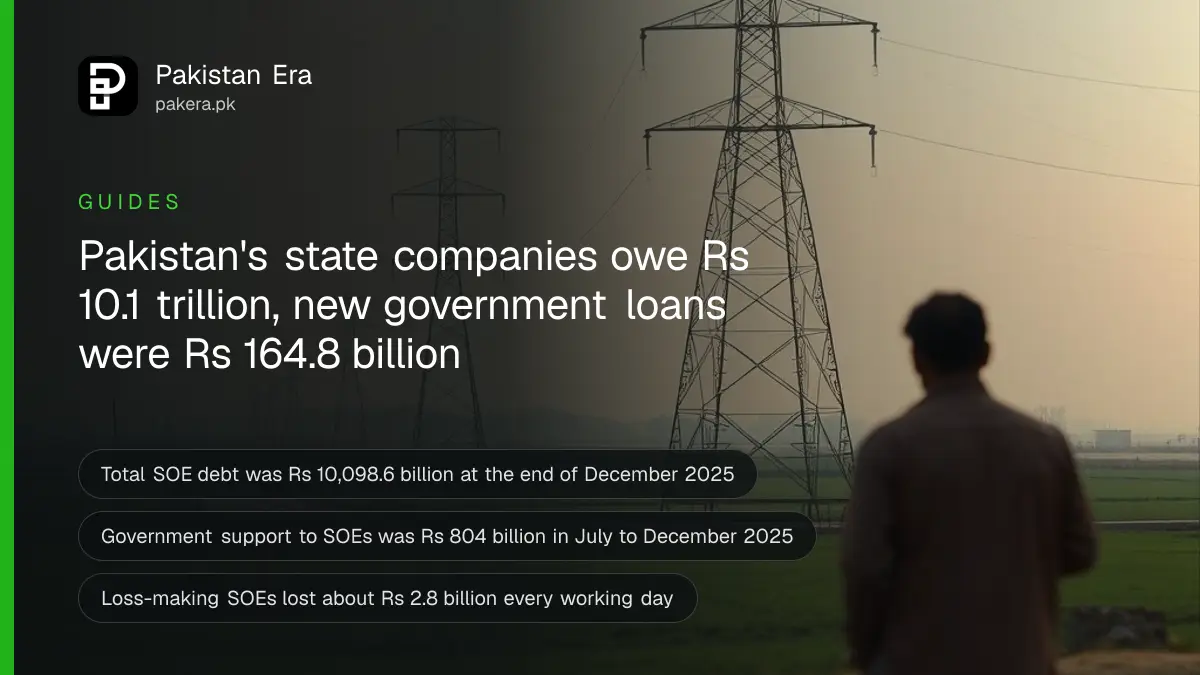
Pakistan's federal state-owned companies owed Rs 10,098.6 billion, about Rs 10.1 trillion, at the end of December 2025. That is the total stock built up over many years. The new government lending to these companies in July to December 2025 was much smaller: Rs 164.8 billion. Both numbers come from the Finance Division's own six-monthly report on state-owned enterprises (SOEs).
The Rs 10.1 trillion figure travelled fast this week, often read as if the state had borrowed that much in six months. It had not. We opened the report on the Finance Division's Central Monitoring Unit page on 9 October 2026 and read the debt and fiscal support tables line by line. Here is what the numbers say, and why they still matter to anyone who pays tax in Pakistan.
SOE debt is money owed by companies the state owns
SOE debt is the total that federal state-owned companies owe to banks, to the government and to foreign lenders, plus interest they have not yet paid. It covers firms such as power distribution companies, PIA Holding, Pakistan Railways and the National Highway Authority.
A state-owned enterprise is a company or body that the federal government owns or controls. Some make money, like the big oil and gas firms. Many lose it, especially the electricity distribution companies, known as DISCOs.
The report was prepared by the Central Monitoring Unit (CMU) of the Finance Division under the SOE Act 2023. It covers the first half of the 2025-26 financial year, from July to December 2025. Its foreword is dated 2 June 2026.
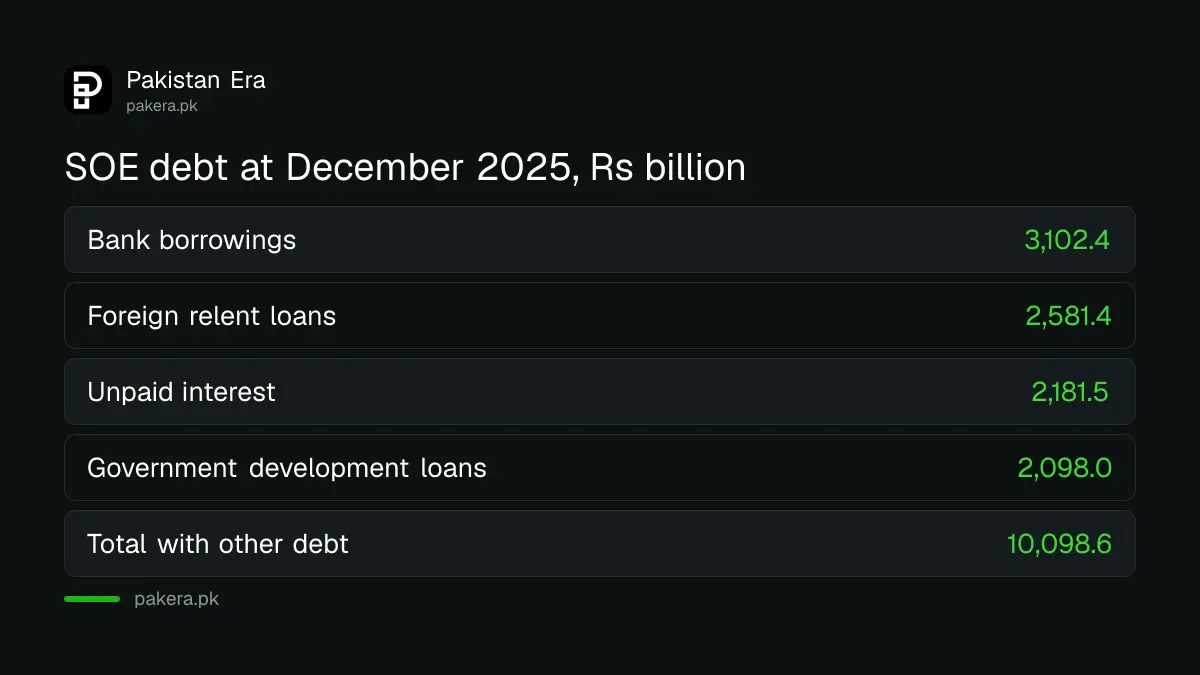
The Rs 10.1 trillion is made of five kinds of debt
The Rs 10,098.6 billion total has five parts: bank borrowing, loans from the government, foreign loans passed on by the government, unpaid interest and a small amount of other debt. It does not include sovereign guarantees or unfunded pensions, which the report counts separately.
| Type of SOE debt | December 2025 (Rs billion) | December 2024 (Rs billion) | Change |
|---|---|---|---|
| Bank borrowings | 3,102.4 | 2,808.9 | +10% |
| Foreign relent loans | 2,581.4 | 1,842.6 | +40% |
| Accrued interest not yet paid | 2,181.5 | 2,000.3 | +9% |
| Cash development loans from the government | 2,098.0 | 1,682.0 | +25% |
| Other debt | 135.4 | 497.4 | -73% |
| Total | 10,098.6 | 8,831.2 | +14% |
Two terms need a plain word. A cash development loan is money the federal government lends to an SOE from its own budget. A foreign relent loan is money Pakistan borrows abroad in dollars and then lends on to an SOE. The report notes that this foreign part is in dollars while the companies earn in rupees, so a weaker rupee makes it bigger.
The accrued interest line is large mainly because of one body. The report says the National Highway Authority alone carries about Rs 1.5 trillion of unpaid mark-up.
Fresh government lending in six months was Rs 164.8 billion
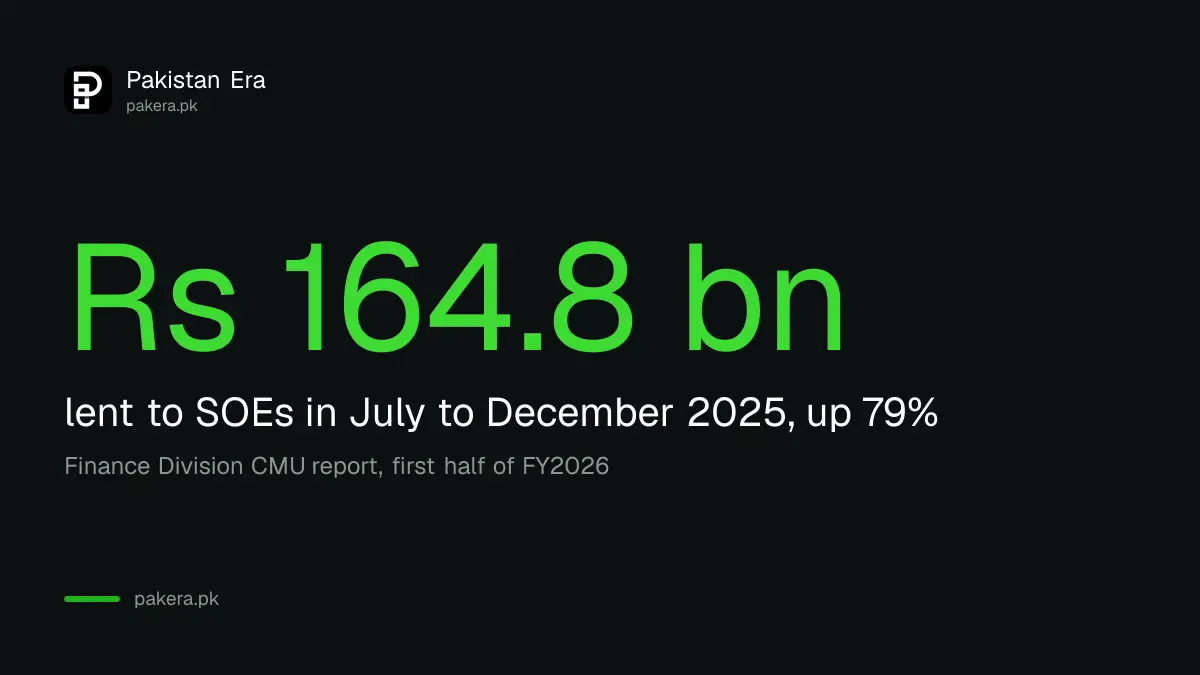
The government lent SOEs Rs 164.8 billion in July to December 2025, up 79% from Rs 91.96 billion a year earlier. That is the new lending in the period. The Rs 10.1 trillion is the stock of all debt, old and new, at one date.
Reports on 8 October said the Finance Division had pointed to a fresh borrowing figure of about Rs 164 billion. We could not find that statement on the Finance Division's press release page when we checked on 9 October. The Rs 164.8 billion in the report itself matches it, so we use the report's number.
The difference is simple. Think of a household with a home loan. The full loan balance is the stock. The money borrowed this month is the flow. Both are real, but they answer different questions.
The stock still grew. Total SOE debt rose by about Rs 1.27 trillion in a year, from Rs 8,831.2 billion to Rs 10,098.6 billion. Part of that is new loans. Part is interest piling up, and part is the rupee value of dollar loans.
Taxpayers fund SOEs through Rs 804 billion of support
In July to December 2025 the federal government gave SOEs Rs 804 billion in subsidies, equity, loans and grants, up 31% from Rs 616 billion. The report says this equals about 11% of federal tax, roughly one rupee in every nine collected.
This is where SOE debt touches your pocket. The money comes from the federal budget, which is funded by taxes on salaries, fuel, phone credit and shopping. When it goes to loss-making companies, it is not available for schools, hospitals or roads.
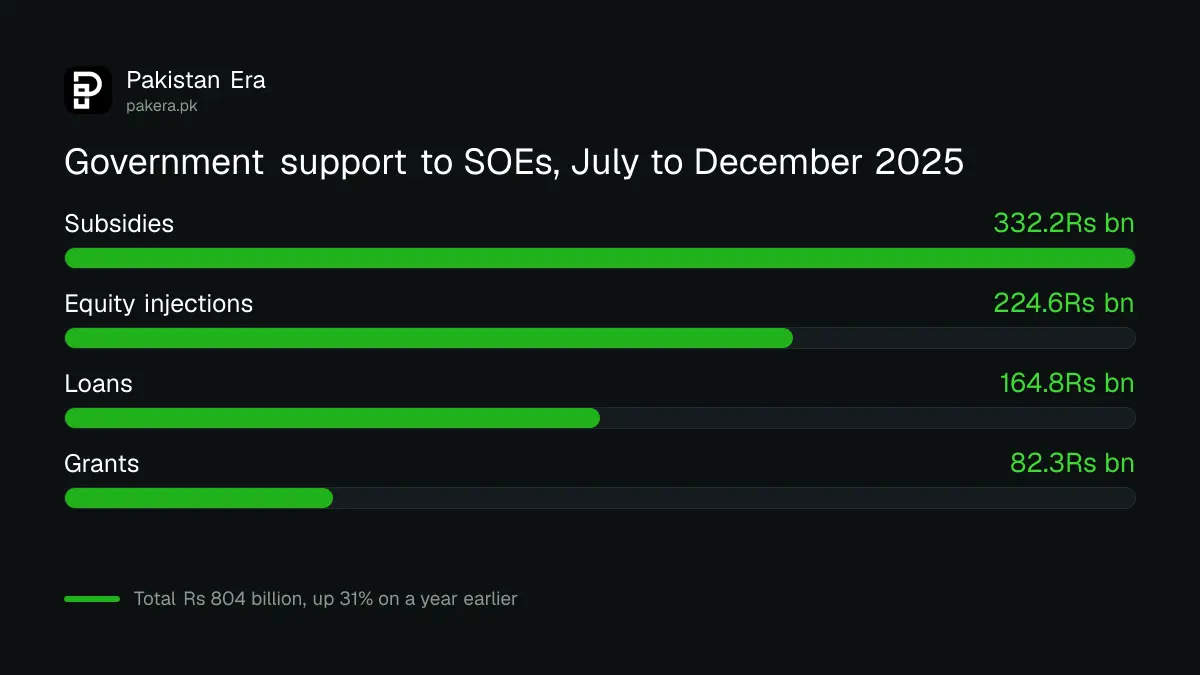
The support breaks down into four parts:
- Subsidies: Rs 332.2 billion, about the same as a year earlier.
- Equity injections: Rs 224.6 billion, up 190%. The report says most of this went to clearing power sector circular debt through payments to independent power producers.
- Loans: Rs 164.8 billion, up 79%.
- Grants: Rs 82.3 billion, down 27%.
SOEs also paid money back to the government: Rs 839 billion in dividends, taxes, non-tax payments and interest. That was 19% less than a year earlier. So the net gain to the government fell to Rs 35.8 billion, from Rs 427 billion. The report warns that SOEs could soon take more from the budget than they return.
Losses and guarantees can turn into future bills
Loss-making SOEs lost about Rs 2.8 billion every working day, the report estimates. On top of the Rs 10.1 trillion, the state has guaranteed Rs 2,123 billion of SOE loans and faces about Rs 1,982 billion of unfunded SOE pensions. If a company cannot pay, those can become federal debt.
A sovereign guarantee is a promise by the government to repay a loan if the company fails to. It does not show up as government debt until something goes wrong.
The power sector is the biggest weak point. Power circular debt, the chain of unpaid bills between distribution companies, the power purchaser and power plants, stood at Rs 1,360.9 billion in December 2025, down from Rs 1,889.9 billion in June 2025. But the report says the flow added Rs 143 billion in the six months, mostly from DISCO losses and under-recovery. Gas sector circular debt was about Rs 2,000 billion and unchanged. The government's plan for that gas debt is covered in our note on the three-year cut to gas circular debt.
Not every SOE is a drain. The Cabinet Committee on SOEs was told on 14 September 2026 that profitable SOEs earned Rs 423.3 billion in the six months, while loss-makers lost Rs 342.8 billion.
How to read SOE debt numbers yourself
Check three things before you share an SOE debt figure: whether it is a stock or a flow, which date it refers to, and whether guarantees and pensions are included. The Finance Division posts the full report on its Central Monitoring Unit page.
Different bodies count SOE debt in different ways. A much smaller State Bank figure has been quoted alongside the CMU total in reports. We did not reconcile the two, and the CMU report does not explain the gap in the pages we read. A good habit is to name the source and the date with any number. The same habit helps with inflation, reserves and remittances, which you can check on the SBP and PBS pages yourself.
Our view is plain. The Rs 10.1 trillion headline is accurate as a stock. Calling it six months of new borrowing is wrong. The more useful number for taxpayers is the Rs 804 billion of support in six months, because that money left the budget.
Common questions
Did the government borrow Rs 10.1 trillion for SOEs in six months?
No. Rs 10.1 trillion is the total debt SOEs owed at the end of December 2025. New government loans to SOEs in July to December 2025 were Rs 164.8 billion, according to the Finance Division report.
Which SOEs carry the most debt and losses?
The report points to the power distribution companies, PIA Holding, Pakistan Railways and the National Highway Authority as the largest drags. The NHA alone has about Rs 1.5 trillion of unpaid mark-up.
Is SOE debt part of Pakistan's public debt?
Some of it is, some of it is not. Loans the government gives SOEs are already funded from public borrowing. Guaranteed loans only become government debt if the company cannot pay. The report counts guarantees separately.
Why does a weaker rupee make SOE debt bigger?
About Rs 2.58 trillion of the total is foreign relent loans in dollars. When the rupee falls, the rupee value of those loans rises, even if no new money is borrowed.
Where can I read the SOE report?
On the Finance Division website, under Central Monitoring Unit. The file is the federal SOE bi-annual report for the first half of FY2026, covering July to December 2025.
Does SOE debt affect my electricity bill?
Indirectly, yes. Losses at distribution companies feed power circular debt. Past plans to clear that debt have relied on a debt servicing surcharge on electricity bills, which the report mentions.
How we verified this
What we checked, where we read it, and what we could not confirm.
Last checked 9 October 2026. We read the Finance Division's Central Monitoring Unit page and its federal SOE bi-annual report for July to December 2025, and the Finance Division press releases, including the 14 September 2026 release on the Cabinet Committee on SOEs. A Finance Division clarification about Rs 164 billion of fresh borrowing was reported on 8 October but was not on its press release page when we checked.
About the author

Global Affairs & Political Economy Writer
Muhammad Hatim is a book lover who started writing because he enjoys it. At Pakistan Era he writes about international relations, geopolitics and the global economy, with a particular interest in South Asia and the forces behind current events.