Pakistan Plans a Three-Year Cut to Its Rs 3.6 Trillion Gas Circular Debt
Pakistan is preparing a three-year plan for its reported Rs 3.6 trillion gas circular debt. What the IMF confirms, what is reported and what it means for bills.
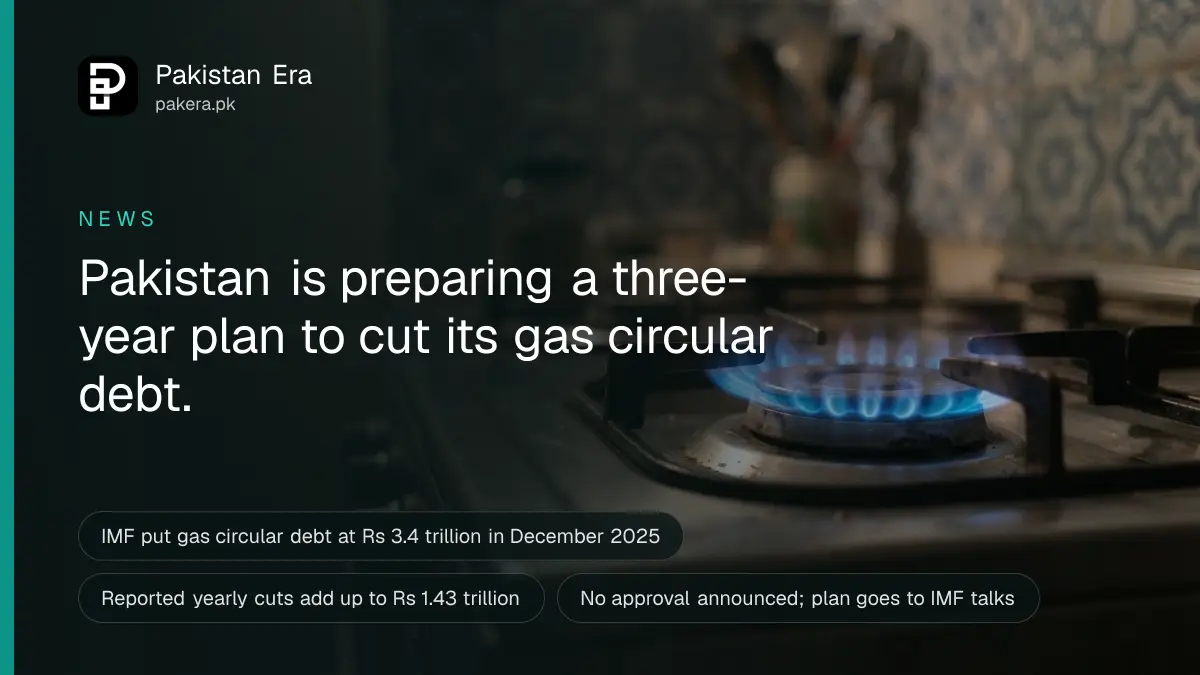
Pakistan's government is preparing a three-year plan to cut the gas sector's circular debt, reported at Rs 3.6 trillion, and to present it to the IMF during review talks due in late September 2026. The plan has not been published. No ministry has announced it.
We checked the Finance Division, the Petroleum Division, the Press Information Department and OGRA websites on 27 September 2026. None had a statement on the plan. Everything about its figures below is reported, from officials who spoke without being named on 13 September.
What we could confirm is the IMF's own record. Its staff report on Pakistan puts gas circular debt at Rs 3.4 trillion in December 2025. It also records the government's promise to roll out a circular debt management plan for gas in the current fiscal year, after approvals.
Gas circular debt is a chain of unpaid bills
Gas circular debt is money owed around the gas supply chain that nobody pays on time. When gas companies cannot collect their full cost, they cannot pay gas producers and the government, and late payment charges keep adding to the pile.
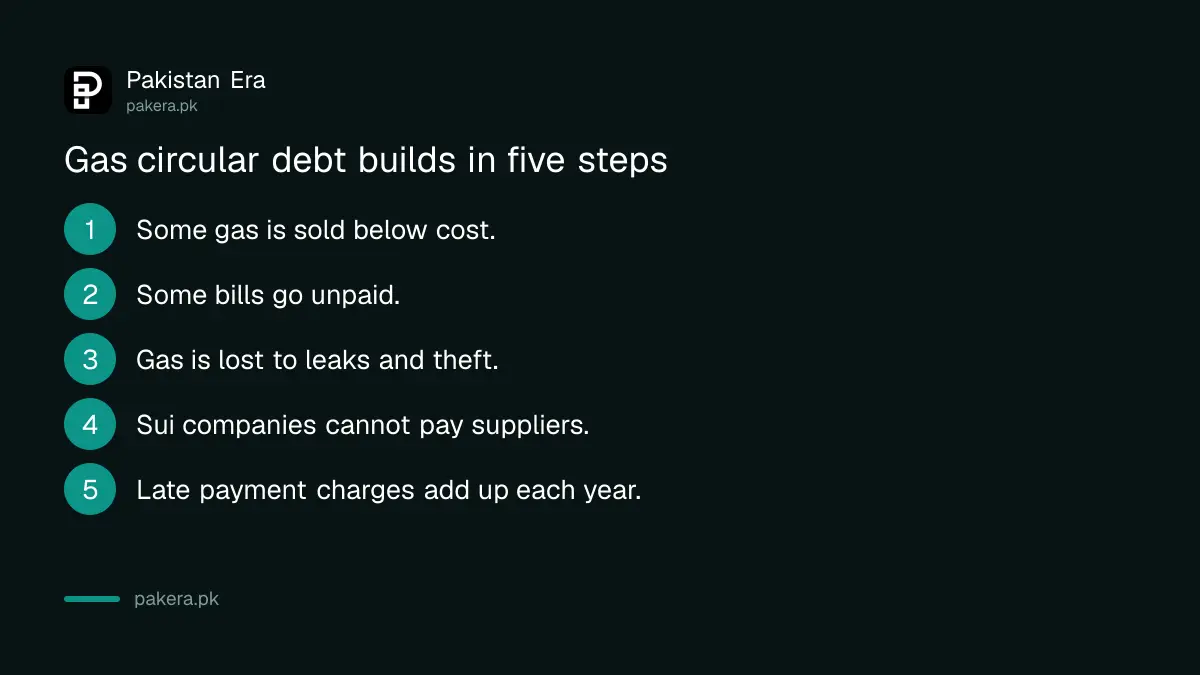
The chain runs like this. SNGPL and SSGC, the two Sui gas companies, sell gas to homes, industry and power plants. Some of that gas is sold below cost. Some bills go unpaid. Some gas is lost to leaks and theft, which the sector calls unaccounted for gas, or UFG. Imported LNG sent to homes also costs more than homes pay for it.
Each shortfall stops a payment further up the chain, from the Sui companies to gas producers and LNG suppliers. And the unpaid amounts carry late payment surcharges, which grow every year.
The IMF puts the debt at Rs 3.4 trillion
The IMF's staff report, Country Report 26/101, says gas circular debt reached Rs 3.4 trillion, or 2.7 per cent of GDP, in December 2025. It says regular tariff increases have stopped new principal building up, but late payment charges keep the total rising.
So the reported Rs 3.6 trillion is a newer, higher figure. It is not in any official document we could find. The reported split is Rs 2.1 trillion in interest and charges and Rs 1.5 trillion in principal. That matches the IMF's point that charges, not new losses, now drive the growth.
| Item | Figure | Status |
|---|---|---|
| Gas circular debt, December 2025 | Rs 3.4 trillion (2.7% of GDP) | IMF staff report |
| Gas circular debt, latest | Rs 3.6 trillion | Reported |
| Principal part | Rs 1.5 trillion | Reported |
| Interest and charges part | Rs 2.1 trillion | Reported |
| Planned cut, year 1 | Rs 528 billion | Reported |
| Planned cut, year 2 | Rs 473 billion | Reported |
| Planned cut, year 3 | Rs 433 billion | Reported |
The reported plan clears about 40 per cent in three years
The reported yearly targets add up to Rs 1.43 trillion over three years. That is about 40 per cent of Rs 3.6 trillion, not all of it. Officials said interest on the debt would also be settled under the plan, but gave no figure for it.
Some reports described the plan as wiping out the debt in three years. The numbers given do not show that. Our arithmetic on the reported figures leaves about Rs 2.2 trillion, most of it interest and charges, for some other arrangement.
The reported sources of money are:
- About Rs 840 billion from dividends of state-owned gas companies.
- About Rs 310 billion by deferring extra LNG cargoes from Qatar.
- About Rs 270 billion from the petroleum levy on fuel.
- About Rs 60 billion from full recovery of LNG costs.
- About Rs 15 billion from power sector take-or-pay arrangements.
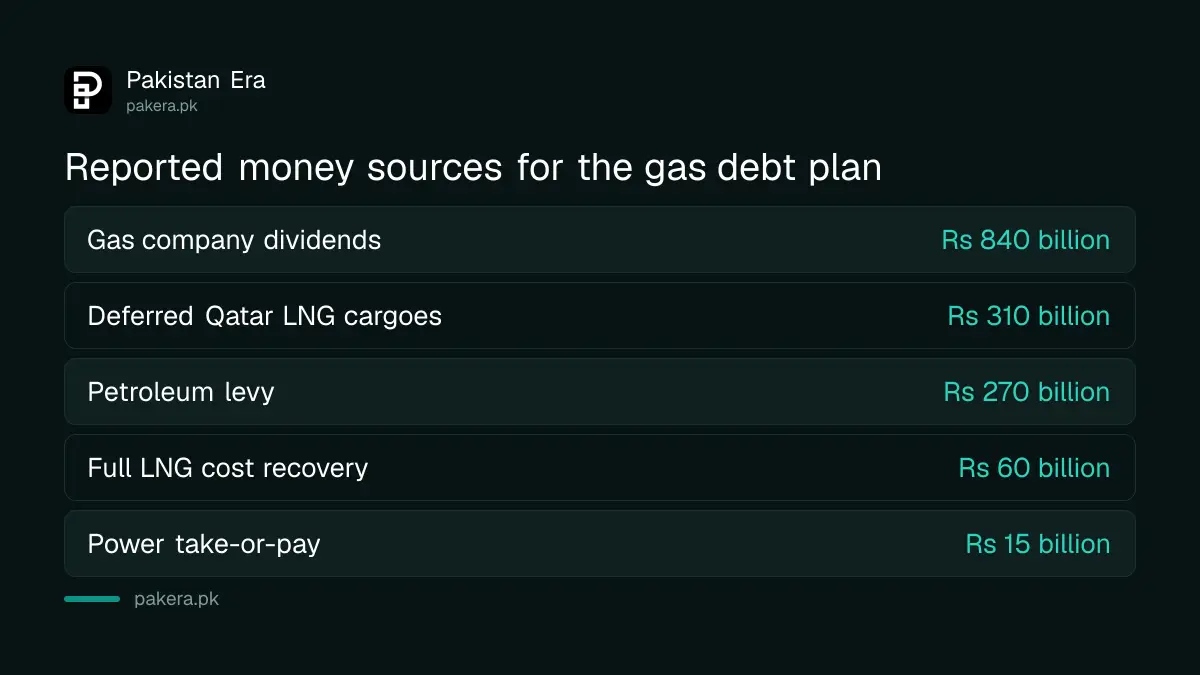
The petroleum levy line matters to anyone who buys petrol or diesel. The levy is already a large source of federal income, as the record Rs 1.57 trillion levy collection showed. Using part of it for gas debt means fuel buyers help pay for it.
The plan is at proposal stage, not approved
The plan is a proposal. Officials said the Finance Ministry would brief the IMF during the September review talks, and the final shape would be decided after that. No cabinet or ECC approval has been announced.
The IMF report fits this timeline. In it, the government says it has built a circular debt management plan for gas and expects to roll it out in the 2026-27 fiscal year "after seeking necessary approvals". It also promises a dedicated settlement office and quarterly gas debt data to the IMF.
The talks themselves are part of the programme's next review, explained in what the fourth IMF review could unlock. The Finance Division's press releases up to 25 September did not mention the gas plan.
Gas bills this winter depend on OGRA, not this plan
The reported plan does not include a gas price rise. Under the IMF programme, gas prices are set twice a year based on OGRA's cost figures, with the next change due by 15 February 2027. Winter bills still rise because use goes up.
The IMF report lists two gas tariff notifications as targets, on 1 July 2026 and 15 February 2027. It says the government will keep the tariff structure progressive and protect vulnerable households. OGRA's consumer gas price page, when we checked, listed notifications up to 1 July 2025. We could not see a July 2026 notification there.
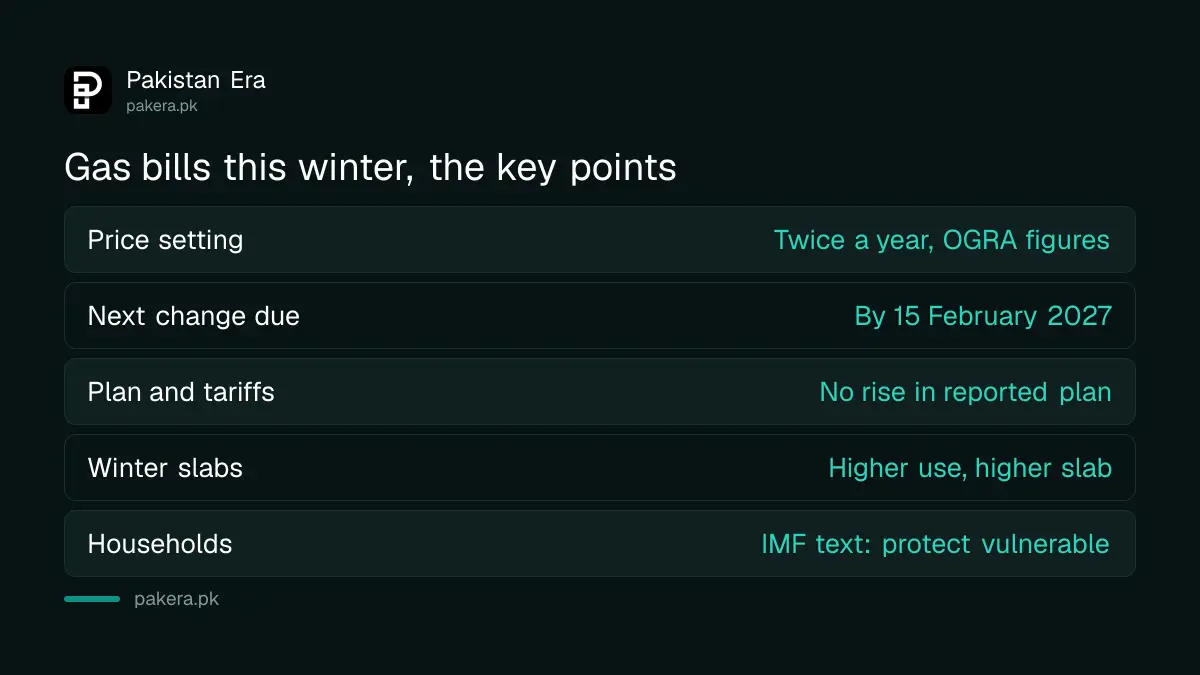
For households, the practical points are these:
- Gas bills use slabs. Heaters and geysers in December and January push use into higher slabs, so the bill jumps even with no price change.
- You can check the amount and due date in your Sui gas bill online before paying.
- Supply cuts are a bigger winter risk than prices for many areas. The timings are tracked in the gas load shedding schedule.
Our view: clearing interest on paper helps the gas companies' books. It does not fix the losses that created the debt. Leaks, theft and unpaid bills are the part to watch.
Common questions
How big is Pakistan's gas circular debt?
The IMF put it at Rs 3.4 trillion in December 2025. A newer figure of Rs 3.6 trillion has been reported but not officially published.
Will the plan clear all gas circular debt?
Not on the reported numbers. The three yearly targets add up to about Rs 1.43 trillion, around 40 per cent of the total.
Has the government approved the plan?
No approval has been announced. It was reported as a proposal to discuss with the IMF in late September 2026.
Will my gas bill go up because of this plan?
The reported plan does not include a tariff rise. Gas prices change twice a year on OGRA's figures, with the next change due by 15 February 2027.
What causes gas circular debt?
Gas sold below cost, unpaid bills, gas lost to leaks and theft, and late payment charges on old unpaid amounts.
How we verified this
What we checked, where we read it, and what we could not confirm.
Last checked on 27 September 2026. The Rs 3.4 trillion figure for December 2025, the point that tariff increases stopped new principal debt, the plan to roll out a gas circular debt management plan in 2026-27 after approvals, the settlement office, the tariff notification dates and the promise to protect vulnerable households are from the IMF staff report, IMF Country Report 26/101. The Rs 3.6 trillion total, its split, the yearly targets and the sources of money were reported on 13 September 2026 from unnamed officials. We could not find them on the Finance Division, Petroleum Division, Press Information Department or OGRA websites. The Rs 1.43 trillion total and the 40 per cent share are our arithmetic. The list of gas price notifications is from OGRA's consumer gas prices page.
About the author

Senior Writer, Public Services and Technology
Shahid joined us in 2024 as an author. He is a senior contributor to Pakistan's leading technology websites. He writes detailed articles, mostly covering his expertise in the latest tech, mobiles, apps, gadgets, and step-by-step guides. His ideology is to help people understand the latest trends and explain complex methods through very easy-to-understand guides.