Pakistan's Fourth IMF Review Could Unlock Over $1 Billion
The IMF's fourth review of Pakistan's $7bn loan checks tax, the budget surplus and energy prices to June 2026. What is at stake and what it means for bills.
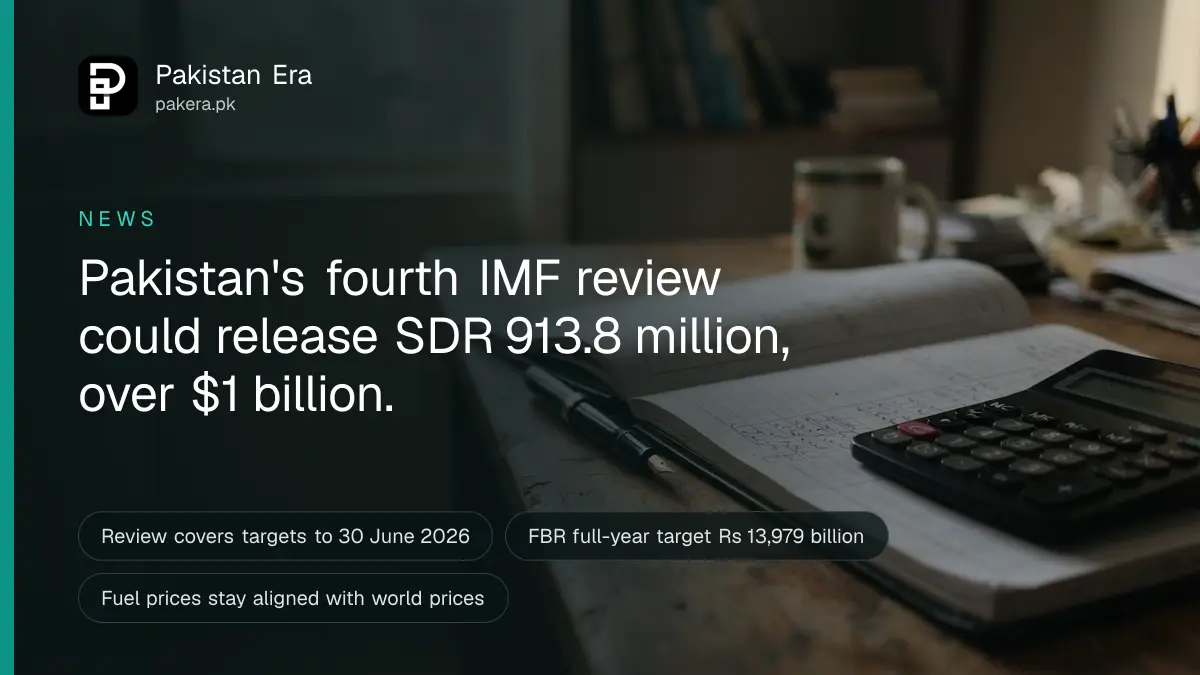
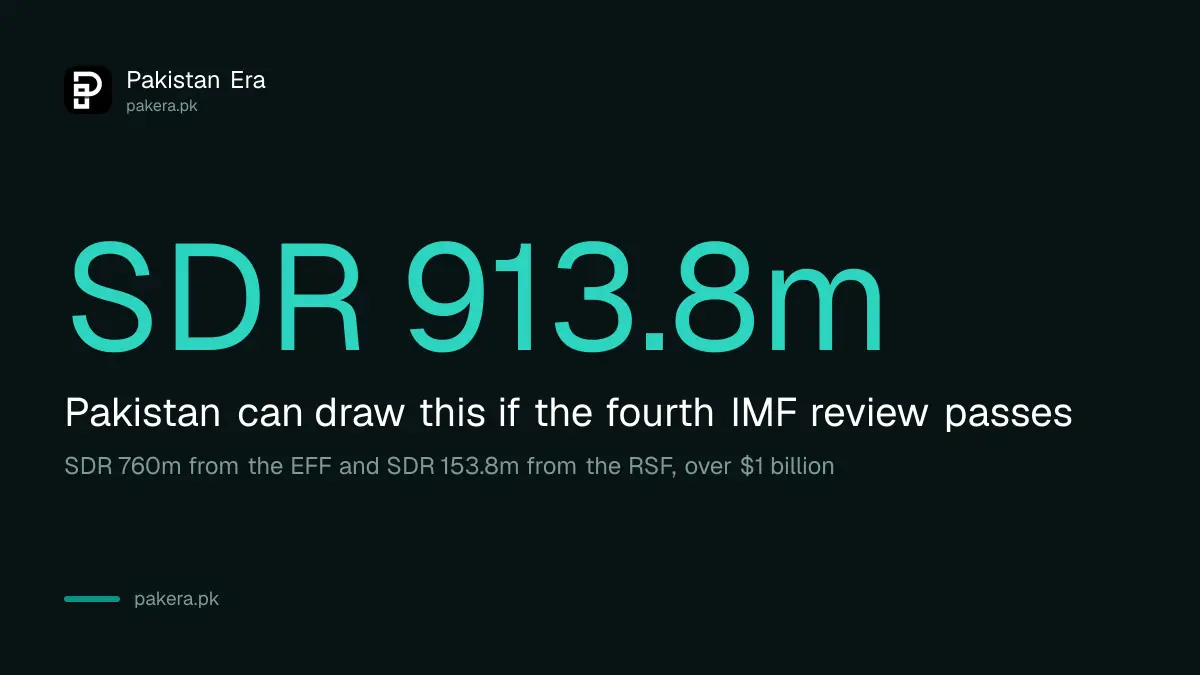
An IMF staff team has started the fourth review of Pakistan's $7 billion loan programme, according to reports from 23 September 2026. If the review goes well, Pakistan can draw SDR 760 million from the main loan and SDR 153.8 million from a separate climate loan. That is a little over $1 billion in total.
SDR means Special Drawing Rights, the IMF's own accounting unit. The IMF valued the same-sized drawings at about $1.1 billion and about $220 million when its Board approved the third review on 8 May 2026. Press reports put the new amount at about $1.2 billion. The final dollar figure depends on the exchange rate on the day.
We read the IMF's staff report on the third review, published in May 2026. It sets out exactly what this review checks. What we could not find is an official statement that the mission has begun. The IMF, the Finance Ministry and the Press Information Department had not published one by the early hours of 27 September.
The IMF review checks Pakistan's numbers up to 30 June 2026
The fourth review tests whether Pakistan met its targets for the period ending 30 June 2026. The IMF staff report says it needs the end-June performance criteria to be met. The review was scheduled for September 2026, with the SDR 760 million drawing available from 15 September.
The main loan is an Extended Fund Facility, or EFF. It is a 37-month arrangement worth SDR 5,320 million, approved in September 2024. The second loan is a Resilience and Sustainability Facility, or RSF. It is a 28-month arrangement of SDR 1,000 million, which pays out when Pakistan finishes agreed climate reforms.
Reports say the mission is led by Iva Petrova and will stay until the first week of October. The Press Information Department named Ms Petrova as the IMF's Mission Chief for Pakistan in July 2026, when Finance Minister Muhammad Aurangzeb met her in Washington. The start date and length of stay come from the press only.
Tax revenue, reserves and the budget surplus are the main tests
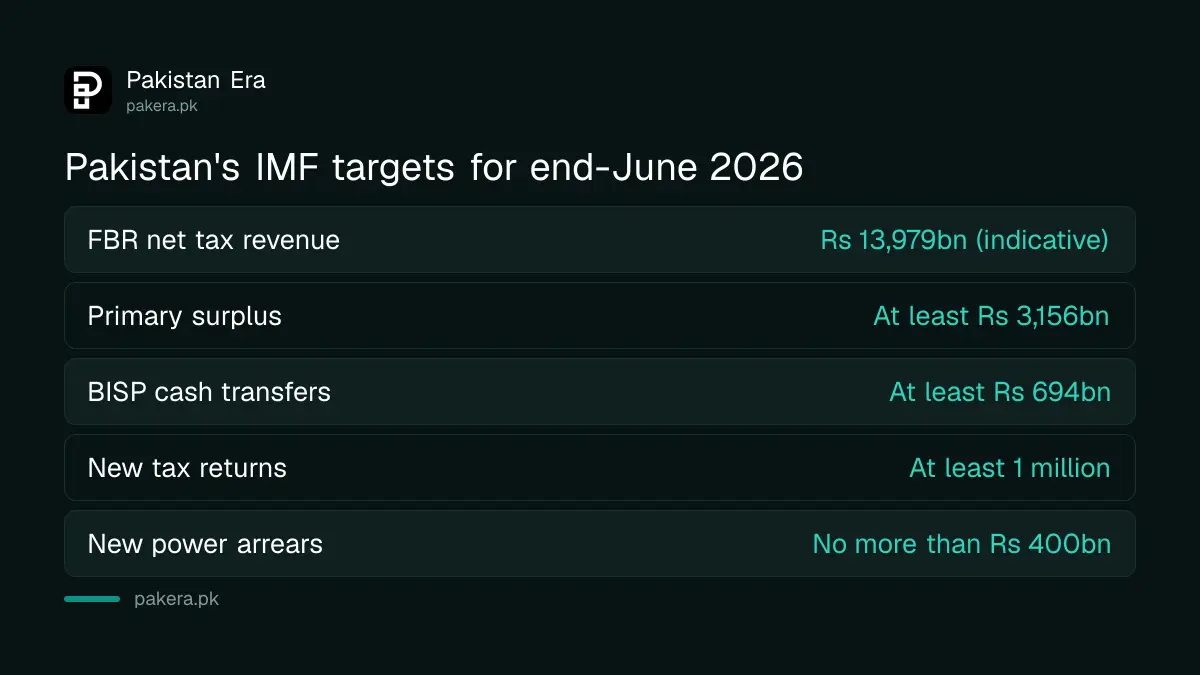
Six numbers sit at the centre of this review. They cover tax collection, the budget, power sector debts and payments to poor families. The FBR revenue figure is an "indicative target" for now, which means missing it does not stop the review by itself.
| Target for end-June 2026 | Level in the IMF table |
|---|---|
| FBR net tax revenue, full year | At least Rs 13,979 billion (indicative) |
| Federal and provincial primary balance | Surplus of at least Rs 3,156 billion |
| BISP cash transfers, full year | At least Rs 694 billion |
| New tax returns | At least 1 million |
| FBR income tax from retailers | At least Rs 707 billion (indicative) |
| New power sector arrears | No more than Rs 400 billion |
A "primary balance" is revenue minus spending, leaving out interest payments. The FBR has struggled against its line. The staff report shows it missed the end-December 2025 target, collecting Rs 6,161 billion against Rs 6,490 billion. The IMF said stronger petroleum levy and provincial collections made up much of that gap.
Reforms with deadlines also count in the review
Beyond the numbers, the IMF checks reforms with fixed dates, called structural benchmarks. Several fall due around this review. They include a budget, tax audits, public buying rules and state companies. Missing one does not end a programme, but it has to be explained.
- Parliament approves an FY27 budget in line with IMF staff agreement, including an underlying primary surplus of 2 per cent of GDP (end-June 2026).
- The government signs cost agreements with its 7 largest public service companies before the FY27 budget goes to Parliament (end-June 2026).
- The FBR prepares an audit manual that selects cases centrally by risk (end-August 2026).
- Laws for 9 more state companies are brought in line with the SOE Act (end-August 2026).
- Procurement rules stop giving state companies contracts without competition (end-September 2026).
The climate loan has its own two tasks for this review, both due by end-August 2026. One raises the climate weighting in public project selection to at least 30 per cent. The other sets up a disaster risk financing plan shared by the federal and provincial governments.
Fuel, electricity and gas prices stay tied to costs under the programme
For households, the review matters most through energy prices. The IMF programme expects fuel, electricity and gas prices to cover their real cost. It does not set your pump price or your bill, but it limits how far the government can hold them down.
Fuel first. Before the third review, the government agreed as a "prior action" to fully align local fuel prices with world prices at each fortnightly change. The IMF says subsidies that stop fuel prices moving have proven "distortionary and fiscally unsustainable". Any relief should be targeted, limited, temporary and budget neutral.
The petroleum levy is part of the same picture. Under the climate loan, Pakistan added a carbon levy of Rs 5 a litre on petrol and diesel through the levy, phased in over two years. That is why the government's request for a flexible fuel levy has to be agreed with the IMF. The levy already brings in a lot of money, with a record Rs 1.567 trillion in fuel levy collected last year.
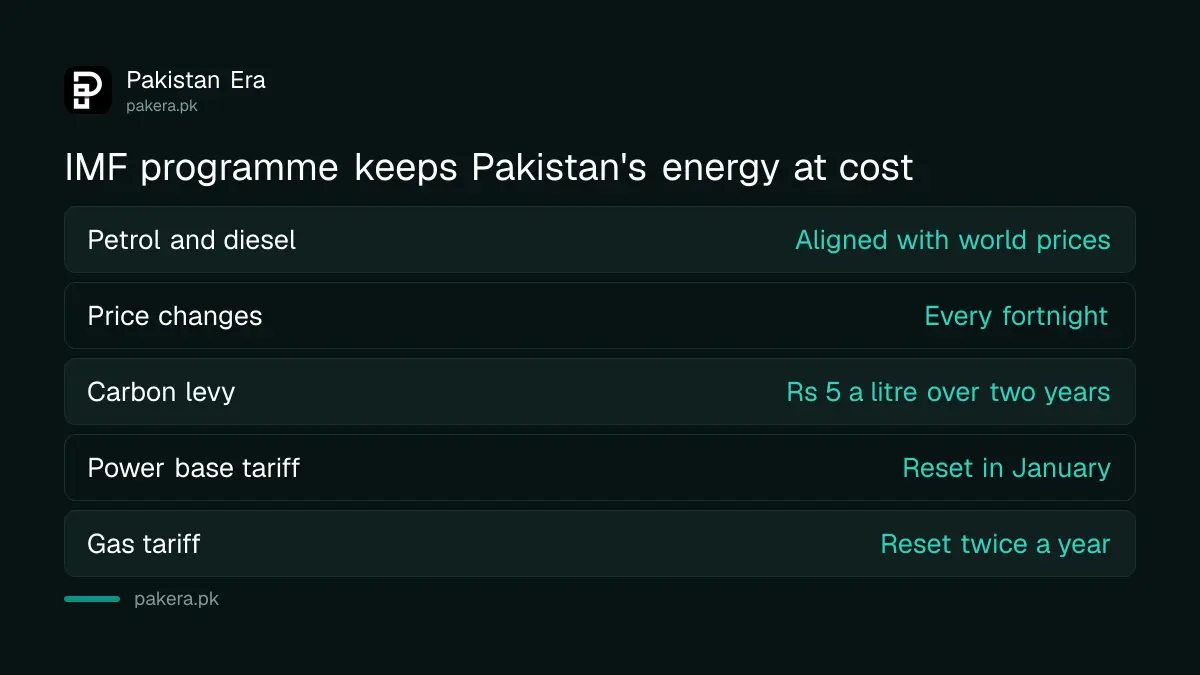
For electricity, the staff report says NEPRA's annual rebasing, the yearly reset of base tariffs, has moved from July to January. The new benchmark list includes a power tariff notification and two gas tariff notifications. So the next big base tariff change is due in January, not July, with monthly fuel adjustments in between.
A passed review steadies reserves but does not cut bills
A passed review adds dollars to the State Bank's reserves. It does not cut prices or taxes. The conditions keep energy priced at cost and taxes rising, so households feel the programme through bills rather than the tranche.
Reserves matter for the rupee. The State Bank's September statement put reserves at $21.4 billion, and it held the policy rate at 11.5 per cent in the same decision. A smooth review supports that position.
Taxes are the other side. The programme bars new tax amnesties and new exemptions, a benchmark the IMF marked "not met" in May. The FBR revenue target becomes a hard performance criterion from December 2026. Expect pressure for more filers and more tax on sectors that pay little now.
Staff-level agreement comes first, then the IMF Board
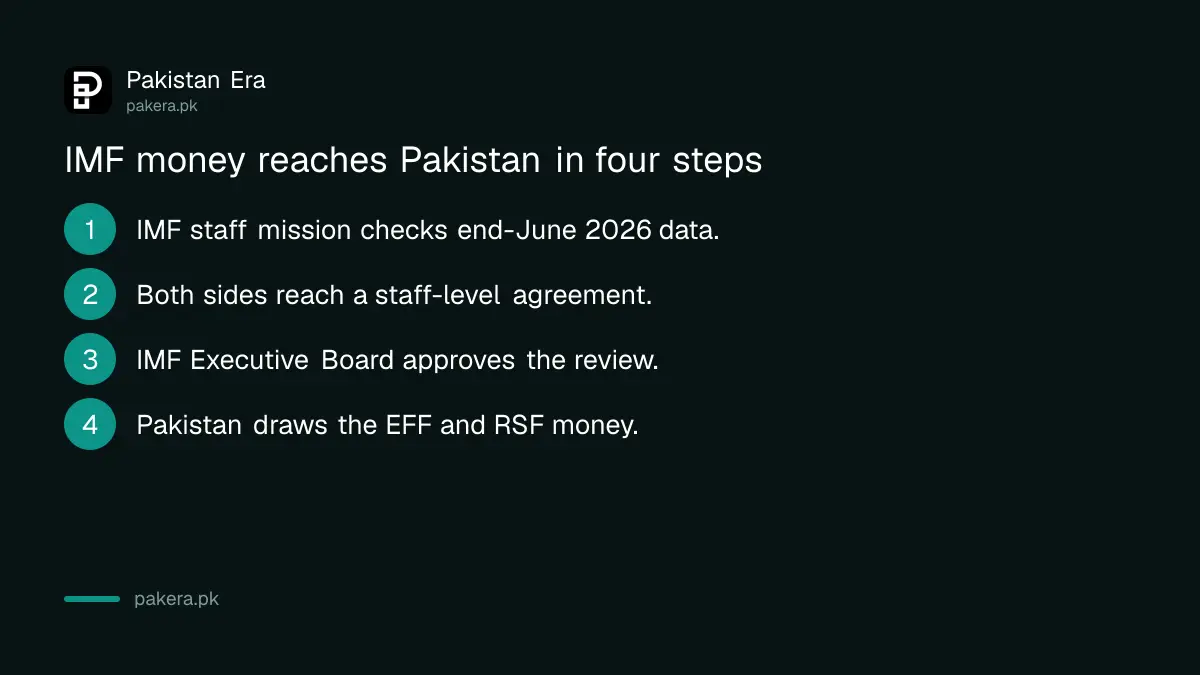
If talks go well, the mission ends with a staff-level agreement. Then the IMF Executive Board meets and approves the money. Reports say the drawing could come by late November or early December 2026. The IMF has not confirmed a date.
Two more reviews remain after this one. The IMF schedule lists a fifth review against end-December 2026 numbers from March 2027, and a sixth against end-June 2027 numbers from September 2027.
Common questions
How much will Pakistan get from the fourth IMF review?
SDR 760 million from the EFF and SDR 153.8 million from the RSF. The same amounts were worth about $1.1 billion and $220 million in May 2026.
Has the IMF mission started in Pakistan?
Reports say it began on 23 September 2026. We could not find an IMF or government statement confirming it by 27 September.
Who leads the IMF mission to Pakistan?
Iva Petrova is the IMF's Mission Chief for Pakistan, as the Press Information Department recorded in July 2026.
Will the IMF review raise petrol prices?
Not directly. But Pakistan has agreed to keep fuel prices aligned with world prices at every fortnightly change, so falls and rises both pass through.
When will the IMF money arrive?
After a staff-level agreement and Board approval. Reports point to late November or early December 2026, which the IMF has not confirmed.
How we verified this
What we checked, where we read it, and what we could not confirm.
Last checked on 27 September 2026. The review schedule, the SDR 760 million EFF and SDR 153.8 million RSF amounts, the end-June 2026 targets, the end-December 2025 FBR shortfall, the structural benchmarks, the climate reform measures, the fuel pricing prior action, the carbon levy and the move of electricity rebasing to January are from the IMF staff report on the third review (Country Report 26/101). The dollar values of the third review drawings are from the IMF's press release of 8 May 2026. Iva Petrova's role is from a Press Information Department release of 23 July 2026. The mission's start on 23 September, its length and the expected payment date are reported and were not confirmed on the Finance Ministry's press releases, which covered the Finance Minister's visit to New York from 22 to 25 September. Reserves and the policy rate are from the State Bank's statement of 14 September 2026.
About the author

Senior Writer, Public Services and Technology
Shahid joined us in 2024 as an author. He is a senior contributor to Pakistan's leading technology websites. He writes detailed articles, mostly covering his expertise in the latest tech, mobiles, apps, gadgets, and step-by-step guides. His ideology is to help people understand the latest trends and explain complex methods through very easy-to-understand guides.