Supplementary Electricity Bill in Pakistan: The 6 Month Limit and How to Dispute It
A supplementary electricity bill can reach back 6 months only and must state the reason, amount and period. See the NEPRA limits and how to dispute one.
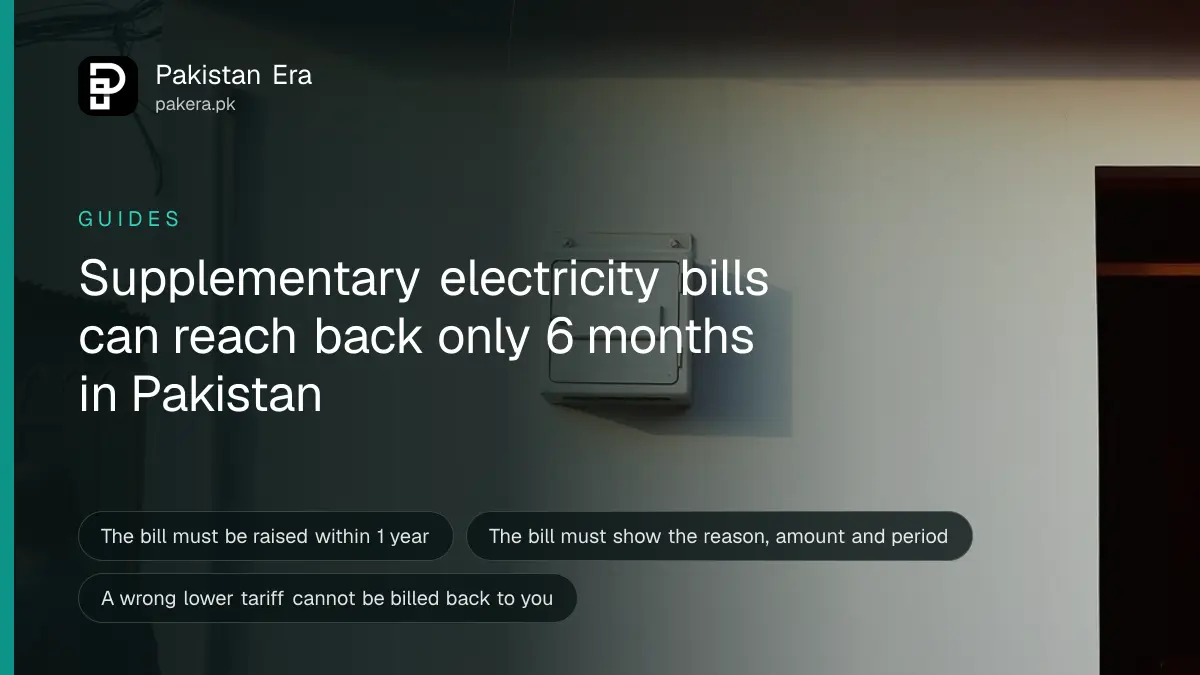
If your electricity company sends a supplementary bill for charges it skipped, NEPRA's Consumer Service Manual says it can go back only six months, and must raise the bill within one year. The bill must also state the reason, the amount and the period. If the company put you on a lower tariff by mistake, it cannot bill you the difference at all.
A supplementary bill is a separate bill for money the company says it should have charged earlier. It often arrives without warning and can run into thousands of rupees. This guide explains each limit in the manual so you can check the bill line by line.
A supplementary bill can go back six months, not more
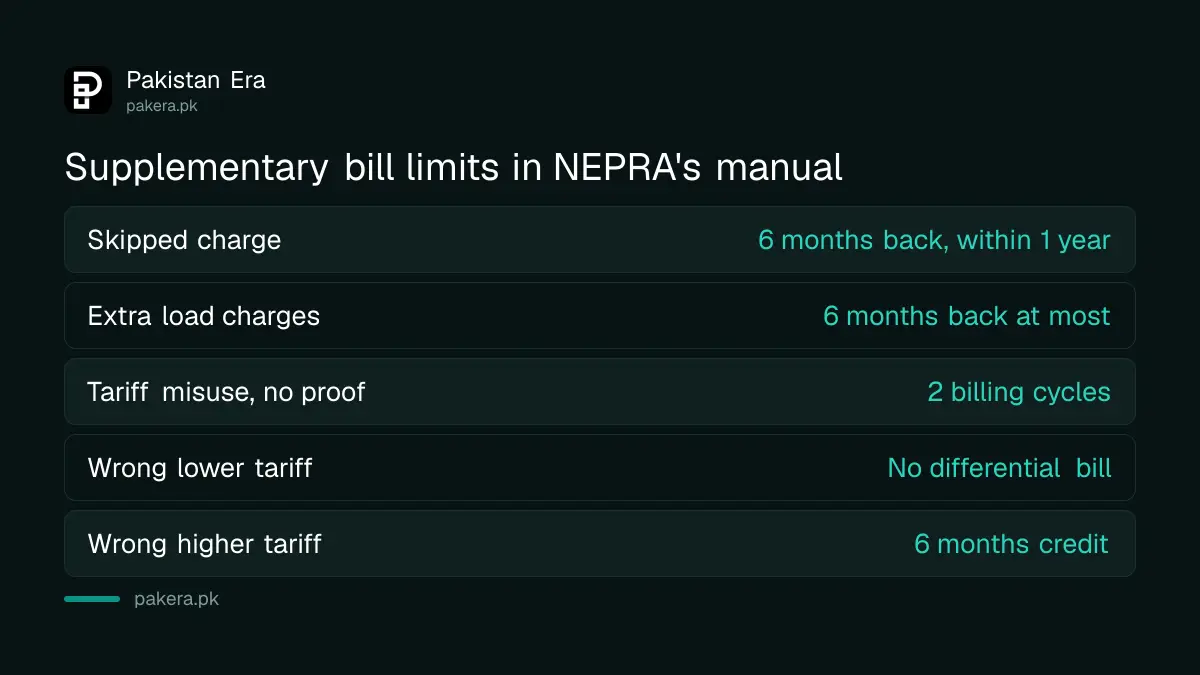
Clause 7.5.5 says that if the company skipped a charge, such as a multiplying factor, fixed charges, a tariff difference, a power factor penalty or the correct tariff category, it can raise the difference within one year, for a maximum of six months retrospectively.
So the company has two limits at once. The charge must be raised within a year of when it should have been, and it can reach back at most six months. A bill that goes back eight months, or arrives after the year has run, breaks the manual's own limit.
The manual also says the supplementary bill must contain the reason, the amount, the period of charging and the taxes. A bill that shows only a lump sum and no reason is incomplete. Ask the sub division office for the breakdown in writing.
A wrong lower tariff cannot be billed back to you
Clause 7.6 says applying the correct tariff is the company's job when it sanctions your connection. If it applied a tariff lower than the right one, no differential bill will be debited against your account.
The reverse also helps you. If it charged a higher tariff than it should have, you are owed credit for six months back, counted from the date you point out the mistake. Our guide to changing a tariff from commercial to residential shows how to ask.
| Situation | Limit in the manual |
|---|---|
| Skipped charge found later | Up to 6 months back, raised within 1 year (clause 7.5.5) |
| Higher load used, fixed charges or penalty skipped | Not more than 6 months back (clause 7.5.3) |
| NEPRA changes tariff terms | Not more than 6 months back, raised within 1 year (clause 7.5.4) |
| Tariff misuse without paper proof | Maximum 2 billing cycles (clause 7.5.2) |
| Wrong lower tariff by the company | No differential bill (clause 7.6) |
| Wrong higher tariff by the company | 6 months credit (clause 7.6) |
Misuse and extra load have their own short clocks
Clause 7.5.2 says that for tariff misuse, such as running a shop from a house connection, the company must serve a clear seven day notice. Without documentary proof of how long the misuse lasted, it can charge back at most two billing cycles.
Clause 7.5.3 covers extra load. If you use more load than sanctioned, the company should issue a notice for extension of load. Fixed charges or power factor penalties cannot be raised for more than six months retrospectively, and only within a year. See how to extend your electricity load.
Meter faults follow a related two-cycle rule. If a test shows your meter ran slow, the company can charge the lost units for two previous billing cycles. If it ran fast, you get credit for two previous cycles. The guide to a faulty electricity meter has the challenge steps.
Check and dispute a supplementary bill in five steps
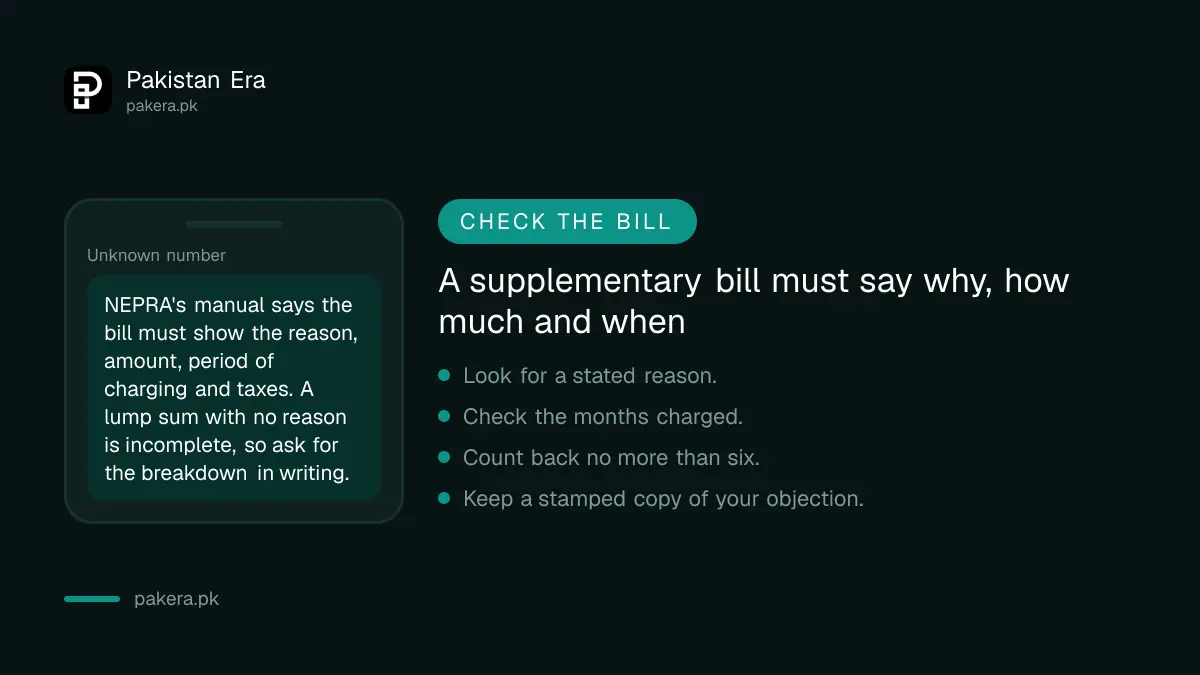
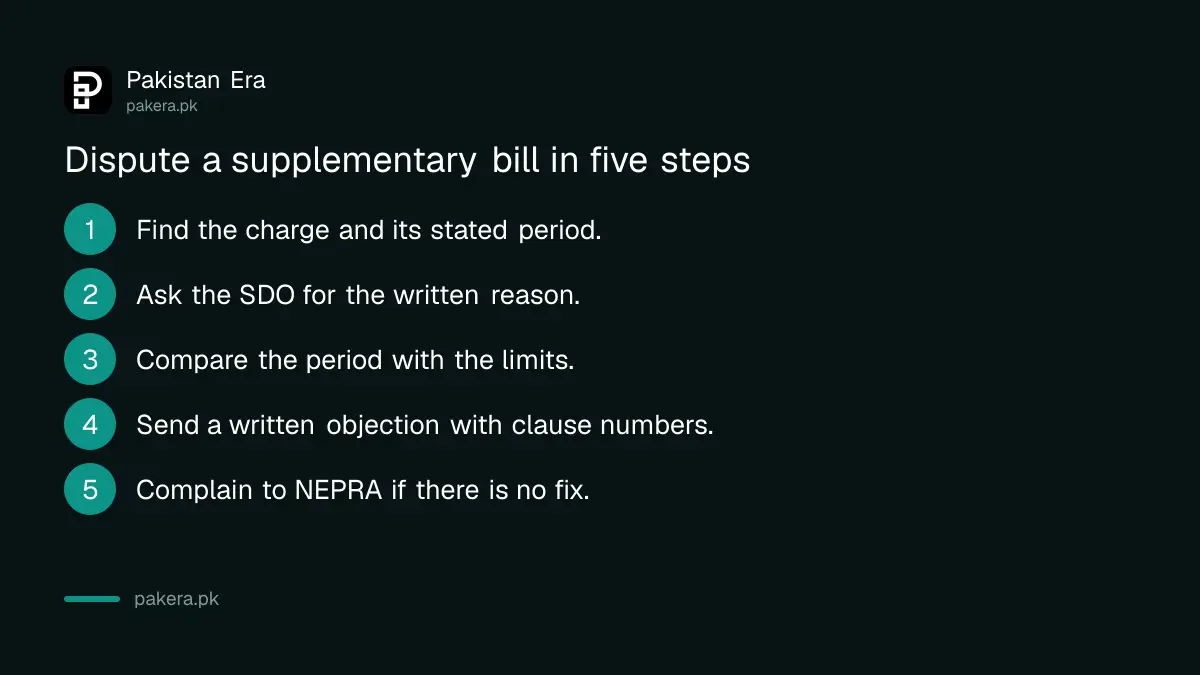
Start with the bill's wording. Find the reason, the period and the amount. Then compare the period with the limits above. If the dates fall outside them, write to the sub division office and ask for the charge to be withdrawn.
- Find the supplementary or arrears line on your bill and note the stated period.
- Ask the sub division office for the written reason, amount and months charged.
- Compare the period with the six month and one year limits.
- Send a written objection to the SDO, quoting the clause number, and keep a stamped copy.
- If there is no fix, follow the NEPRA complaint guide or log it on the NEPRA Asaan Approach app.
Detection bills for suspected tampering follow different rules, set out in how to dispute an electricity detection bill. NEPRA proposed changes to those on 25 September 2026, and they are not in force, as our report on the proposed manual changes explains.
Common questions about supplementary electricity bills
What is a supplementary electricity bill?
It is a separate bill for a charge the company skipped earlier, such as a tariff difference or a fixed charge. The manual says it must show the reason, amount, period and taxes.
How far back can the company charge me?
For skipped charges, up to six months, and the bill must be raised within one year. For tariff misuse without proof, up to two billing cycles. Detection bills for theft have separate rules.
Can the company bill me if its own mistake put me on a lower tariff?
No. Clause 7.6 says that when the company applied a lower tariff than the correct one, no differential bill will be debited against your account.
Do I have to pay before I complain?
We could not confirm a general rule on this in the manual for supplementary bills. Ask the sub division in writing what you must pay while the objection is open, and keep paying your current bills on time.
Where do I complain if the office will not listen?
Use the NEPRA route in our complaint guide, or the Asaan Approach app for urgent cases. Attach the bill, your written objection and the clause numbers.
How we verified this
What we checked, where we read it, and what we could not confirm.
Last checked 8 October 2026. We read the NEPRA Consumer Service Manual (with amendments and clarifications, as on 26 November 2025) on nepra.org.pk, clauses 4.3.3, 4.3.4, 7.5.2 to 7.5.5 and 7.6. NEPRA's six proposed changes of 25 September 2026 are not in force. We did not test how each company applies the limits, and the manual does not say whether you must pay a disputed amount first, so confirm with your sub division.
About the author

Public Services and Education Journalist
Fajr Riaz is a journalist and content writer at Pakistan Era, based in Lahore. She covers the questions people meet in everyday life in Pakistan: how a public service works, what a change in the rules means, and where to find a reliable answer.