Raise Beef Calves in Punjab: Start at 9 to 14 Months and 100 kg, Fatten for 3 to 4 Months
Punjab says start beef fattening with calves of 9 to 14 months and 100 kg, vaccinate on time and feed a balanced ration for 3 to 4 months. See the steps.
Punjab's Livestock Department says to start beef fattening with a calf of any breed aged 9 to 14 months and weighing about 100 kg, vaccinate it on time, and feed a balanced ration for 3 to 4 months. A calf is bought, fed, vaccinated and sold within about a season, so the plan has to be set before you buy.
We read the department's FAQs page and its farmer awareness page at livestock.punjab.gov.pk on 21 October 2026. The three rules above are the department's. The feed and space examples are our own arithmetic, and the page gives no price, weight gain or profit figure, so we give none.
Buy a calf of 9 to 14 months and about 100 kg
The department says to select calves of any breed from 9 to 14 months of age weighing 100 kg. It does not name a preferred breed for fattening. For breeding it does list the local breeds it promotes, such as Nili Ravi, Sahiwal, Cholistani and Dhanni.
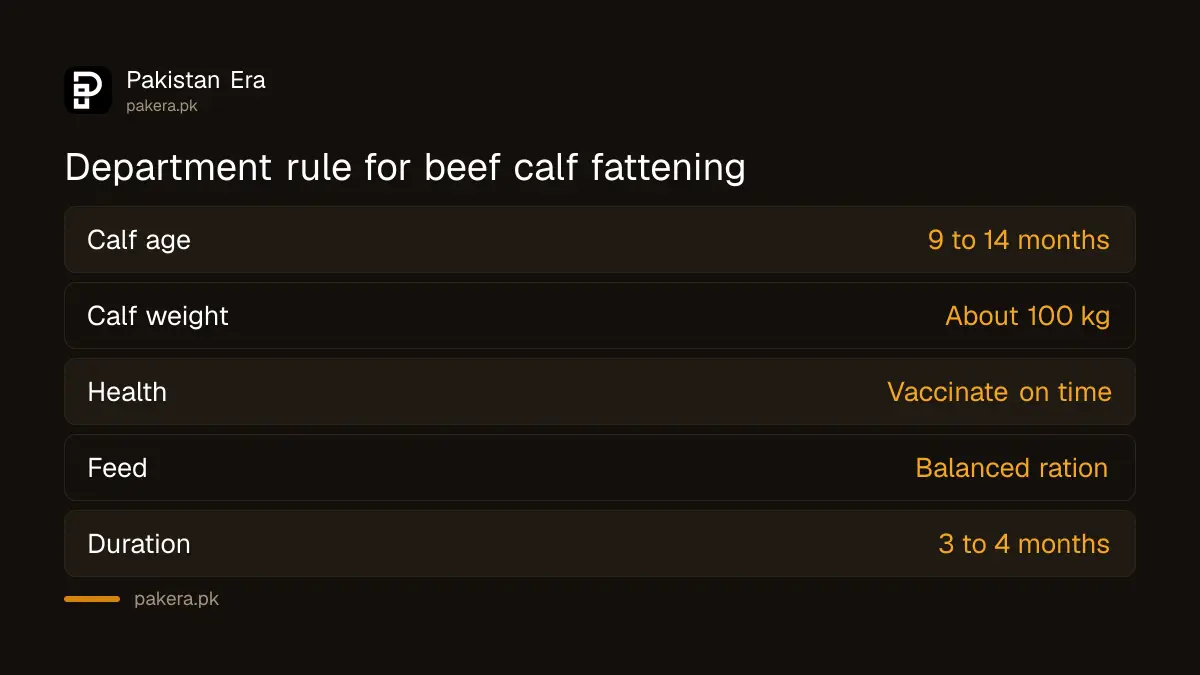
| Step | Department's rule |
|---|---|
| Calf age | 9 to 14 months |
| Calf weight | About 100 kg |
| Health | Vaccinate timely |
| Feeding | Balanced feed |
| Duration | 3 to 4 months |
Weigh the calf at purchase, or at least ask the seller to let a vet estimate it. A calf far under 100 kg is outside the department's rule and will take longer.
Fatten for 3 to 4 months on a balanced feed
The department says fattening is done with a balanced feed for 3 to 4 months. It does not publish the ration on the FAQ page. It says ration formulas for big meat animals and small meat animals are in its printed literature, which a farmer can read and use.
So ask the nearest centre for the ration sheet, or call 08000-9211. Mixing your own ration without the sheet is how farmers overspend on feed. We did not see the printed sheet, so we cannot quote its mix.
The department lists beef production among the booklets it publishes, together with dairy farming, goat rearing, sheep rearing, winter and summer fodder and a vaccination chart. Ask for the beef one when you visit the centre.
A fattening calf needs shed and yard space
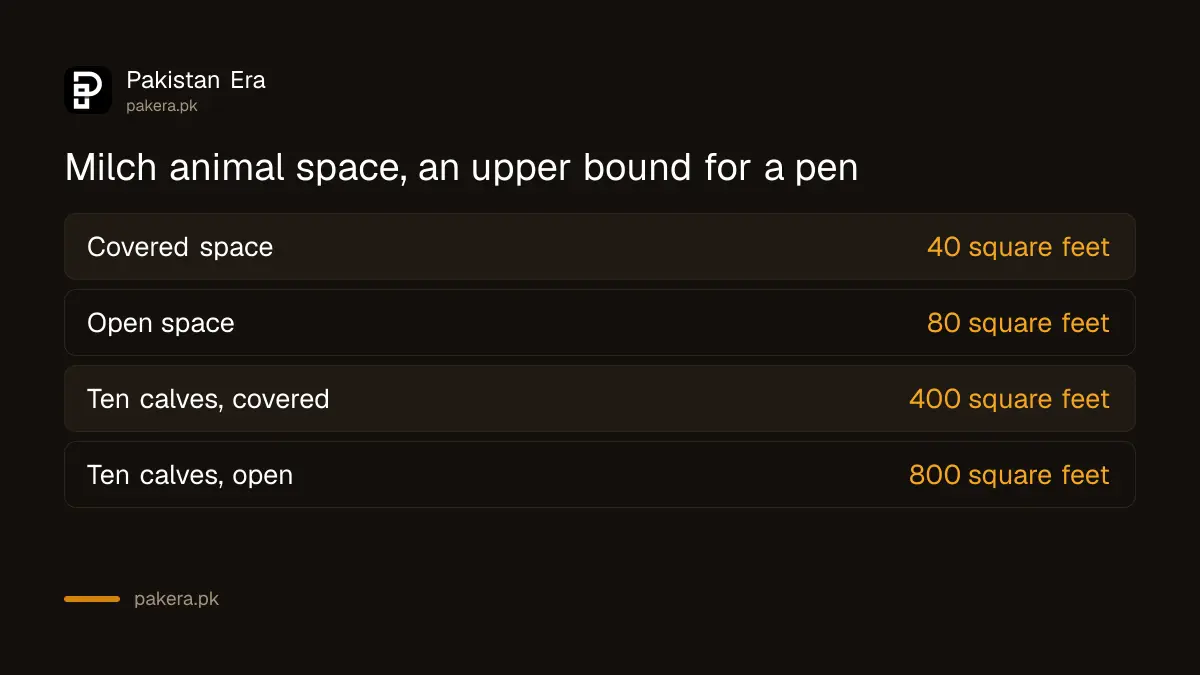
The department's space figure is for a milch animal: 40 square feet covered and 80 open. It gives no separate number for a beef calf. A small calf needs less room than a milch buffalo, but use the department's figure as the upper bound when you plan a pen.
Take ten calves as an example. At the milch figure that is 400 square feet of shed and 800 of yard, or about 1,200 square feet in total. That is our arithmetic. A vet can tell you how much you can trim.
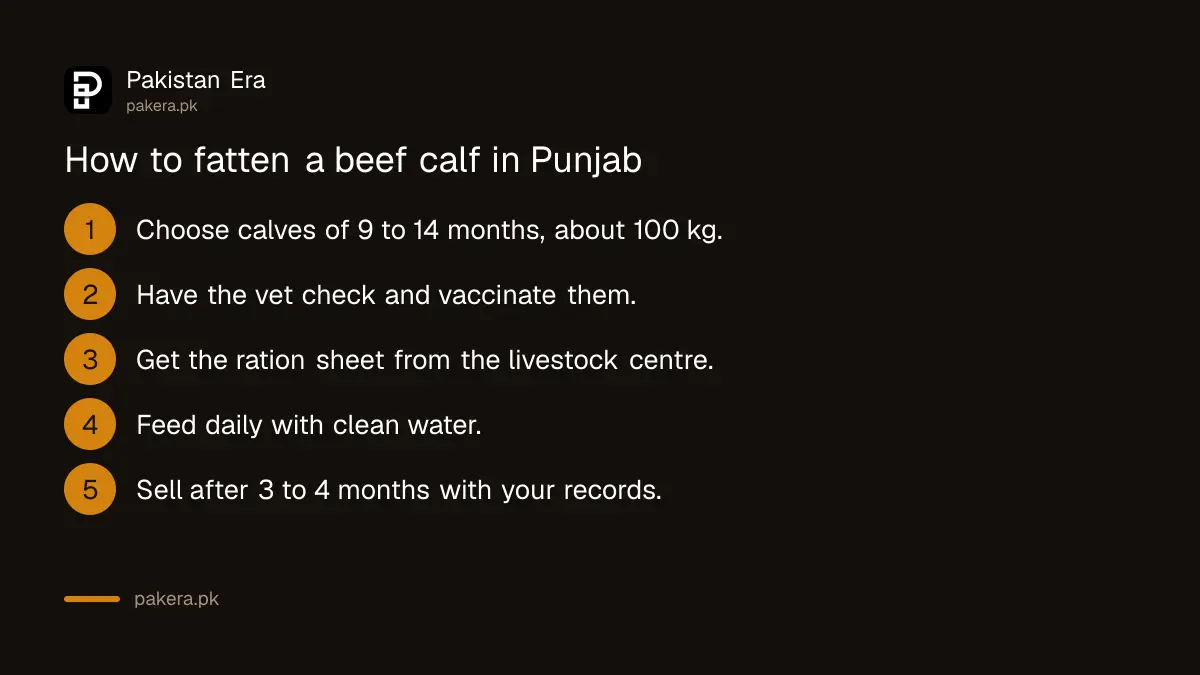
- Choose calves of 9 to 14 months, about 100 kg each.
- Have the vet check and vaccinate them.
- Get the ration sheet from the livestock centre.
- Feed it daily with clean water.
- Sell after 3 to 4 months, with your records.
Keep dewormer and vaccines on schedule during the 3 months
The department's rule for worms is a dung test and a dewormer every four months. A fattening cycle is only three to four months, so deworm at the start and ask the vet whether a repeat is needed. Vaccines should be given on time, and the first dose should be before the feed ration starts.
The guide on mastitis and worms shows how the dung sample step works, and the vaccine list and cold chain guide explains what the department makes.
Check the calf's price against the market and loan terms before you borrow
The department does not publish a calf price, a daily weight gain or a margin. Treat any seller who promises a profit figure with caution. Work the numbers with your own feed bill and the weights you record.
For money, the department says it does not give loans. Look at the ZTBL sheep and goat fattening loan for one lender's scheme, and the Punjab Livestock Card for government support. Neither page is about cattle fattening specifically, so read their conditions.
The department also publishes booklets on goat rearing, sheep rearing and raising sheep and goats, and its FAQ mentions ration formulas for small meat animals as well as big ones. Local veterinary officers hold a Farmers' Day every month where the department says landowners are informed about its education and dairy farming. Ask your local office when the next one is.
Record each calf's weight at purchase, at one month and at sale. Even a rough scale or tape estimate by the vet gives you your own gain figure, which is more useful than any promise from a seller.
Common questions about beef calf fattening in Punjab
How old should a calf be for fattening?
Nine to 14 months old, says the department.
How long does fattening take?
Three to four months on a balanced feed.
What weight should the calf start at?
About 100 kg, says the department.
Is there a ration formula?
Yes, in the department's printed literature. It is not on the FAQ page.
Does the department give loans?
No. It says listed banks provide livestock loans.
Whom should I call for advice?
The department's home page lists 08000-9211. We did not call it.
How we verified this
What we checked, where we read it, and what we could not confirm.
Last checked 21 October 2026. We read the Punjab Livestock and Dairy Development Department's FAQs page and its farmer awareness page. We did not find the ration formula, calf prices, weight gain, or a beef-specific space figure. The ten-calf example is our arithmetic. We did not visit a fattening farm.
About the author

Global Affairs & Political Economy Writer
Muhammad Hatim is a book lover who started writing because he enjoys it. At Pakistan Era he writes about international relations, geopolitics and the global economy, with a particular interest in South Asia and the forces behind current events.