Check Animal Vaccines Made in Punjab: VRI Lahore List and the 2 to 8 Degree Cold Chain
Punjab makes more than 20 animal vaccines and test products at VRI Lahore. See the department list, the 2 to 8 degree cold chain rule and the Newcastle doses.
Punjab's Veterinary Research Institute in Lahore makes more than 20 animal vaccines and test products, and the department says every vaccine must be stored between 2 and 8 degrees Celsius. A vaccine left in the sun or carried without ice is wasted money, and your animal is not protected.
We read the Livestock and Dairy Development Department's vaccine production and supply page on 21 October 2026, with its FAQs page. The lists below are the department's. We did not inspect a vaccine batch or a cold box.
The institute makes bacterial, viral and test products
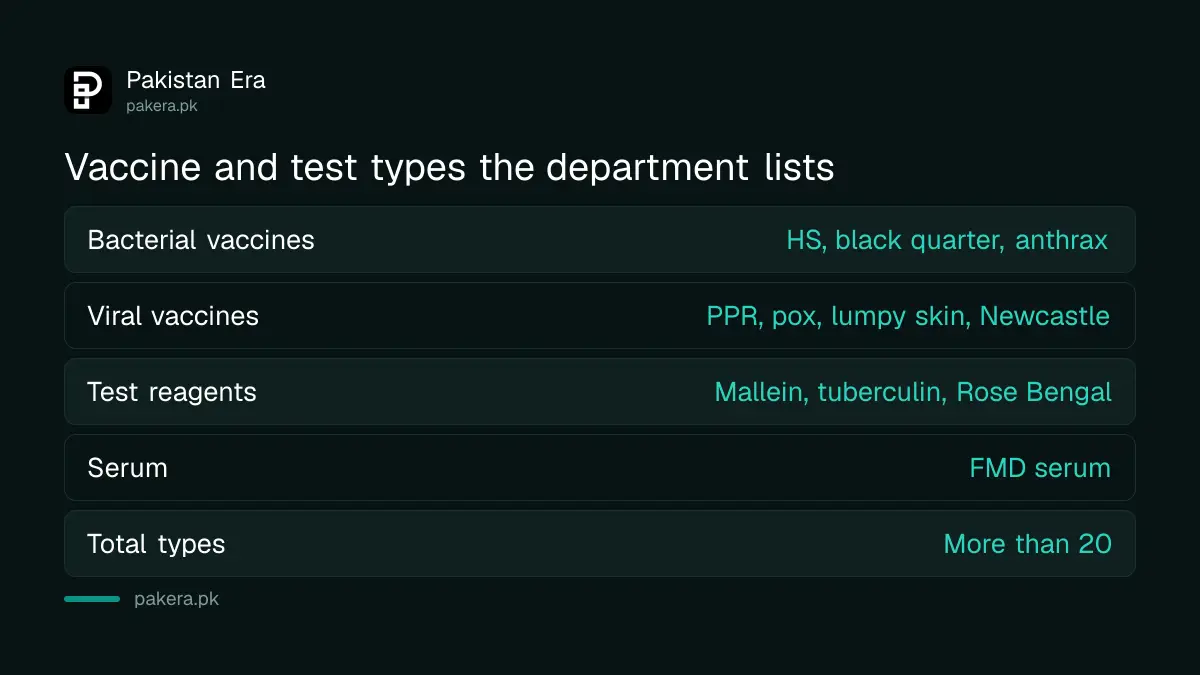
The Veterinary Research Institute (VRI), Lahore Cantt, was set up in 1963 and is the central body for animal vaccine production in Punjab. The department says it makes more than 20 types of biologics used across the province.
| Type | Examples the department lists |
|---|---|
| Bacterial vaccines | Haemorrhagic septicaemia (HS-50, HS Plus), black quarter, anthrax spore, enterotoxaemia, caprine pleuropneumonia |
| Viral vaccines | PPR, sheep pox, goat pox, lumpy skin disease, Newcastle disease (Mukteswar and Lasota), avian influenza H9 |
| Test reagents | Mallein, tuberculin, Rose Bengal brucella test, milk ring test |
| Serum | FMD serum |
Biologics means products made from living material to prevent, treat or test for disease. Vaccines, antibody products and test kits are all biologics.
Cattle and buffalo vaccines include HS, black quarter, anthrax and lumpy skin
For large animals the department's list names haemorrhagic septicaemia, black quarter, anthrax and lumpy skin disease. For goats and sheep it names PPR, sheep pox, goat pox, enterotoxaemia and caprine pleuropneumonia. For poultry it lists Newcastle and avian influenza H9.
Foot and mouth disease appears on the page only as an FMD serum and as an emergency the laboratories prepare for. We did not find an FMD vaccine on the list, so ask your vet which product the centre uses. The department says its vaccination chart carries the schedule.
The helpline and free treatment services are explained in the guide to free animal treatment and vaccines in Punjab.
The cold chain must hold 2 to 8 degrees from store to farm
The department's cold chain section says vaccines must be kept within 2 to 8 degrees Celsius, moved in a refrigerated chain, dispatched to field centres in proper cold chain conditions and recorded at storage, dispatch and use.
Farmers can use the same rule. Ask the vet to carry the vial in a cold box and to open it only when your animal is restrained. A vial that sat on a motorbike seat in October heat may not work.
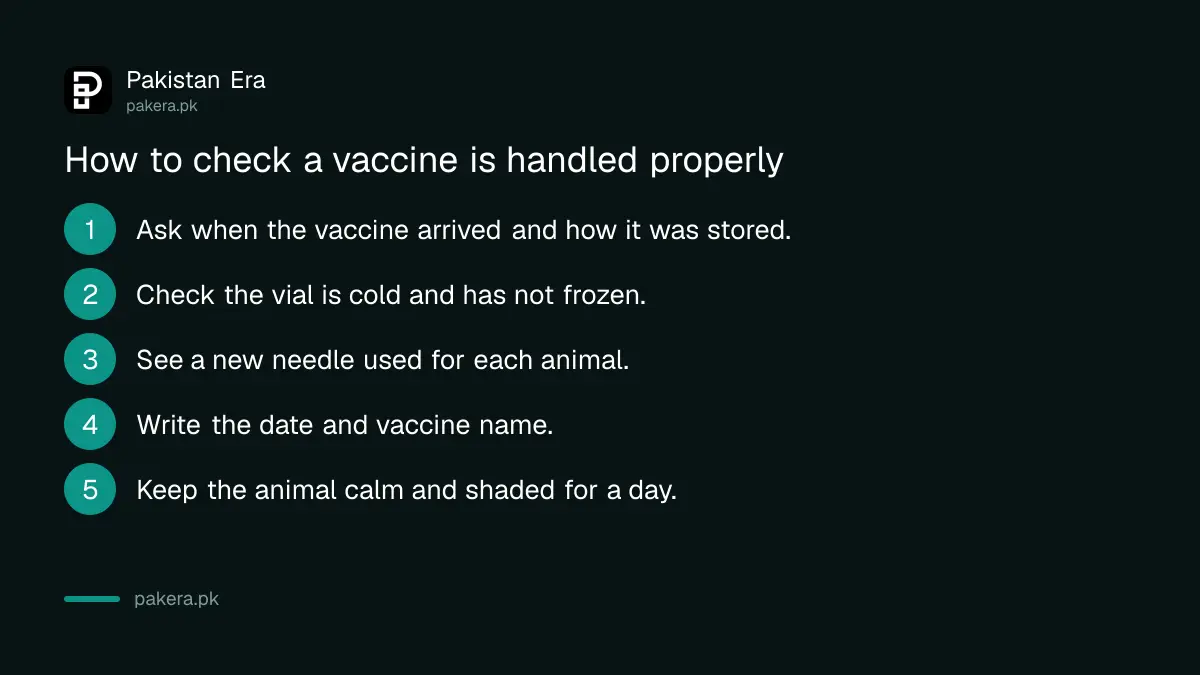
- Ask the centre when the vaccine arrived and how it was stored.
- Check the vial is cold to the touch and has not frozen.
- See the vet use a new needle for each animal.
- Write the date and vaccine name for each animal.
- Keep the animal in a shaded, calm place for a day.
The needle and the shaded rest are common vet practice, not lines from the department's page, which says nothing on them. We say so because the department only gave the cold chain temperatures.
Newcastle disease vaccination follows three doses
The FAQ page gives the Newcastle schedule: eye drops in the first week, half a cc under the skin after 21 days and 1 cc under the skin after 2 months. More on that is in the poultry farm rules and Newcastle schedule.
For lumpy skin disease, the department said in 2022 that vaccine was being given free to cows. We do not know if that campaign is on now, so ask.
Keep a record, because a vaccine is only proved by a date
The department says it keeps records of vaccine storage, dispatch and field use. You should keep your own: the animal, the product, the date and the vet. Then a repeat dose or an insurance claim has a paper trail.
If your animal falls sick after a vaccine, call the centre the same day. The page gives no reaction rules, so do not treat it yourself. For crop-side or credit insurance questions, the guide on getting a crop loan insurance claim shows how paperwork matters there too.

The institute also makes test reagents. The department's list includes tuberculin for tuberculosis and Johne's disease, the Rose Bengal plate test antigen and the milk ring test antigen for brucellosis, and mallein for glanders. These are used by vets to find disease, not to prevent it, and your centre decides when to use them.
The institute also says it has upgraded laboratories under development programmes to meet good manufacturing practice. We could not verify the quality of any batch ourselves. If something seems wrong with a product, note the batch number and report it to the centre.
Common questions about animal vaccines in Punjab
Who makes animal vaccines in Punjab?
The Veterinary Research Institute in Lahore, which the department calls the central body, makes more than 20 types.
At what temperature should a vaccine be kept?
Between 2 and 8 degrees Celsius, says the department.
Is there a lumpy skin vaccine?
Yes, it is on the institute's list of viral vaccines.
Is there a foot and mouth vaccine on the list?
We found an FMD serum on the list but no FMD vaccine. Ask your centre.
What are the Newcastle vaccine doses for chicks?
Eye drops in week one, half a cc at 21 days and 1 cc at 2 months.
Where can I see the vaccination chart?
The department says its FAQs refer to a vaccination chart. Ask your centre for a copy.
How we verified this
What we checked, where we read it, and what we could not confirm.
Last checked 21 October 2026. We read the department's vaccine production and supply page and its FAQs page. We could not open the vaccination chart, find prices, or confirm which campaigns run now. We did not visit the institute or call the helpline.
About the author

Global Affairs & Political Economy Writer
Muhammad Hatim is a book lover who started writing because he enjoys it. At Pakistan Era he writes about international relations, geopolitics and the global economy, with a particular interest in South Asia and the forces behind current events.